BARCELONA, Spain--(BUSINESS WIRE)--Jul 15, 2026--
Surgerii Robotics today announced the first European installation of its SHURUI Single-Port (SP) Surgical System at Vall d'Hebron University Hospital in Barcelona, Spain, one of Europe's leading academic medical centers.
This press release features multimedia. View the full release here: https://www.businesswire.com/news/home/20260713209503/en/
The SHURUI SP system is CE-marked for adult and pediatric use, making it the only CE-marked single-port robotic surgical system currently indicated for pediatric procedures in Europe. The installation marks an important milestone in the international expansion of Surgerii Robotics and the introduction of the technology into a major European reference center.
Designed for single-port access, the SHURUI SP system combines continuum-bending instruments with a flexible stereoscopic 3D endoscope, enabling surgeons to access and operate within confined anatomical spaces through a single incision. The system's proprietary Dual Continuum Mechanism supports continuous bending and wide anatomical reach while maintaining precise control throughout the procedure.
Clinical experience with the SHURUI SP system has been associated with lower blood loss, reduced complication rates, lower postoperative pain, improved cosmesis and shorter length of hospital stay across a range of minimally invasive procedures.
"This first installation at Vall d'Hebron represents an important milestone for Surgerii Robotics," says Professor Kai Xu, CEO of Surgerii Robotics.
About Vall d'Hebron University Hospital
Vall d'Hebron University Hospital is one of Europe's leading healthcare campuses, bringing together patient care, research, innovation, education and management within a unique healthcare ecosystem. As one of Spain's largest university hospitals and a recognized leader in innovation and advanced therapies, Vall d'Hebron provides highly specialized care for both children and adults while advancing medical knowledge through research and education. The hospital also serves as a gateway for the introduction and evaluation of pioneering healthcare technologies that have the potential to transform patient care across Europe.
About Surgerii Robotics
Surgerii Robotics develops robotic surgical technologies designed to support minimally invasive procedures across multiple specialties.
Founded by Professor Kai Xu, whose research spans more than two decades in surgical robotics, the company has contributed to the development of more than 800 patents in surgical robotics and related technologies.
The company's flagship SHURUI Single-Port Surgical System is CE-marked for adult and pediatric use and has supported a growing volume of clinical procedures worldwide.
As of May 19, 2026:
The SHURUI SP system is currently used across:
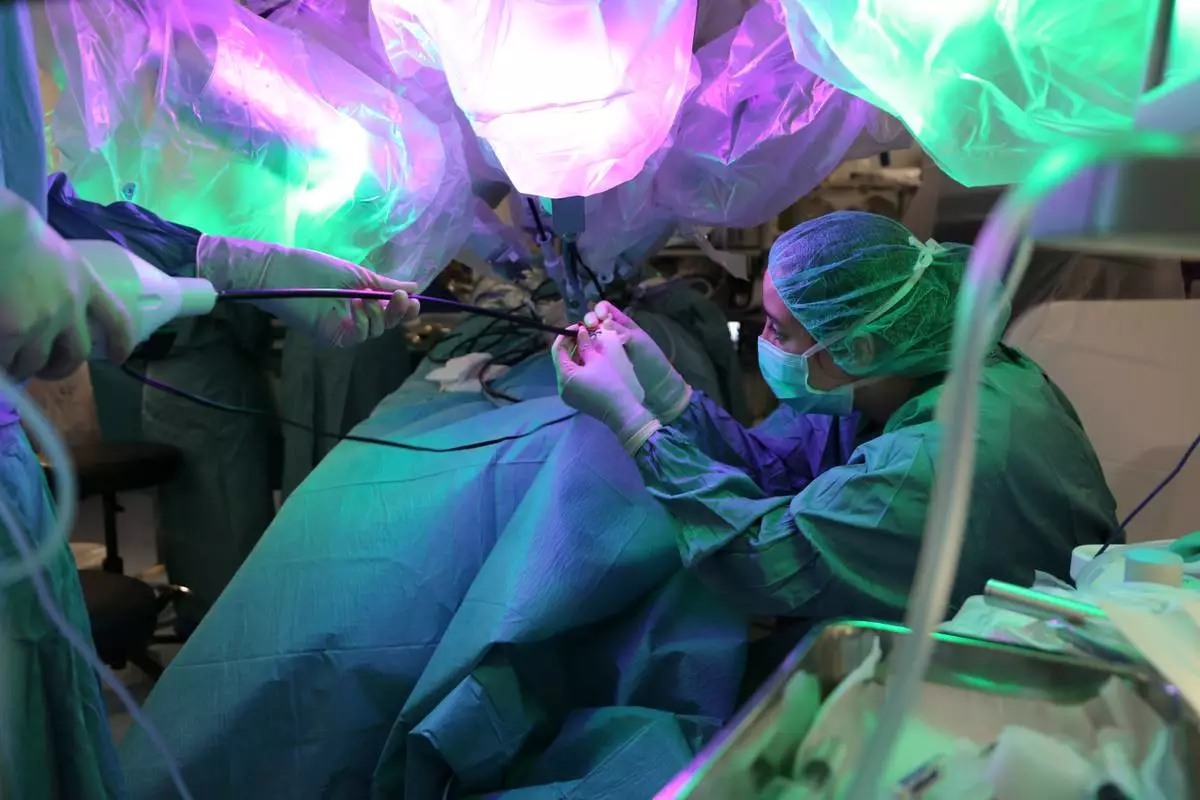
Designed for single-port access, the SHURUI system combines continuum-bending instruments with a flexible stereoscopic 3D endoscope, enabling surgeons to access and operate within confined anatomical spaces through a single incision.

The first pediatric procedure performed with the SHURUI SP system was a nephroureterectomy on a twelve-year-old boy whose kidney and ureter had become infected and non-functional due to multiple stones.
DUBAI, United Arab Emirates (AP) — The U.S. military early Wednesday reimposed a blockade on Iranian ports over Tehran’s attacks on ships trying to pass through the Strait of Hormuz, sparking new strikes on nations hosting American forces as an interim deal to end the war further unraveled.
Days of retaliatory strikes across the Middle East by Iran — and both nations’ attempts to assert control of the waterway through which a fifth of the world’s oil and natural gas trade passes during peacetime — threaten to push the region back to all-out war.
In Iran, more than 260 people were wounded in the latest round of overnight strikes alone, according to the Health Ministry, suggesting an intensification in the bombing. More than 30 people have been killed over “recent days,” Iranian government spokesperson Fatemeh Mohajerani said, without elaborating.
The U.S. first imposed the blockade in mid-April and then lifted it in mid-June, a day after signing the interim deal that set a 60-day period for negotiations over issues like Iran’s nuclear program, but talks have stalled as fighting over the strait has intensified.
Iran’s paramilitary Revolutionary Guard threatened Wednesday to halt all energy exports from the Middle East over the blockade.
“The export of oil and gas from the region will be either for everyone or for no one,” it said.
When U.S. President Donald Trump announced the return of the blockade Monday, he also said he would impose a 20% fee on ships passing through the strait. But he dropped the plan to collect fees hours before resuming the blockade, citing requests from allies in the Persian Gulf.
The U.S. carried out another wave of strikes as it reimposed the blockade, striking dozens of targets over seven hours, the U.S. military’s Central Command said Wednesday.
Hossein Kermanpour, a spokesperson for the Health Ministry, gave Wednesday's casualty figure, without specifying how many people had been killed. Kermanpour's figures reported far more people injured than in any other round of recent violence between Iran and the U.S.
Authorities offered no immediate explanation, though initial local reports suggested a significant strike hit Iran's southeastern Sistan and Baluchestan province on the Gulf of Oman.
Missile alert warnings went out in Bahrain and Kuwait early Wednesday morning as they faced incoming Iranian fire, something that’s been a daily occurrence, further straining a ceasefire in the war. Jordan also said it shot down three incoming Iranian missiles. Iran claimed attacks on the three nations.
U.S. Navy Adm. Brad Cooper, who leads Central Command, said in a statement that Iran had launched dozens of missiles and drones at neighboring Gulf Arab countries.
“U.S. forces are holding Iran accountable for unwarranted aggression that continues to endanger innocent lives,” Cooper said.
There are at least 19 U.S. warships in the Arabian Sea, including two aircraft carriers and an amphibious assault ship with more than 1,000 Marines aboard. Central Command also said in a social media post that there are “hundreds of military aircraft operating across the Middle East.”
When the U.S. and Israel launched the war on Iran on Feb. 28, Tehran effectively shut the passage by attacking and threatening ships. That sent the price of oil, fertilizer and other goods soaring.
Iran has more recently attacked ships moving through the strait on a route near Oman overseen by the U.S. military that is outside Tehran’s control, setting off the recent violence. The U.S. has threatened to reopen the strait by force — but experts say that would require a much bigger armada if not tens of thousands of ground troops.
Iran’s ambassador to the United Nations, Amir Saeid Iravani, criticized America’s ongoing attacks targeting his country.
“The U.S. is the aggressor, not the victim,” he wrote to the world body’s leader, according to the state-run IRNA news agency.
Trump said Tuesday that he was called by the region’s “kings and emirs,” who suggested an alternate arrangement to charging ships fees to pass through the strait like the president proposed a day earlier.
“They said we’d love to do it a different way. We’d love to invest in the United States with billions and billions of dollars,” Trump told reporters Tuesday in the Oval Office.
Trump said he preferred that arrangement to charging tolls “because I don’t think anybody should be able to charge a fee for the strait.”
It was unclear if the investment deals would be new commitments relative to what Trump announced after a visit last year to the Middle East.
Trump’s plan to charge fees would have been a change to longstanding American policy and a departure from U.S. promises that the strait would remain open to all without tolls.
Trump told Fox News Channel on Tuesday night that more U.S. strikes against Iran were coming over the next two days and that bridges and power plants could be targets by next week unless negotiations resume. Already, the U.S. has struck at least one bridge.
“You better make a deal, or you’re not going to have anything left,” Trump warned.
U.S. Central Command said it struck several areas in Iran earlier Tuesday; Tehran acknowledged the strikes but provided no overall casualty or damage assessments.
Hours after the U.S. said it ended its strikes, the Iranian city of Bushehr on the Persian Gulf was hit in at least four locations, the IRNA news agency reported. Explosions in the southwestern city of Ahvaz and the southern port city of Bandar Abbas also were reported by Iranian state media Tuesday night.
The attacks again raised the possibility that Gulf Arab states were retaliating against Iran without discussing it in public.
Kuwait separately said an Iranian attack wounded four members of its navy Tuesday and set a building on fire.
Under the interim deal, Iran agreed that passage through the strait would remain free of charge for 60 days — but the agreement left open what would happen after. Iran asserts it has the right to manage traffic and potentially charge fees. The U.S. has disputed that.
The price for a barrel of Brent crude oil, the international standard, briefly topped $87 early Tuesday, still well below the nearly $120 reached at the height of the war. The price dipped to $78 in the aftermath of Trump’s announcement that he had changed course.
Regional mediators meanwhile are still trying to get the United States and Iran back to the negotiating table.
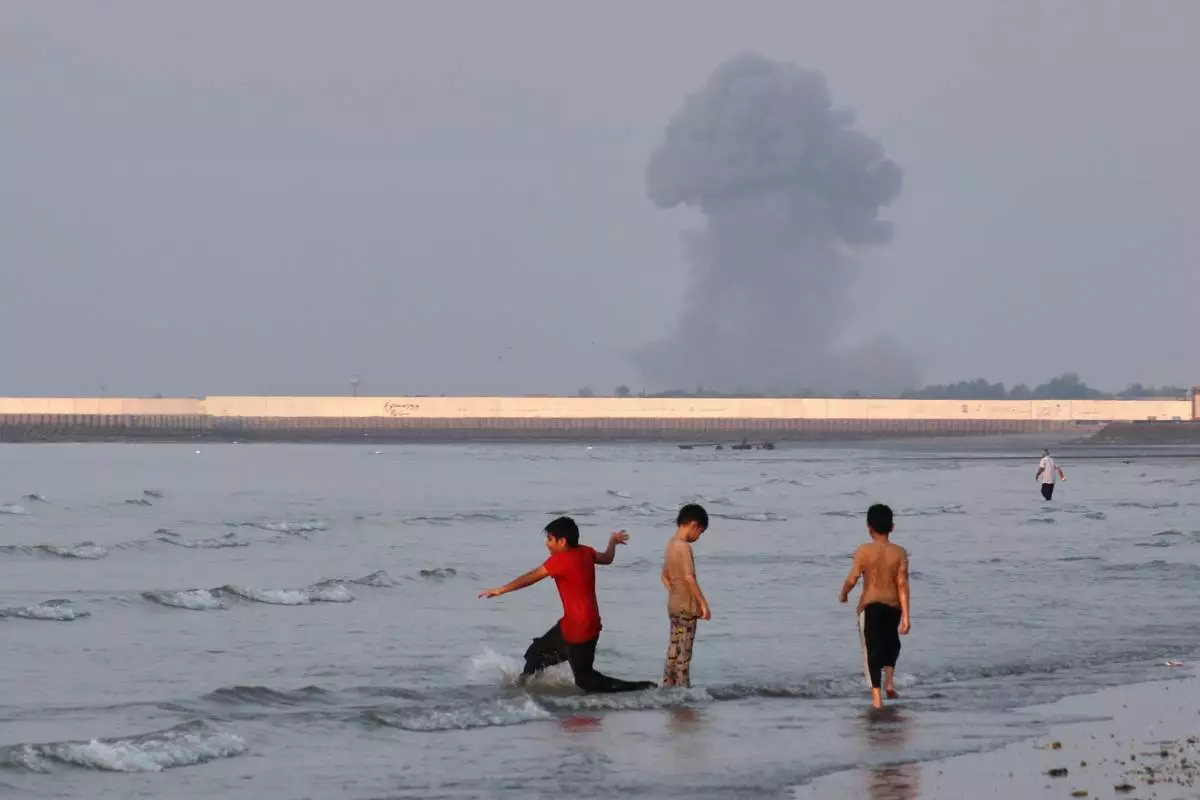
Three boys play in the shallow waters of the Strait of Hormuz, as a plume of smoke rises from an explosion in the background, off Bandar Abbas, Iran, Monday, July 13, 2026. (Razieh Poudat/ISNA via AP)
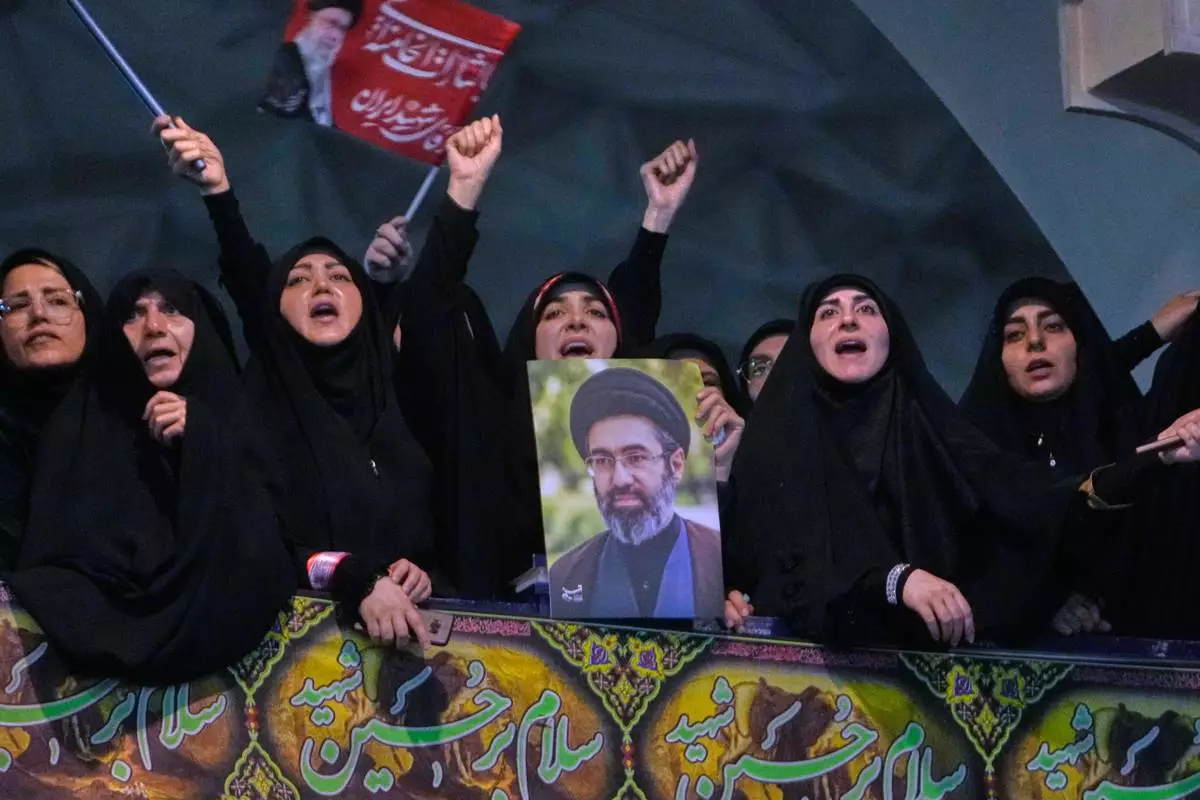
Mourners chant slogan as one of them holds a poster of the Supreme Leader Ayatollah Mojtaba Khamenei in a ceremony commemorating the late Supreme Leader Ayatollah Ali Khamenei at the Imam Khomeini Mosalla Grand Mosque in Tehran, Tuesday, July 14, 2026. (AP Photo/Vahid Salemi)