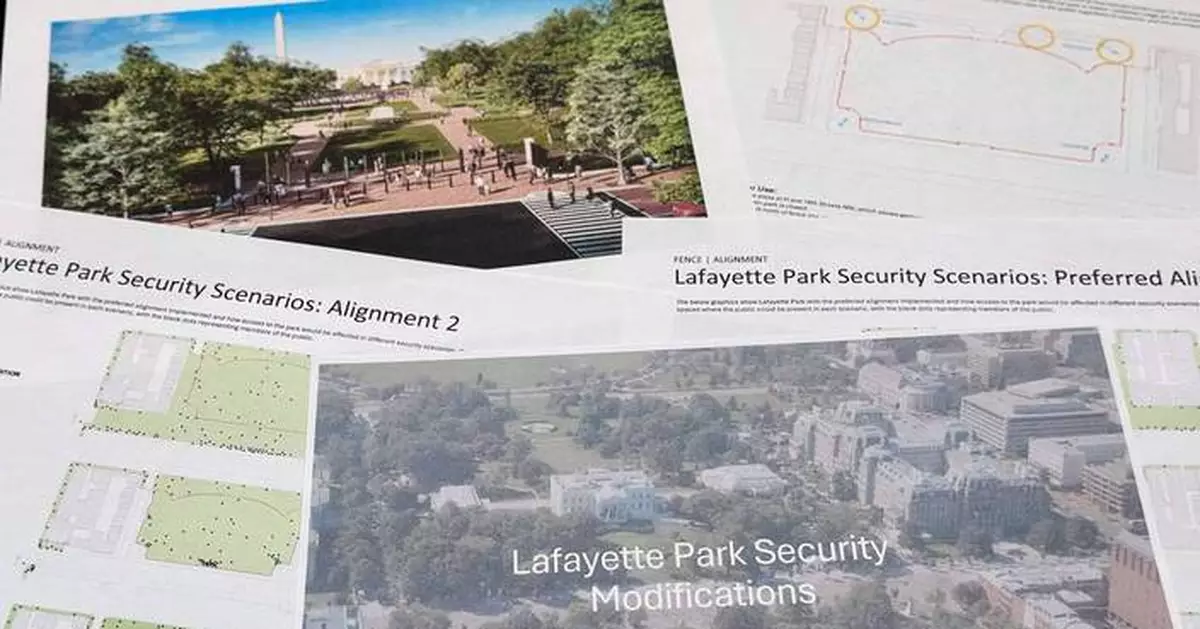
WASHINGTON (AP) — The Trump administration is proposing to improve security around the White House by putting up a fence around nearby Lafayette Park to help limit public access when law enforcement authorities determine doing so is necessary.
The proposal is scheduled for consideration on Thursday by the U.S. Commission of Fine Arts, according to a meeting agenda and the plans posted on the agency's website. The agency has oversight over the design of construction on federal land in Washington.
The commissioners are also set to take another look at the design for an underground facility to screen the thousands of tourists and others who visit or work at the White House. All seven commissioners were appointed by the Republican president.
The proposals are being considered at a time when security for the president has become a top concern. President Donald Trump has been the target of multiple assassination attempts, including two during the 2024 campaign and a third this past April as he attended a dinner in Washington with White House journalists.
Those concerns were heightened the following month after U.S. Secret Service officers fatally shot a man who opened fire near a White House security checkpoint.
The administration says the projects will be an improvement over temporary structures that have long been used to aid perimeter security, like barriers fashioned out of bicycle racks, and for screening the many guests who access the White House and its grounds.
A look at both projects:
Trump was accompanied by Interior Secretary Doug Burgum on a recent tour of the park to see updates being made at his direction. The president has worked with the Interior Department and one of its agencies, the National Park Service, to restart dormant park fountains.
“We're really doing a job at Lafayette Park, which is really the entrance to the White House, and that’s going to be completed very shortly and it’ll be incredible,” Trump said in June.
The administration's 79-page proposal for the 8-acre (3-hectare) park calls for fencing it all the way around with gates at the north and south entrances to control public access. Options call for either including or excluding four monuments located at each of the park's four corners.
The proposal, which is backed by the Secret Service and the Executive Office of the President, in coordination with the Interior Department and National Park Service, notes that leaving out the monuments would expose them to vandalism.
The report says the goal of the plan is to “enhance long-term safety," preserve the Lafayette Park's identity as a significant National Park Service landscape and “maintain public access to this nationally symbolic space.” Throngs flock to the park to protest or celebrate major events.
Lafayette Park has not had a permanent fence around it since the 19th century. The Secret Service anticipates the fence would start going up sometime next year.
The administration wants similar fencing along Pennsylvania Avenue on the north side of the White House complex, from the Treasury Department building at 15th Street to the Eisenhower Executive Office Building at 17th Street. The report said that will be treated as a separate proposal and submitted to the commission at a later date.
The commission is set to review a revised design for the facility, which would be built beneath Sherman Park, federal land southeast of the White House, to support screening for public tour participants, guests attending large events, White House staff and contractors.
The original design called for locating the facility's entrance at the southern end of the park, but meetings and consultations led to a revised proposal that shifted the entrance to the western edge of the park to avoid conflicts with infrastructure and minimize the impact on the surrounding views, according to the report submitted for the commission's review on Thursday.
The administration said the permanent facility will eliminate the need for a series of temporary screening tents currently used for events, improve security on the White House complex and enhance the experience for visitors.
The Secret Service, Interior Department, National Park Service and Executive Office of the President want to start construction in August on the 33,000-square-foot (3,066-square-meter) underground facility. They have set a July 2028 date for it to be operating.
White House visitors would face an initial ID check before they enter the facility through a pavilion located above ground, then head down to a lower level and a second checkpoint. After they are cleared, visitors will ride escalators that will take them up to the White House grounds.
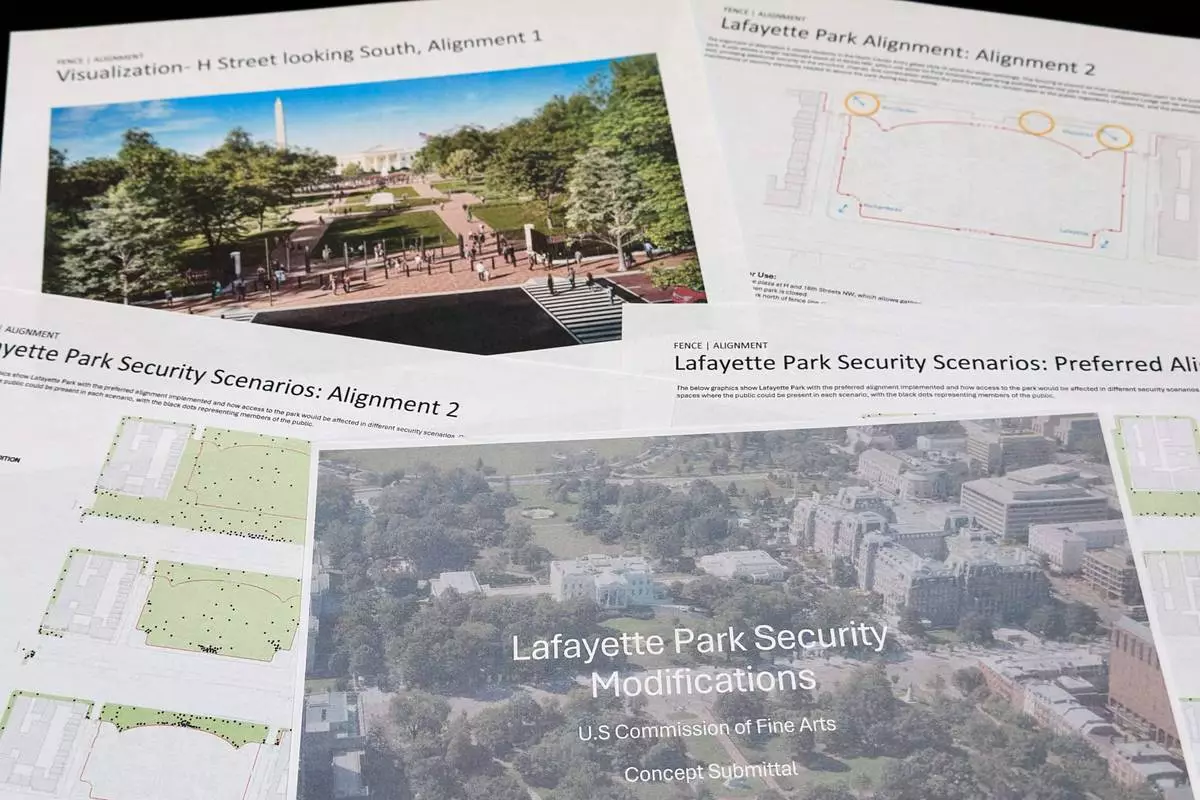
Part of a proposal to improve security at Lafayette Park, across from the White House, is photographed Wednesday, July 15, 2026, before a meeting on July 16 of the U.S. Commission of Fine Arts. (AP Photo/Jon Elswick)
DUBAI, United Arab Emirates (AP) — The United States intensified its strikes targeting Iran early Thursday, hitting targets further north as American forces also fired into a ship it accused of trying to break its naval blockade on the Islamic Republic. Iran retaliated with missile and drone fire targeting Bahrain, Jordan and Kuwait before dawn.
Days of back-and-forth strikes by the U.S. and Iran across the Middle East — and renewed threats to the Strait of Hormuz — have shredded the interim deal to end the Iran war and could tip the region back into all-out war. Already, Iranian officials say U.S. strikes have killed more than 35 people and wounded over 300 others. Strikes also reached into areas around Iran’s capital, Tehran, for the first time of this latest round of violence.
When the U.S. and Israel launched the war on Iran on Feb. 28, Tehran effectively closed the strait to shipping traffic, a move that sent the price of oil, fertilizer and many other goods soaring far beyond the region and gave Iran major leverage in negotiations.
Those rising prices pose a particular challenge to U.S. President Donald Trump and his Republican Party, which hopes to retain control of Congress in elections in November. But Washington has struggled to successfully reopen the waterway, leading to Trump reimposing the naval blockade Wednesday.
Iran’s parliament speaker and lead negotiator, Mohammad Bagher Qalibaf, said Iran was prepared for a fuller military confrontation if the U.S. does not live up to the terms of the interim deal, and Iran’s paramilitary Revolutionary Guard threatened to halt all energy exports from the Middle East over the blockade.
“The export of oil and gas from the region will be either for everyone or for no one,” the Guard said.
Trump again insisted Iran was ready to strike a peace deal, but he did not elaborate.
“They don’t like what we’re doing, and they do want to settle. We’ll find out whether or not we settle with them, or we just finish it off,” he said Wednesday at the U.S. Army War College in Pennsylvania.
Trump separately said on social media that Tehran made a goodwill gesture by releasing an American citizen wrongly detained in Iran since 2024. He didn’t release further details. Human rights lawyer Jared Genser released a statement identifying the detainee as his client Dena Karari, a U.S.-Iranian citizen who runs a nonprofit and was charged with espionage.
Iran did not immediately acknowledge the release and her case was not publicly known, as is sometimes the case with detentions in the Islamic Republic.
The U.S. strikes early Thursday hit around Tehran, state media reported. It also reported that American attacks targeted Semnan province, home to Iran’s ballistic missile production and space program.
On Wednesday, the U.S. resumed striking Iran during daylight, further showing the increasing tempo of the attacks. An attack on Greater Tunb Island, a strategic point in the Strait of Hormuz, targeted Iranian defense and missile sites, Central Command said.
Meanwhile, the U.S. military said it opened fire on the Curacao-flagged oil tanker Belma sailing toward Kharg Island, Iran’s main oil export terminal in the Persian Gulf. After the ship “ignored multiple warnings,” a U.S. aircraft disabled the merchant vessel by firing a missile into the ship’s smokestack.
Another American strike Wednesday targeted a barracks for Iran’s 388th Mechanized Infantry Brigade, which operates tanks and armored vehicles, in Sistan and Baluchestan province, Iranian state television reported. The report said Americans fired at least 13 missiles in the attack and the seven dead included conscripts and career soldiers. A number of troops were wounded.
Iran retaliated Thursday with missile and drone attacks on Bahrain, Jordan and Kuwait, authorities in those countries home to U.S. forces said. There was no immediate acknowledgment of damage or casualties from the attacks.
The latest round of fighting is focused on the Strait of Hormuz. How to reopen the strait has bedeviled the U.S. since Iran choked it off in the early days of the war.
During the interim deal, some ships began moving through the passage using a route near Oman overseen by the U.S. military that is outside Tehran’s control.
In recent days, Iran attacked ships using that route — and back-and-forth attacks ensued. The U.S. has threatened to reopen the strait by force — but experts say that would require a much bigger armada if not tens of thousands of ground troops. Imposing the blockade is another way to put pressure on Iran.
But in the meantime, oil prices are rising. The price for Brent crude oil, the international standard, traded above $85 a barrel on Thursday — more than 15% higher than the price before the war, but still well below the nearly $120 reached at the height of the conflict.
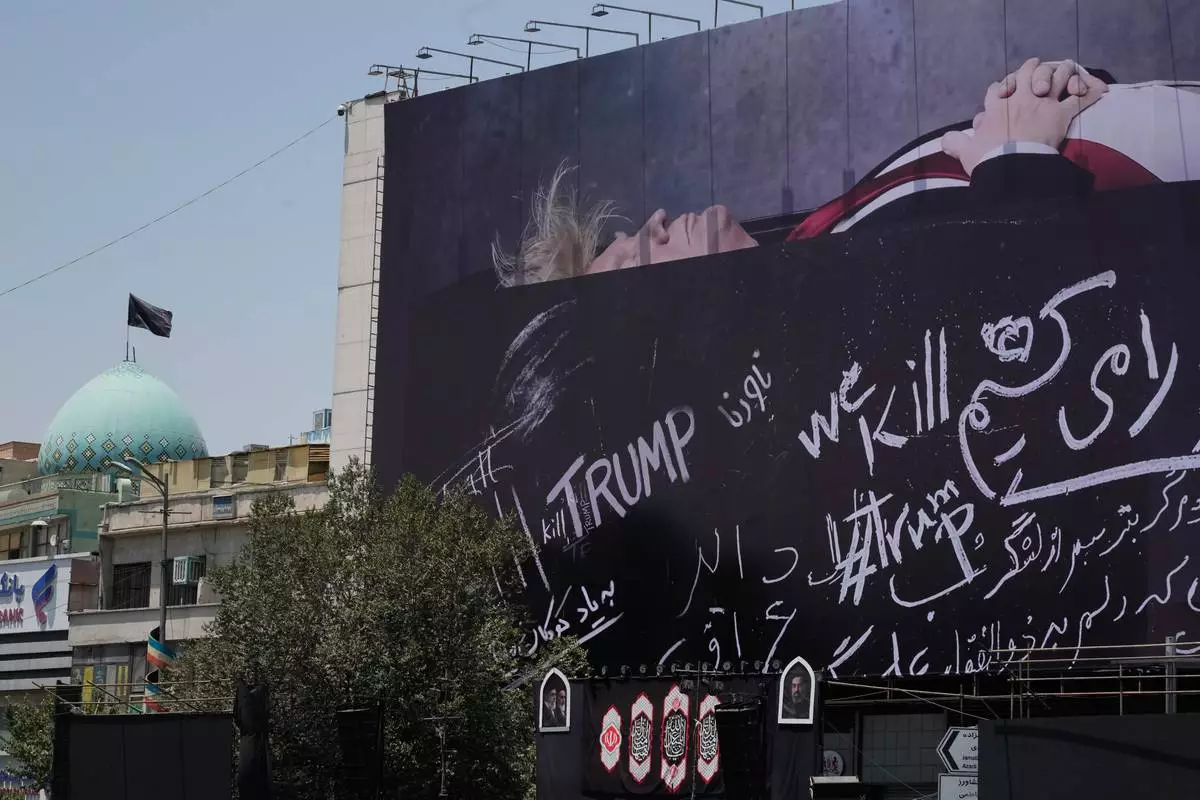
A billboard depicting U.S. President Donald Trump lying on what appears to be a coffin and bearing anti-Trump messages, including the phrase "We Kill Trump," is seen at Islamic Revolution Square in downtown Tehran, Iran, Wednesday, July 15, 2026. (AP Photo/Vahid Salemi)
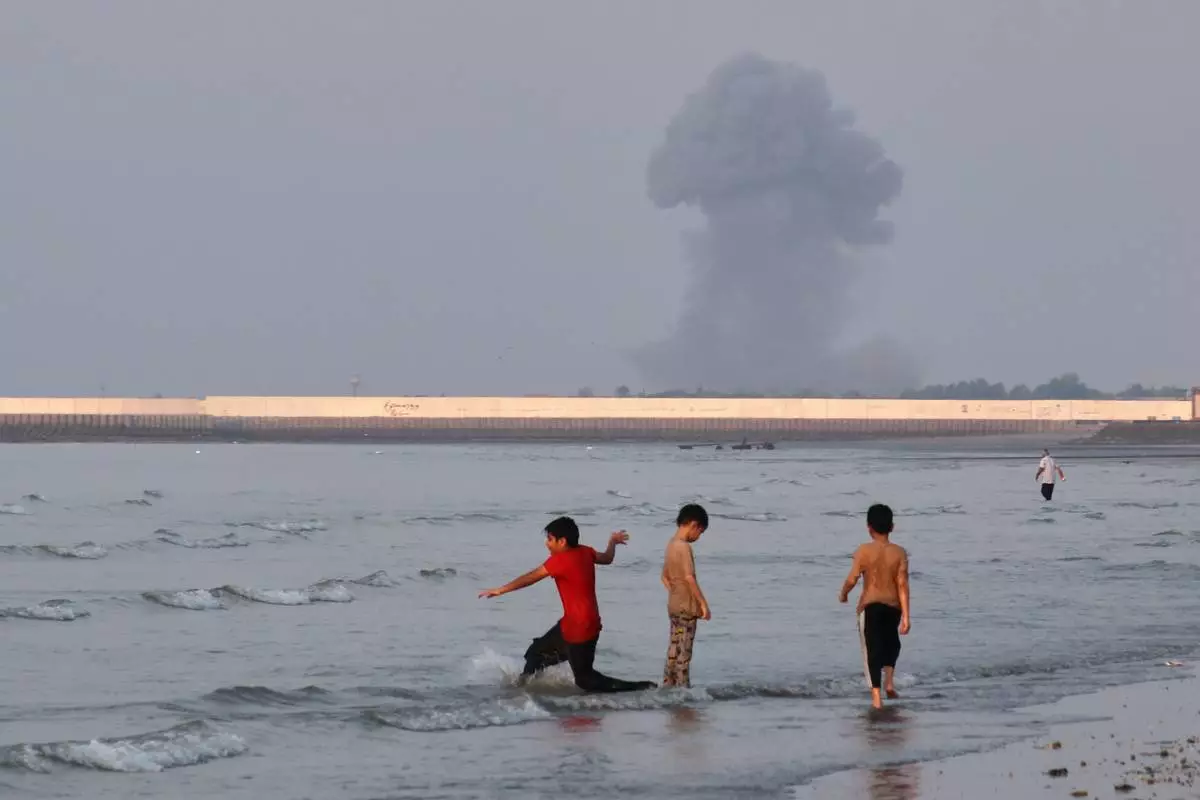
Three boys play in the shallow waters of the Strait of Hormuz, as a plume of smoke rises from an explosion in the background, off Bandar Abbas, Iran, Monday, July 13, 2026. (Razieh Poudat/ISNA via AP)