NEW YORK--(BUSINESS WIRE)--Jul 16, 2026--
Finout, a FinOps platform that gives engineering and finance teams a single, dollar-based view of cloud and AI spend, announced the world-first native FinOps integration with OpenAI Codex. The integration converts Codex Enterprise's credit-based billing into per-team, per-model dollar costs across every other AI provider Finout tracks, and is available now to Finout customers running Codex on ChatGPT Enterprise- timing that lines up with external Codex adoption climbing from near zero to roughly 17% of active enterprise users in under a year.
This press release features multimedia. View the full release here: https://www.businesswire.com/news/home/20260716517429/en/
At a glance:
Coding agents are moving from experiment to default workflow. As that shift accelerates, Codex's credit-based billing, split across models and reasoning-effort tiers, becomes harder to attribute to teams or reconcile against a budget. Finout closes that gap by converting Codex credits into dollars using each customer's contract rate, then allocating that spend the same way it allocates cloud and other AI costs.
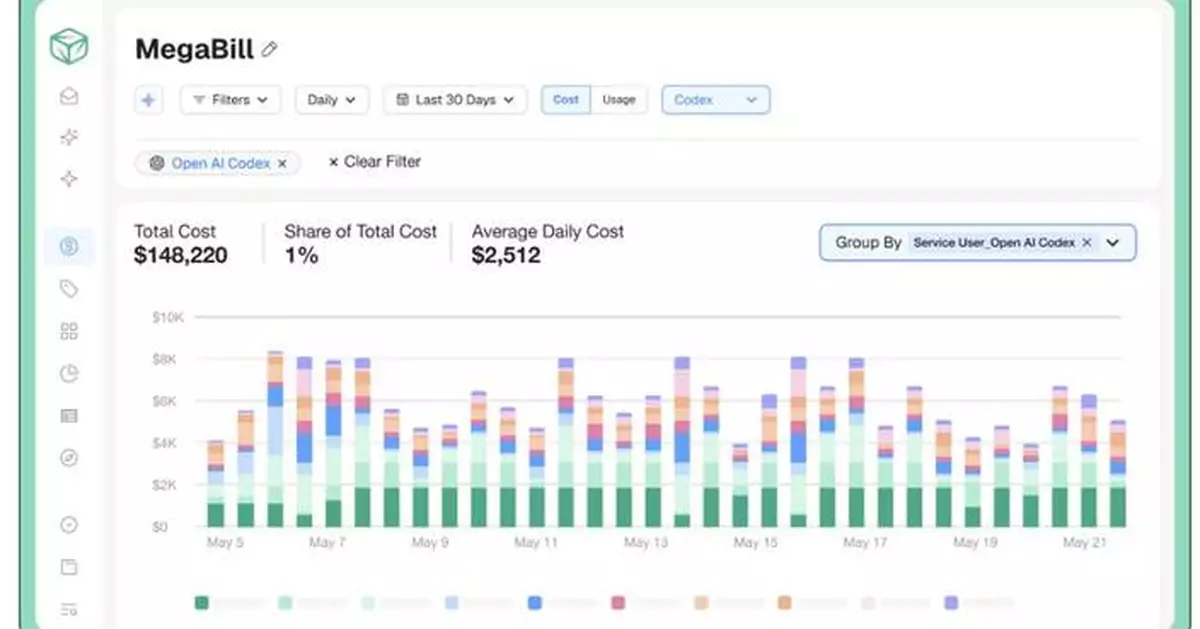
Once connected, Codex credits are converted to dollars and sliced by user, model, and reasoning effort. A new OpenAI Origin dimension separates Codex spend from OpenAI Platform spend inside the same account. Finout's Virtual Tags, its rules engine for mapping raw spend to business context, map Codex spend to teams, products, and cost centers alongside OpenAI Platform, Anthropic, Cursor, and cloud costs inside MegaBill, Finout's unified billing layer. The result: finance and engineering get one bill and one anomaly feed, instead of a separate Codex report to reconcile by hand.
Head FinOps, Large B2B SaaS company: “Connecting OpenAI Codex inside Finout finally let us allocate AI spend by team and improve our ROI projections instead of guessing at them"
The integration also extends Finout's Anomaly Detection to Codex usage. A common cost spike is a team shifting from medium to high reasoning effort, which can multiply per-task cost overnight; Finout flags the shift as it happens rather than after it compounds across a billing cycle. Codex spend also flows into Billy, Finout's AI FinOps assistant, so teams can ask plain-English questions like which team drove this week's AI spend spike, and get a live, chart-backed answer with no dashboards or queries.
The integration is read-only and built to the same security standard as the rest of Finout's platform: SOC 2 Type II audited, ISO 27001 certified, and GDPR compliant.
FAQ
What does the Finout Codex integration actually do?
It converts OpenAI Codex Enterprise credit usage into dollar costs at the customer's contract rate, then attributes that spend to teams, products, and cost centers.
Does Finout read prompt or code content from Codex?
No. The integration is read-only and accesses only usage and credit metadata.
How is this different from OpenAI's own Codex reporting?
Codex reporting shows credits and usage; Finout converts that into dollars and merges it with cloud, OpenAI Platform, Anthropic, and Cursor spend in one unified view, MegaBill.
Who is this for?
FinOps, engineering, and finance leaders at companies running Codex on ChatGPT Enterprise who need to attribute AI spend to teams and reconcile it against budget.
Documentation: docs.finout.io/billing-integrations/ai-providers/connect-to-openai
Book a demo: finout.io/book-a-demo-page
About Finout
Finout is the enterprise-grade FinOps platform built for the agentic era, where AI workloads shift weekly and automation accelerates cost decisions across cloud, Kubernetes, LLMs, and shared resources. Finout delivers accurate, automated cost allocation, unified visibility through MegaBill, precise unit economics, and reliable planning at scale, turning cloud and AI complexity into clarity so every team owns its number. Finout is trusted by companies including Wiz, The New York Times, Lyft, and SiriusXM. Learn more at www.finout.io.
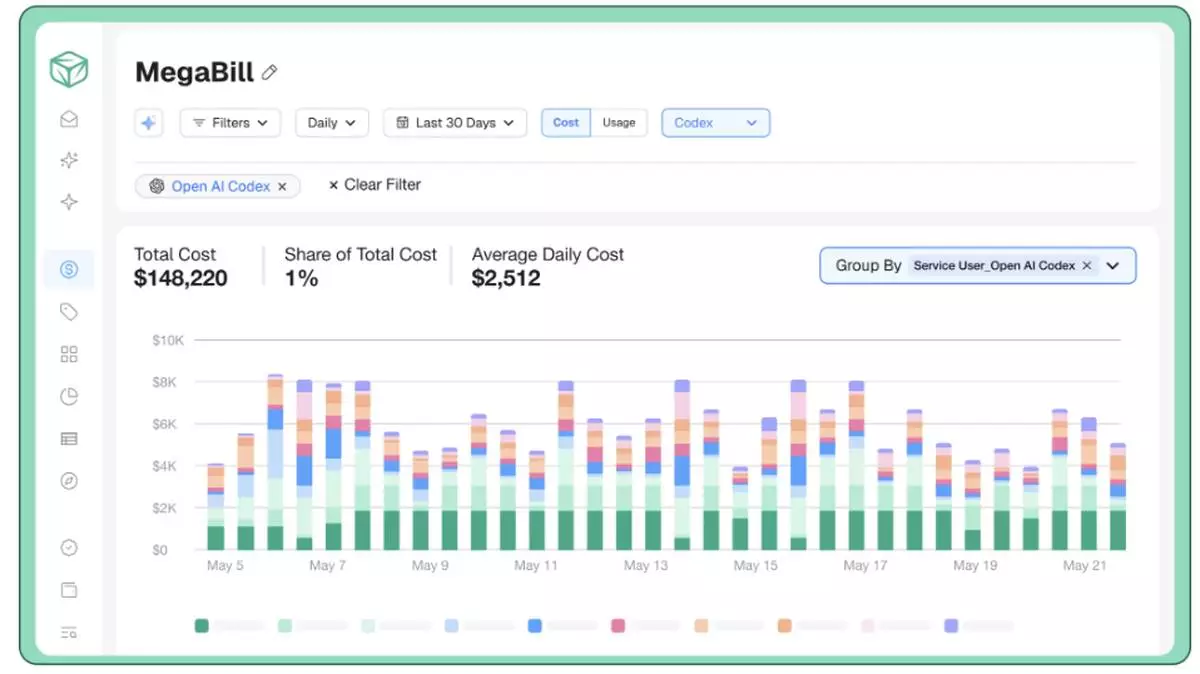
Finout's OpenAI Codex dashboard

President Donald Trump is set to address the nation Thursday at 9 p.m. ET on topics he said will include elections and voting machines, suggesting he could revisit long-debunked conspiracy theories about his 2020 defeat to Democrat Joe Biden. The speech comes as he’s escalated his calls for Republicans to pass tighter federal voting rules ahead of November’s midterm elections.
At Trump’s last primetime presidential address in April, he said the U.S. would accomplish its Iran war objectives “very shortly.” But days of back-and-forth attacks by the U.S. and Iran across the Middle East and in the Strait of Hormuz have shredded the interim deal to pause the fighting. U.S. strikes intensified early Thursday against a widening set of targets, including a ship it accused of breaking its blockade on Iranian ports. Iran retaliated by firing on U.S. allies in the region.
Here's the latest:
They are the Juárez Cartel, on the border with Texas, and Los Viagras, a criminal group from the western state of Michoacán. The Federal Register, the U.S. government’s gazette, published the designation Thursday.
They joined six other Mexican criminal organizations the U.S. considers terrorist groups, including the Sinaloa Cartel and the Jalisco New Generation Cartel. Gangs in other Latin American countries, including Venezuela, Brazil, Ecuador and El Salvador, also have been designated as foreign terrorist organizations by the Trump administration.
President Trump began to extend the terrorist label to Latin American cartels in February 2025 to allow U.S. authorities to take more aggressive action against them or against anyone the U.S. sees as aiding the groups.
▶ Read more
U.S. Secretary of State Marco Rubio convened more than 60 governments to address what he described a growing increase of left wing violence around the globe. Rubio opened the conference by making sweeping statements about the issue and noting that the U.S. and most of the world has spent the last few decades focusing on Islamic terrorism.
“For far too long, however, our counterterrorism doctrine has had a blind spot, a blind spot when it comes to extremist violence from the political left,” he said.
Rubio added that the U.S. plans to make more terrorist designations against groups like antifa.
Two of the eight men indicted on murder and terrorism conspiracy charges for their alleged roles in a thwarted drone and sniper attack on the UFC cage-fighting show at the White House last month pleaded not guilty Thursday.
Tycen Proper, 19, of Danville, Ohio, and Chandler Scaggs, 21, of Chapmanville, West Virginia, entered the pleas before U.S. District Court Judge Edmund Sargus Jr. in Columbus, Ohio. Each is charged, as are the six others, with conspiracy to provide material support to terrorists and conspiracy to commit murder on federal government territory and to murder a federal government official.
Sargus set their trial date for Sept. 14.
A message seeking comment was left with Proper’s attorney. Scaggs’ lawyer declined to comment.
▶ Read more
When Markwayne Mullin took over as Homeland Security secretary from fired Kristi Noem, he pledged to get the department responsible for carrying out the Trump administration’s mass deportations policy out of the headlines.
But just months into Mullin’s time in office, the department is squarely in the center of controversy again after three people were killed in encounters with Immigration and Customs Enforcement officers in the span of less than a week.
The events are the first major test for Mullin, who promised a steady hand for a department roiled by his predecessor’s conduct and the Trump administration’s immigration crackdown.
As he navigates the uptick in violence, he’s being forced into a balancing act that has him juggling pressures from a White House eager to carry out mass deportations and his former colleagues in Congress seeking answers — all while attempting to ease tensions in American cities over the deaths.
▶ Read more
In the weeks after Trump lost to Joe Biden in 2020, the people Trump appointed to run the Department of Justice, cybersecurity agencies and intelligence departments all said the same thing — the election was fair, legitimate and free of major fraud or foreign interference.
In his second term, Trump has tried to use the levers of power to rewrite that well-settled history, something he’s expected to try again Thursday night with an address to the nation.
He’s already appointed loyalists who’ve echoed his false claims that the 2020 election was stolen and made clear he expects everyone to follow his lead.
In an indication of how fealty to Trump’s lies has become a litmus test for his administration, many of his nominees have steadfastly refused to directly answer the question of who won in 2020, preferring to tersely note that Biden became president.
▶ Read more
When major disasters strike, Americans are routinely waiting weeks — or even months — to receive presidential approval for aid. And if they live in a state that didn’t support President Trump, chances are greater that aid will be denied.
Since taking office last year, Trump has approved about 65 requests for major disaster declarations and denied more than two dozen others from states, tribes or territories seeking federal financial assistance following hurricanes, tornadoes, storms, floods and fires.
Trump has taken longer on average to approve disaster requests than any other president, according to an Associated Press analysis of data dating back to 1989, when a federal law setting new parameters for disaster determinations was implemented. And no other president has such a disparity in denials between states that supported him politically and those that did not.
▶ Read more
President Donald Trump is set to address the nation Thursday night on topics he said will include elections and voting machines, suggesting he’s likely to revisit some of the unproven claims he’s previously made about Republican losses, particularly his own in 2020.
Trump’s fixation on his loss to Democrat Joe Biden six years ago and the long-debunked theories he’s circulated about it are something he still brings up regularly when discussing other subjects. But elevating the deeply political and conspiratorial topics to a presidential primetime address underscores the lengths to which Trump has used his second term to both blow past norms and fixate on old grievances.
Trump has offered only vague details about the address, scheduled for 9 p.m. When asked by a reporter Tuesday if it would concern “election machines and integrity,” Trump said it would “concern that subject” and “we’ll have a couple of other things to say also.”
▶ Read more
President Donald Trump arrives at the United States Army War College for the Pennsylvania Defense and Innovation Summit, Wednesday, July 15, 2026, in Carlisle, Pa. (AP Photo/Julia Demaree Nikhinson)
President Donald Trump departs on Marine One after speaking at the United States Army War College in Carlisle, Pa., at the Pennsylvania Defense and Innovation Summit, Wednesday, July 15, 2026. (AP Photo/Julia Demaree Nikhinson)