TOKYO & SAN JOSE, Calif.--(BUSINESS WIRE)--Jul 16, 2026--
Rapidus Corporation and Cadence (Nasdaq: CDNS) today announced a collaboration to advance agentic AI for advanced-node system-on-chip (SoC) design by integrating the Cadence® InnoStack™ AI Super Agent into the Rapidus AI-Agentic Design Solution (Raads). The joint effort combines Rapidus’ AI-native design and manufacturing ecosystem for advanced-node semiconductors with Cadence’s agentic AI design orchestration technology to help design teams improve productivity, accelerate time to market and enhance design quality across the SoC design lifecycle. As part of this collaboration, Rapidus is targeting up to a 2X improvement in design turnaround time (TAT) over traditional flows.
This press release features multimedia. View the full release here: https://www.businesswire.com/news/home/20260716669554/en/
The buildout of AI infrastructure, and the coming wave of physical AI-powered systems, requires tight, system-level co-optimization across semiconductor design, manufacturing, packaging and systems. Agentic AI is critical for this next generation of advanced SoCs. As part of today’s announcement, Rapidus is extending its Raads lineup with the introduction of Raads Navigator and Raads Indicator to enhance quality assurance and support designers in resolving design issues and challenges. Significantly, the new tools have been integrated with the Cadence InnoStack AI Super Agent to enable agentic design orchestration across key SoC workflows, automating and coordinating tasks from early architectural exploration through implementation and signoff. By applying data-driven optimization across the design lifecycle, the integration is intended to help teams manage advanced-node complexity, improve design predictability and scale engineering productivity while driving toward Rapidus’ design TAT reduction goals.
“Advanced-node SoC design increasingly requires AI agents that can orchestrate complex workflows across the design lifecycle, not just optimize individual tasks,” said Anirudh Devgan, president and CEO, Cadence. “By combining Cadence’s InnoStack AI Super Agent with Rapidus’ Raads platform, we are extending agentic AI into a leading-edge semiconductor ecosystem, enabling customers to improve productivity, accelerate design closure and bring more advanced silicon to market faster.”
Rapidus and Cadence will discuss the collaboration at CadenceLIVE Japan 2026, where Dr. Atsuyoshi Koike, representative director and CEO of Rapidus will deliver a keynote on how Rapidus is evolving Raads with Cadence Agentic AI and EDA to improve efficiency and quality in advanced-node SoC development.
“At its completion, our Innovative Integration for Manufacturing facility will be the most advanced, AI-native foundry where AI is incorporated at almost every stage of semiconductor manufacturing,” said Koike. “By evolving Raads and integrating it with Cadence’s InnoStack AI Super Agent, we are strengthening our AI-agentic design environment to help customers manage increasing SoC complexity, improve engineering productivity and realize the full value of Rapidus’ advanced process technologies. In working closely with Cadence on InnoStack and additional Cadence AI Super Agent solutions, we see a clear path to significantly reducing design turnaround time and enabling faster innovation on Rapidus’ advanced nodes.”
To learn more about the Rapidus Raads tools, visit the Rapidus website. To learn more about Cadence AI-driven design solutions and the InnoStack AI Super Agent, visit cadence.com/ai-for-design. For more information on this collaboration and CadenceLIVE Japan 2026, visit the CadenceLIVE Japan event page.
About Cadence
Cadence is a market leader in AI and digital twins, pioneering the application of computational software to accelerate innovation in the engineering design of silicon to systems. Our design solutions, based on Cadence’s Intelligent System Design™ strategy, are essential for the world’s leading semiconductor and systems companies to build their next-generation products from chips to full electromechanical systems that serve a wide range of markets, including hyperscale computing, mobile communications, automotive, aerospace, industrial, life sciences and robotics. In 2025, Cadence was recognized by Fortune as one of the world’s top 100 best companies to work for. Cadence solutions offer limitless opportunities.
© 2026 Cadence Design Systems, Inc. All rights reserved worldwide. Cadence, the Cadence logo, and the other Cadence marks found at www.cadence.com/go/trademarks are trademarks or registered trademarks of Cadence Design Systems, Inc. All other trademarks are the property of their respective owners.
About Rapidus Corporation
Rapidus Corporation aims to develop and manufacture the world's most advanced logic semiconductors. We will create new industries together with our customers through the development and provision of services to shorten cycle times in design, wafer processes, 3D packaging and more. We will continue to challenge ourselves in order to contribute to the fulfillment, prosperity and happiness of people’s lives through the use of semiconductors. Visit: https://www.rapidus.inc/en/
Category: Featured

The joint effort combines Rapidus’ AI-native design and manufacturing ecosystem for advanced-node semiconductors with Cadence’s agentic AI design orchestration technology to help design teams improve productivity, accelerate time to market and enhance design quality across the SoC design lifecycle.
DUBAI, United Arab Emirates (AP) — The United States intensified its strikes against Iran on Thursday, hitting targets farther north and firing into a ship the U.S. accused of trying to break its naval blockade on the Islamic Republic. Iran retaliated by launching missiles and drones at U.S. allies in the region, and warned its attacks may escalate.
The interim ceasefire agreed to last month has collapsed, and the region has endured days of back-and-forth attacks by the U.S. and Iran as they battle for control of the Strait of Hormuz. Iranian officials say U.S. strikes have killed more than 35 people and wounded over 300 others.
For the first time in this latest round of violence, strikes also reached into areas around Iran’s capital, Tehran, showing a widening set of targets for the Americans. The U.S. launched a second wave of strikes late Thursday, saying it was aiming to “further degrade” Iran's military capabilities.
When the U.S. and Israel launched the war on Iran on Feb. 28, Tehran effectively closed the strait to shipping traffic, a move that sent the price of oil soaring and gave Iran major leverage in negotiations.
Col. Ebrahim Zolfaghari, a spokesperson for the Iranian military’s Khatam al-Anbiya Central Headquarters, threatened that Iran could launch widespread attacks on “all the infrastructure in the region” if the U.S. acts on President Donald Trump 's repeated warnings that America could hit Iranian bridges and power plants.
“Under no circumstances and in no way will we allow America, as a foreign and extraregional country, to interfere in the Strait of Hormuz,” he added. “This is Iran’s invincible red line.”
Iranian state media said the U.S. strikes Thursday hit around Tehran and Semnan province, home to Iran’s ballistic missile production and space program. State media also reported strikes around the provinces of Hamedan, Hormozgan, Khuzestan, Lorestan, Markazi, and Sistan and Baluchestan, as well as on Iran’s Qeshm island, near the Strait of Hormuz.
Seven people were wounded in a U.S. strike that hit the Allah-Akbar Hill residential neighborhood in the port city of Bandar Abbas, according to Iranian state media. Two more people were wounded in a U.S. attack on the Bandar Abbas railway junction station, state media said.
And just west of Bandar Abbas, witnesses reported that two bridges were struck in a U.S. attack, killing three people and wounding nine others, state media said.
An attack on Greater Tunb Island targeted Iranian defense and missile sites, U.S. Central Command said.
Greater Tunb Island is one of three small rocky islands that sit at the confluence of the Persian Gulf and the strait. The islands — seized in 1971 by Iran from what would become the United Arab Emirates — help the Islamic Republic exert significant control over the strait.
The U.S. military also said it disabled a Curacao-flagged oil tanker as it sailed toward Iran’s main oil export terminal, firing a missile after the ship “ignored multiple warnings.”
Another American strike Wednesday targeted a barracks for Iran’s 388th Mechanized Infantry Brigade, which operates tanks and armored vehicles, in Sistan and Baluchestan province, Iranian state television reported. The report said seven were killed in the attack, including conscripts and career soldiers.
Iran retaliated Thursday with missile and drone attacks on Bahrain, Jordan and Kuwait, authorities in those countries home to U.S. forces said. There was no immediate acknowledgment of damage or casualties from the attacks.
Iraqi Prime Minister Ali al-Zaidi condemned an overnight drone attack in Iraq’s semiautonomous northern Kurdish region. The drone, which authorities said had been intercepted, came during his trip to the U.S. in which he said Iraq would work to disarm non-state armed groups, including those backed by Iran.
A drone separately targeted a tanker Thursday in the Persian Gulf off the coast of Basra in southern Iraq, the state-run INA news agency reported. No casualties were reported.
The latest round of fighting is focused on the Strait of Hormuz, as Iran attacks ships using a U.S.-controlled route through the vital waterway.
Week-to-week cargo shipments through the strait dropped by almost a quarter at the beginning of the month, according to Maritime data firm Lloyd’s List Intelligence. And that was before the recent surge in tit-for-tat attacks.
Given the risks, some oil shippers are transiting the strait with their location devices turned off, but many are just staying put, Lloyd's said Thursday. A growing amount of the region’s energy is being shipped through pipelines, but not nearly enough to offset the decline in shipping through the strait.
U.S. forces have redirected three commercial vessels trying to run the blockade, disabled one that did not comply and boarded another “to ensure full compliance," U.S. Central Command said in a post on X.
“The Strait of Hormuz and the surrounding waters remain free and open, except for vessels attempting to violate America’s steel wall blockade,” the post said.
The U.S. has threatened to reopen the strait by force, but experts say that would require a much bigger armada if not tens of thousands of ground troops.
The price for Brent crude oil, the international standard, traded above $85 a barrel on Thursday, more than 15% higher than the price before the war, but still well below the nearly $120 reached at the height of the conflict.
Rising prices pose a particular challenge to Trump and his Republican Party, which hopes to retain control of Congress in elections in November.
The U.S. reimposed a naval blockade on Iranian ports Wednesday.
“They don’t like what we’re doing, and they do want to settle. We’ll find out whether or not we settle with them, or we just finish it off,” Trump said Wednesday at the U.S. Army War College in Pennsylvania.
Pakistan’s Foreign Ministry on Thursday said efforts were still underway to bring the U.S. and Tehran to the negotiating table but acknowledged that was becoming increasingly difficult.
Trump said on social media that Tehran made a goodwill gesture by releasing an American citizen wrongly detained in Iran since 2024. He did not release further details. Human rights lawyer Jared Genser released a statement identifying the detainee as his client Dena Karari, a U.S.-Iranian citizen who runs a nonprofit and was charged with espionage.
Iran did not immediately acknowledge the release, and her case was not publicly known, as sometimes happens with detentions in the Islamic Republic.
Associated Press writers Abby Sewell in Beirut, Mae Anderson in New York and Christopher Weber in Los Angeles contributed to this report.
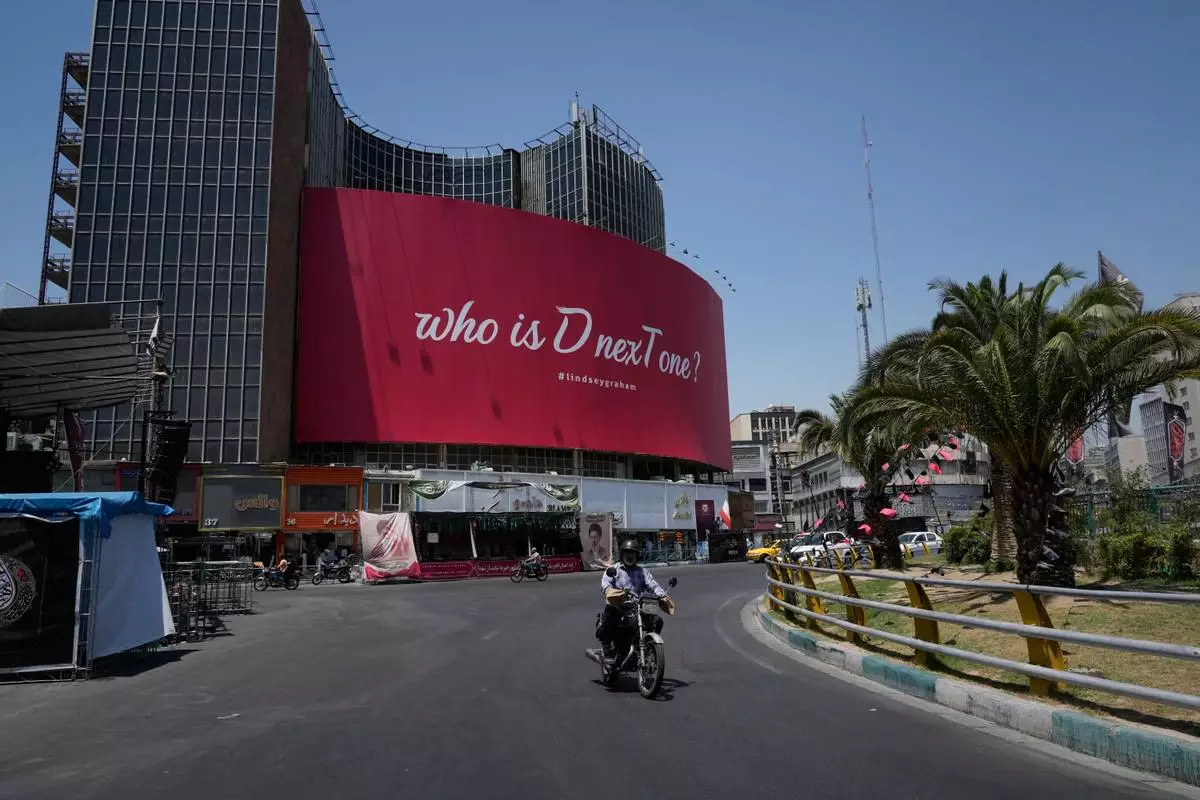
Vehicles drive by a billboard reading in English, "Who is D nexT one?" and "#lindseygraham," referring to late U.S. Sen. Lindsey Graham and using the capital letters "D" and "T" in an apparent play on the initials of U.S. President Donald Trump, in downtown Tehran, Iran, Thursday, July 16, 2026. (AP Photo/Vahid Salemi)
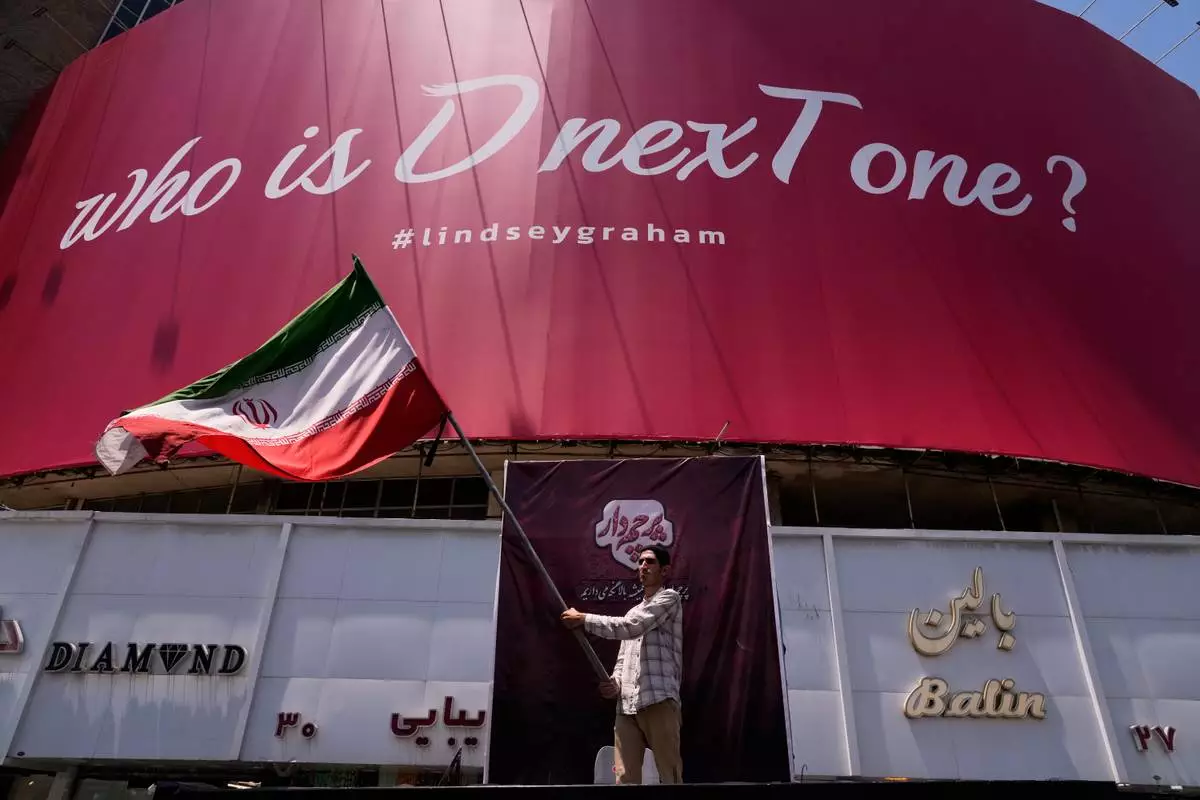
A man waves an Iranian flag beneath a billboard reading in English, "Who is D nexT one?" and "#lindseygraham," referring to late U.S. Sen. Lindsey Graham and using the capital letters "D" and "T" in an apparent play on the initials of U.S. President Donald Trump, in downtown Tehran, Iran, Thursday, July 16, 2026. (AP Photo/Vahid Salemi)
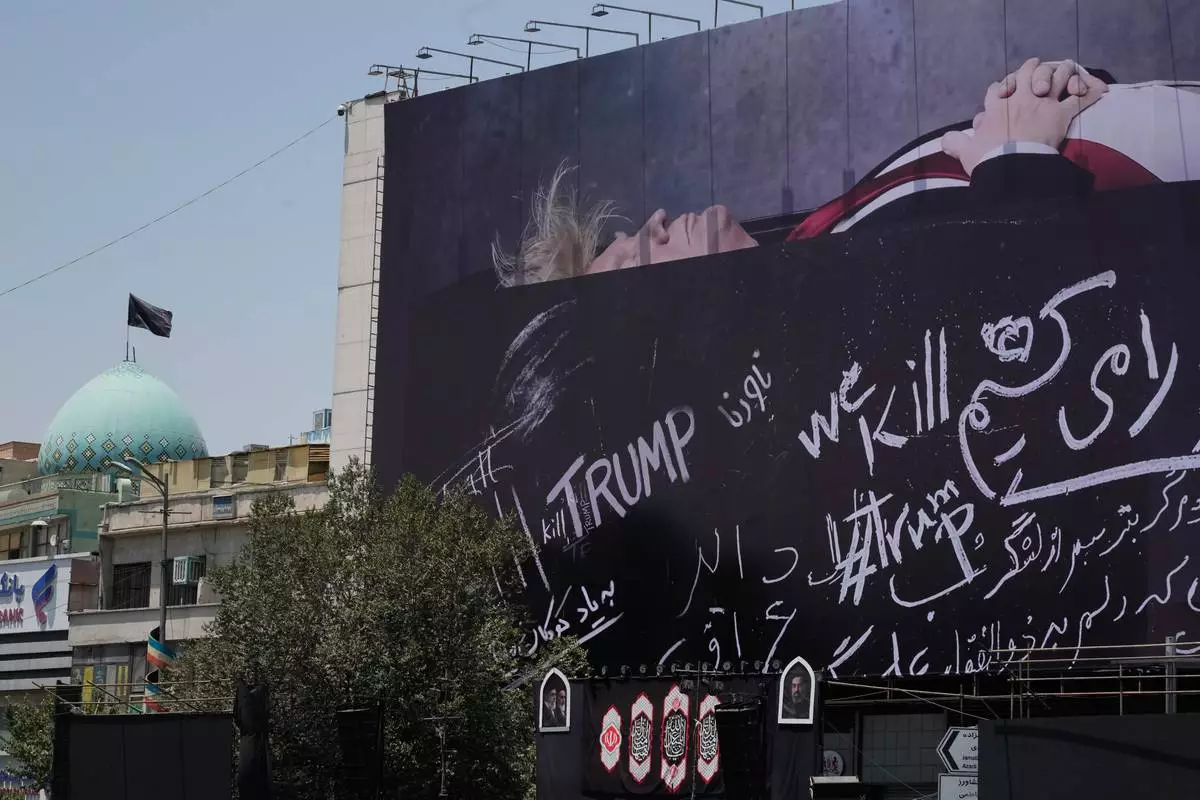
A billboard depicting U.S. President Donald Trump lying on what appears to be a coffin and bearing anti-Trump messages, including the phrase "We Kill Trump," is seen at Islamic Revolution Square in downtown Tehran, Iran, Wednesday, July 15, 2026. (AP Photo/Vahid Salemi)
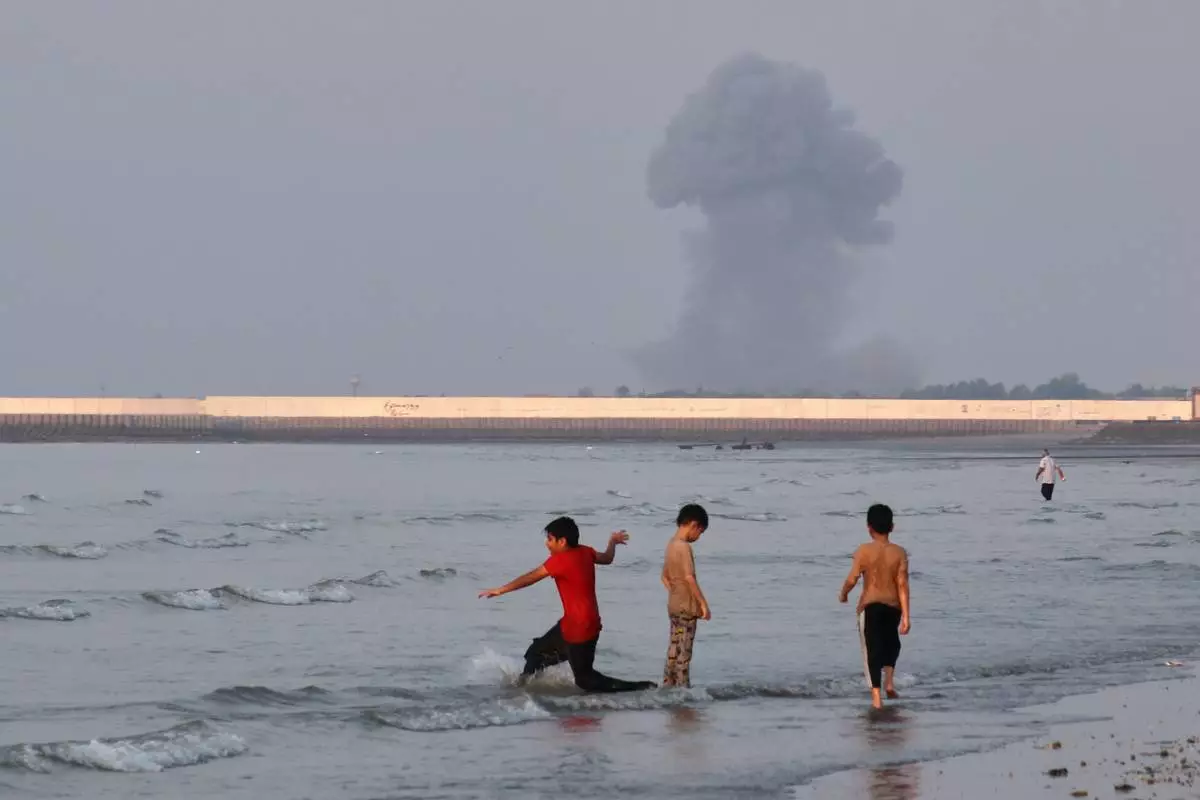
Three boys play in the shallow waters of the Strait of Hormuz, as a plume of smoke rises from an explosion in the background, off Bandar Abbas, Iran, Monday, July 13, 2026. (Razieh Poudat/ISNA via AP)