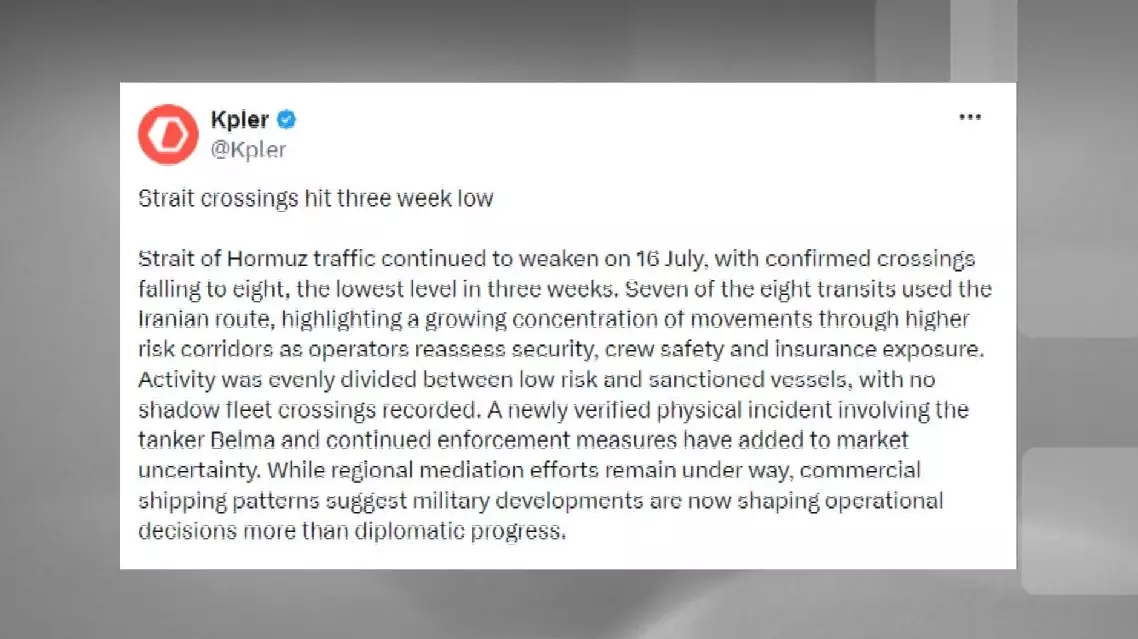
Shipping traffic through the Strait of Hormuz has continued to decline, falling to its lowest level in three weeks, according to maritime data firm Kpler.
Data released by Kpler on Friday showed that only eight vessels crossed the strait on Thursday, with seven using the Iranian route.
Kpler noted that attacks on tankers and the U.S. naval blockade have heightened market uncertainty, indicating that maritime companies are being influenced more by military developments than diplomatic efforts.
Meanwhile, Executive Director of the International Energy Agency (IEA) Fatih Birol warned on Thursday that global energy security faces a serious threat unless disruptions in the Strait of Hormuz are resolved within weeks.
Birol recalled that the IEA coordinated the release of 400 million barrels of oil reserves in March, but stressed that such measures "cannot last forever". He called for the strait to be "fully open, unconditionally open".
Tensions in the Strait of Hormuz have escalated since renewed fighting between the United States and Iran broke out earlier this month.
Shipping traffic in Strait of Hormuz drops to 3-week low: data
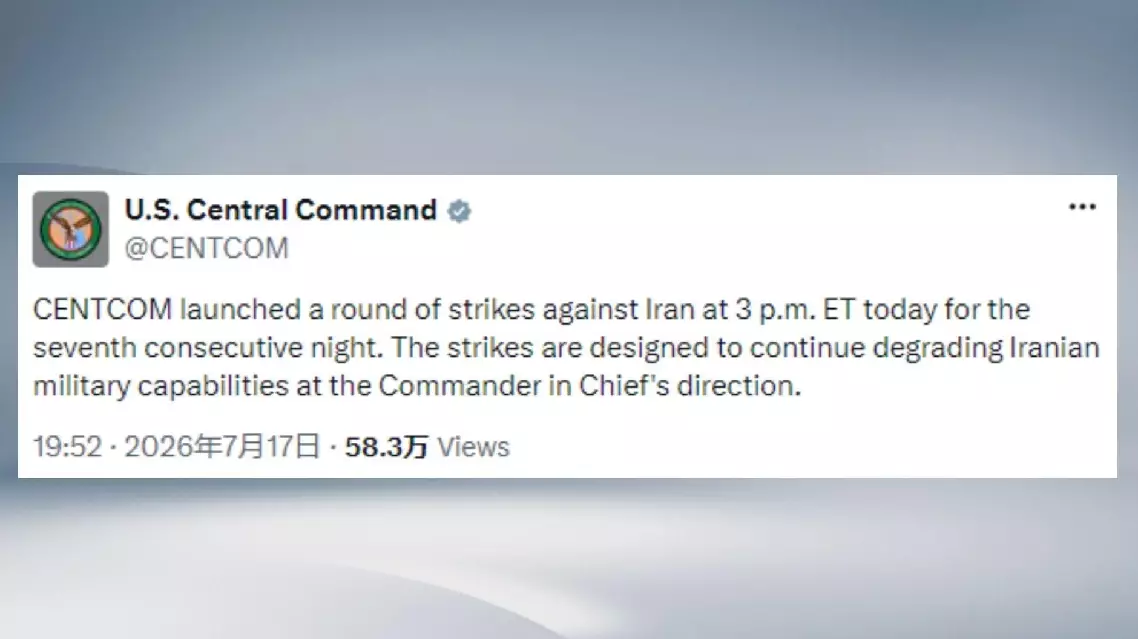
U.S. forces conducted a new round of strikes against Iran on Friday afternoon, marking the seventh consecutive night of attacks, the U.S. Central Command (CENTCOM) said in a statement.
The strikes, launched at 15:00 Eastern Time (1900 GMT), are intended to further degrade Iran's military capabilities, CENTCOM said.
Iranian media reported that U.S. strikes hit multiple areas across southern, central, and southwestern Iran overnight, with explosions heard.
The deputy governor of Hormozgan Province confirmed early Saturday that three people had been killed and eight others wounded in the attacks.
In strikes the day before, several bridges in southern Iran were hit by U.S. forces, with civilian casualties reported. Iranian Foreign Minister Seyed Abbas Araghchi and spokesman Esmaeil Baghaei condemned the attacks on civilian infrastructure and civilians, saying the Iranian people are now more resolute and united than ever.
While U.S. forces were conducting strikes, Iran also announced multiple strikes on U.S. military targets.
The Iranian military said on Friday that its navy launched shore-based cruise missiles at a U.S. warship in the northern Indian Ocean, forcing it out of Iran's strike range.
The Islamic Revolutionary Guard Corps (IRGC) said early Saturday that it had struck and destroyed a U.S. unmanned vessel storage base in Bahrain, along with an artificial intelligence center used by the United States for targeting enemy positions.
Separately, Iran's semi-official Tasnim news agency reported that a U.S. MQ-9 Reaper drone was shot down over Bushehr by the IRGC Navy's air defense system.
US launches new wave of strikes against Iran