Public healthcare fees and charges reform effectively strengthens protection for poor, acute, serious, and critical patients
The following is issued on behalf of the Hospital Authority:
Click to Gallery

The Hospital Authority, Photo source: reference image

Photo source: reference image

The HA spokesperson added that following the implementation of the public healthcare fees and charges reform, the HA can deploy more resources to strengthen care for emergency patients and critical patients. Photo by Bastille Post

The public healthcare fees and charges reform, Photo source: reference image
The Hospital Authority (HA) spokesperson announced today (July 19) that the public healthcare fees and charges reform, which has been implemented for half a year, has not only effectively enhanced efficiency and reduced waste, but also significantly strengthened protection for poor, acute, serious, and critical patients. The HA will analyse the effectiveness of the Reform at this stage and study further reform measures to make the public healthcare system a safety net better safeguarding the health of the public.

The Hospital Authority, Photo source: reference image
The public healthcare fees and charges reform has yielded remarkable results in its measures to protect poor patients. The expansion of the medical fee waiver mechanism has drastically increased the potential number of beneficiaries from about 900 000 in the past to approximately 2 million. Since the implementation of the reform, the number of beneficiaries of medical fee waivers has surged. As of June 30, the HA had received a total of 289 799 applications, of which 264 087 were approved. The approval rate exceeded 90 per cent, which is nearly 19 times of approximately 14 000 patients who received medical fee waivers in the full year prior to the reform. Excluding those who have been benefiting from medical fee waivers both before and after the reform (including Comprehensive Social Security Assistance recipients, recipients of Old Age Living Allowance aged 75 or above, and holders of Level 0 Vouchers under the Residential Care Service Voucher Scheme for the Elderly), there were already about 900 000 patient attendances benefited from the enhanced medical fee waiver mechanism in the first half of this year, with the vast majority being fully waived.
Furthermore, the HA has introduced a cap on annual spending of $10,000 without requiring financial assessment, providing more comprehensive protection for members of the public who unfortunately suffer from serious or chronic illnesses, thereby protecting them from impoverishment due to illness. As of June 30, for the 10 595 patients whose applications were approved, all other eligible medical fees for the remainder of this financial year will be fully waived.

Photo source: reference image
The public healthcare fees and charges reform has also strengthened subsidies for the application of innovative drugs and medical devices for critical patients. Over the past six months, the HA has incorporated 16 new drugs (including seven targeted therapy drugs for cancer treatment) into the HA Drug Formulary. Among them, six were included in the Special Drugs category, meaning patients only need to pay the standard drug fee (i.e. $20 every four weeks) under specific clinical applications; another five are self-financed drugs subsidised by the safety net. The estimated additional annual expenditure involved is $134 million.
In addition, during the same period, 17 newly added drugs/medical devices or relaxations of clinical indications (including 10 items related to cancer drugs) were covered under the scope of the Samaritan Fund (SF) subsidy, involving an estimated additional annual expenditure of $46 million. Concurrently, the HA will include another 10 newly added drugs or expanded clinical indications and 26 self-financed medical devices into the subsidy scope of the SF this month.
The reform has also relaxed the financial assessment criteria for SF subsidies, strengthening drug and medical device support for critical patients, including those from middle-income families. Compared with the same period in the first half of last year, the approved subsidy amounts for drug and non-drug items under the SF increased by about 22 per cent and 10 per cent to $1.28 billion and $220 million respectively. The number of approved applications for drug and non-drug items involving non-Comprehensive Social Security Assistance recipients increased by about 21 per cent and 10 per cent to about 4 500 and 2 100 cases respectively. Among them, the patient's contribution in about 1 070 drug subsidy cases decreased due to the relaxation of the Fund's application eligibility, while over 80 non-drug subsidy cases changed from generally not being subsidised by the Fund before the relaxation to receiving subsidies.
Following the implementation of the public healthcare fees and charges reform, the service and efficiency of Accident and Emergency Departments (A&Es) have also been enhanced. In the first six months of this year, a total of 913 248 attendances were recorded across the 18 A&Es under the HA, representing a decrease of 3.9 per cent compared with the same period last year. Among them, priority treatment for Triage Category I (Critical) and Category II (Emergency) cases fully met the target, and these 44 522 attendances were fully exempted from A&E fees under the new fees and charges mechanism. The proportion of Triage Category III (Urgent) cases treated within 30 minutes meeting the service pledge target increased from 81.4 per cent to 88.5 per cent, with the average waiting time reduced from 23 to 20 minutes. Attendances for Triage Category IV (Semi-urgent) and Category V (Non-urgent) cases decreased by about 10 per cent, with non-urgent cases dropping by about 20 per cent.
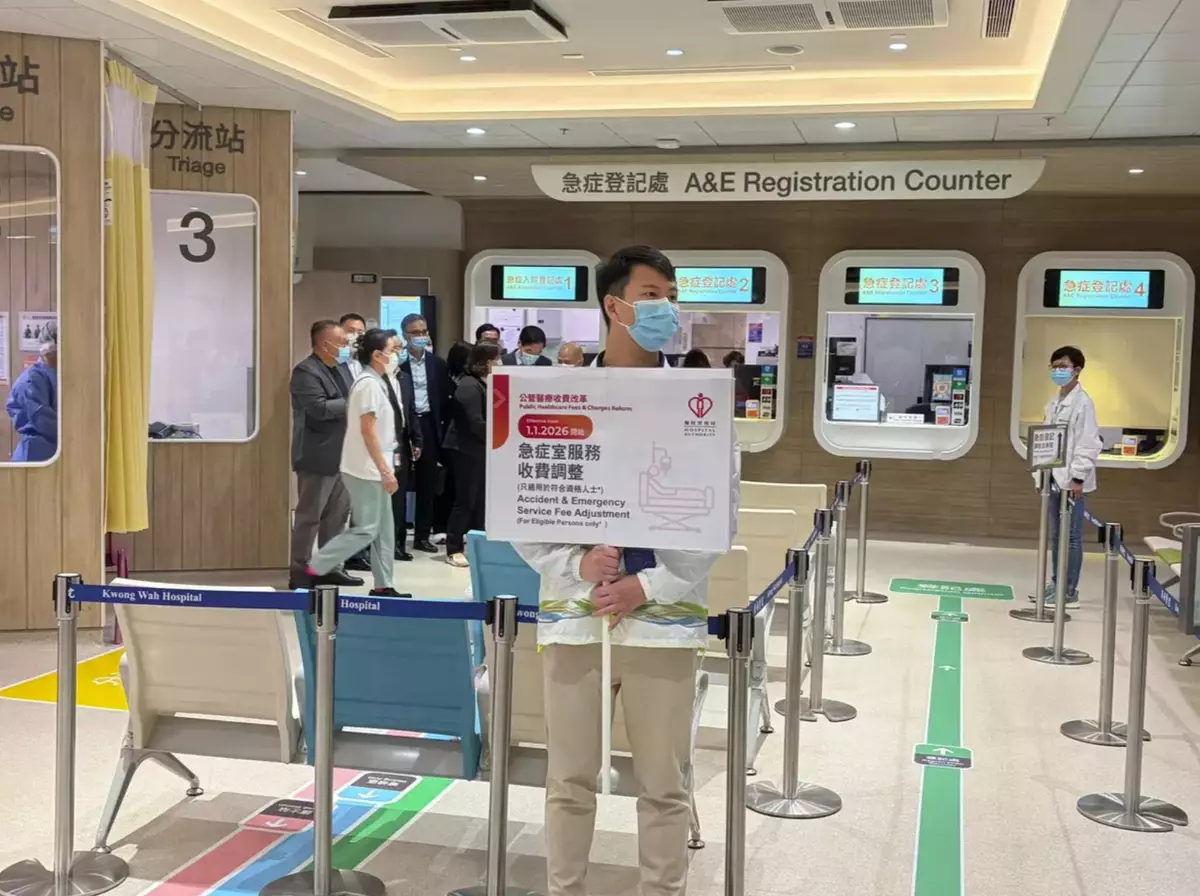
The HA spokesperson added that following the implementation of the public healthcare fees and charges reform, the HA can deploy more resources to strengthen care for emergency patients and critical patients. Photo by Bastille Post
The HA spokesperson added that following the implementation of the public healthcare fees and charges reform, the HA can deploy more resources to strengthen care for emergency patients and critical patients. A&Es focus resources on critical care, serving as the most effective protection for emergency patients. The HA's safety net also provides better protection for critical patients, with more effective medical devices and drugs with fewer side effects being included in the subsidy scope, thereby enhancing treatment efficacy.
These results reflect the positive impact of the fees and charges reform in guiding patients to use healthcare services appropriately, reducing default appointments and resource wastage, and improving the utilisation efficiency of public healthcare resources. Following the implementation of the new booking and payment arrangements in mid-April, the number of default appointments for Computed Tomography (CT), Magnetic Resonance Imaging (MRI), and Ultrasonography scans between April and June this year decreased by about 28 per cent, 40 per cent, and 35 per cent respectively compared with the same period last year. Preliminary estimates suggest that these improvements equate to an annual saving of about 6 000 CT, 2 500 MRI, and 9 000 ultrasonography appointments, which is roughly equivalent to the annual service capacity of one CT scanner, one MRI scanner, and two ultrasound scanners. This further enhances examination capacity and resource utilisation efficiency, allowing patients in need to undergo examinations sooner.
Patients' habits when using public healthcare services have also changed, as they have become more prudent in utilising limited services and resources. Taking the habit of collecting "as needed" medications (such as artificial tears or topical preparations for pain) as an example, as of June 30, the demand for "as needed" medications has generally dropped by about 12per cent compared with the same period last year.
The HA spokesperson stressed that the data clearly reflects the correct direction of the public healthcare fees and charges reform, which is yielding initial results. In accordance with the policies of the Health Bureau, the HA is summarising the reform experience at this stage to prepare for the next phase of the public healthcare fees and charges reform, progressing step by step in the direction of the reform to continuously enhance public healthcare services for the benefit of patients.

The public healthcare fees and charges reform, Photo source: reference image