Experts and scholars shared their insights on the future prospects and governance of artificial intelligence (AI) during the 2026 World Artificial Intelligence Conference (WAIC) in Shanghai, which was just concluded on Monday.
Arieh Warshel, 2013 Nobel Prize Laureate in Chemistry, believes human judgment remains indispensable at least for the next three years.
"One might be afraid that AI will replace the scientist. At least at present, good scientists are leading the AI rather than the AI leading them. There might be a stage where the AI will be able to evaluate AI better than humans, but in the next three years I still think that human judgment is very important to the proper activation of AI," said Warshel.
Zheng Qinghua, an academician of the Chinese Academy of Engineering, stressed the need for more foundational research and patience.
"Although AI is rapidly iterating, objectively speaking, there are still many major foundational theoretical issues and core technologies that need breakthroughs. In this regard, we need to commit to long-term, painstaking research and achieve major breakthroughs in basic disciplines such as mathematics," Zheng said.
Wang Jian, also an academician of the Chinese Academy of Engineering, highlighted China's critical role in global AI governance.
"I think China plays a very critical role. China has truly reached the forefront of the world in AI. At the same time, as everyone can see, it is very responsible in its approach to technological development," said Wang, who is also the founder of Alibaba Cloud.
China has hosted the WAIC annually since 2018 as a key platform to forge global AI partnerships to unlock AI's benefits for all.
This year's event was held from Friday to Monday, bringing together 1,400 guests from home and abroad.

Experts weigh in on AI future, governance during WAIC in Shanghai
Jordan, Kuwait and Bahrain said on Monday that they have intercepted Iranian aerial attacks.
The Jordan Armed Forces-Arab Army said in a statement Monday night that its air defenses intercepted three missiles launched from Iran.
It said the interception caused no casualties or material damage, adding that it remains on high alert and will respond firmly to any threats to national security and sovereignty.
The General Command of the Bahrain Defense Force said that its air defense systems intercepted and destroyed multiple Iranian aerial attacks against the kingdom.
It condemned what it called Iran's "systematic hostile approach," saying the "deliberate use of missiles and drones to target civilians and private property" violates international humanitarian law.
Kuwait's armed forces said on Monday its air defense systems were intercepting "hostile" missile and drone attacks, as explosions were heard in parts of the country.
In a statement on social media platform X, the General Staff of the Kuwaiti Armed Forces confirmed the explosions resulted from air defense systems engaging with "hostile" aerial attacks, urging the public to follow safety instructions issued by authorities.
Iran's Islamic Revolution Guard Corps said earlier on Monday that it had launched missile and drone strikes against U.S. assets and facilities in Kuwait and Jordan in response to continued U.S. airstrikes on Iran.
Recent strikes on Kuwait targeted military installations and some of its vital infrastructure, including oil facilities and power and water desalination plants, causing injuries and material damage.
Explosions were heard on Monday evening in Iran's southern provinces of Hormozgan and Fars, the semi-official Mehr news agency reported.
Several explosions were heard in Hormozgan's Sirik County, Mehr cited local citizens as saying, adding the nature of the blast remains unclear.
It also quoted Seyed Ahmad Ahmadizadeh, Fars' deputy governor for political, security and social affairs, as saying that the United States has carried out an airstrike against a region in the provincial capital Shiraz, without causing casualties.
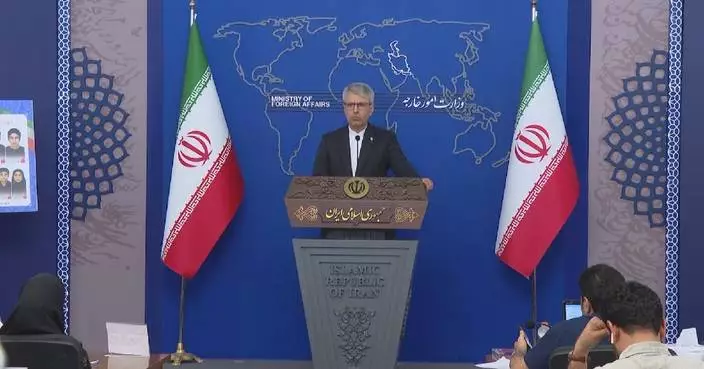
Earlier in the day, Iranian President Masoud Pezeshkian declared a "full-scale war" with the United States. Foreign Ministry spokesperson Esmaeil Baghaei said Iran has received mediation proposals and keeps its diplomatic channels open.
The United States has launched multiple strikes on Iran's southern provinces over the past week, saying they were aimed at "degrading Iran's ability to threaten commercial shipping."
Iran has responded with waves of missile and drone attacks targeting U.S. military bases and facilities in regional countries, including Kuwait, Bahrain and Jordan.

Jordan, Kuwait, Bahrain say intercepted Iranian aerial attacks