NEW YORK (AP) — How many women hold executive-level positions at top U.S. companies? What is the racial and ethnic breakdown of those roles? What is the gender and racial breakdown of the lowest-paid roles at those companies?
The Trump administration is making it harder for the public to know, moving to toss aside a 60-year-old requirement for tens of thousands of private sector employers to submit workforce demographic reports each year to the Equal Employment Opportunity Commission, the agency responsible for enforcing anti-discrimination laws in the workplace.
The EEOC's Republican majority voted 2-1 Tuesday to rescind the data collection requirement, submitting the proposal to a 30-day public commentary period before final approval. The proposal is a quiet but profound salvo in President Donald Trump's shake up of civil rights enforcement, ending a practice that has endured through 10 Republican and Democratic administrations.
EEOC Chair Andrea Lucas, an outspoken critic of diversity and inclusion practices who has urged white men to come forward with discrimination complaints, argued that requiring companies to submit the annual demographic reports risks encouraging companies to justify discriminatory practices to diversify their workforce.
“It may promote racial stereotyping at work, and it may encourage employers to engage in discrimination," Lucas said during a hearing ahead of the vote.
Former Democratic EEOC commissioners and civil rights organizations have denounced the proposal, saying it will deprive the agency of a critical tool for uncovering discrimination patterns and tracking how women and racial minorities have fared since the 1964 Civil Rights Act, which created the EEOC and prohibited employment discrimination based on race, color, sex, national origin and religion.
The EEOC, which receives more than 88,000 worker complaints each year, has historically used the data to guide its enforcement priorities and inform some of its investigations.
Commissioner Kalpana Kotagal, the sole Democrat left on the EEOC since Trump moved to wrest control of the agency, voted against the proposal.
“Today, the commission discusses whether to turn back time to a period before the civil rights movement, kneecapping its ability to protect workers,” Kotagal said.
Here's what to know about the reporting requirement and the proposal to end it:
Since 1966, the EEOC has required companies with at least 100 employees, or federal contractors with at least 50 workers, to submit a form called the EEO-1 each year.
The form, which has evolved over time, identifies 10 job categories from “Executive/Senior Level Officials and Managers” to “Laborers” and “Service Workers.” It asks employers to report on the number male and female workers in each job category, as well as the number of workers from different race and ethnicities.
The data typically covers more than 50 million employees and 73,000 employers nationwide.
The EEOC launched during the Biden administration an interactive tool allowing the public to explore historical demographic metrics across industries and job categories. The most recent data is from 2023. Under the Trump administration, the EEOC last collected EE0-1 data for the year 2024 but has not publicly disclosed it. Collection of the year 2025 would have begun this year.
The data shows white men dominating executive and senior manager roles at private companies, though women and minorities have made inroads, especially in the years following the #MeToo and Black Lives Matters movements.
Women remain underrepresented in the top ranks of companies. While they make up nearly half the workforce at the companies surveyed, women held just 34.5% of executives and senior manager roles in 2023. That was up from 29.2% a decade earlier.
White and Asian women made the fastest gains, and by 2023, were no longer underrepresented in senior roles compared to their numbers in the overall workforce. In contrast, Black and Hispanic women remained sharply underrepresented in executive and senior manager roles despite making modest gains.
Asian men have been proportionally represented in senior roles for years, while Black and Hispanic men remained underrepresented in 2023.
Of those demographic groups, only one was overrepresented in senior roles: white men, who made up a third of the overall workforce at the companies surveyed but held 52.7% of executive and senior management roles.
Lucas said the annual reporting requirements impose “hundreds of millions of dollars” on costs on employers, a burden she argued was unnecessary absent “any allegation, indication, or evidence of discrimination.”
The move was recommended by Project 2025, the conservative Heritage Foundation’s blueprint that has guided many of the Trump administration’s policies.
A group of former Democratic EEOC commissioners and legal counselors said there is little evidence that companies are routinely using employment data to engage in quotas or race-based hiring.
“This is simply inaccurate and unsupported speculation, at odds with the ways in which this data is actually collected, managed and used,” the former officials said in a statement.
Instead, the officials said, tracking such data encourages companies to proactively examine their hiring, promotion, benefits and other policies to ensure they are not unnecessarily erecting barriers. The agency has also issued special reports on demographic employment trends across certain industries or roles.
The EEOC is prohibited from publicly releasing an individual company’s EEO-1 form, only publishing the information in the aggregate. In recent years, however, a growing number of the country’s top companies began publicly releasing their forms in response to pressure from shareholders and Democratic elected officials to show transparency in their diversity efforts.
That trend has started to reverse.
Companies have started to pull back on publicizing both EEO-1 forms and their own diversity reports, which conservative advocates and the Trump administration have seized on to argue that companies are using discriminatory tactics to add women and minorities to their ranks.
In 2025, 24 companies in the S&P 100 — the largest U.S. publicly traded companies — chose not to disclose their EEO-1 data after having done so the year before, according to Andrew Jones, principal researcher at The Conference Board Governance & Sustainability Center. Still, 60 S&P 100 companies did release the data.
Companies are still likely to keep track of their demographic data, whether or not they disclose any of those metrics publicly, and even if they are no longer required to submit annual EEO-1 reports. That's because Title VII requires employers to keep records that could be pertinent to any discrimination investigation, and the EEOC is empowered to request them.
“What we are generally advising is to stay the course,” Jennifer Robins, counsel in law firm Saul Ewing’s Labor and Employment Group. “Private litigants, employment discrimination lawsuits are not going away, and this data is helpful to defending oneself.”
The EEOC has demanded extensive demographic data from companies to bolster Lucas' own marquee cases. Those include an investigation into diversity, equity and inclusion practices of sports giant Nike, which Lucas has alleged discriminate against white employees.
Lucas emphasized Tuesday that the EEOC would continue to demand data in the course of its investigations. Kotagal warned employers that under future leadership, the EEOC could reinstitute the EEO-1 collection.
The Associated Press’ women in the workforce coverage receives financial support from Pivotal Ventures. AP is solely responsible for all content. Find AP’s standards for working with philanthropies, a list of supporters and funded coverage areas at AP.org.
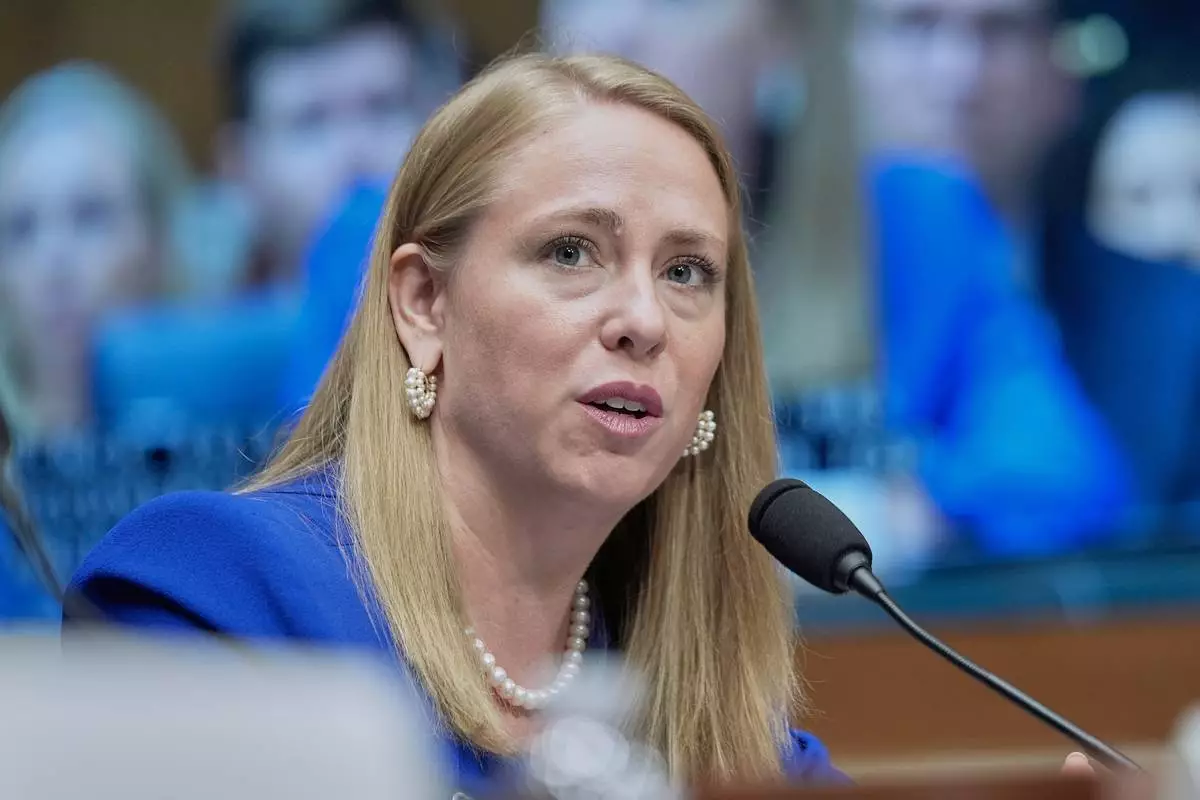
FILE - Andrea Lucas, nominee to be a member of the Equal Employment Opportunity Commission, testifies during a Senate Health, Education, Labor, and Pensions (HELP) Committee hearing on June 18, 2025, on Capitol Hill in Washington. (AP Photo/Mariam Zuhaib, File)