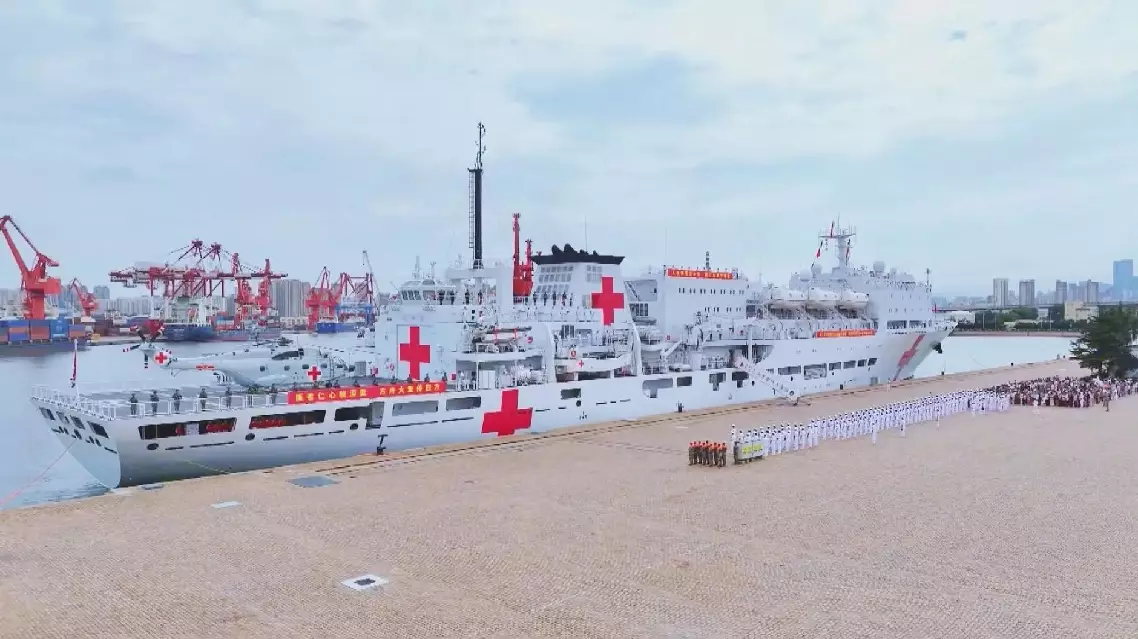
The Chinese People's Liberation Army (PLA) Navy hospital ship, Auspicious Ark, departed from a port in Qingdao, east China's Shandong Province, on Wednesday for a humanitarian medical service mission in Africa and South Asia.
Mission Harmony-2026, the 12th iteration of Mission Harmony since 2010, is scheduled to last more than 200 days, during which the ship will visit multiple African and South Asian countries to provide free medical services to local people.
The vessel left the port at around 10:00 on the day, marking the first overseas mission since its commissioning.
The hospital ship houses 18 clinical departments and five diagnostic support departments, enabling it to perform more than 60 types of examinations, treatments, and surgeries across general surgery, orthopedics, obstetrics and gynecology, ophthalmology, and other disciplines.
It is also equipped with eight standard operating rooms.
"The hospital ship Auspicious Ark shoulders the responsibility of spreading peace. For its first overseas mission, it will visit many countries and have long port calls. All officers and soldiers on the mission will build a maritime bridge of friendship through professional medical services," said Gao Guozheng, a crew member.
The crew will also carry out cultural exchanges with people in those countries.
Chinese navy hospital ship sets sail for humanitarian medical mission in Africa, South Asia
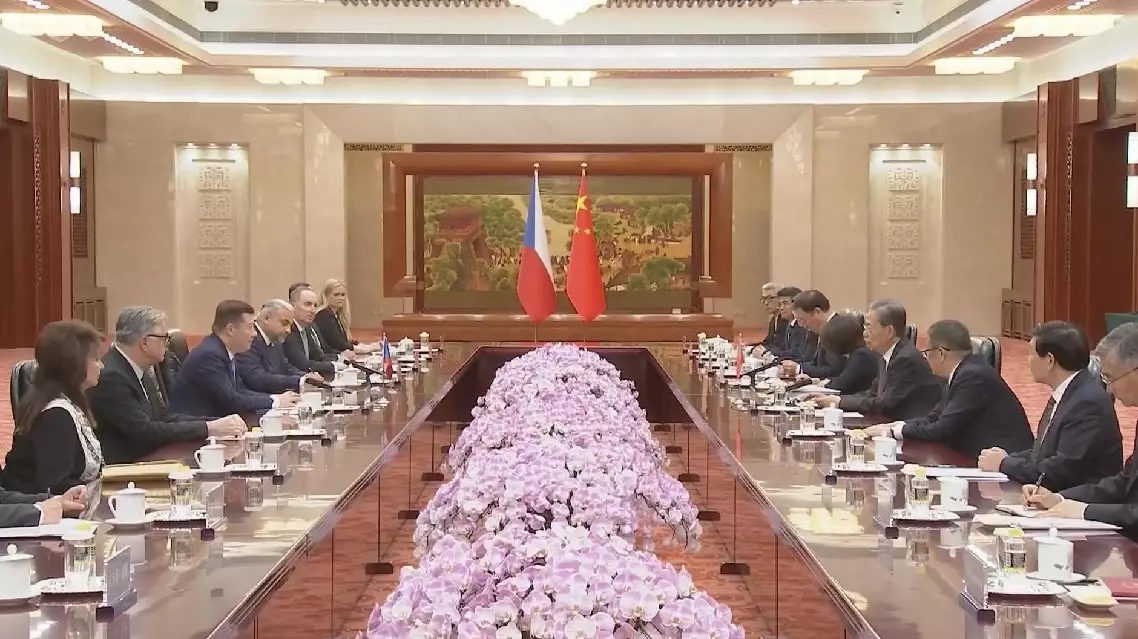
Zhao Leji, chairman of China's National People's Congress (NPC) Standing Committee, held talks with Tomio Okamura, speaker of the Chamber of Deputies of the Czech Republic, in Beijing on Thursday.
Noting that this year marks the 10th anniversary of the China-Czech strategic partnership, Zhao, also a member of the Standing Committee of the Political Bureau of the Communist Party of China Central Committee, said China stands ready to work with the Czech side to carry forward traditional friendship, enhance mutual understanding and trust, strengthen exchanges and cooperation, and promote the sound and steady growth of bilateral relations.
Zhao called on both sides to consolidate the political foundation of their ties, sustain the momentum of improvement in bilateral relations, and resume and step up exchanges and interactions at all levels and across all fields.
Both sides should further tap cooperation potential, give full play to the role of mechanisms such as the economic joint committee between China and Czech and the China-Central and Eastern European Countries Expo, explore ways to strengthen cooperation in new energy, electric vehicles and other fields, and support enterprises of the two countries in expanding investment cooperation, Zhao added.
The NPC is ready to enhance friendly exchanges with the Chamber of Deputies of the Czech Republic, carry out mutual learning and exchanges on legislative supervision, economic development, improvement of people's livelihood, formulate, revise and ratify legal documents conducive to bilateral cooperation, and maintain close communication and collaboration within multilateral mechanisms such as the Inter-Parliamentary Union, Zhao said.
Zhao also said China is willing to work with all countries, including the Czech Republic, to strengthen exchanges and cooperation in the field of artificial intelligence and promote the establishment of a fair and equitable global governance system for AI.
Okamura said the Czech Republic adheres to the one-China policy, adding that it hopes to strengthen tourism cooperation with China and welcome more Chinese tourists to visit the Czech Republic, expand cooperation in areas such as economy and trade, cultural relic exhibitions, and direct flights, and enhance people-to-people exchanges.
The Chamber of Deputies of the Czech Republic stands ready to strengthen friendly exchanges with China's NPC and enhance the friendship between the two peoples, Okamura added.
China's top legislator holds talks with speaker of Czech Chamber of Deputies