The China-Philippines relations now stand at a crossroads, and it falls to the Philippine side to make correct, rational decisions about the path ahead, Chinese Foreign Minister Wang Yi said on Wednesday.
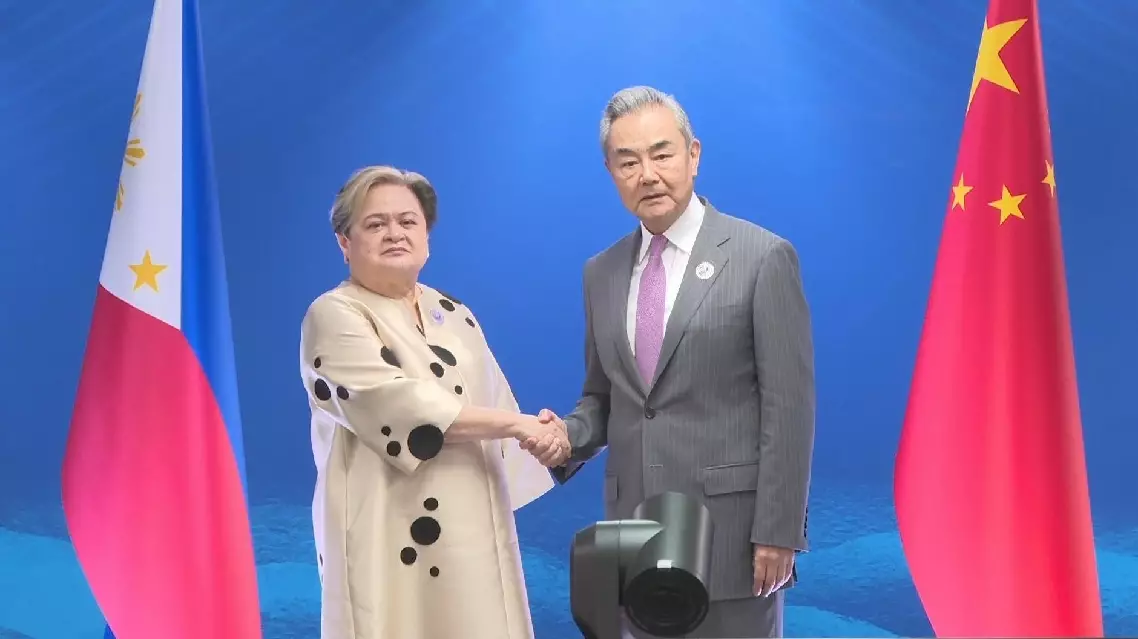
Wang, also a member of the Political Bureau of the Communist Party of China Central Committee, made the remarks during his meeting with Philippine Foreign Affairs Secretary Ma. Theresa Lazaro in Manila, the Philippines.
The Chinese foreign minister elaborated on China's stern position to the Philippine side and lodged a strong protest against the reckless conduct of Philippine personnel ramming Chinese law-enforcement vessels at Ren'ai Jiao.
Wang stated that China-Philippines relations have been beset by persistent difficulties and challenges over the past few years, which is clearly in neither side's interest and impedes the Philippines' own development. Both sides ought to jointly uphold the hard-won peace and development in the region, yet the Philippines is moving in the opposite direction to other regional countries, turning itself into a source of disruption to regional peace and stability.
Facts have proven that allowing external forces to meddle in regional affairs and deliberately hyping up maritime disputes will only reduce the Philippines to a pawn manipulated by others, Wang said, adding that any attempt at provocation backed by external countries will ultimately leave the Philippines bearing the bitter consequences of its own making.
It is unfortunate that whenever China and the Philippines prepare to launch dialogue, certain forces within the Philippines, particularly those from the military and law enforcement, deliberately stir up trouble to derail dialogue progress. These parties harbor malicious intentions: rather than prioritising the well-being of the Filipino people, they act on the instructions of external forces to advance personal interests, Wang said.
He emphasized that to develop China-Philippines relations, it is crucial to grasp the right direction. China has never constituted a security threat to the Philippines, nor has it ever invaded or colonized the country throughout history.
It is an objective reality that the two sides have disputes over territorial claims and maritime delimitation, Wang noted, saying that China has consistently committed to managing differences and stabilizing the situation through bilateral dialogue and consultation. The Philippines, however, abandoned bilateral negotiation mechanisms, assembled an ad hoc "arbitral tribunal" urged by extraterritorial forces, and manufactured and hyped up the so-called award, which is illegal and void.
China has never accepted, participated, or recognized this "award" from the very outset, he said. The Philippines should immediately stop its provocative actions on maritime issues, abide by the commitments it has made to China to date, and take tangible steps to stabilize bilateral ties, Wang said.
Lazaro remarked that the Philippines and China share a long history of exchanges, and are and will always be each other's neighbor. The Philippines remains committed to the one-China policy and its diplomatic commitments established upon the normalization of bilateral relations. There is but one China in the world, and Taiwan is an inalienable part of China's territory. She said the Philippine side hopes to work out proper solutions to maritime issues via dialogue and achieve progress in the improvement of bilateral ties.
Philippines must make correct decisions as bilateral relations reach crossroads: Chinese FM