China’s government‑backed consumer goods trade‑in programs generated 1.1 trillion yuan (about 162.3 billion U.S. dollars) in the first half of 2026, benefiting 150 million consumers, according to data released by the Ministry of Commerce.
The nationwide initiative has spurred significant growth across multiple sectors. From January to June, 2026, the programs facilitated the trade-in of 3.707 million vehicles and 63.266 million home appliances, alongside the purchase of 79.098 million digital and smart products. Additionally, 19 provincial-level regions have implemented autonomous subsidy policies for specific categories, driving the sales of 992,000 related items.
More consumers are opting for green and energy-efficient new energy vehicles (NEVs), accelerating the electrification of the auto market.
The proportion of NEVs benefiting from the auto trade-in subsidy has steadily increased since the beginning of 2026, reaching 65.4 percent in June. This surge supported the domestic retail penetration rate for NEVs to hit a record high of 62.4 percent in the second quarter.
Beyond the auto sector, the push for smarter consumption is also evident in the digital market. Sales of digital and smart products grew by 13.4 percent year on year in the first half of 2026, with a robust 32 percent increase recorded in June alone.
Since the implementation of the policy, smart glasses have emerged as a new growth hotspot in the smart consumption segment, with their sales growth accelerating month by month to hit 30.6 percent in June.
To further cater to consumers' desire for novel products, the 2026 trade-in policy grants local authorities greater autonomy to launch targeted subsidy programs based on local conditions.
Provinces and cities like east China's Jiangsu Province and Shanghai have incorporated cutting-edge smart products, such as embodied intelligent robots, into their subsidy scopes. This approach not only satisfies consumers' demand for new experiences but also opens up new market spaces for emerging technologies and industries.
The widening coverage of the trade-in program is also injecting fresh vitality into consumption in county and rural areas.
The number of offline participating outlets has increased by 28.1 percent year on year, further energizing county and rural markets. In east China's Fujian Province, the count of offline stores joining home appliance trade-in activities in county and rural areas has grown by 15 percent compared with the start of the year.
To fully tap into the potential of low-tier markets, the Ministry of Commerce, in conjunction with the Ministry of Industry and Information Technology, has launched campaigns to bring NEVs to the countryside. These efforts focus on increasing the supply of suitable vehicle models in rural areas, ensuring the fulfillment of trade-in subsidy demands, and improving charging infrastructure and after-sales service networks.
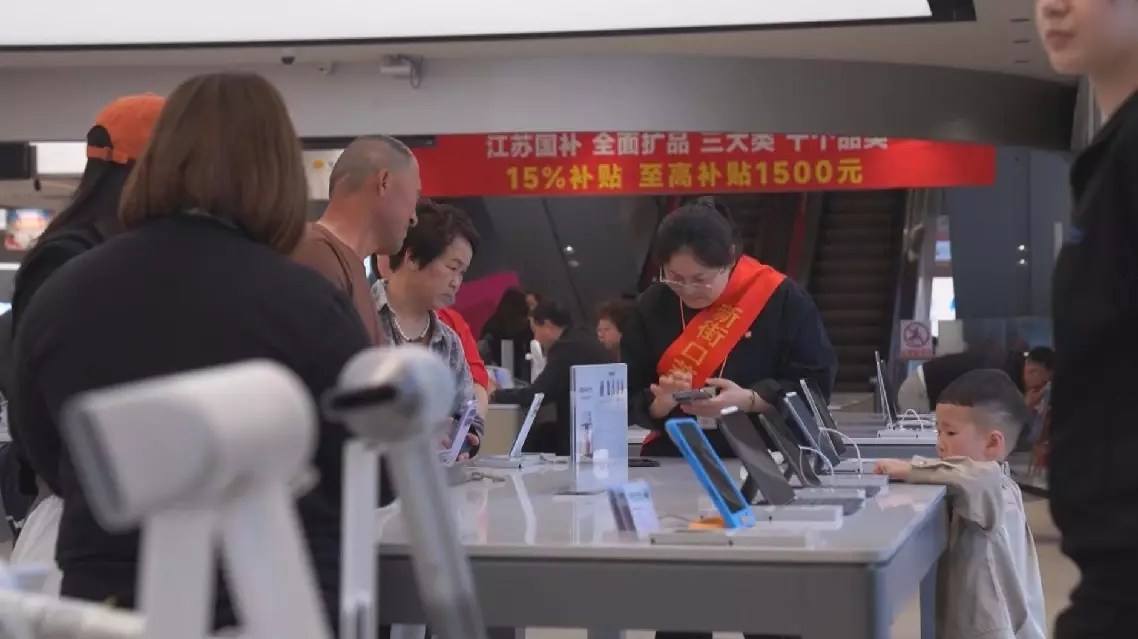
China's consumer goods trade-in program generates 1.1 trillion yuan sales