Skip to Content Facebook Feature Image

SITI: Emphasizing HK's AI and Digital Innovation for Sustainable Development at APEC Ministerial Meeting in Chengdu

HK

SITI: Emphasizing HK's AI and Digital Innovation for Sustainable Development at APEC Ministerial Meeting in Chengdu
HK

HK

SITI: Emphasizing HK's AI and Digital Innovation for Sustainable Development at APEC Ministerial Meeting in Chengdu

2026-07-23 11:25 Last Updated At:13:11

Speech by SITI at "Session 1: Enhancing Digital and AI Technologies for Development" of Asia-Pacific Economic Cooperation Digital and AI Ministerial Meeting in Chengdu

Following is the speech by the Secretary for Innovation, Technology and Industry, Professor Sun Dong, at "Session 1: Enhancing Digital and AI Technologies for Development" of the Asia-Pacific Economic Cooperation (APEC) Digital and AI Ministerial Meeting in Chengdu today (July 23):

Chair (APEC Digital and AI Ministerial Meeting Chair, Minister of Industry and Information Technology, Mr Li Lecheng) and distinguished fellow colleagues,

Good morning. On behalf of Hong Kong, China (HKC), it is my great pleasure to participate in the APEC Digital and AI Ministerial Meeting in Chengdu, with our motherland as the host of APEC 2026.

Nowadays, digital and AI technologies underpin economic resilience, social inclusion and sustainable development. Guided by the Hong Kong Innovation and Technology (I&T) Development Blueprint, HKC has been making continuous efforts to harness the immense opportunities brought by technological advancement. We have identified AI as a core industry and are advancing the "AI+" initiative for high-quality development for both HKC and China.

Quality world-class research and development (R&D) is fundamental to impactful innovation. HKC is home to five of the world's top 100 universities. Building on this strength, we have developed an I&T ecosystem anchored by three major I&T parks and five key R&D institutions. Together, they form a full pipeline, from upstream research, to midstream technology transfer, to downstream industrial application, creating a robust and internationally competitive landscape.

Our flagship R&D initiative, InnoHK, embodies our ambition to build a global innovation powerhouse. With more than 30 laboratories in AI robotics and health technologies, we have forged collaborations with over 30 world-renowned universities and research institutes from 12 economies, pooling together around 3000 international research talents. Through these research clusters, HKC stands ready to work with global partners to advance R&D excellence and delivering breakthroughs that benefit the region and the world.

Ensuring that R&D achievements deliver real-world impact is equally important. HKC has put in place substantial policy and financial support, including three HK$10 billion initiatives. We launched the Research, Academic and Industry Sectors One-plus Scheme to accelerate commercialisation of university R&D outcomes, and the New Industrialisation Acceleration Scheme to support enterprises in setting up new smart production facilities. To dovetail with China's strategy of developing patient capital, we will soon launch a fund-of-funds called the I&T Industry-Oriented Fund to encourage market capital to invest in strategic industries such as AI, robotics and digitalisation.

Recognising that small and medium-sized enterprises (SMEs) are the backbone of our economy, we launched the Digital Transformation Support Pilot Programme to subsidise SMEs in adopting ready-to-use digital solutions. Building on this success, we plan to launch an enhanced version focusing on ready-to-use AI and cybersecurity solutions, enabling SMEs to upgrade, transform, and strengthen competitiveness in the digital era.

HKC is also promoting AI empowerment across sectors. At the strategic level, we established the Committee on AI+ and Industry Development Strategy to steer AI-driven industrial transformation, with an initial focus on embodied AI. The Government has also set up a dedicated AI Efficacy Enhancement Team to co-ordinate intergovernmental efforts in AI adoption and re-engineering processes. By the end of this year, we will roll out AI tools covering 100 public administration procedures, expanding to no less than 200 by end-2027.

As we navigate this transformative era, HKC is fully committed to promoting global synergies and working hand in hand with all members. Through concerted efforts with our APEC colleagues, we look forward to promoting advances in digital and AI technologies and their sustainable development across the AsiaPacific community. Thank you.
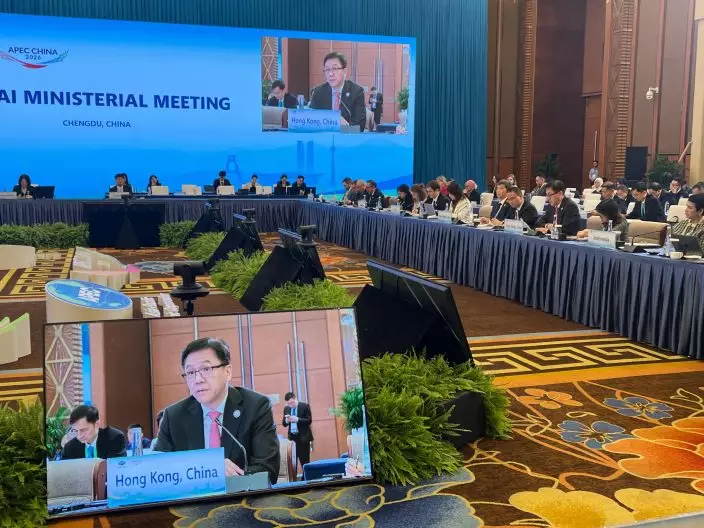
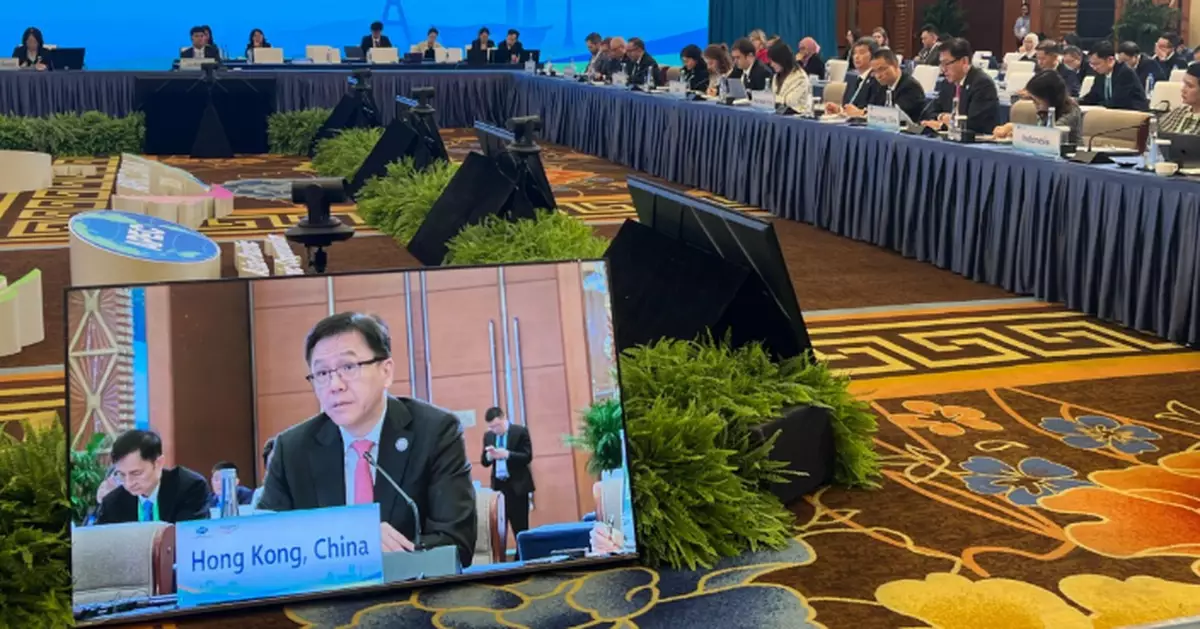
The Secretary for Innovation, Technology and Industry, Professor Sun Dong, attended the Asia-Pacific Economic Cooperation (APEC) Digital and AI Ministerial Meeting (DMM) in Chengdu today (July 23). Photo shows Professor Sun speaking at "Session 1: Enhancing Digital and AI Technologies for Development" of the APEC DMM. Source: HKSAR Government Press Releases


The Secretary for Innovation, Technology and Industry, Professor Sun Dong, attended the Asia-Pacific Economic Cooperation (APEC) Digital and AI Ministerial Meeting (DMM) in Chengdu today (July 23). Photo shows Professor Sun speaking at "Session 1: Enhancing Digital and AI Technologies for Development" of the APEC DMM. Source: HKSAR Government Press Releases
Outcome of 2026 rent review for public rental housing

The Subsidised Housing Committee (SHC) of the Hong Kong Housing Authority (HA) today (July 23) endorsed the outcome of the 2026 rent review for public rental housing (PRH) in accordance with section 16A of the Housing Ordinance (HO).

"Section 16A of the HO provides that the HA shall conduct a rent review every two years in accordance with the mechanism stipulated therein and vary the PRH rent according to the change in the income index between the first and second periods covered by the review. The report compiled by the Commissioner for Census and Statistics (C for C&S) for the 2026 PRH rent review showed that the income index of the second period of the review (i.e. 2025) was higher than that of the first period (i.e. 2023) by 2.04 per cent. To this end, PRH rent will be adjusted upwards by 2.04 per cent with effect from October 1, 2026, " a spokesman for the HA said.

The extent of the 2026 PRH rent adjustment is mild. The average monthly rent as at March 2026 for PRH tenants was $2,519. Applying the adjustment of +2.04 per cent, the average monthly rent increase per PRH household is about $51, with the amount of monthly rent increase ranging from $10 to $128.

"After excluding the ‘well-off tenants’ and Comprehensive Social Security Assistance households whose rent is paid by the Government, the monthly rent increase for more than 60% of the remaining PRH households will be $60 or less, and about 90 per cent of the remaining PRH households have a monthly rent increase of $80 or below. We believe that the increase is within an affordable level for PRH tenants," the HA spokesman said.

The Government announced in the 2026-27Budget that rates concessions would be provided for the first two quarters of 2026-27, subject to a ceiling of $500 for each rateable property per quarter. In line with established practice, HA will pass on the rates concessions to PRH tenants. The rates concessions receivable by each PRH household in 2026-27 range from about $258 to $1,000.

In addition, rents for newly completed PRH estates are set according to the District Best Rent Levels of respective districts, which are determined per meter square of internal floor area with reference to the location and value of the estates concerned. In light of the 2026 rent review of PRH, the rent adjustments for both existing and newly completed PRH estates will take effect on October 1,2026. The HA will notify all PRH tenants in writing one month before the new rent implementation date. Meanwhile, the Housing Bureau has stated that the monthly licence fee for Light Public Housing (LPH) is set at about 90 per cent of the rents for newly completed PRH estates in the same district. Therefore, the monthly licence fees payable of LPH projects will be aligned and adjusted on October 1, 2026 according to the new PRH rental levels. All LPH occupants will be informed of the relevant details in writing one calendar month before the effective date of the new licence fee.

The HO stipulates the PRH rent adjustment mechanism, which came into effect in 2008. Under this mechanism, PRH rent is reviewed every two years. Section 16A(7)(b) of the HO provides that the C for C&S shall compute the income index for the first and second periods under a rent review. The income index is compiled by comparing the income data of about 24 000 PRH households in each of the periods. The mechanism provides an objective basis for the HA to determine when and to what extent PRH rent should be adjusted, taking into account tenants' affordability. According to the mechanism, there is a 10 per cent cap on the rate of rent increase, whereas there is no floor in the case of rent reduction.

Source: AI-found images

Source: AI-found images

Recommended Articles