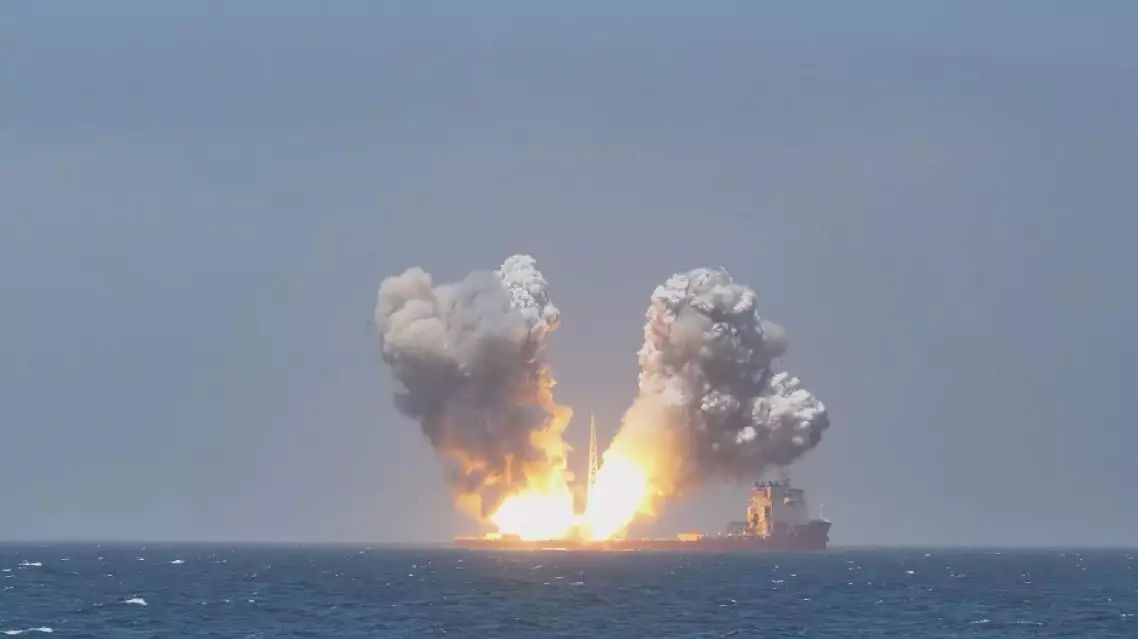
Far-sea launches demand thorough planning of weather and sea conditions throughout the journey, the chief designer of Gravity-1 said Wednesday after the rocket successfully completed its third flight from the East China Sea.
The rocket blasted off from waters about 170 kilometers east of Shanghai, sending nine satellites into orbit and conducting one payload test.
It was the first commercial sea launch by a private Chinese firm in the East China Sea waters, and the first time Gravity-1 was launched from open waters, after two previous missions just a few kilometers off the coast of Haiyang in east China's Shandong Province.
The launch vessel sailed 360 nautical miles, about 40 hours, from its home port in Haiyang to reach the predetermined area.
"The biggest feature of this mission is that we conducted a far-sea launch. At sea, even without wind, there are waves. From our departure to the target area, we had to plan the weather and sea condition support for the entire journey in advance," said Xu Guoguang, the chief designer.
To tackle the rough seas, the team took three preparatory measure: coordinating with meteorological satellites to simulate sea conditions along the route, equipping the vessel with real-time weather monitoring devices, and identifying shelters along the way.
"We have to consider wind, rain, thunder, lightning and waves. We identified the risks related to the rocket's anti-rocking capability and reinforced the launch pad accordingly. With limited support far from ground facilities, we had to simplify operations as much as possible while ensuring the mission's success," he said. According to Xu, sea launches offer three main advantages: safety, as the rocket's trajectory and debris remain over the ocean; efficiency, as flying directly along the optimal azimuth preserves payload capacity; and flexibility, as the launch site can be adjusted to meet different orbital requirements.
"At sea, there are fewer people and fewer assets, making the launch zone inherently safer. In addition, the flight route itself is more secure, ensuring safety even in the event of an emergency," said Xu. "We choose different launch azimuths for different missions. At sea, the azimuth options are more flexible, so taking all factors into consideration, sea launches allow us to fully leverage the rocket's flexible capabilities," he said.
China's Gravity-1 mission validates far-sea mobile launch capability: designer
China's National Forestry and Grassland Administration has outlined ambitious targets for 2030, while a senior official detailed six key measures to realize these goals during the 15th Five-Year Plan period (2026-2030).
China aims to increase forest coverage to 25.8 percent by 2030, raise forest stock volume to 22.4 billion cubic meters, and expand the sector's total output value to 14 trillion yuan (about 2 trillion U.S. dollars), according to the plan issued by the National Forestry and Grassland Administration and three other government departments.
The plan also targets decisive progress in landmark projects for the national shelterbelt program in northwest, north and northeast China by 2030.
It outlines efforts to carry out large-scale afforestation campaigns, develop the system of protected areas, and foster and expand the forestry and grassland industry.
"Comprehensively advance the construction of the nature reserve system. Build national parks to high standards, implement the integration and optimization of nature reserves, carry out rescue protection for 165 species of critically endangered national key protected wild animals and plants, and comprehensively protect wetlands," said Zou Qinghao, deputy director of the Planning and Finance Department at the National Forestry and Grassland Administration.
The forestry and grassland industry will be cultivated and strengthened. This includes improving wood self-sufficiency rates, increasing forage supply, revitalizing the forestry and grassland seed industry, unlocking the spatial potential of forestry and grassland resources, vigorously developing under-forest economy, expanding the forest grain bank, and fostering new consumption application scenarios.
Collaborative efforts will be made to strengthen ecological security capacity building. Forest and grassland fire prevention and control capabilities will be enhanced, and harmful biological organisms in forests and grasslands will be controlled. The average annual disaster rates for forest fires and grassland fires will be kept within 0.7 per thousand and 1.8 per thousand respectively.
Reforms in key areas will be continuously deepened. This includes advancing the collective forest rights system reform, accelerating the construction of modern state-owned forest farms, promoting green transformation and development of state-owned forest areas, deepening the grassland protection system reform, and improving the sustainable forest management system.
Innovation-driven development and open cooperation will be vigorously promoted.
"Enhance scientific and technological innovation capabilities, strengthen the transformation and application of scientific and technological achievements, implement high-level opening up to the outside world, and strengthen the construction of forestry and grassland talent teams," said Zhou.
China unveils six measures for forestry, grassland protection