Built on a 5-nanometer process, the new SoC is designed to support models in the 100 billion parameter class, with full-stack software for private and responsive AI agents at the edge
SINGAPORE, July 23, 2026 /PRNewswire/ -- Acrab, a technology company building agentic AI compute infrastructure for the next generation of intelligent systems, today unveiled GΞLIX 1, its first-generation edge AI system-on-chip (SoC), together with Agent Box, a personal edge AI system powered by the company's full-stack computing platform.
As AI moves from generating answers to completing tasks, agents increasingly need to understand context, remember preferences and coordinate tools and devices in real time. Running these capabilities locally can produce faster responses, keep sensitive information under the user's control and maintain core functions when cloud connectivity is limited.
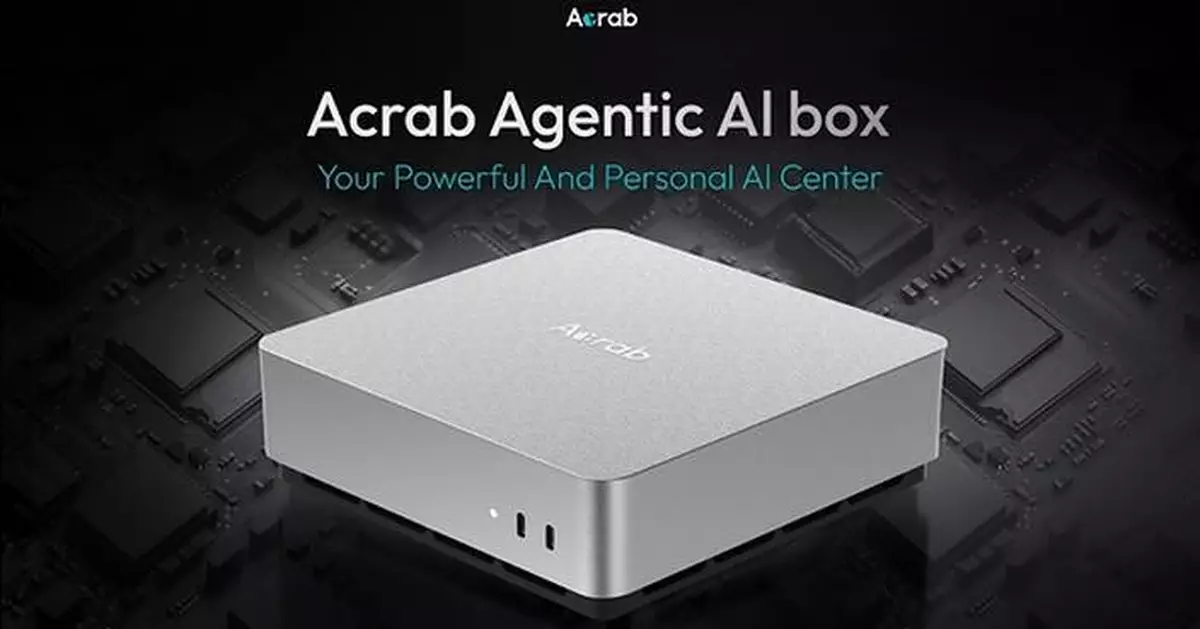
For years, models in the 100 billion parameter class have required cloud infrastructure. GΞLIX 1 is designed to bring state-of-the-art AI models at this scale into locally operated edge systems. Powered by GΞLIX, Acrab's Agent Box is a high-performance personal edge AI center designed to put AI agents into action in a more personal and customized way, with local large model inference, persistent memory, multimodal interactions and agent orchestration capabilities.
By replacing cloud AI's recurring token-fees per use, Agent Box is a one-time investment with long-term value, hence relieving users' token anxiety, and allowing AI to move from an occasional tool into an always-available assistant woven into everyday work and life.
"Generative AI helped people find answers. Agentic AI will help them get things done," said Dr. Ken Phua, CEO of Acrab. "Running models in the 100 billion parameter class on a system small enough to sit on a desk presents a significant computing challenge. GΞLIX 1 is designed to deliver the performance, memory bandwidth and responsive local inference required, while Agent Box shows how that capability can become a complete user experience."
A private AI center built for everyday life
Agent Box is designed as a private, always-on AI center for personal workspaces and homes. It keeps intelligence close to the people, information and physical environments it serves, while showing how device makers can turn Acrab's computing platform into complete agentic AI experiences.
For decades, personal computing advanced in predictable steps: faster processors, larger screens, more storage. Agent Box represents something else entirely—the first system designed not to run programs, but to host intelligence.
Agent Box brings together local language and vision model inference, multimodal interaction, persistent memory and an orchestration layer that can understand goals, break tasks into steps and coordinate action across agents, systems and connected devices. Users' data and memories remain private and stored locally on the device, while the system grows more capable and customized as the context deepens and memories accumulate. Acrab designed the compute architecture from the ground up to achieve optimal local AI performance, usability, cost efficiency, and power efficiency within one device.
A purpose-designed SoC for large model inference at the edge
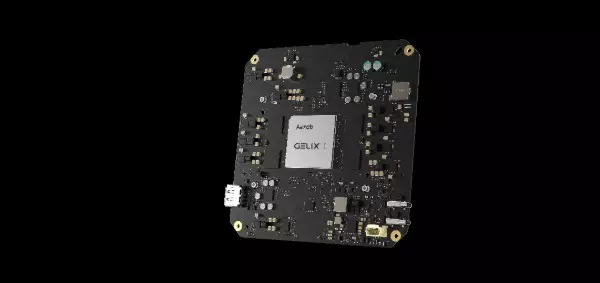
GΞLIX 1 is built on a 5-nanometer process and is Acrab's first SoC designed specifically for edge AI. Rather than relying on separate compute components, it integrates CPU, GPU and NPU resources with a unified memory architecture engineered for large AI models and agentic workloads.
The SoC features a 20-core Arm CPU, multicore NPU acceleration and 273 GB/s of unified memory bandwidth. It is designed to support local deployment of open-source models in up to the 100 billion parameter class, with coordinated execution across CPU, GPU and NPU resources. Supporting models at this scale locally places substantial demands on computing performance, memory bandwidth and power efficiency.
GΞLIX 1 is engineered for rapid responses at power levels suitable for systems that remain active throughout the day. A central design goal was reducing the delay before a model begins to respond, particularly with long prompts and large context windows.
In company testing, GΞLIX 1 achieved a prefill rate of 1416.8 tokens per second under a Gemma 26B A4B configuration with a 40K KV cache and a 10K token input, compared with 188.9 tokens per second on Mac Mini M4 Pro, representing up to 7.5X faster prefill performance. These capabilities turn a single chip into a versatile supercomputing platform for a wide range of applications.
A full-stack platform, from silicon to applications
Beyond the SoC, Acrab has built the software and system layers needed to turn local model inference into working agentic products. These include an optimized runtime and developer toolchain, agent operating system capabilities, reference designs and applications that help devices understand context, retain memory and coordinate real-world action.
Agent Box is the first expression of Acrab's broader ambition to provide a horizontal computing foundation for agentic AI across a wide range of edge devices and intelligent systems.
Processing a substantial share of AI workloads locally can reduce dependence on metered cloud inference, lower recurring processing and data transfer costs, and avoid the delay involved in sending every interaction to a remote service. Cloud resources can still be used when a task requires them, allowing developers to choose the right balance between local and cloud execution.
Building a broader edge AI device ecosystem
Acrab plans to work with device manufacturers and developers to bring its computing platform into products including AI NAS systems, AI PCs, smart vehicles, and industrial and service robots.
Agent Box demonstrates how Acrab's silicon and software can be integrated into a complete product experience. The company aims to provide a complete set of compute platform and agent-native infrastructure for the next generation of AI transformation across industries. By combining custom AI silicon, full-stack software, and reference designs of agents for use scenarios, Acrab enables industry partners and developers to bring intelligent AI products to market faster.
"Our goal is to give device makers and developers the foundation to bring agentic intelligence into many different products and environments," Dr. Phua said. "Agent Box demonstrates what the technology can do today, while GΞLIX 1 and our full-stack platform are designed to support a much broader ecosystem of devices and applications."
Product Launch Event Video Replay:
About Acrab
Acrab is a technology company building agentic AI compute infrastructure for the next generation of intelligent systems. Founded in 2024, the company develops high-performance AI compute architecture and integrated software platforms designed to bring AI agents into action, providing personalized assistance and real-time execution across a range of edge environments.
By combining purpose-designed silicon, advanced edge AI models, full-stack software and system orchestration, Acrab provides the computing foundation for AI agent systems across everyday life, bringing assistance, creativity, utility and value.
In June 2026, Acrab announced that it had received over US$350 million in cumulative financing from global venture capital firms and strategic industry investors, including early backers Vertex Ventures Southeast Asia & India, Vertex Growth, and K3.
For more information about Acrab, please visit https://www.acrab.ai/.
** This press release is distributed by PR Newswire through automated distribution system, for which the client assumes full responsibility. **
Acrab Unveils GΞLIX 1 SoC and Agent Box, Bringing State-of-the-Art AI to the Edge

Acrab Unveils GΞLIX 1 SoC and Agent Box, Bringing State-of-the-Art AI to the Edge
SAN JOSE, Calif., Oct. 15, 2026 /PRNewswire/ -- Reallusion's 2026 3D Character Contest was held from June 1st to October 1st, 2026. Within 3 months, 200 submissions were submitted from 49 countries. The contest showcases the best 3D character design and animation created using Reallusion's powerful character production ecosystems: Character Creator for 3D character creation, iClone for facial and body animation, and AccuRIG for rigging.
"We at Reallusion are thrilled to watch so many world-class character artists integrate Character Creator and iClone into their professional workflows. This contest clearly demonstrated that Character Creator gives artists complete creative freedom to build original 3D characters in any style or genre. Huge congratulations to every participant. We are excited to keep pushing the boundaries of 3D innovation for the community!"
– Enoc Burgos, Reallusion Director of Partnership Marketing
Prizes Sponsored by Renowned Industry Leaders
The Contest was hosted by Reallusion and sponsored by industry leaders such as NVIDIA, Maxon, Epic Games, Unity, SideFX, Marvelous Designer, MSI, WD, and CenterGrid. Through this contest, Character Creator's extensive pipeline lets artists seamlessly integrate a new workflow for rapid creativity with zero sacrifice in character quality.
Meet Our Winners And Their Testimonials
The contest challenged artists to create stunning, original 3D characters that not only showcased their artistic abilities, but also demonstrated mastery of animation tools like Character Creator and iClone. After weeks of careful evaluation by our esteemed panel of judges, the following winners stood out for their exceptional work.
Watch winner video: https://youtu.be/zhGfrHHtT7Y
Realistic Character Design
Under this category, entrants create a realistic human character in Character Creator by combining the character base with tools like ZBrush, Substance Painter, Marvelous Designer, Blender, Wrap, Texturing.xyz, and Maya. Watch their winning entry and testimonials below.
1st Place: Jax: Soul of the Street – by Jimmy Watelle, Manager | Costa Rica
"Character Creator and the Blender Data Link helped me a lot in building the base of the Jax character, but I also faced numerous challenges related to my skill level and navigating between software, sometimes losing data or synchronization along the way. This project brought me as much enjoyment, and it helped me grow tremendously." – Jimmy Watelle
View Jimmy's entry and WIP
2nd Place: Shannaz – by Leudemar "Leo" Lima, Concept Artist | Brazil
"Character Creator helped me bring my design to 3D with a lot of fidelity and realism; easy to use and intuitive, CC5 is a really powerful tool for concept artists." – Leudemar "Leo" Lima
View Leo's entry and WIP
3rd Place: An Unearthly Find – by Jeet Shah, Technical Artist | India
"The speed of CC5 in making changes to primary forms for any character is impeccable and probably the best among any 3D software I've ever used. Need a skinny short girl- tweak a few sliders you get a skinny short girl. Need a fat stubby creature- tweak some more sliders and take it to ZBrush and you have a humanoid creature in under an hour all the while maintaining the subdivided geometry details in CC5 thanks to GoZ Plus. And all of them with a full-body skeleton that's ready to add some controls for posing. The new HD morphs in CC5 are certainly an upgrade to the previous version, where the lack of base mesh resolution made the morphs a bit less detailed; the new ones still come out quite detailed. One other feature I've heavily used is the new addition to Auto Setup for Maya. That allowed for a seamless experience in making the facial expressions on the characters directly in Maya, where I rendered them."– Jeet Shah
View Jeet's entry and WIP
Stylized Character Design
Under this category, entrants create a stylized character in Character Creator by combining the character base with tools like ZBrush, Substance Painter, Marvelous Designer, Blender, Wrap, Texturing.xyz, and Maya. Watch their winning entry and testimonials below.
1st Place: Kohaku - Warden of Memories – by Oscar Fernandez Gonzalez, 3D Character Artist | Spain
"As a sculptor, Character Creator lets me start from a clean, optimized base mesh that I can freely customize in ZBrush. Moving back and forth between ZBrush and CC5 allows me to use each application for what it does best, making the entire workflow faster and more efficient. My favorite feature is being able to test poses on the character with incredible precision. It's fast, intuitive, and a genuinely enjoyable part of the creative process." – Oscar Fernandez Gonzalez
View Oscar's entry and WIP
2nd Place: Erlen From Lemuria's Savage Lands – by Felix Enrique Yaguare Lopez, Student and Freelancer | Venezuela
"Character Creator allowed me to bring my character to life effortlessly. Being able to quickly test and iterate different poses gave me the freedom to explore Erlen in multiple situations, something that would have been impossible in my timeframe, as I joined the contest a month and a half late while finishing my class projects for Libel Academy." – Felix Enrique Yaguare Lopez
View Felix's entry and WIP
3rd Place: Alyssa – by Thivolan Moodley, 3D Sculptor & Freelancer | South Africa
"I was able to use the base mesh to really push the design from start to finish without needing to retopologize or change much else! This helped me focus on sculpting and likeness more!" – Thivolan Moodley
View Thivolan's entry and WIP
Realistic Character Animation
Use iClone to create a realistic animation for a character made with the CC3+ Base. The character model can be customized with Reallusion tools and content or third-party software like ZBrush, Blender, Unreal Engine. Watch their winning entry and testimonials below.
1st Place: Franco Colapino – by Off World, FCGI Cinematics Freelancer | Argentina
"Without Reallusion's tools, achieving this level of quality and ease of iteration in pursuing our goal would not have been possible; the power and creative freedom it provides are immense." – Off World
View Off World's entry and WIP
2nd Place: The Hunt – by Joseph Hoback, 3D | United States
"There's no way I could have gotten as far as I did without the use of an iClone. The mocap informed not only the timing and energy but also the character as a whole." – Joseph Hoback
View Joseph's entry and WIP
3rd Place: Special ops: Lioness – by Hector Mercado, CGI artist & Filmmaker | Dominican Republic
"The new Headshot 3 features, together with the AI-assisted reference image generation and cleanup, really help in getting the character likeness when trying to create a digital double!" – Hector Mercado
View Hector's entry and WIP
Stylized Character Animation
Under this category, contestants use iClone to create a stylized animation for a character made with the CC3+ Base. The character model can be customized with Reallusion tools and content or third-party software like ZBrush, Blender, Unreal Engine. Watch their winning entry and testimonials below.
1st Place: STONE GODZ – by Dazhi Benjamin Sokomba, Animator | Nigeria
"I used iClone for the final real-time render, Character Creator 5 for the main character and AccuRIG for the stone characters." – Dazhi Benjamin Sokomba
View Benjamin's entry and WIP
2nd Place: Moss Fairy – by Affan Shiekh, CGI artist | Pakistan
"Character Creator 5 is amazing. It gets better every year, and I would like more implementations for the Blender addon!" – Affan Shiekh
View Affan's entry and WIP
3rd Place: Max Mad Animation – by Soorena Sardarzadeh, CGI artist & Filmmaker | United States
"With iClone, making animation isn't harder than it needs to be." – Soorena Sardarzadeh
View Soorena's entry and WIP
Best AccuRIG Characters
Powered by AccuRIG, artists can transform static models into fully animatable characters, regardless of topology. The winning characters showcase high sculpting details with attractive poses and professional renders. Reallusion selected four winners from this category, and here are the winners, entries, and respective WIPs.
- Oscar Fernandez Gonzalez (Spain)
- Laura Antonacci (Italy)
- Carolyna Figueiredo (Portugal)
- Stasia Bubnova (Russian Federation)
Special Awards
Special Awards recognize outstanding achievement across specific technical and artistic categories. Beyond their distinctive visual aesthetics, these winning entries demonstrate a deep mastery of 3D pipelines and creative problem-solving techniques. Their entries present compelling character designs, solid anatomy, and exceptional composition. View all winning entries and WIPs.
Best Render
- Vanesa Arambašić (Croatia)
- Jacopo Filo della Torre (Italy)
- Bahar Tavakoli (Iran)
Best Pipeline Use
- David Sujono (Australia)
- Olivier Beguin (Switzerland)
- Ignacio Coronel (Argentina)
- Joachim Jensen (Denmark)
- Jorge Leonardo Ayala Arias (Colombia)
Best Mocap Use
- Sangkoo Lee (Republic of Korea)
Best Digital Double
- Mobin Hivehchi (Iran)
- Frederick Talavera Martinez (Spain)
Best Student Artwork
- Carlos Humberto Rivas Garcia (Venezuela)
Best Costume
- Eva Sophie Cringle (Belgium)
- Myron Mortakis (United States)
- Massimo De Antonis (Italy)
- Saillish (Australia)
- Weedi Masindraoka (Madagascar)
- Sadegh Khavand (Iran)
- Rafael S. Benedicto (Philippines)
- Angel Ricalde (Peru)
Honorable Mentions
Honorable Mentions celebrate standout entries that captivated the judging panel through exceptional dedication, skill, and creative vision. While not taking home a top placement, these artists delivered remarkable craft and passion throughout the competition. View all Honorable Mention entries and WIPs.
- Ariya Hasani (Iran)
- Markus Haertel (Brazil)
- Kurt Boutilier (Canada)
- Onur Erdurak (Turkey)
The judging process for the "2026 Reallusion 3D Character Contest" proved to be quite difficult and took many hours of deliberation. In addition to the top 3 placements in Best Character Animation & Best Character Design, Reallusion also selected 28 winners for AccuRIG characters, Special Awards, and Honorable Mentions. See the Winner Page for winner details and showcases, and we look forward to your entry submission next year!
** This press release is distributed by PR Newswire through automated distribution system, for which the client assumes full responsibility. **
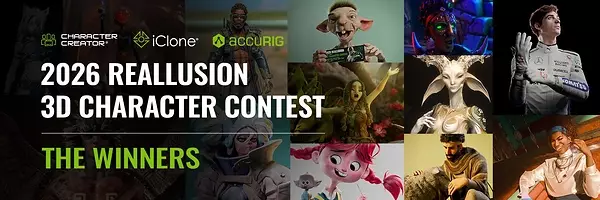
Reallusion's 2026 3D Character Contest - Meet the Winners!