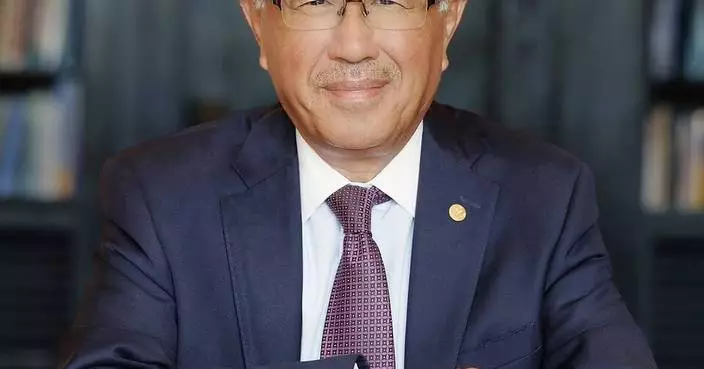
BURLINGTON, Mass.--(BUSINESS WIRE)--Jul 23, 2026--
This press release features multimedia. View the full release here: https://www.businesswire.com/news/home/20260723939326/en/
Through Cove Data Protection, N-able helps organizations minimize downtime, protect critical systems and data, and recover with confidence following cyberattacks, outages, and other disruptions. Continued innovation across backup, recovery testing, security, and Disaster Recovery as a Service (DRaaS) is helping IT teams and MSPs build stronger, more scalable services in an increasingly complex threat landscape.
Omdia estimates the managed services segment, including BaaS (Backup as a Service) and DRaaS, will reach around $38 billion in 2026 and grow at more than 16%. To help businesses capture this opportunity, N-able provides a co-managed DRaaS offering designed to support rapid recovery from cyber incidents and site failures without the cost, complexity, or risk of building and managing disaster recovery environments in-house. By enabling production workloads to be mirrored in a secure, cloud-hosted environment from N-able, DRaaS helps support faster failover, simplify recovery, and keep customers operating when disruption strikes.
“Data protection is a core part of cyber resilience, and Cove's continued recognition as a Champion for three years running reflects the differentiators that set it apart — ease of use, operational efficiency, and the ability to scale with our customers' businesses,” said Chris Groot, General Manager of Cove. “With DRaaS now integrated into Cove, we’re helping businesses reduce recovery complexity and deliver the always-on business resilience their customers increasingly expect.”
The latest Omdia recognition follows N-able’s third consecutive Champion placement in the Omdia RMM and PSA Leadership Matrix earlier this year, further reinforcing the company’s focus on helping businesses strengthen security, improve operational efficiency, and deliver resilient services through a unified security platform.
Learn more about Cove Data Protection on the N-able blog.
About N‑able
N‑able protects businesses from evolving cyberthreats. Our AI powered cybersecurity platform delivers business resilience to more than 500,000 organizations worldwide, leveraging advanced end-to-end capabilities, simplified workflows, market leading integrations, and flexible deployment options to improve efficiency and drive critical security outcomes. Our partner-first approach pairs our technology with experts, training, and peer-led events that empower customers to be secure, resilient, and successful. n-able.com
© 2026 N‑able Solutions ULC and N‑able Technologies Ltd. All rights reserved.
The N‑able trademarks, service marks, and logos are the exclusive property of N‑able Solutions ULC and N‑able Technologies Ltd. All other trademarks are the property of their respective owners.
Category: Product

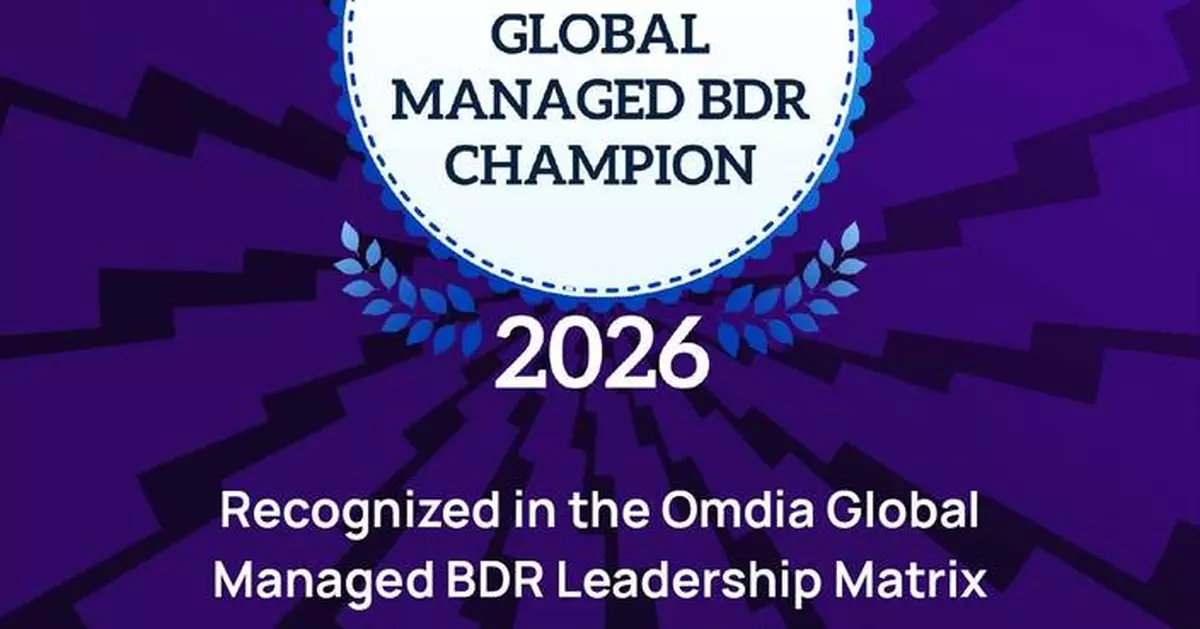
N-able Named Omdia Managed BDR Champion for Third Consecutive Year as Cyber Recovery Becomes Business Critical
KYIV, Ukraine (AP) — In the span of a single week, the dismissal of a Ukrainian defense minister set in motion a transformation of the country’s armed forces that replaced the old guard with a new generation of leadership.
Ukrainian President Volodymyr Zelenskyy’s decision to fire his popular defense minister, Mykhailo Fedorov, triggered days of public protest that quickly shifted toward the country's commander-in-chief and highlighted the growing rift over the future of Ukraine’s military.
Demonstrators denounced the commander, Oleksandr Syrskyi, and overwhelmingly rallied behind the departed defense minister, who has emerged as one of the country’s most influential wartime reformers with support from Ukrainians hungry for change. Protesters demanded his reinstatement. Fedorov's dismissal followed months of increasingly bitter disagreements between the two men.
For Zelenskyy, it was the second time in a year that a wartime decision triggered a public backlash, after he moved in mid-2025 to curb the powers of anti-corruption agencies. As he did then, the president appeared to move quickly to contain the political fallout. He dismissed Syrskyi and replaced him with Mykhailo Drapatyi, a disciplined battlefield commander whose reputation was forged in the years following Russia’s first invasion in 2014.
Drapatyi's appointment marked a sharp generational and philosophical break from Syrskyi, who was shaped by Soviet military tradition. But public support continues to coalesce around Fedorov. The protests have further elevated his political standing.
Much of the public’s anger was directed at Syrskyi, who became a symbol of deeper frustrations that had accumulated within the military since Russia's full-scale invasion in 2022.
Drapatyi’s appointment has helped ease some of those concerns. Widely respected by troops and fellow officers, he represents a younger generation of commanders whose credibility was earned on the battlefield rather than inherited through the Soviet military system.
“He enjoys a high level of trust within the military. I think this appointment could boost what is often called morale, that is, strengthen the fighting spirit,” said Oleksandr Musiienko, a military analyst in Kyiv.
The divide between Fedorov and Syrskyi was described by one Western defense official as between “different planets.” The official spoke on the condition of anonymity because they were not authorized to brief journalists.
Fedorov championed a data-driven, technology-led approach to warfare that clashed with Syrskyi’s more traditional ground-forces doctrine. Drapatyi could be a bridge between the two camps, analysts said. Low-profile but highly respected, he has earned the confidence of front-line commanders while embracing many of the reforms championed in Kyiv.
“He has shown an ability to adapt to the realities of modern warfare, to changing battlefield conditions and to shifting and reallocating resources,” Musiienko said.
For many Ukrainians, Syrskyi came to embody the rigid command structures and Soviet-era thinking that Fedorov’s ambitious reforms sought to overhaul. When Fedorov publicly identified Syrskyi as the chief obstacle to those reforms, it brought to light those broader public grievances.
They include the military’s entrenched bureaucracy and Syrskyi’s command style, criticized as overly centralized and prone to micromanagement, alongside constant mobilization challenges.
Syrskyi also came under intense criticism for his association with the 425th Separate Assault Regiment, known as Skelia, which for many Ukrainians became emblematic of the tactics that expended soldiers’ lives for marginal territorial gains.
In addition, the regiment was the focus of a major public scandal after an investigation by the Ukrainian publication Babel reported allegations of systemic abuse, torture in training camps and dozens of noncombat deaths. The allegations triggered an investigation, resulted in the suspension of the regiment's commander and intensified scrutiny of the military’s command culture.
To some lawmakers and analysts, the episode demonstrated that democracy and accountability are alive in Ukraine despite martial law and the suspension of elections. Zelenskyy, they argued, showed he is still responsive to public demand.
Other lawmakers, however, cautioned that the episode could set a troubling precedent by allowing public sentiment, rather than institutional decision-making, to shape appointments to the military’s highest ranks.
Tetiana Shevchuk, a board member of Ukraine’s Anti-Corruption Action Center, said protest is one of the few ways the public can make their voice heard in the absence of elections.
“Frustrations built up to the point where people felt the only way to be heard was to take to the streets. That’s not a healthy precedent, but it should also be a signal to the government to address problems before they reach that stage,” Shevchuk said.
Ukrainian social media quickly filled with memes mocking the president’s apparent search for a new army chief, jokes that underscored the political cost of the episode for Zelenskyy.
Some memes depicted Zelenskyy interviewing absurd candidates, including Jon Snow from the “Game of Thrones” television series, as well as an alien and a dolphin.
Zelenskyy recently weathered a politically damaging corruption investigation involving several of his closest associates, including his former chief of staff, Andriy Yermak, who was dismissed amid mounting public pressure.
The protests were not simply an expression of support for Fedorov, Shevchuk said. They reflected public backing for the reforms he aspired to create.
“Fedorov was pushing the idea that Ukraine had to preserve every soldier’s life and become more efficient than Russia,” Shevchuk said. “Over the past six months, people finally felt Ukraine was gaining an advantage. For the first time in a long time, there was hope that this war was winnable — that we weren't just taking loans while slowly losing territory.”
Then Zelenskyy dismissed him.
Despite Drapatyi’s appointment, the political drama is far from over. Fedorov appears unwilling to accept another government post unless he is reinstated as defense minister, the same demand many protesters continue to make.
Where he goes next, and whether he returns to government at all, could shape the next phase of the saga.
The episode has also elevated the political profile of Fedorov, who was once known primarily as the architect of Ukraine’s digital transformation and subordinate to Zelenskyy. Now he has a broad base of public support.
That inevitably raises questions about his long-term political future.
In just six months as defense minister, Fedorov pursued an ambitious agenda aimed at accelerating Ukraine’s military modernization.
He redirected funds originally earmarked for personnel costs toward long-range strike capabilities, fiber-optic drones, reconnaissance systems and other advanced technologies. He also highlighted expanded drone acquisition, new contracts related to Patriot air-defense systems, successful ballistic missile tests and a sweeping overhaul of military procurement.
Fedorov also proposed overhauling military service contracts to make front-line service more sustainable, including higher pay, expanded leave and greater flexibility for infantry soldiers. The changes resonated with troops.
This story has been updated to correct the spelling of Skelia, a name for the 425th Separate Assault Regiment, and to correct the spelling of the last name of the dismissed commander-in-chief in one instance to Syrskyi.
Associated Press journalist Volodymyr Yurchuk contributed.
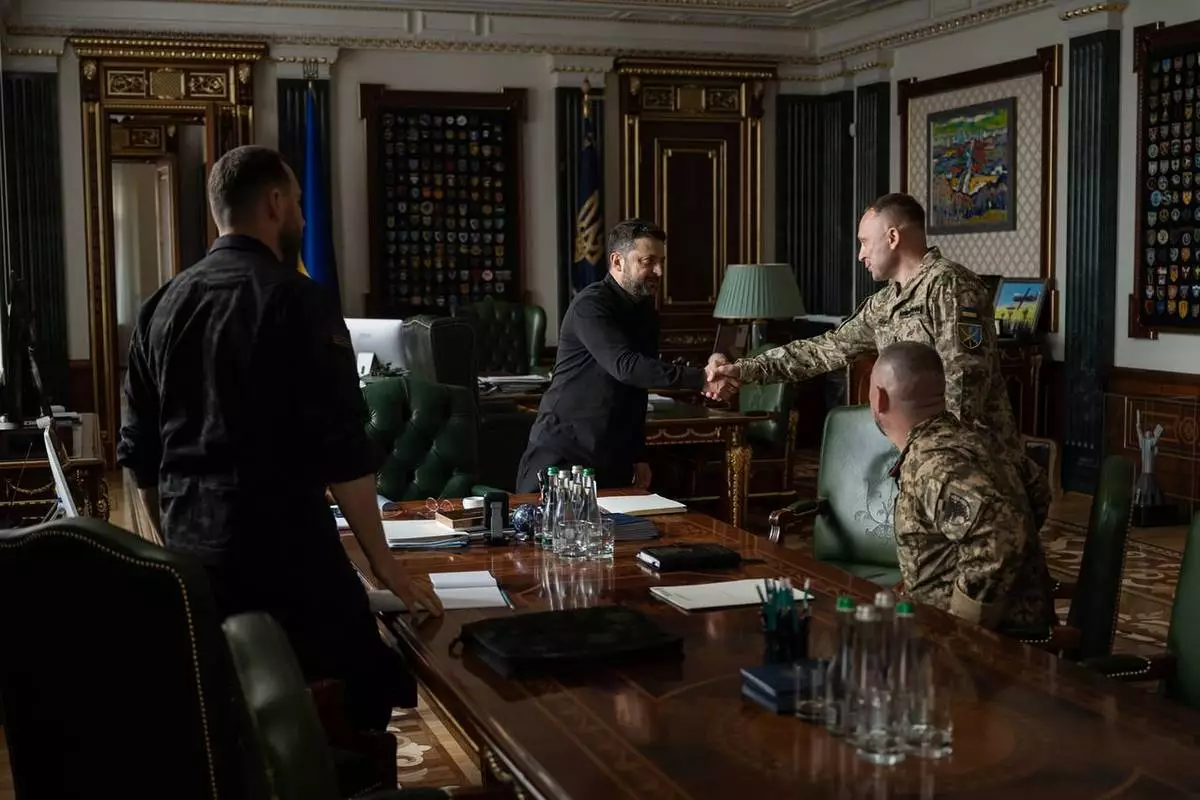
In this photo provided by the Ukrainian Presidential Press Office, Ukrainian President Volodymyr Zelenskyy, center, shakes hands with new commander-in-chief of Ukraine's Armed Forces Mykhailo Drapatyi during their meeting in Kyiv, Ukraine, Monday, July 20, 2026. (Ukrainian Presidential Press Office via AP)
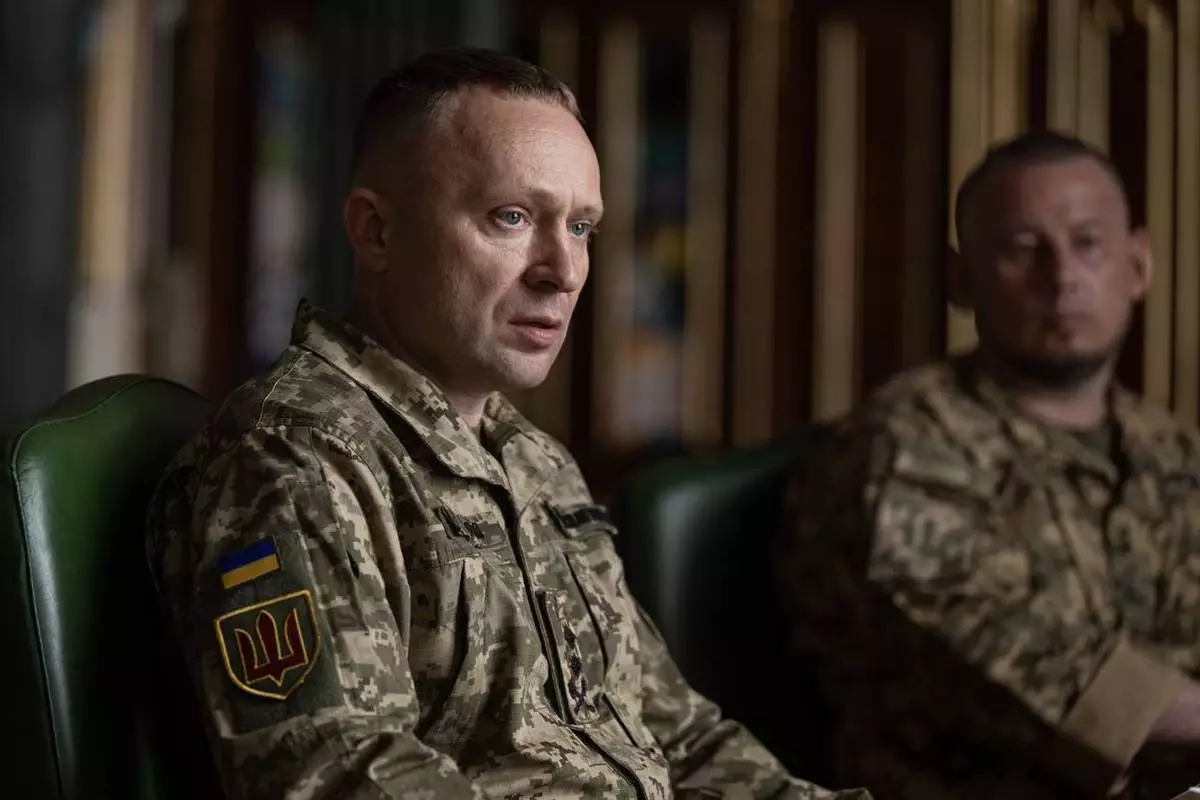
In this photo provided by the Ukrainian Presidential Press Office, new commander-in-chief of Ukraine's Armed Forces Mykhailo Drapatyi looks on during his meeting with Ukrainian President Volodymyr Zelenskyy in Kyiv, Ukraine, Monday, July 20, 2026. (Ukrainian Presidential Press Office via AP)
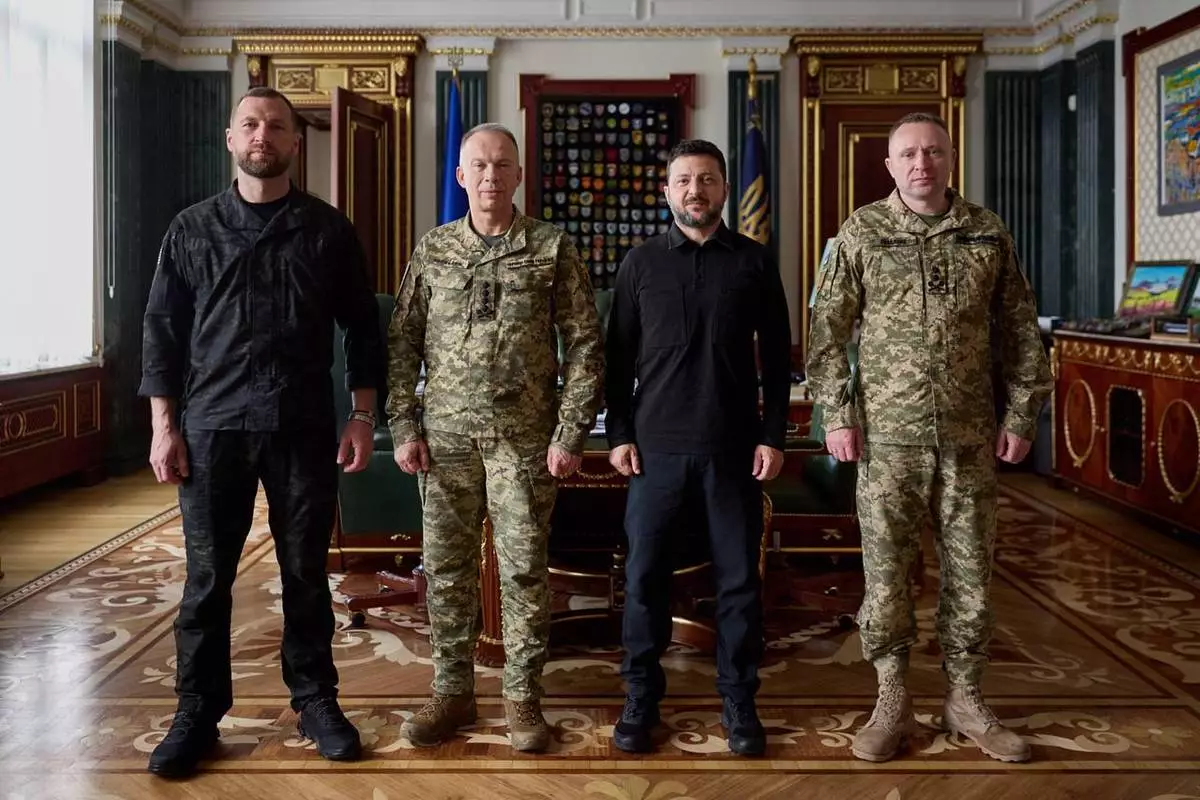
In this photo provided by the Ukrainian Presidential Press Office, from left, acting Minister of Defense Major General Yevhen Khmara, former Commander-in-Chief of the Ukrainian Armed Forces Oleksandr Syrskyi, Ukrainian President Volodymyr Zelenskyy and new commander-in-chief of Ukraine's Armed Forces Mykhailo Drapatyi, pose for a photo during their meeting in Kyiv, Ukraine, Wednesday, July 22, 2026. (Ukrainian Presidential Press Office via AP)