Skip to Content Facebook Feature Image

Newly-launched Chinese rocket sends AI-empowered satellites into space

China

China

China

Newly-launched Chinese rocket sends AI-empowered satellites into space

2026-07-24 20:54 Last Updated At:07-27 11:45

China on Friday launched a Lijian-1 Y15 carrier rocket, sending five satellites into space, with two of them equipped with advanced AI large models in a pioneering effort to expand AI application to space.

The Jitian Star A-04 is equipped with embodied intelligent models developed by Zhejiang Lab, a research institution based in Hangzhou, east China's Zhejiang Province.

The model enables the satellite to manage itself as it can autonomously complete multiple in-orbit tasks such as monitoring the satellite's status, as well as planning and executing onboard missions for a single satellite or a satellite cluster.

The Xiguang-2 03 Satellite carries three AI meteorological models, which can improve efficiency and precision of forecast for sudden weather events like short-duration torrential rains and strong winds.

It typically takes conventional meteorological satellites 90 minutes to transmit weather data to ground stations after recording it. The ground team also need time to parse and correct data before releasing the forecasts, resulting in slow data refresh rates. The workflow is efficient enough for conventional weather services but falls short of the demand to issue timely forecast for abrupt weather events.

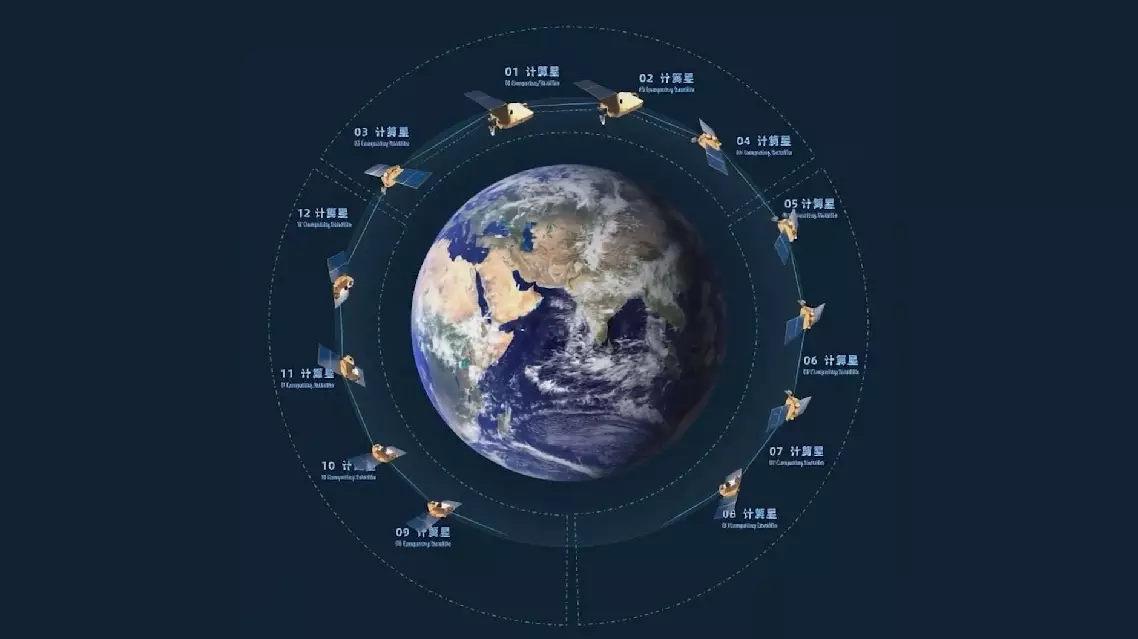
The two satellites are part of the "Three-Body Computing Constellation" project, which is initiated by the Zhejiang Lab and aims to send AI into space to achieve in-orbit data processing.

On May 14, 2025, the first batch of 12 computing satellites of the "Three-Body Computing Constellation" successfully entered orbit.

According to the plan, the constellation will reach a scale of 100 satellites by 2027.

Experts said that by strengthening coordination among satellites and equipping them with AI models, data collected across the globe can be processed more efficiently.

"Currently, there is no joint global efforts to process data in space and the real-time data transmission cannot be ensured. These can only be addressed by strengthened coordination among satellites. With the assistance of AI models, the satellites can achieve real-time process of data collected across the globe, thus pushing AI application from the ground into space," said Li Chao, chief technology engineer of the "Three-Body Computing Constellation" project.
Newly-launched Chinese rocket sends AI-empowered satellites into space
Newly-launched Chinese rocket sends AI-empowered satellites into space
China’s electronics industry surged in the first half of the year, posting a 96.9 percent profit jump on strong computing power demand, with the sector’s gains lifting overall profit growth of industrial enterprises above designated size by 8.5 percentage points, the National Bureau of Statistics (NBS) said Monday.

The growth in profits of the electronics sector has been a significant driving force of the rapid increase in profits of industrial enterprises with an annual main business revenue of at least 20 million yuan (about 2.95 million U.S. dollars), the NBS said.

Profits in computer system manufacturing soared 689.3 percent, while computer peripheral equipment manufacturing jumped 305.8 percent, fueled by demand for servers and high‑performance workstations.

In the electronic device manufacturing field, integrated circuit manufacturing rose 2,579.5 percent and discrete semiconductor devices 31.2 percent. In the electronic component and special materials field, profits of electronic special materials manufacturing expanded 209.7 percent and electronic circuit manufacturing 26.9 percent.

The breadth of gains across upstream and downstream sectors has provided important support to industrial profits.

"These industries share a common feature, which is relatively long industrial chains. The stable development of these industries has also led to the recovery of profits along the upstream and downstream of the chains. Therefore, it has played an important supporting role in the growth of industrial profits," said Wei Qijia, researcher of the State Information Center under the National Development and Reform Commission (NDRC).

Meanwhile, new growth drivers boosted profits across related industries. Recycled rubber manufacturing and aluminum smelting both rose more than 100 percent, while optical fiber manufacturing surged 410.4 percent. Profits in raw material manufacturing also climbed, as unit costs continued to fall and overall profitability improved.

"New technologies will be leveraged to further reduce the operating costs of enterprises. At the same time, implement and refine various policies aimed at alleviating the burdens of real economy enterprises. By continuously optimizing the business environment, we will steadily expand the room for enterprises' profit growth, and create more favorable conditions for the steady recovery of the industrial profits," said Wei.

China's electronics sector profits up 96.9 pct in H1

China's electronics sector profits up 96.9 pct in H1

Recommended Articles