WASHINGTON (AP) — Dangerously hot weather will expand across much of the central United States this weekend and into next week, pushing temperatures above 100 degrees Fahrenheit (37.8 degrees Celsius) from Dallas to North Dakota with roughly 70 million people facing heat advisories.
A heat dome, where atmospheric conditions trap heat, will create sustained high temperatures and accumulating discomfort. Overnight low temperatures aren’t expected to come down enough for people to have much chance to recover, allowing heat stress to build as the bad weather lingers, forecasters said. The high humidity will make it feel even worse.
A huge stretch of the country will endure the oppressive midsummer weather. It will stretch from the desert Southwest to the Gulf Coast, reaching up into the Midwest and Great Plains. Some records around the Denver area may be broken, forecasters said. Temperatures are expected to be 10 F to 15 F (5.6 to 8.3 C) above what’s normal.
“It looks like it is going to be pretty much stationary in that position as we go through the week,” said Bob Oravec, meteorologist with the National Weather Service.
Places under a National Weather Service extreme heat warning included western Nebraska, where temperatures Saturday and Sunday were forecast to reach 108 F (42 C).
At the Museum of the Fur Trade near Chadron, Nebraska, there were fewer visitors than usual for this time of year. Meanwhile, fur hats and pelts in the gift shop weren’t selling so hot.
“I’m sure no one would be willing to wear it on a day like this,” said museum employee Hannah Lovelace. Loose-fitting, period-correct fabric shirts, on the other hand, remained popular sellers among folks headed to historical frontier re-enactments called rendezvous, she said.
The region's heat was forecast to continue through the week, with temperatures topping 100 F (37 C) even in normally moderate areas of Montana and Wyoming.
There might be some relief in the central United States toward next weekend, but even that might be temporary, said Oravec.
Some areas will be spared. The Mid-Atlantic and Northeast should avoid the extreme heat, as will much of the Pacific Northwest.
This is the latest miserable stretch of weather during a summer that has already had a lot of it. The eastern United States endured an unbearably hot early July that forced communities to cancel Independence Day celebrations and disrupted the country's 250th anniversary. Another heat wave in mid-July hit the Southwest and Great Plains. It’s not just the United States. A heat wave in June devastated Europe; France recorded at least 5,700 more deaths than usual during this period.
Fans at the Indianapolis Motor Speedway for the Brickyard 400 on Sunday will be offered water refill stations and places to get cool. Packed coolers are allowed. In Denver, recreation centers will set aside areas for people to get out of the heat and in front of air conditioning.
This heat dome will be dangerous. Children and the elderly, along with those with medical conditions, are especially at risk of serious conditions including heat stroke. The basics are important: people should seek out air conditioning or a cooling center and make sure they drink enough water and limit time under the direct sun.
The weather will shift somewhat through the week with the worst pockets of heat becoming particularly severe across Texas and parts of the Gulf Coast by Wednesday.
It can be difficult to know exactly how climate change contributes to particular events in real time. But rising carbon dioxide levels from burning fossil fuels makes it more likely that hotter weather becomes more frequent and extreme, according to Andy Pershing, chief program officer at Climate Central, a climate change communications nonprofit.
“We are experiencing exactly what the climate models in the 1990s said we should experience now. That is more frequent, more severe heat waves, bigger temperature anomalies, more humidity, higher overnight temperatures,” Pershing said. “These are all part and parcel of the climate story.”
The Associated Press receives support from the Walton Family Foundation for coverage of water and environmental policy. The AP is solely responsible for all content. For all of AP’s environmental coverage, visit https://apnews.com/hub/climate-and-environment
Mead Gruver in Fort Collins, Colorado, contributed.

Jake the Asian elephant takes a dip in a pool at the Denver Zoo Conservation Alliance as daytime high temperatures soared toward the triple-digit mark Friday, July 24, 2026, in Denver. (AP Photo/David Zalubowski)
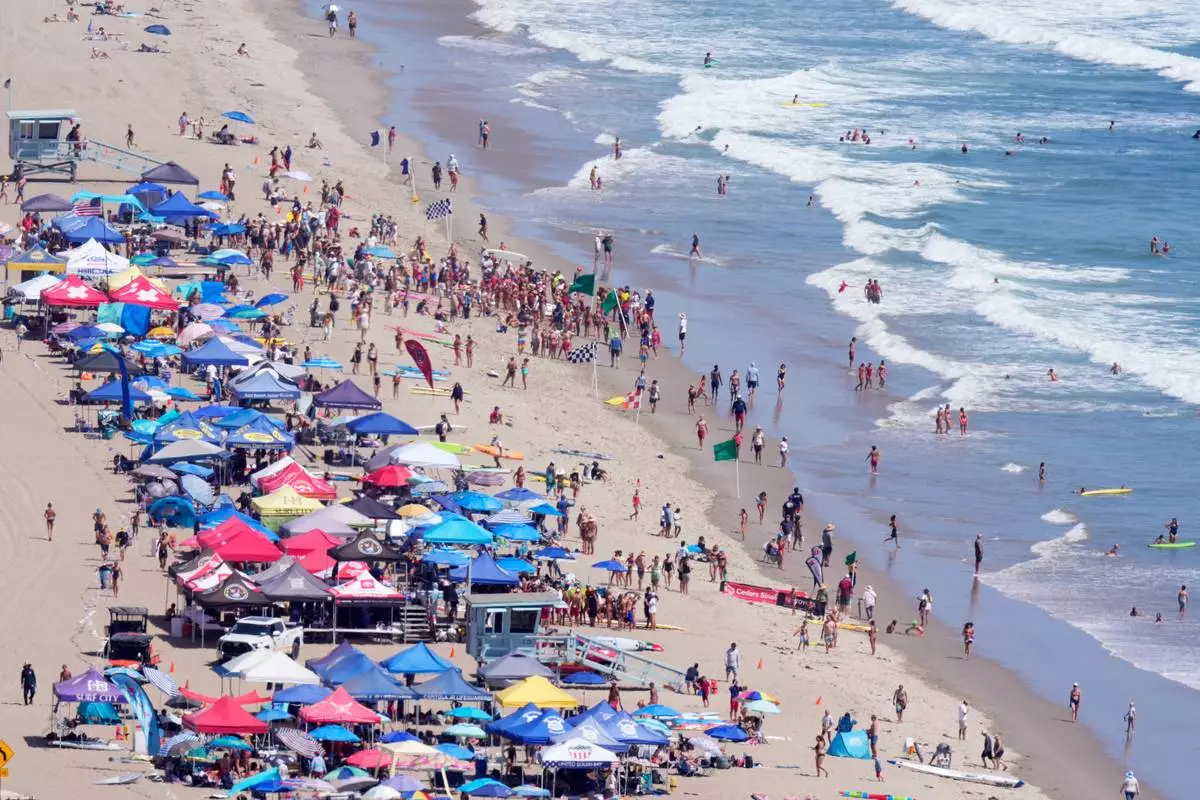
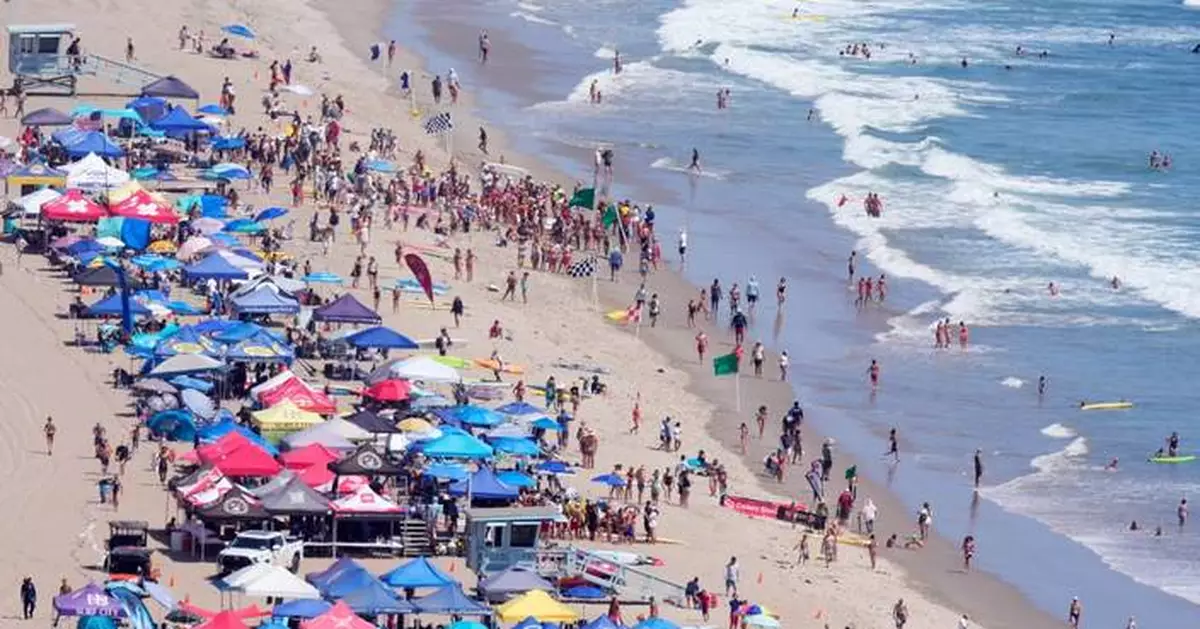
Beach goers watch during the the 46th Annual California Surf Lifesaving Championships on Will Rogers State Beach Friday, July 24, 2026, in the Pacific Palisades section of Los Angeles. (AP Photo/Mark J. Terrill)
LEGE-CAP FERRET, France (AP) — France sent a hulking military cargo plane to dump tons of flame retardants as it battled raging wildfires on Saturday and slashed the final stage of Tour de France to redeploy security personnel to the blazes that forced tens of thousands of people to flee their homes.
The latest wildfires in southern Europe this week have displaced more than 250,000 people, including some 70,000 people who were evacuated in central Spain. One man died in Manises, the municipality reported on its Facebook page, the first death so far in the blazes.
In France, the giant A400M transporter swooped in low, its long plume of ochre-colored retardant trailing over drought-hit woodlands in the southwest as fire crews on the ground fought flames that authorities feared could spread toward the wine region city of Bordeaux.
Race organizers and the Paris police department announced a truncated 21st and final stage on Sunday for the three-week Tour, France's most famous annual sporting event, reflecting the immense strain that two large fires in the southwest are causing for emergency services.
Tour riders will race Sunday inside Paris, rather than starting from Thoiry, west of the capital, on a circuit of 89 kilometers (55 miles) — down by a third from the 133-kilometer (82.5-mile) route that had been planned. Part of the race's security detail will instead “reinforce the response efforts in the areas affected by the wildfires,” according to the statement announcing the ”exceptional measures made necessary by the situation."
With winds expected to shift in a west-to-east direction on Saturday afternoon, potentially driving flames closer to Bordeaux, fire crews and authorities were digging trenches, using retardants and taking other blaze-blocking steps, French Interior Minister Laurent Nunez said, predicting a “long and very difficult” battle.
He said the fire was about 30 kilometers (20 miles) west of the city and lost some of its intensity overnight. The prefect of the Gironde region that includes Bordeaux said the blaze grew into “a firestorm" on Friday after igniting earlier this week and cautioned that it “remains dangerous" even though firefighters were making progress.
The government mobilized soldiers to join fire crews and was rushing in 1.5 million face masks to protect against choking smoke.
Authorities ordered people between the fire and Bordeaux to evacuate, including from parts of the city’s western suburbs and other towns and villages.
Prime Minister Sébastien Lecornu described the fires as unprecedented and said the Gironde blaze became so strong on Friday that it had begun generating its own winds. Firefighting teams were being reinforced with the addition of hundreds of soldiers and breathing masks to filter out potentially noxious smoke particles were being rushed to those exposed, Lecornu said.
In Bordeaux, authorities took in thousands of evacuees, offering them food and shelter in an exhibition center, and the city’s mayor said it could be equipped to welcome as many as 10,000 people if that became necessary. The city's airport said it remained open but that its bus and tram services were suspended.
Evacuation orders were sent with special alerts to mobile phones, instructing people to leave, Gironde prefect Sophie Brocas said. She said the fire had destroyed about 140 homes in the region.
The French military A400M transport plane, specially converted for fire-fighting, was a heavyweight new tool in the battle. It joined at least 18 other water- and retardant-dropping aircraft and helicopters that Nunez said were deployed in the Gironde region, working in rotation in the smoke-filled skies.
The virulence of the French and Spanish wildfires, fueled by high temperatures and the long-term effects of climate change, caught fire crews and authorities off guard.
Firefighters in Spain said the blazes spread so fast and violently that they could not be tackled head on. In France, some people even fled by boat when flames swept through touristic towns on the Atlantic coast.
“We’ve never seen anything like this,” said Javier Organista, a resident of El Tiemblo, west of Madrid, where fire charred a famed chestnut grove. “When we saw the flames coming into our town, surrounding us, leaving us with practically no way out, all the neighbors joined together to try to stop its advance.”
“It’s just really sad,” he said.
Spain deployed 2,600 firefighters, police and other emergency personnel to two blazes west of Madrid, backed by 19 water-dumping aircraft and helicopters.
France deployed 1,400 firefighters to the Gironde fire and hundreds of others to another wildfire further south in the Landes region. Dozens of firefighters suffered injuries, authorities said amid panic scenes with townsfolk fleeing by car and police went door to door to tell people to leave.
Successive heat waves that hit unusually early and hard this year, baking Europe with record-shattering high temperatures, have turned forests and scrublands into tinderboxes.
Fires have burned 130,000 hectares of forest already this year in Spain, up from an annual average of 100,000 hectares over the past decade, Spanish Prime Minister Pedro Sánchez said Saturday as he visited a command post west of Madrid.
He said more favorable weather Saturday offered “a window of opportunity” for fire crews to bring the blazes under control. Madrid's regional government said the fires decreased in intensity as winds and temperatures dropped.
The fatality reported on Saturday occurred in Manises, part of the wildfire-affected region of Valencia.
Other European nations were helping, with Italy, Greece, the Netherlands, Portugal, Croatia, the Czech Republic, Sweden, Slovakia, Germany and Switzerland already providing or expected to deploy water-dumping planes and helicopters to the Spanish and French fire fronts.
Leicester reported from Paris. Associated Press journalists Barry Hatton in Lisbon, Portugal; Manu Fernandez in El Tiemblo, Spain; and Joseph Wilson in Barcelona contributed.
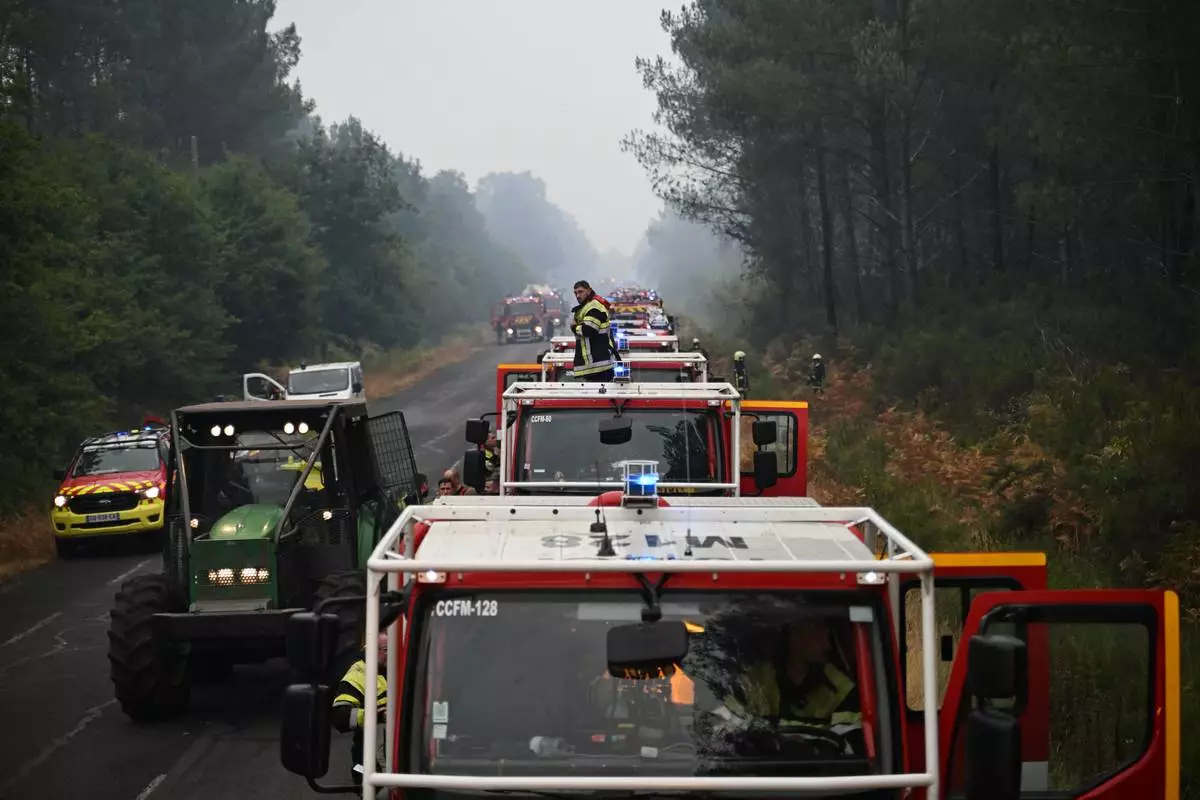
A firefighter stands on a truck on a road near Lacanau, southwestern France, Saturday, July 25, 2026, as wildfires rage in the area. (AP Photo/Emma Da Silva)
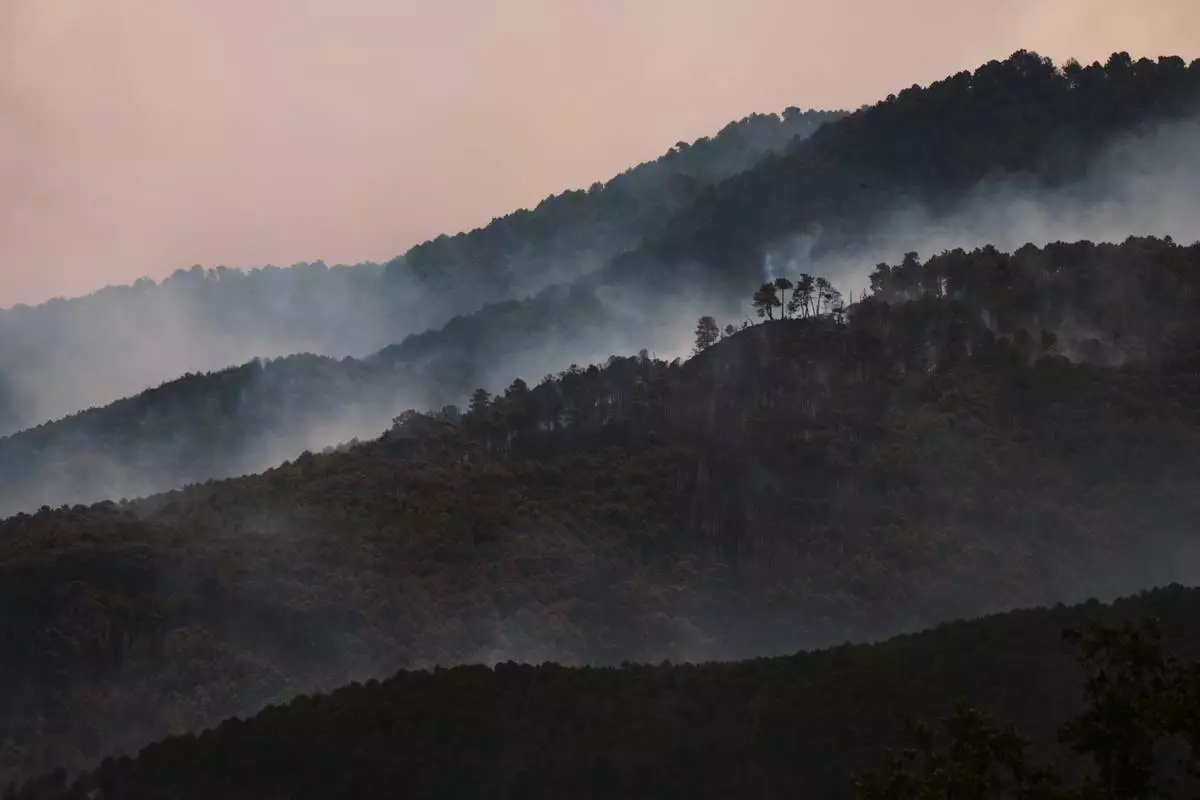
Smoke rises as a wildfire advances near El Tiemblo, Madrid province, Spain, Saturday, July 25, 2026. (AP Photo/Manu Fernandez)
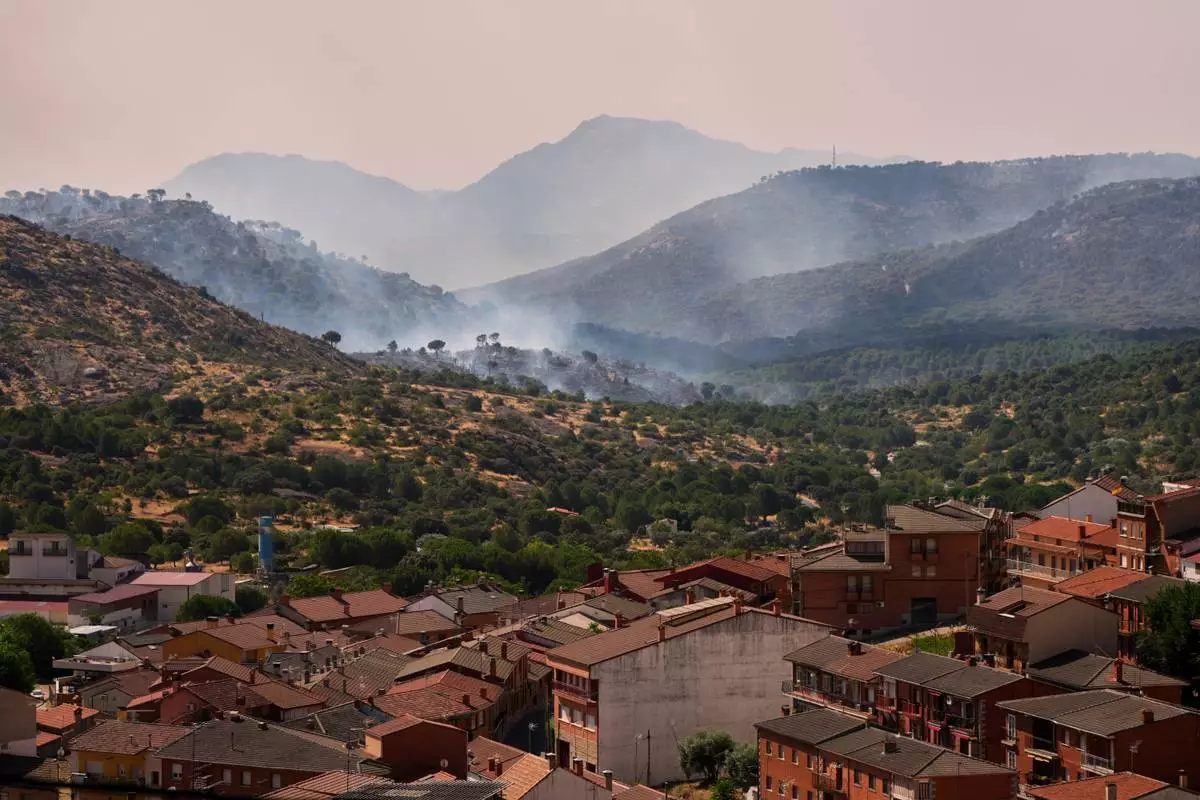
Smoke rises as a wildfire advances near Hoyo de Pinares, Madrid province, Spain, Saturday, July 25, 2026. (AP Photo/Manu Fernandez)
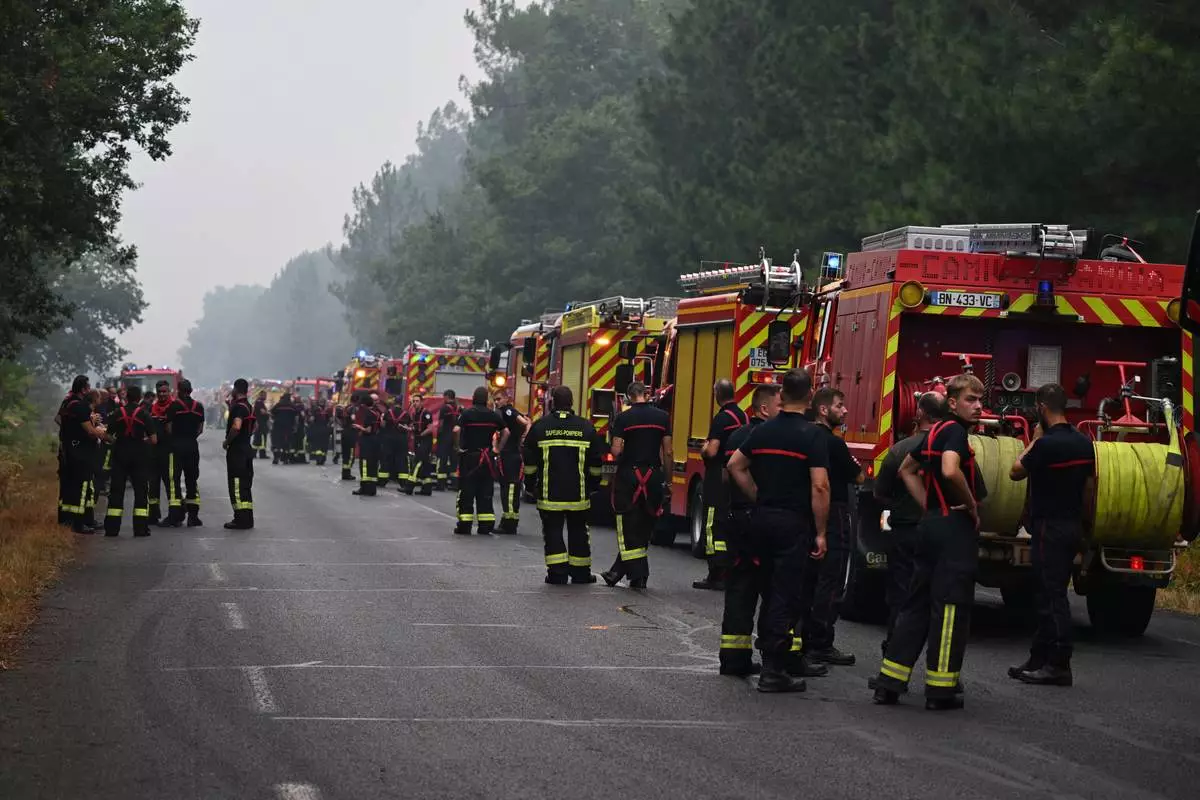
Firefighters wait on a road near Lacanau, southwestern France, Saturday, July 25, 2026. (AP Photo/Emma Da Silva)
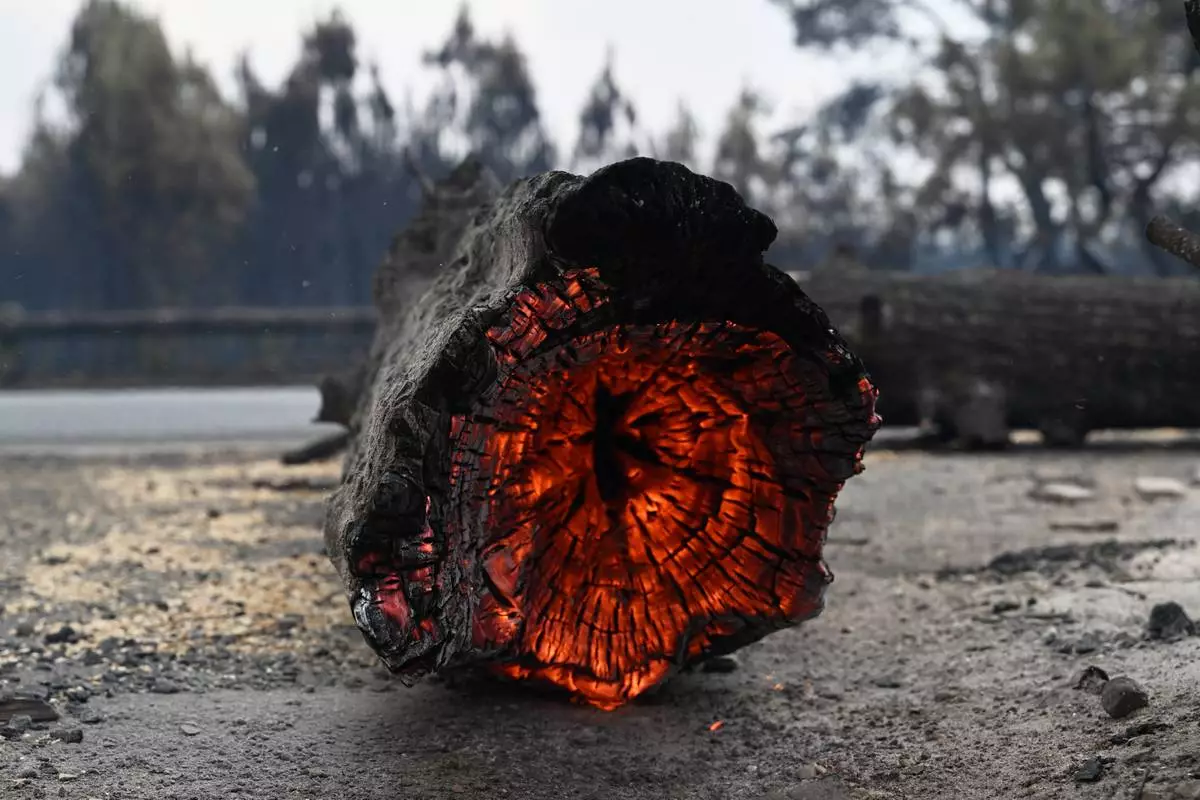
A tree trunk burns in Lanton, in the Lege-Cap-Ferret region, southwestern France, Saturday, July 25, 2026. (AP Photo/Emma Da Silva)
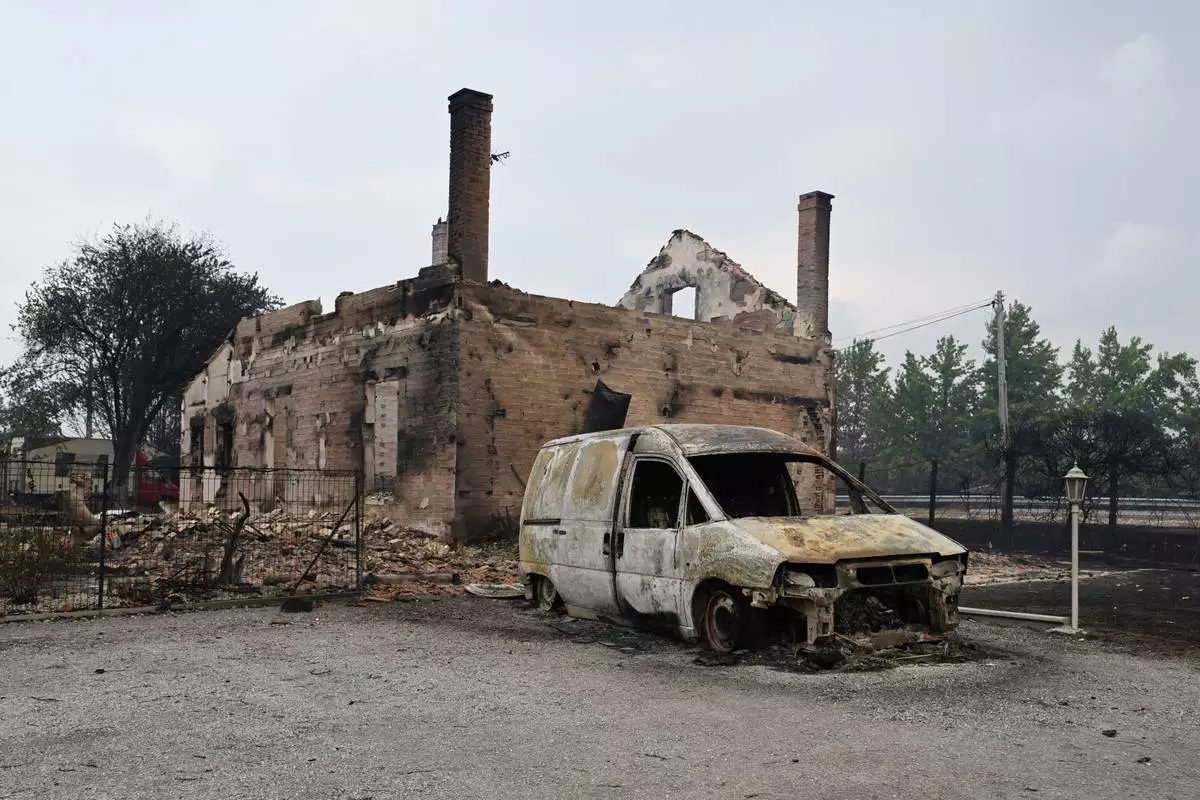
A view of a burned house and vehicle, in Lanton, in the Lege-Cap-Ferret region, southwestern France, Saturday, July 25, 2026. (AP Photo/Emma Da Silva)

A resident sits at a bullring serving as a temporary shelter after being evacuated from their homes because of the threat of a wildfire in Valdemorillo, Madrid province, Spain, Saturday, July 25, 2026. (AP Photo/Manu Fernandez)
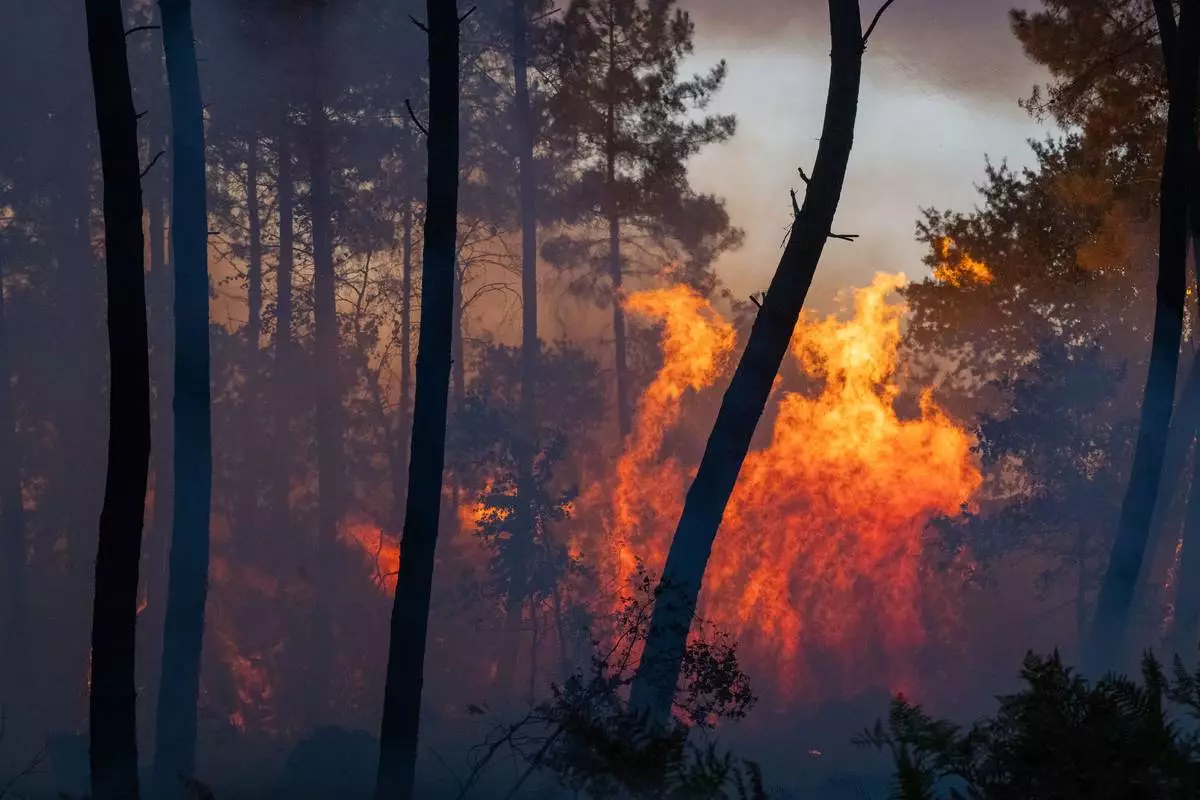
Wildfires advance near Le Proge region, western France, Thursday, July 23, 2026. (AP Photo/Caroline Blumberg)
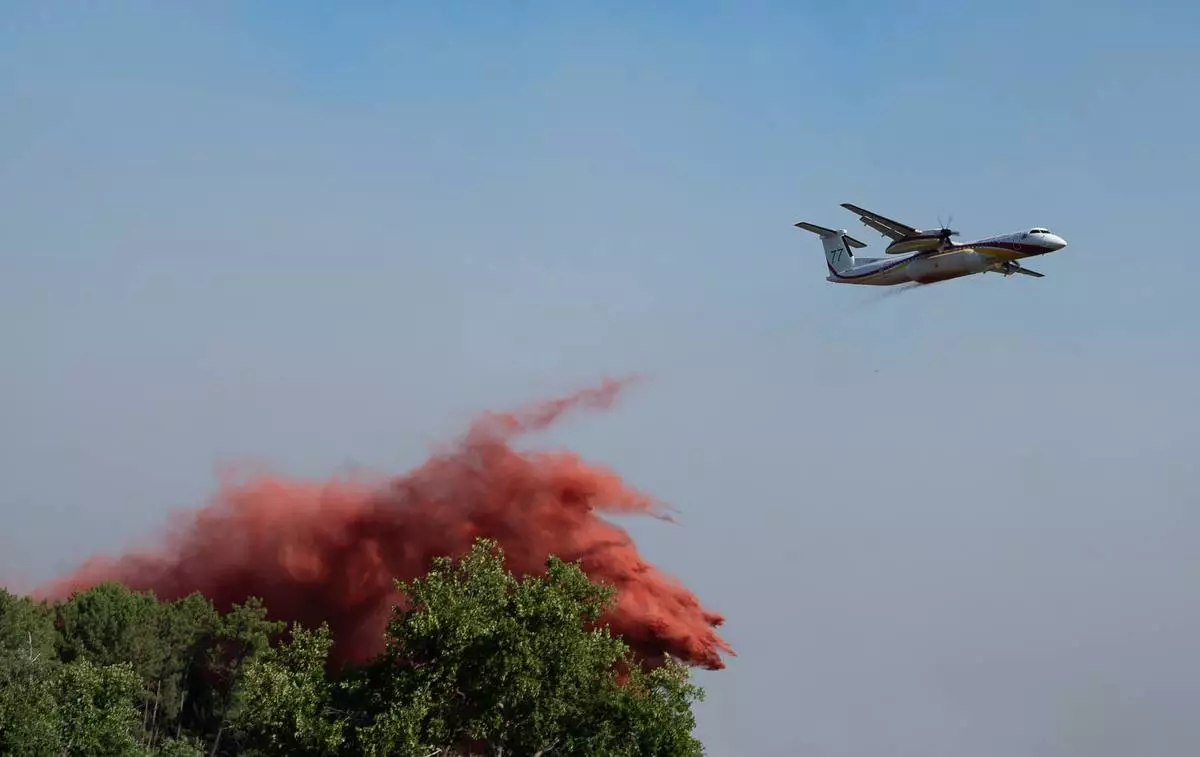
A water bomber drops water while fighting wildfires In Ares, western France, Friday July 24, 2026. (AP Photo/Caroline Blumberg)
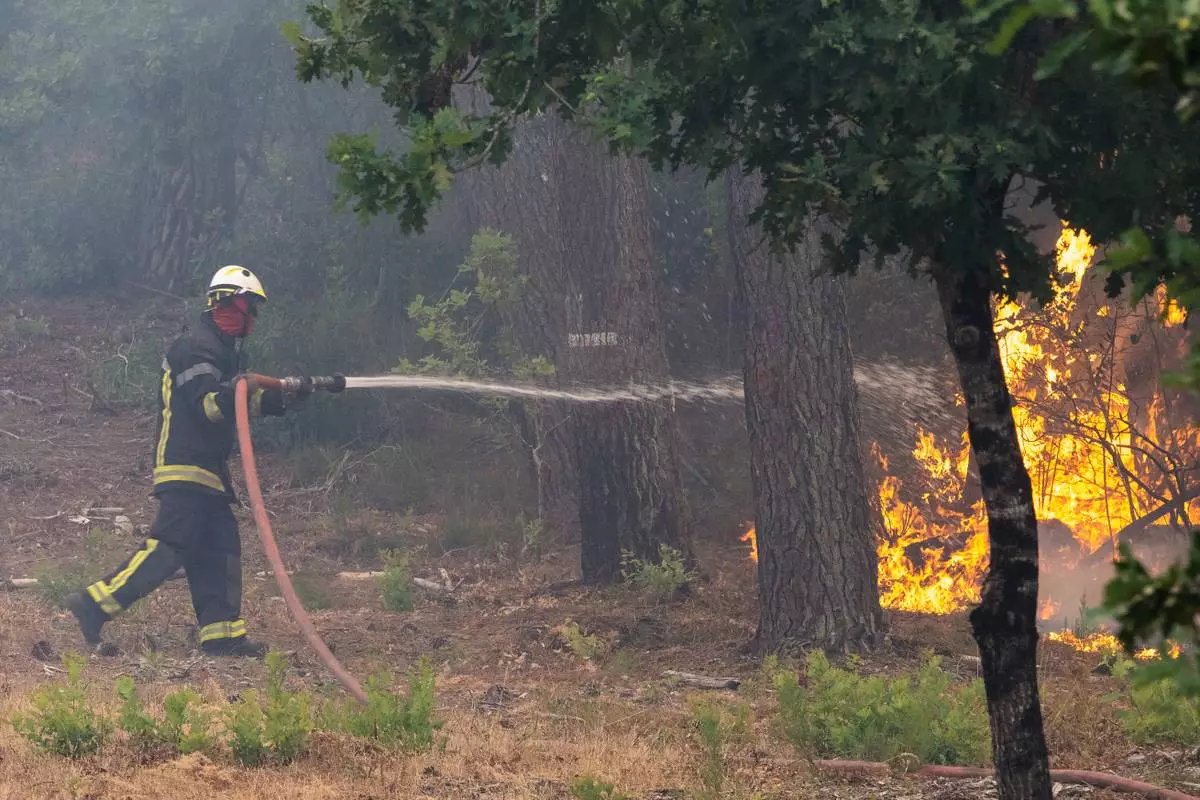
A firefighter sprays water in a burning forest in the Lège-Cap-Ferret region, western France, Friday, July 24, 2026. (AP Photo/Caroline Blumberg)
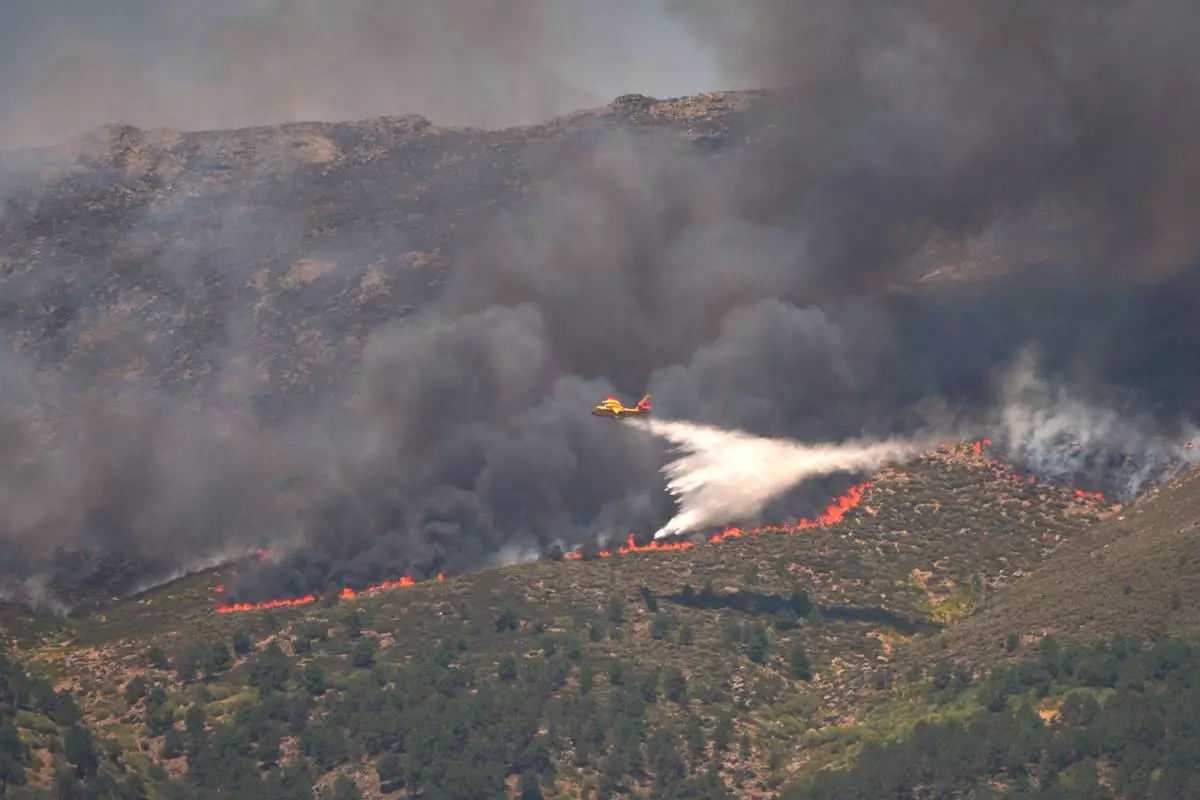
A seaplane drops water onto the fire as a wildfire advances near La Adrada, Ávila province, Spain, Friday, July 24, 2026. (AP Photo/Manu Fernandez)
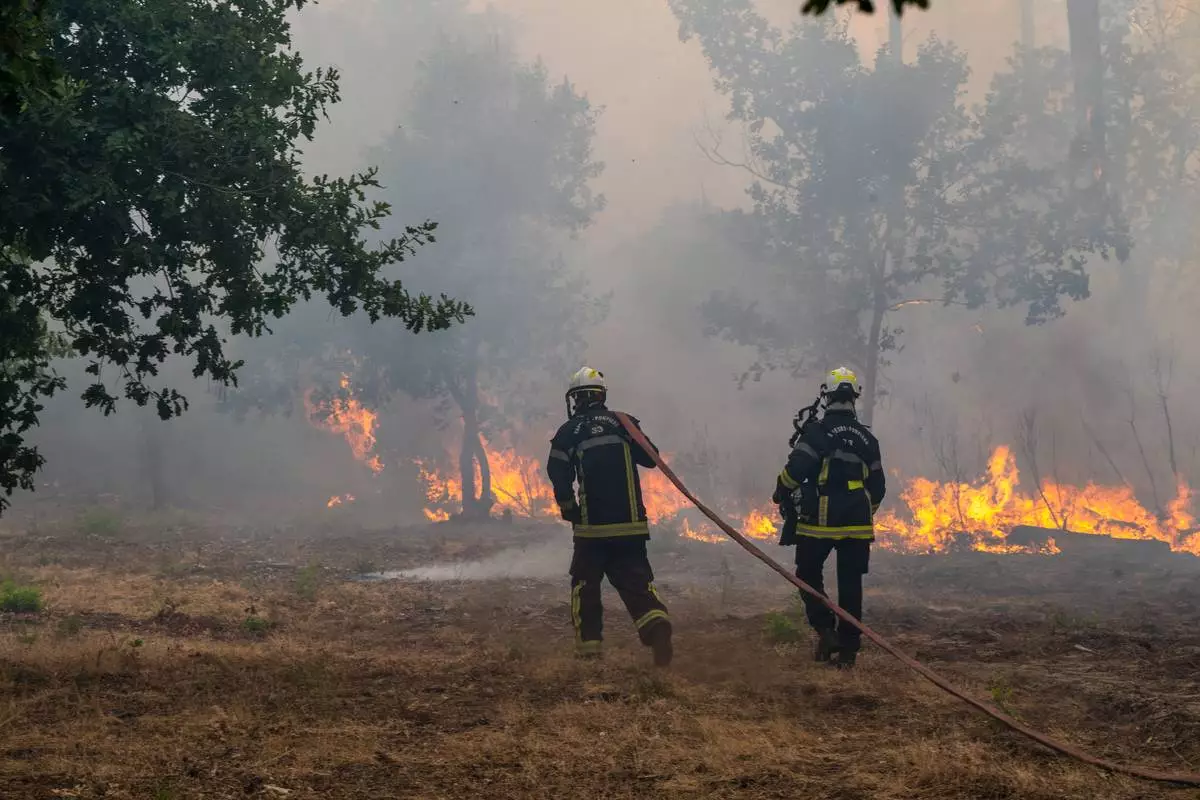
Fiirefighters spray water in a burning forest in the Lège-Cap-Ferret region, western France, Friday, July 24, 2026. (AP Photo/Caroline Blumberg)