Short-term heavy rainfall swept parts of northwest and east China on Sunday, triggering waterlogging on some road sections, with order largely restored after swift emergency response and disaster relief operations.
At around 17:00 on Sunday, parts of Qianxian County in Xianyang City, northwest China's Shaanxi Province, were hit by severe convective weather, with 12 meteorological monitoring stations across the county recording short-term heavy rainfall. The station in Linping Town recorded the maximum hourly rainfall intensity of 52.6 millimeters.
Footage from various locations in Qianxian showed thunderstorms and gale-force winds in some areas, with heavy downpours causing severe waterlogging on low-lying road sections, power outages in some areas, and temporary traffic control measures at expressway entrances and exits.
As the rain subsided, the standing water receded and power supplies were restored by around 22:00 on Sunday, with road traffic returning to normal.
Meteorological authorities have warned that Qianxian will continue to experience frequent showers and thunderstorms over the coming week, urging local authorities to strengthen hazard inspections and guard against secondary disasters triggered by short-term heavy rainfall and thunderstorm gales.
In Jinan City of east China's Shandong Province, multiple areas were hit by short-term heavy rainfall on Sunday afternoon, with the Jiefangqiao monitoring station in Lixia District recording 97 millimeters of rainfall within one hour.
The heavy rain caused severe waterlogging on some road sections, with water even overflowing curbs. Local traffic management authorities rushed to the scene to direct traffic, assist vehicles trapped in floodwater, help and guide pedestrians, and impose traffic controls on affected sections.
According to meteorological forecasts, parts of Jinan will continue to experience thunderstorms from midday through the night on Monday, with locally heavy or torrential rain in some areas. Scattered thunderstorms are also expected over the next three days, and the public is advised to take precautions when going out.
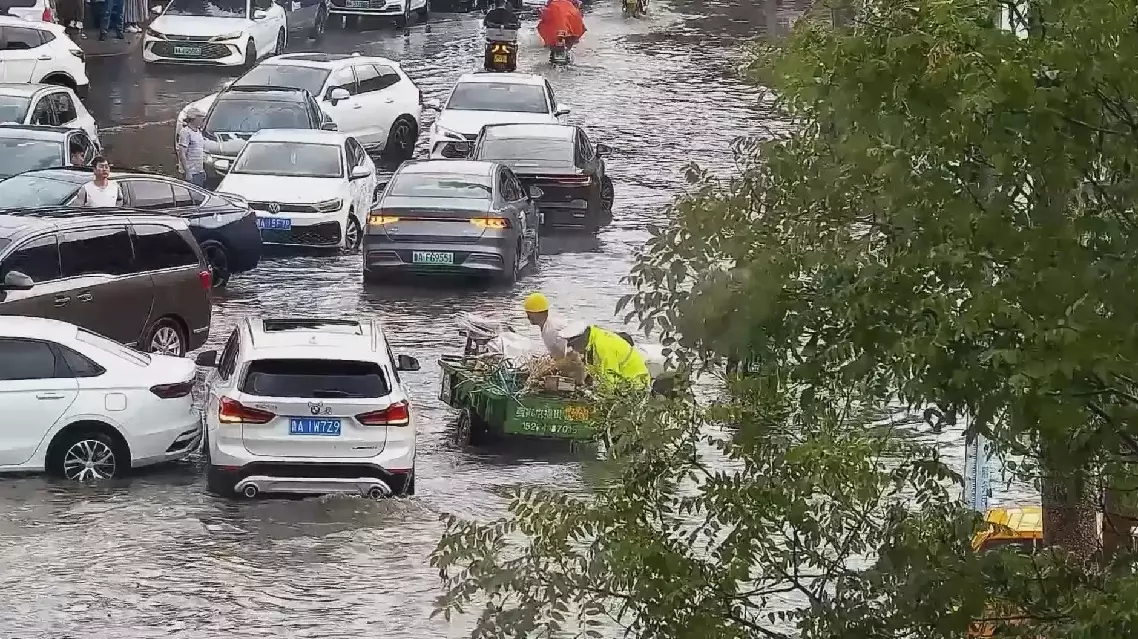
Heavy rain triggers waterlogging in parts of China
Civil Defense teams in the Gaza Strip are struggling to carry out a major operation to recover the remains of hundreds of people still believed to be buried underneath, but a severe shortage of heavy equipment is making the task extremely difficult.
Israel acknowledged earlier this year that at least 70,000 people were killed during its two-year bombardment of Gaza, leaving the Palestinian enclave in ruins.
Sabra, one of Gaza City's hardest-hit neighborhoods, saw dozens of homes destroyed in Israeli airstrikes, burying many residents under the rubble.
The Abu Sharia family was among the worst affected, losing more than 200 relatives, many of whom remain trapped beneath the debris.
Ibrahim Abu Sharia lost his children, brothers, and many extended family members.
"All the families here carry the same wound. Life was already difficult, and now it has become even harder. For nearly three years we have come here every day remembering them. These recovery operations have renewed our pain. Even when remains are recovered, we cannot tell whose bones they are," he said.
Gaza Civil Defense crews face a daunting task amid the massive destruction, with a severe shortage of heavy machinery and specialized equipment.
"Every building here has victims beneath the rubble. This work requires heavy equipment, but unfortunately it is not available in Gaza. Right now, we are working with this single excavator to recover the victims and remove the debris," said Mahmoud Basal, spokesman for the Civil Defense in Gaza.
The International Committee of the Red Cross (ICRC) is supporting the operation with fuel and equipment, while Palestinian human rights groups estimate that more than 10,000 people remain missing beneath Gaza's rubble.
"We are supporting the civil defense in Gaza to continue their excavation operations to recover deceased Palestinians beneath the rubble. Thousands of families in Gaza have been in agony and uncertainty for the past two and a half years, waiting to be able to recover their loved ones, to mourn them and bury them," said Amani Al Naouq, an ICRC spokeswoman in Gaza.
According to the United Nations, more than 90 percent of Gaza's housing has been damaged or destroyed, and the Palestinian death toll has risen above 73,000.
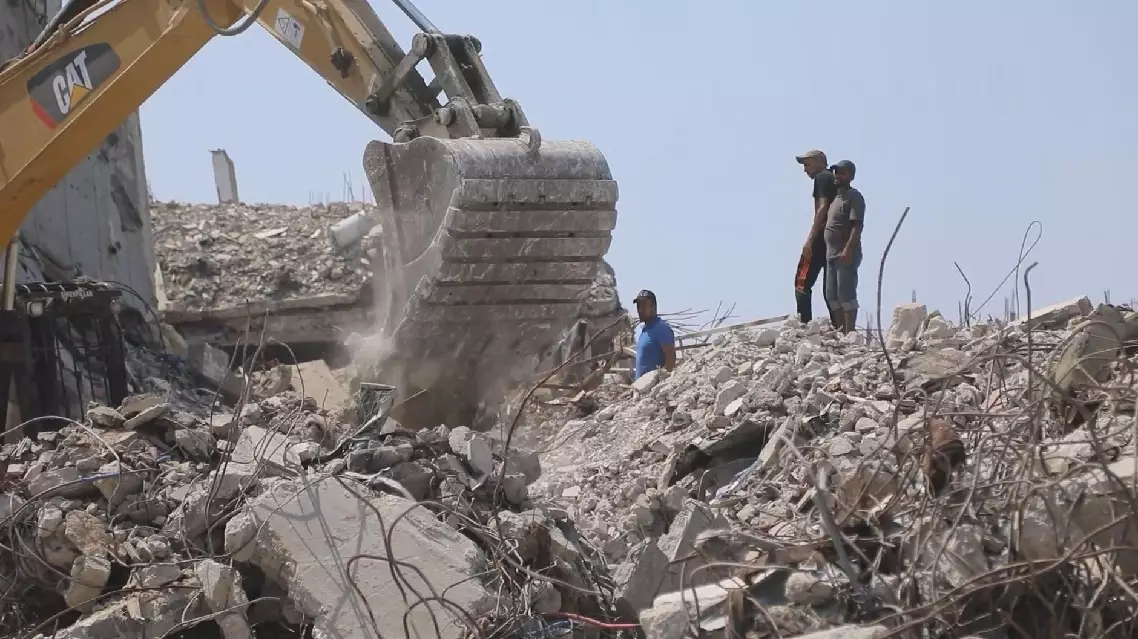
Gaza struggles to recover remains buried under rubble with few tools