Skip to Content Facebook Feature Image

Clinton Foundation launches an institute to help state governments find nonpartisan solutions

News

Clinton Foundation launches an institute to help state governments find nonpartisan solutions
News

News

Clinton Foundation launches an institute to help state governments find nonpartisan solutions

2026-07-27 20:00 Last Updated At:20:10

The Clinton Foundation unveiled a new initiative Monday to help state and local governments develop and enact nonpartisan policy solutions to improve health outcomes, especially for women and children, economic security and democracy.

The foundation’s first new initiative in more than a decade, the Clinton Policy Institute has already begun convening political leaders from both parties, research experts, and Americans affected by the issues being studied to create new approaches to long-existing problems.

“Rising costs, economic uncertainty, rapid technological change, and growing pressures on our public institutions are making it harder for families to get ahead,” former Secretary of State Hillary Rodham Clinton said in a statement to The Associated Press. “We created CPI because we believe there are still practical, evidence-based solutions that can improve people’s lives.”

CPI is building on its work with New York state in banning cellphones from schools in the past academic year. Though the institute did not technically exist last year when it teamed with New York Gov. Kathy Hochul’s administration on creating distraction-free schools in the state, the Clinton Foundation saw promise in its approach and decided to expand it before publicly announcing CPI’s creation. It’s a strategy that the foundation, also led by former President Bill Clinton and public health expert Chelsea Clinton, used when it launched the Clinton Health Access Initiative in 2004.

Zayn Siddique, former principal deputy director of the Domestic Policy Council, will serve as CPI’s chief executive officer. Jennifer Klein, who was director of the White House Gender Policy Council under former President Joe Biden, will be CPI’s chair.

In New York, CPI helped create the Teen Tech Council so that students could help make the phone-ban program more effective. The result, according to Hochul’s office, was that educators found a marked improvement in classroom behavior and engagement.

“CPI is bringing together policymakers, researchers, business leaders, and community organizations to identify what works, build stronger policy networks, and help turn those ideas into policy,” Hillary Clinton said. “We’re taking a particular focus on states and local communities, where so much innovation is happening.”

Kansas Gov. Laura Kelly said a CPI conference on improving the lives of children earlier this month was “the best roundtable I’ve been involved with since becoming governor.”

Kelly, who will leave office in January due to term limits after serving two consecutive terms, said she was inspired by CPI’s nonpartisan approach to solving problems affecting children.

“I am a Democrat governor in what is considered a very red state,” Kelly told The Associated Press in an interview. “It became very clear to me that if I wanted to accomplish anything in my political life, I was going to need to do it in a bipartisan way.”

Kelly believes that, despite political polarization, CPI can succeed in finding nonpartisan solutions – especially to issues involving children and healthcare – and giving state leaders the research and other support to implement them.

“Every once in a while, you get people from both sides of the aisle who come together and crafted, maybe not sexy legislation, but something that really needed to be done,” Kelly said. “And they get it through.”

Dr. Jerome Adams, former U.S. Surgeon General in President Donald Trump’s first administration, agrees that nonpartisan solutions are possible to find. But he says the nonpartisan nature of the solutions has to be intentional.

“Health is inherently political,” said Adams. “When you talk about access to healthcare coverage, when you talk women’s health issues, particularly around the issue of abortion and contraception, when you talk about drug policy and whether you’re in favor of harm reduction, when you talk of firearm safety -- all of these are inherently political issues.”

That is complicated further, Adams said, because “we live in a country that is very binary, so every issue, no matter how nuanced, is, for purposes of elections, turned into black/white, yes/no, all or none.”

However, Adams said CPI has already found a way to get bipartisan buy-in for some of its solutions to adverse childhood experiences (ACEs). In 2020, the state of California launched the ACEs Aware initiative to begin screening for ACEs – which include abuse, neglect and household challenges – and treating them early to reduce the impact and the cost to the state later.

Through CPI, Adams was asked to become the co-chair of the National Leadership Council for the ACE Resource Network in June in an effort to bring California’s work treating ACEs to other states.

“I’m very interested in work that has proven and practical solutions,” he said. “We bring in states and say, ‘Hey, let’s look at the best evidence in terms of what works around adverse childhood experiences and state level policy and then try to implement it in your state’.”

That strategy has led Republican-led states like Utah and Georgia to consider parts of Democrat-led California’s work on the issue, Adams said.

He said it’s a sign that CPI’s approach works and can be expanded to other areas.

The Clinton Foundation hopes that will be the case.

“Too many people have lost faith that progress is possible,” Hillary Clinton said. “But across the country, leaders are developing innovative policies that are strengthening families and communities. Those ideas deserve to be shared and scaled.”

Associated Press coverage of philanthropy and nonprofits receives support through the AP’s collaboration with The Conversation US, with funding from Lilly Endowment Inc. The AP is solely responsible for this content. For all of AP’s philanthropy coverage, visit https://apnews.com/hub/philanthropy.

FILE - Former Secretary of State Hillary Clinton walks outside the Chappaqua Performing Arts Center, after testifying before U.S. House lawmakers as part of a congressional investigation into convicted sex offender Jeffrey Epstein, Thursday, Feb. 26, 2026, in Chappaqua, N.Y. (AP Photo/Yuki Iwamura, File)

FILE - Former Secretary of State Hillary Clinton walks outside the Chappaqua Performing Arts Center, after testifying before U.S. House lawmakers as part of a congressional investigation into convicted sex offender Jeffrey Epstein, Thursday, Feb. 26, 2026, in Chappaqua, N.Y. (AP Photo/Yuki Iwamura, File)
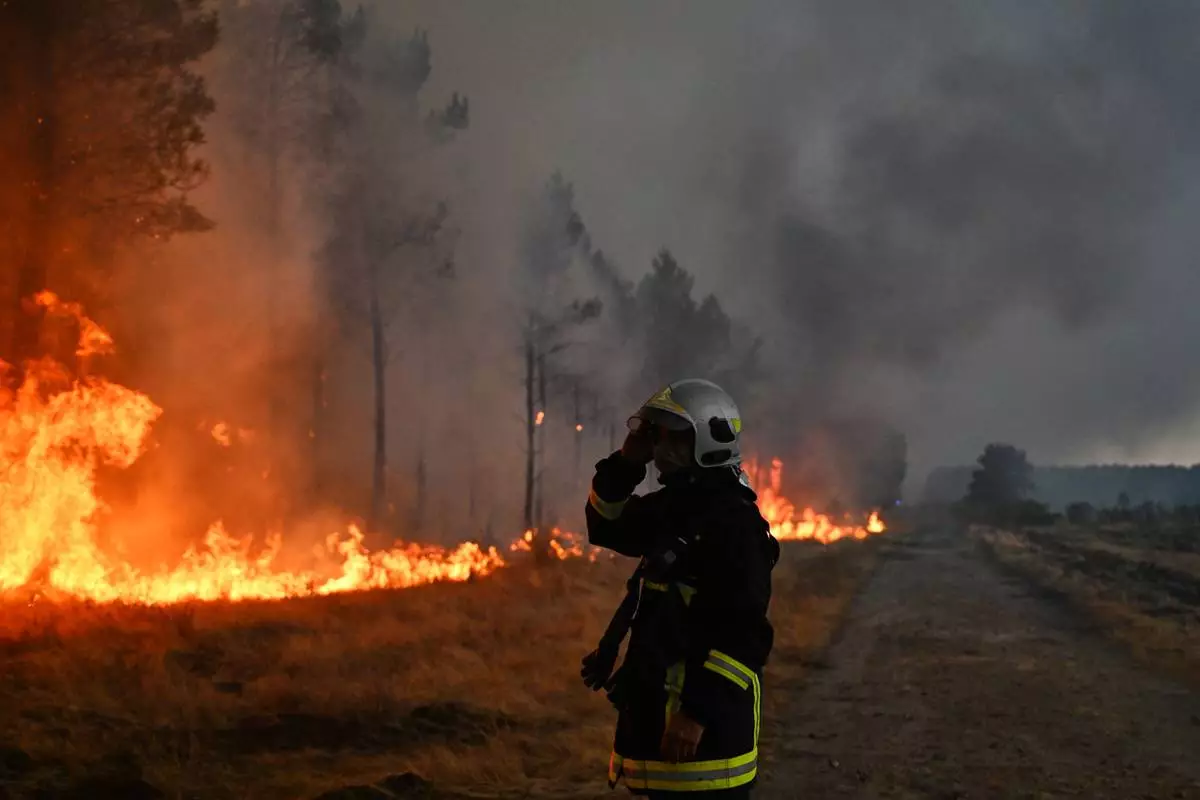
LEGE-CAP FERRET, France (AP) — France’s interior minister said Monday that a monster wildfire has stopped growing after forcing 220,000 people out of their homes in the country’s southwest but cautioned that it isn’t yet beaten.

“It hasn’t progressed during the night,” the minister, Laurent Nuñez, said. “We have to remain very concentrated, very determined, to go at any moment.”

He spoke after French President Emmanuel Macron held a crisis meeting Monday focusing on the massive firefighting effort in the Gironde region and on wildfires elsewhere.

The Gironde blaze has burned an area four times the size of Paris. The region's prefecture said the situation overnight had remained “globally stable” — a change from previous days where the giant blaze raging since last week edged closer to the wine region city of Bordeaux.

In the adjacent southwestern Landes region, where hundreds of firefighters have been making progress against another virulent but smaller fire, the prefecture said some rain fell overnight and described the conditions as “favorable” for firefighting but also cautioned that they could change.

No new evacuations were announced. But with France about to enter its peak August tourist season, Gironde authorities took more steps to keep vacationers away, banning holiday camps for children and for people with disabilities.

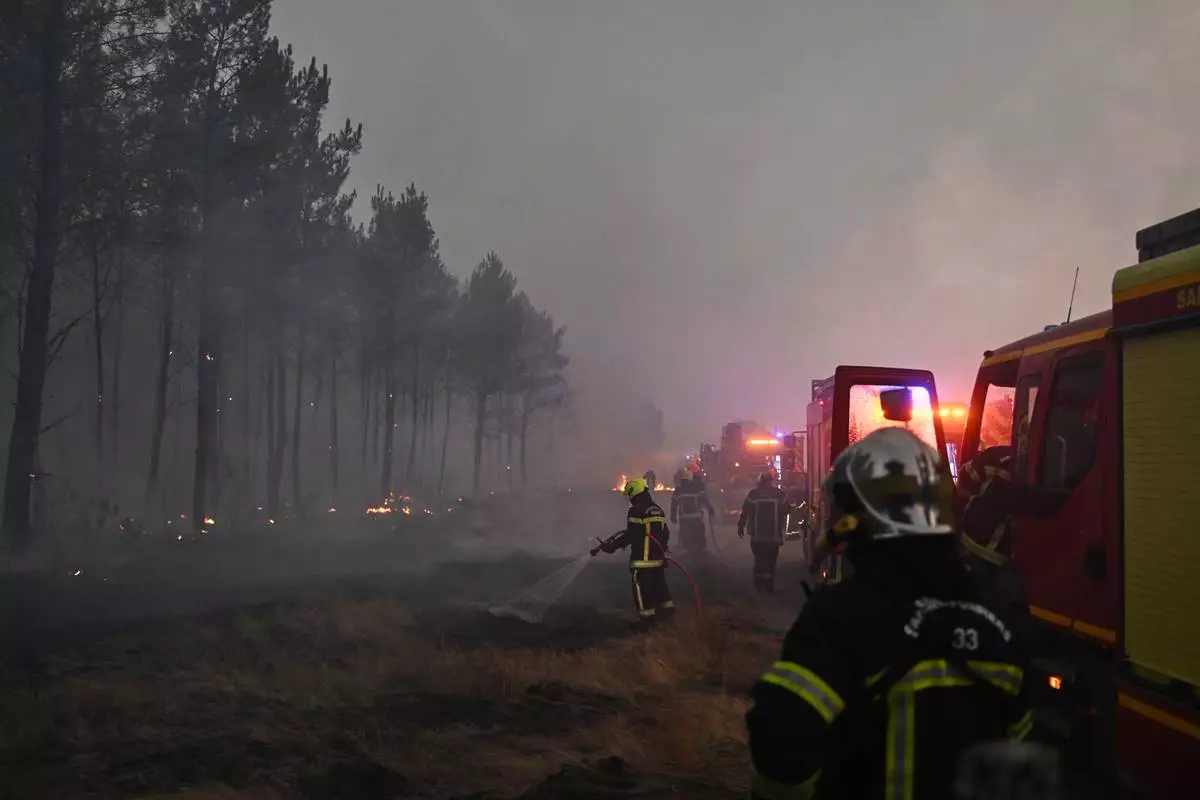
With thousands of firefighters on the ground and rotations of water- and retardant-dropping aircraft in the air, the massive firefighting effort was engaged in a race against time, battling to make progress before a forecast surge in temperatures from Tuesday that could make fighting flames more difficult.

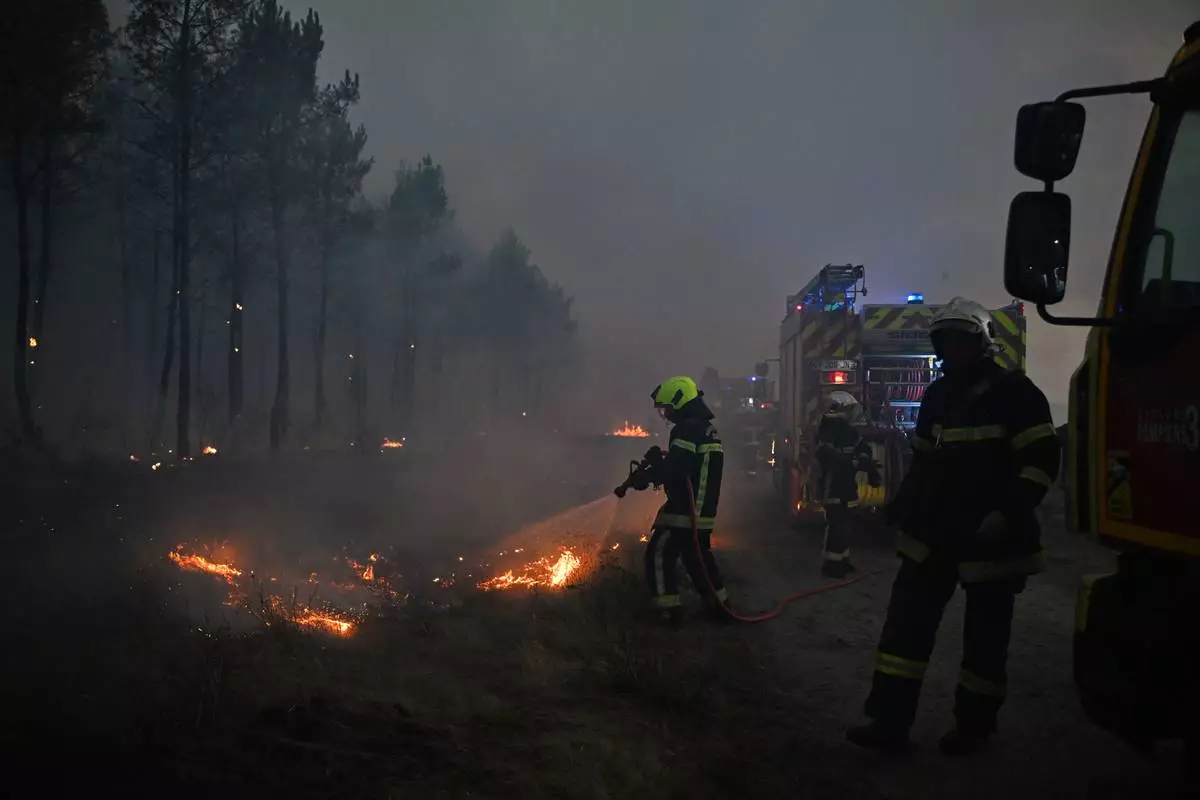
Crews using earth movers tore up strips of forest and scrubland to create barren spaces, intended to stop fires from spreading. Farmers were keeping fire crews supplied with water, transporting it to them in tanks. Around a dozen countries have provided planes, helicopters, firefighters and other assistance to both France and Spain, which is also fighting unprecedented blazes. All told, fires in both countries have forced more than 330,000 people to flee.

Macron didn't immediately comment after the government crisis meeting he presided over. In a weekend post on X, he pledged long-term support for fire-hit communities, saying: “We will rebuild, we will repair and we will be present for as long as necessary.”

In Spain, wildfires have burned out of control around Madrid and in the Valencia region. Authorities evacuated 76,000 people and confined 30,000 others to their homes.

In both Spain and France, the exceptional scale of the fires — fueled by heat waves that hit especially hard and early this year, making forests and scrubland tinder-dry — are driving calls for stronger action against climate change.

“What we are experiencing is not a series of isolated incidents. It is the consequence of a climate emergency that is making wildfires even more violent, heat waves more frequent,” Spanish Prime Minister Pedro Sánchez said.

A fire raging in hilly, rural terrain in Ávila, west of Madrid, has become Spain’s largest on record, scorching 50,000 hectares (193 square miles), the government said. That's five times the size of Barcelona.

Fires have burned 153,000 hectares (590 square miles) this year in Spain — six times the area scorched by blazes in the first half of 2025, said Sara Aagesen, the ecology minister.

The minister said that another heat wave forecast from Tuesday — which would be Spain’s fourth so far this year — could ratchet up the fire danger.

Evacuees are fretting about what they’ll find when they’re allowed to return to fire-hit regions.

“It looked like the apocalypse. You couldn’t see anything. Everything was covered in ash,” said Rocío Domínguez, who evacuated with her dog, Simba, from Chapinería, west of Madrid.

“We don’t know when we get to the town, if we’ll have half the house burned down or we’ll have it intact or we won’t have a house,” she said. “All the clothes, all the memories, everything.”

A wildfire driven by strong winds broke out on Sunday afternoon near Peschici, in Italy’s southern Puglia region, burning pine forest and scrub and forcing the evacuation of about 300 tourists from beaches and campgrounds, authorities said.

The Coast Guard evacuated tourists by sea to nearby Vieste, where authorities opened temporary shelters.

Three Canadair water-bombing planes and fire crews on the ground continued Monday to battle the blaze, which revived memories of devastating wildfires that hit the same coastal area in 2007.

Leicester reported from Paris. Associated Press writers Joseph Wilson in Barcelona and Giada Zampano in Rome contributed.

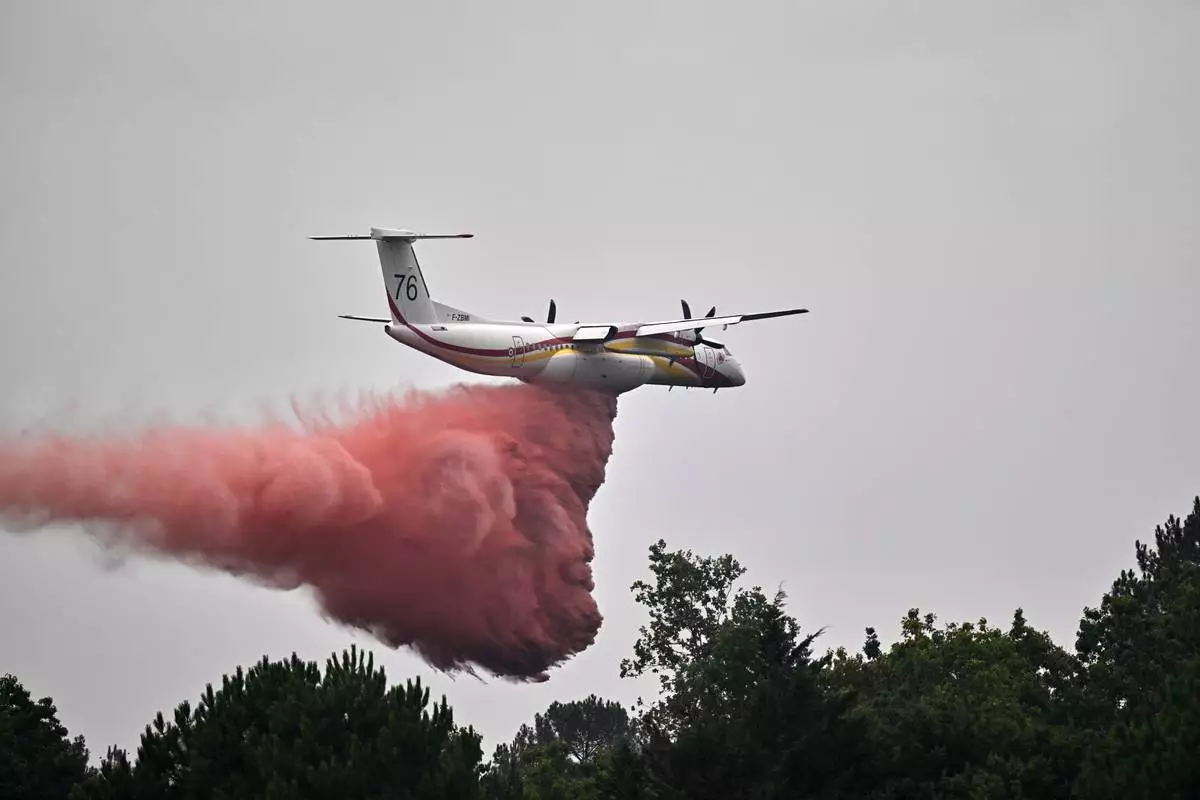
A De Havilland Canada DHC-8-400 Dash 8 operated by the French civil defense agency drops fire retardant as wildfires rage near Marcheprime, outside Bordeaux, France, Monday, July 27, 2026. (AP Photo/Emma Da Silva)

A De Havilland Canada DHC-8-400 Dash 8 operated by the French civil defense agency drops fire retardant as wildfires rage near Marcheprime, outside Bordeaux, France, Monday, July 27, 2026. (AP Photo/Emma Da Silva)

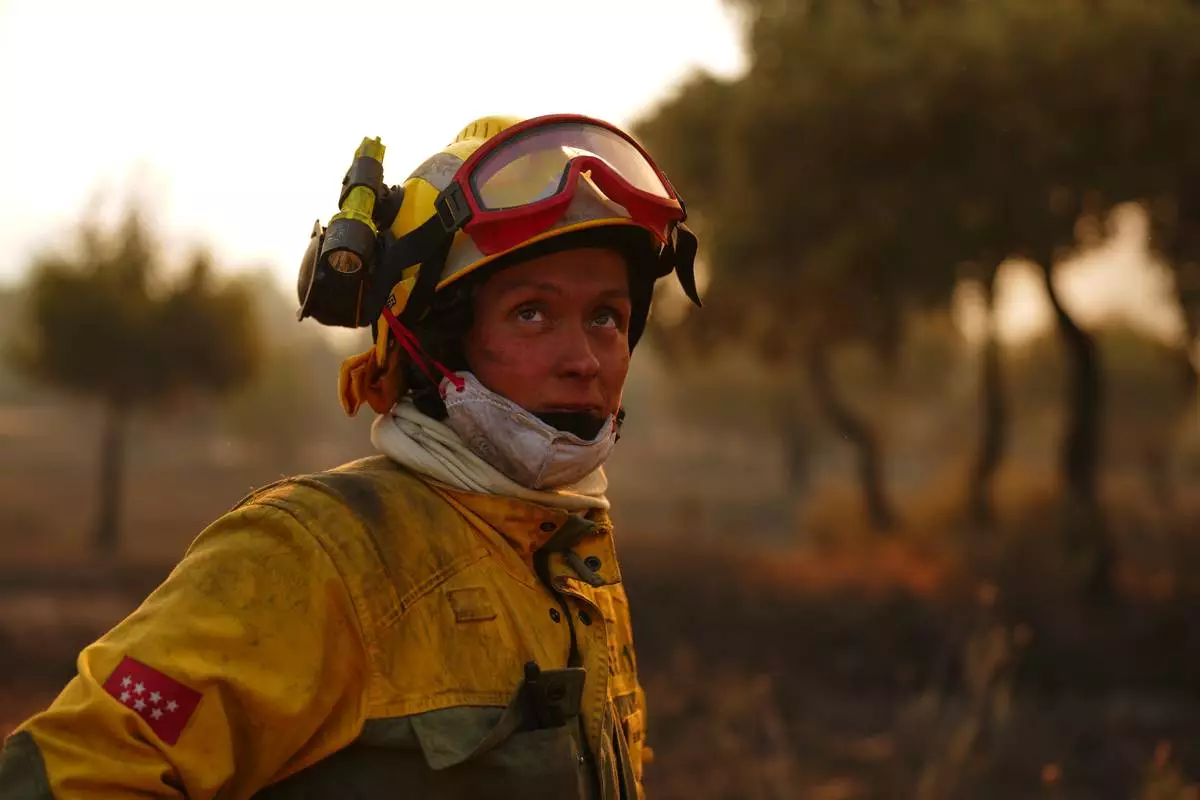
Firefighters battle a wildfire in San Martin de Valdeiglesias, west of Madrid, Spain, Sunday, July 26, 2026. (AP Photo/Manu Fernandez)

Firefighters battle a wildfire in San Martin de Valdeiglesias, west of Madrid, Spain, Sunday, July 26, 2026. (AP Photo/Manu Fernandez)

A firefighter gestures next to burning trees as a wildfire rages near Marcheprime, outside, Bordeaux, France, Sunday, July 26, 2026. (AP Photo/Emma Da Silva)

A firefighter gestures next to burning trees as a wildfire rages near Marcheprime, outside, Bordeaux, France, Sunday, July 26, 2026. (AP Photo/Emma Da Silva)

Firefighters battle a wildfire near Marcheprime, outside, Bordeaux, France, Sunday, July 26, 2026. (AP Photo/Emma Da Silva)

Firefighters battle a wildfire near Marcheprime, outside, Bordeaux, France, Sunday, July 26, 2026. (AP Photo/Emma Da Silva)

Firefighters battle a wildfire near Marcheprime, outside, Bordeaux, France, Sunday, July 26, 2026. (AP Photo/Emma Da Silva)

Firefighters battle a wildfire near Marcheprime, outside, Bordeaux, France, Sunday, July 26, 2026. (AP Photo/Emma Da Silva)

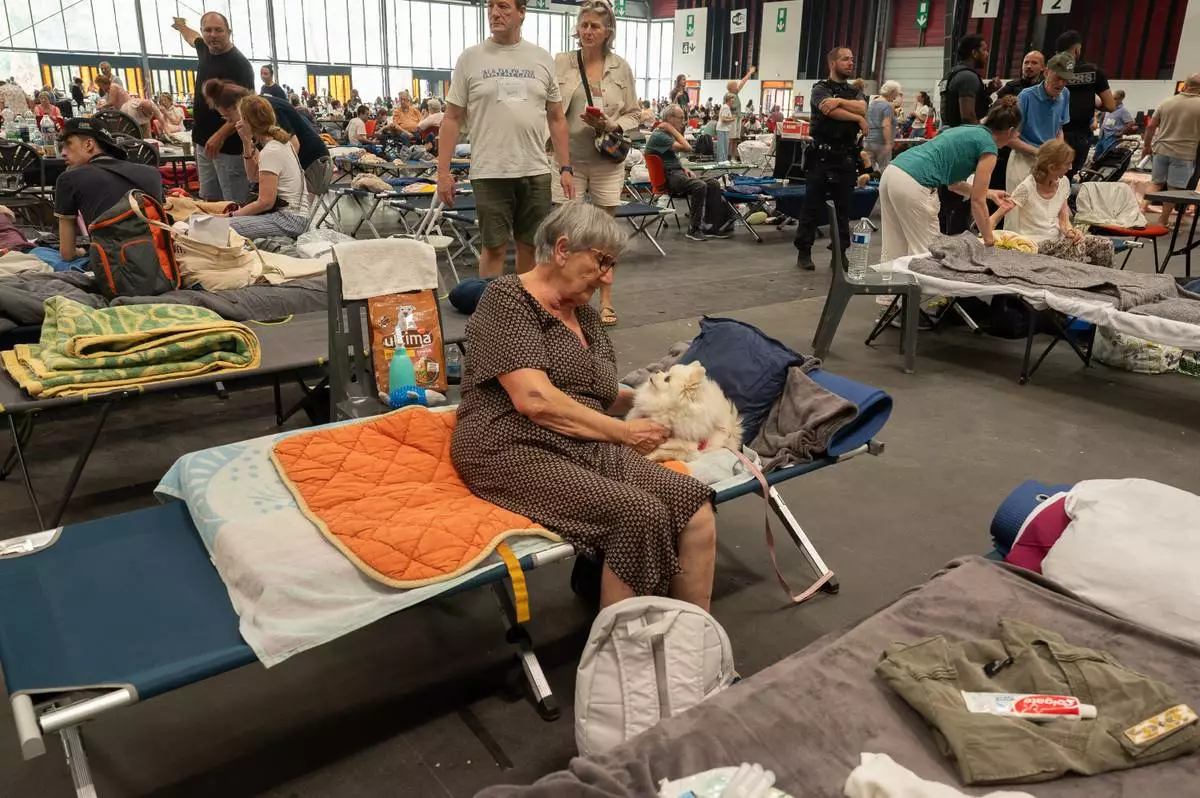
A woman caresses her pet dog at an emergency shelter set up in the Bordeaux Exhibition Centre in Bordeaux, France, for those that had to leave their homes outside town due to the raging wildfires, Sunday, July 26, 2026. (AP Photo/Caroline Blumberg)

A woman caresses her pet dog at an emergency shelter set up in the Bordeaux Exhibition Centre in Bordeaux, France, for those that had to leave their homes outside town due to the raging wildfires, Sunday, July 26, 2026. (AP Photo/Caroline Blumberg)

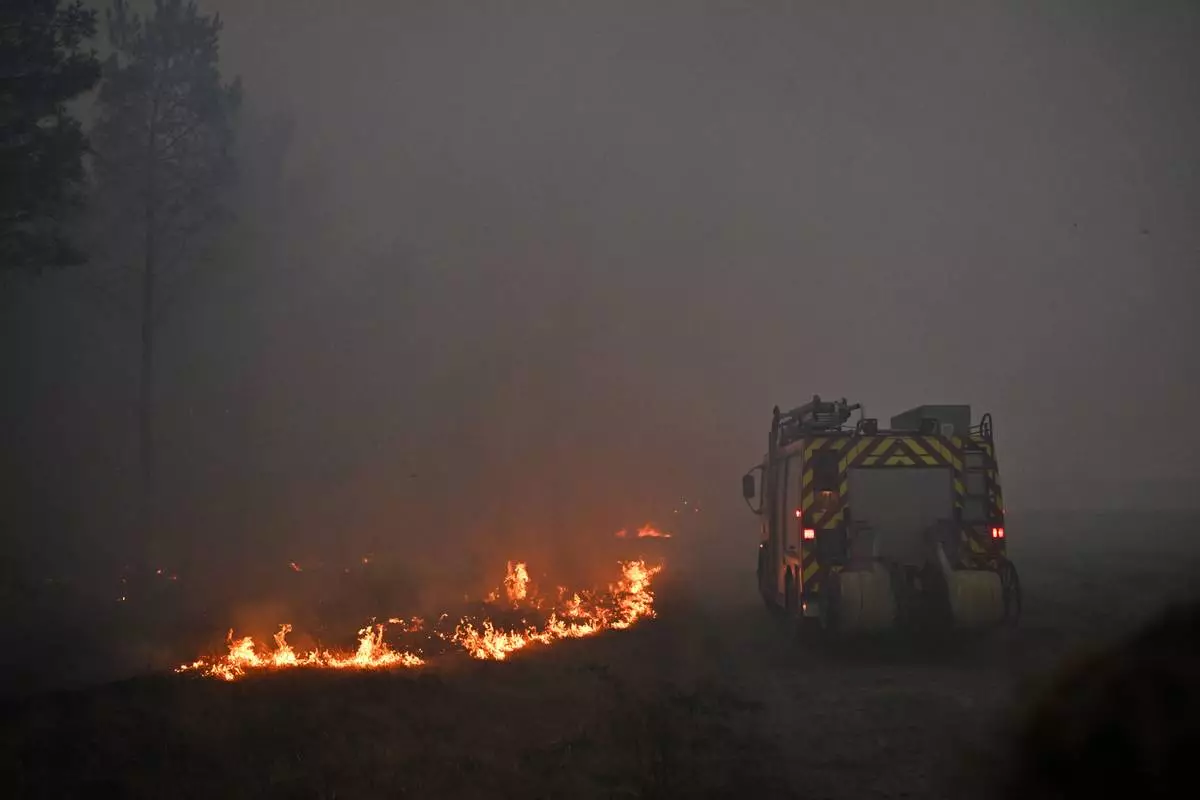
A fire engine drives through smoke of a wildfire raging near Marcheprime, outside, Bordeaux, France, Sunday, July 26, 2026. (AP Photo/Emma Da Silva)

A fire engine drives through smoke of a wildfire raging near Marcheprime, outside, Bordeaux, France, Sunday, July 26, 2026. (AP Photo/Emma Da Silva)

Recommended Articles