A U.S. Secret Service agent and two other men have been arrested and charged with violent felonies in the Miami area, where authorities say they committed brutal beatings as part of a fraternity hazing ritual in April that left two people hospitalized with severe injuries.
One of the men charged, 29-year-old Marquez Christopher Pinder, works in the Secret Service's Miami field office and is described in an arrest warrant as a “dean of pledges” for a Miami chapter of the Kappa Alpha Psi fraternity.
The Secret Service said it’s cooperating with investigators and has placed Pinder on administrative leave. He was released from jail after posting a $75,000 bond Monday and faces arraignment before a judge Sept. 24.
The three men were charged last week after police uncovered evidence of “alleged hazing incidents involving prolonged and repeated beatings with canes and paddles,” the Miami-Dade County state attorney's office said in a news release.
Police said in court documents that a University of Miami graduate student and another young man had injuries that could have been fatal had they not been treated. One required skin grafts to his backside and suffered kidney damage, the documents said, while the other had a tube placed in his windpipe to help him breathe.
Charges against the three men include felony counts of hazing with a deadly weapon, aggravated battery with great bodily harm and attempted manslaughter.
“In Florida, hazing is abuse and it is a crime,” Katherine Fernandez Rundle, state attorney for Miami-Dade County, said in a statement Sunday. “Its victims too often lie in their graves and in hospital beds.”
An attorney for Pinder, Justin Beckham, did not immediately return phone and email messages seeking comment Monday. Court and jail records did not list attorneys for the other two men.
Pinder has worked as a Secret Service agent since 2023, agency spokesman Matt Fagiana confirmed Monday.
"Any misconduct will be addressed swiftly and appropriately upon completion of the investigative and judicial process,” Michael Townsend, the special agent in charge of the Secret Service's Miami field office, said in a statement.
A spokesman for Kappa Alpha Psi did not immediately return a phone message left at the fraternity's Philadelphia headquarters.
According to Pinder's arrest warrant, the graduate student told police that he and another young man had their backsides beaten by Pinder and the other defendants during four nights in early April at an apartment and a home off-campus. The paddling started when the victims failed to correctly answer questions about the fraternity and its history, a police investigator said in an arrest warrant filed in court.
The warrant did not name either victim.
The beatings stopped on the fourth night when one of the victims had blood seeping through the seat of his pants, according to the warrant. It said fraternity leaders ordered both victims to strip off their clothes and place them in garbage bags before going home.
One of the victims suffered vomiting, fevers and intense pain before being admitted to a hospital, where he required skin grafts on his buttocks and treatment for kidney damage, according to police.
Without emergency medical treatment, the warrant said, “his injuries would have resulted in renal failure leading to death.”
The second victim told police he knew the other victim from the fraternity. He denied being paddled, the warrant said, but acknowledged receiving emergency medical care in April.
That person's medical records showed he had been hospitalized with injuries to his backside and “was intubated during his stay in the hospital to prevent further physical deterioration and death,” the arrest warrant said.
Florida lawmakers in 2005 made hazing a felony punishable by up to five years in prison if it results in serious injury or death. The law was spurred by the 2001 death of Chad Meredith, a University of Miami freshman who drowned after drinking alcohol and then attempting to swim across a lake at the urging of campus fraternity leaders.
Bynum reported from Savannah, Georgia.
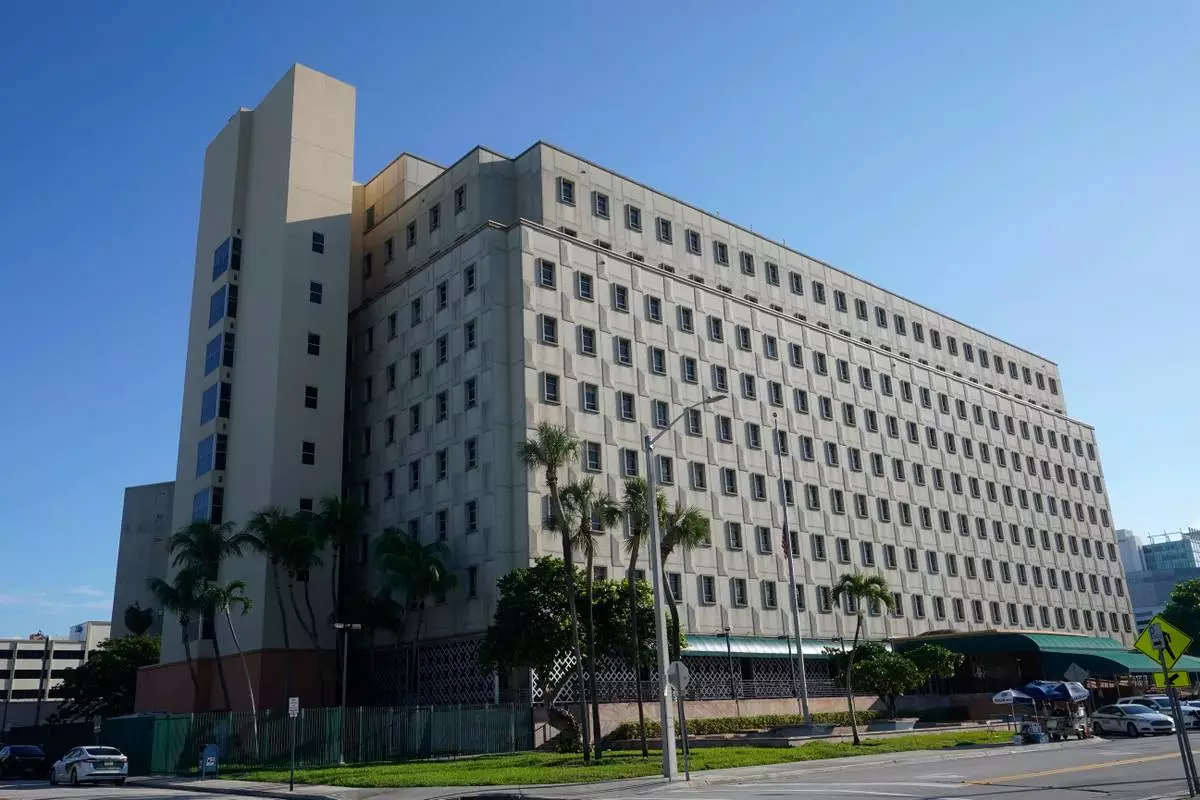
FILE - The Richard E. Gerstein Justice Building is seen, Sept. 20, 2022, in Miami. (AP Photo/Wilfredo Lee, File)
The teenager who killed two students and two teachers in a 2024 shooting at Georgia's Apalachee High School had a chaotic, lonely upbringing and immersed himself in an online community of people interested in mass shootings, a psychologist testified Monday.
Colt Gray, 16, pleaded guilty Friday to 55 counts, including murder, in the Sept. 4, 2024, shooting that also left several others wounded at the school about 45 miles (73 kilometers) northeast of Atlanta.
He entered the plea without having reached a plea deal with prosecutors. Murder carries a minimum sentence of life in prison, and it is up to Barrow County Superior Court Judge Nicholas Primm to decide whether he will have the possibility of parole after hearing testimony and considering evidence. The sentencing hearing started Friday, continued Monday and was set to resume Tuesday.
Teachers Richard “Ricky” Aspinwall, 39, and Cristina Irimie, 53, and students Mason Schermerhorn and Christian Angulo, both 14, died in the shooting. Another teacher and eight more students were wounded, seven of them hit by gunfire.
A forensic psychologist who evaluated Gray after the shooting at the request of an attorney for the teen testified that during their first meeting in May 2025, Gray asked if he could pull his arms inside his sweatshirt to wrap them around himself.
“I thought he was kind of an odd kid," Kevin Richards said. The psychologist said he did four interviews with Gray for a total of about 15 hours and also spoke to Gray's mother twice for a total of about three hours.
“It was pretty chaotic,” the psychologist said of Gray's upbringing, noting that the family had financial problems and moved around a lot, so he wasn’t enrolled in school for long stretches. His parents used drugs and fought a lot, and Gray had a lonely and neglected childhood, Richards testified.
Gray talked about fearing that teachers were plotting against him, and that people in public were whispering about him. Richards said that while he believes Gray experienced paranoia and anxiety, he doubts that motivated the attack.
“I don’t think he was driven by hallucinations or delusions to do what he did. I think he planned it out,” Richards said.
Most of the teen's social life was online, Richards said. He was a gamer but also became immersed in a community of young true crime enthusiasts who were particularly fascinated by mass shootings. Initially, Gray focused on Adam Lanza, who killed 26 people at Sandy Hook Elementary School in Connecticut, as well as James Holmes, who killed 12 people in a Colorado movie theater. Richards said Gray was particularly interested in Nikolas Cruz, the shooter in the 2018 massacre at Florida’s Marjory Stoneman Douglas High School.
“He had just kind of disappeared into Discord and disappeared into the true crime community,” Richards said.
District Attorney Brad Smith showed Richards some of Gray's online conversations on Discord, an online communication platform. They established that Gray would sometimes lie about his own mental health symptoms when talking to people online to establish common ground with them and get attention.
When asked by Smith if Gray studied and emulated school shooters, Richards responded that Gray was “kind of obsessed” with them.
In interviews with investigators, Gray lied about having called a suicide hotline right before the shooting, which Holmes had done, Smith said. He also told investigators he had damaged his computer the morning of the shooting and left it in the middle of his room, as Lanza had done. Smith called these “easter eggs” that Gray was planting to “gain fame and status” within the online community that fetishized those killings.
In an online conversation just days before the shooting, Gray mentioned Sept. 4. When the person he was chatting with asked what was happening that day, he wrote, “something i have for nik!” — an apparent reference to the Parkland shooter's first name. He also noted that day was a Wednesday, just like the Parkland shooting.
Gray had more than 2,000 photos of Cruz saved on his phone and had 16 photos of Cruz printed and posted on his bedroom wall, Ashley Gilleland, an investigator with the district attorney’s office, testified. He shared photos of that “shrine” with another Discord user in the days before the shooting.
Similarly, he saved photos of other mass shooters and searched for details of those shootings, Gilleland said.
In phone calls with his mother while he was in custody just over a month after the shooting, Gray had her search online for mentions of his name within the “true crime community” and got excited when she found “fan art” drawings of him, Gilleland said. It appears his mother printed out some of the images she found to bring to her son, Gilleland said.
After Gray entered his plea Friday, the judge heard from family members of those killed and victims of the shooting. Most asked the judge to sentence Gray to life without the possibility of parole.
Prosecutors also played recordings of two interviews the lead investigator did with Gray, one that took place less than an hour after the shooting at the school and another that was done several hours later at the sheriff's office. Though the teenager seemed hysterical, repeatedly apologized and described what had happened as “horrible” during the interview at the school, Barrow County Sheriff's Office Investigator Jason Smith said Monday that he believed "a majority of that interview to be performative.”
A jury in March convicted his father, Colin Gray, on charges including second-degree murder and involuntary manslaughter. He is scheduled to be sentenced later this week. Prosecutors said he gave his son the assault-style rifle used to open fire at the school.
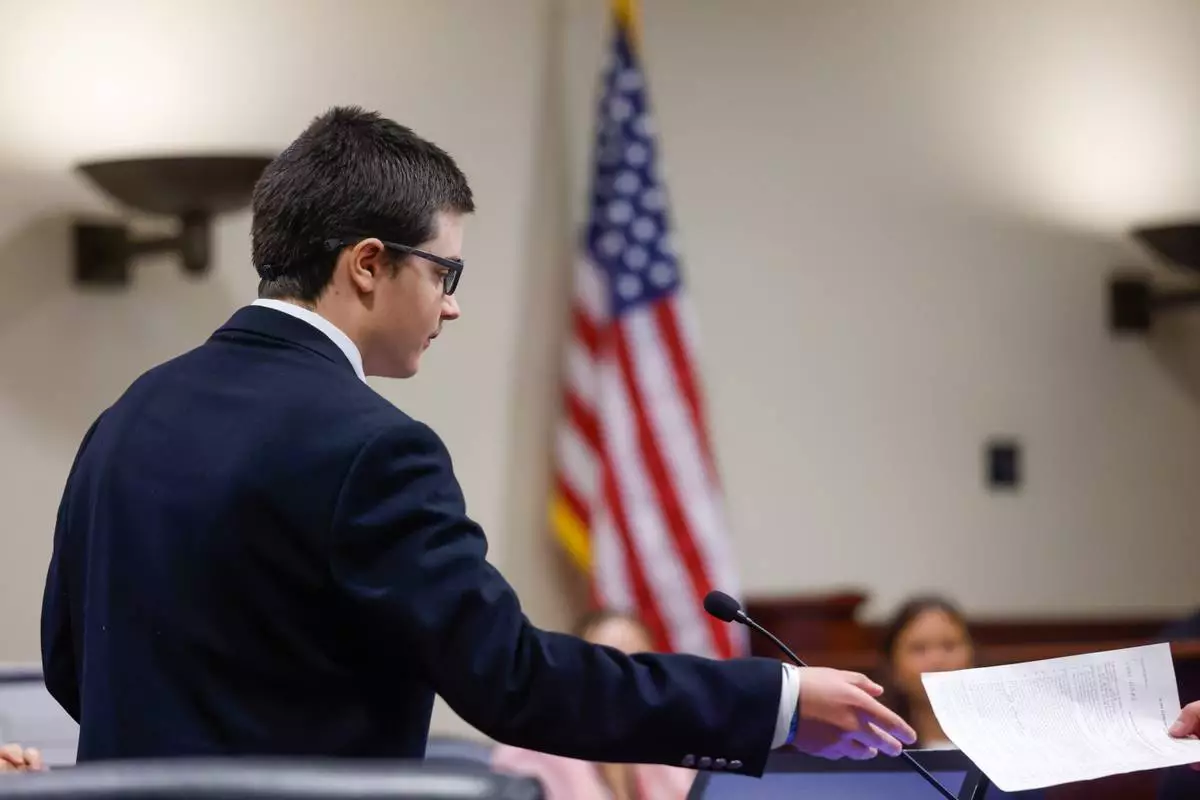
Colt Gray, the 16-year-old Apalachee High School shooting suspect, pleads guilty at Barrow County Superior Court in Winder, Ga., on Friday, July 24, 2026. (Arvin Temkar/Atlanta Journal-Constitution via AP)
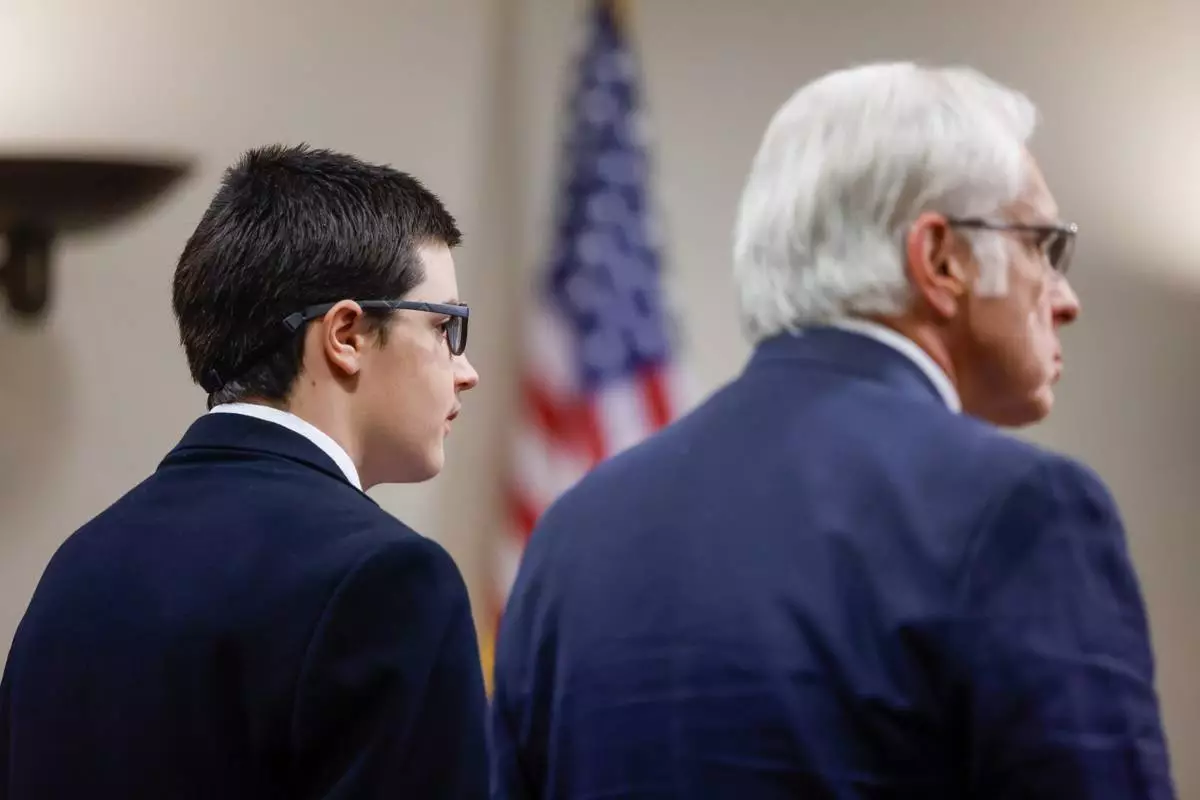
Colt Gray, left, the 16-year-old Apalachee High School shooting suspect, stands next to his attorney Charlton Allen and pleads guilty at Barrow County Superior Court in Winder, Ga., on Friday, July 24, 2026. (Arvin Temkar/Atlanta Journal-Constitution via AP)
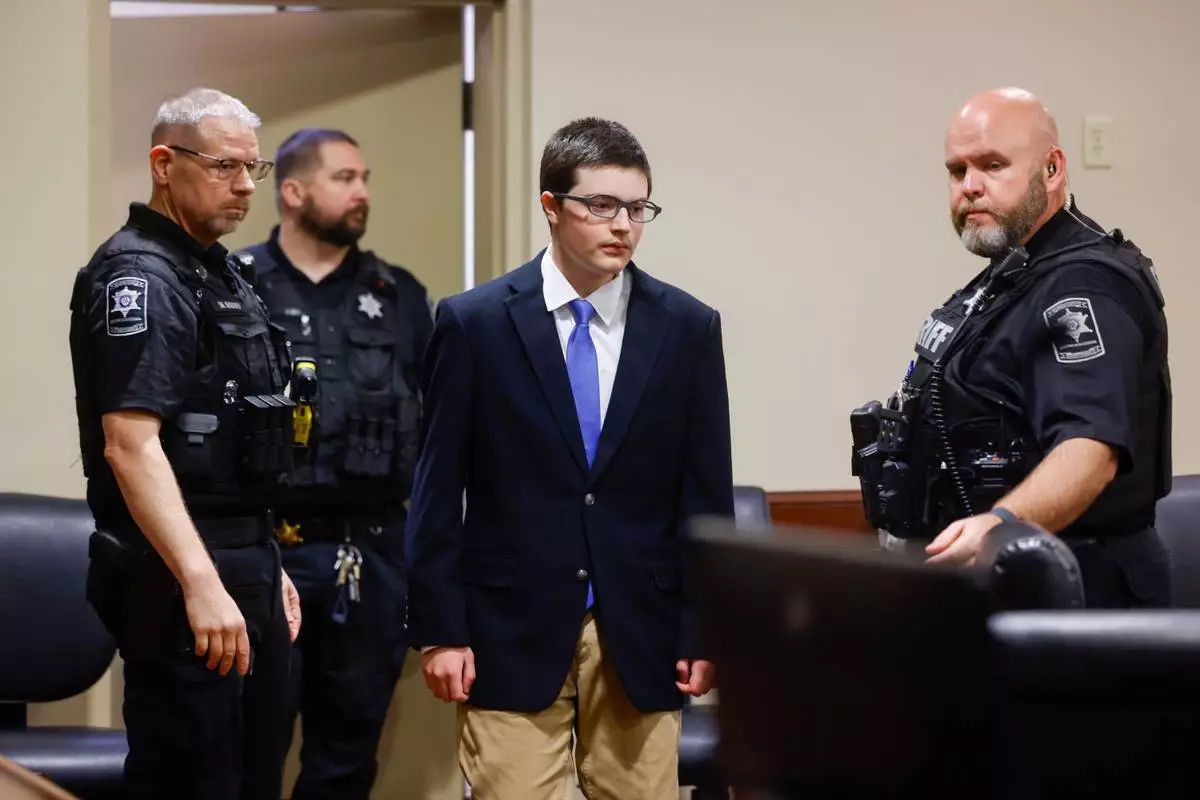
Colt Gray, the 16-year-old Apalachee High School shooting suspect, is led in by deputies for a plea hearing at Barrow County Superior Court in Winder, Ga., on Friday, July 24, 2026. (Arvin Temkar/Atlanta Journal-Constitution via AP)