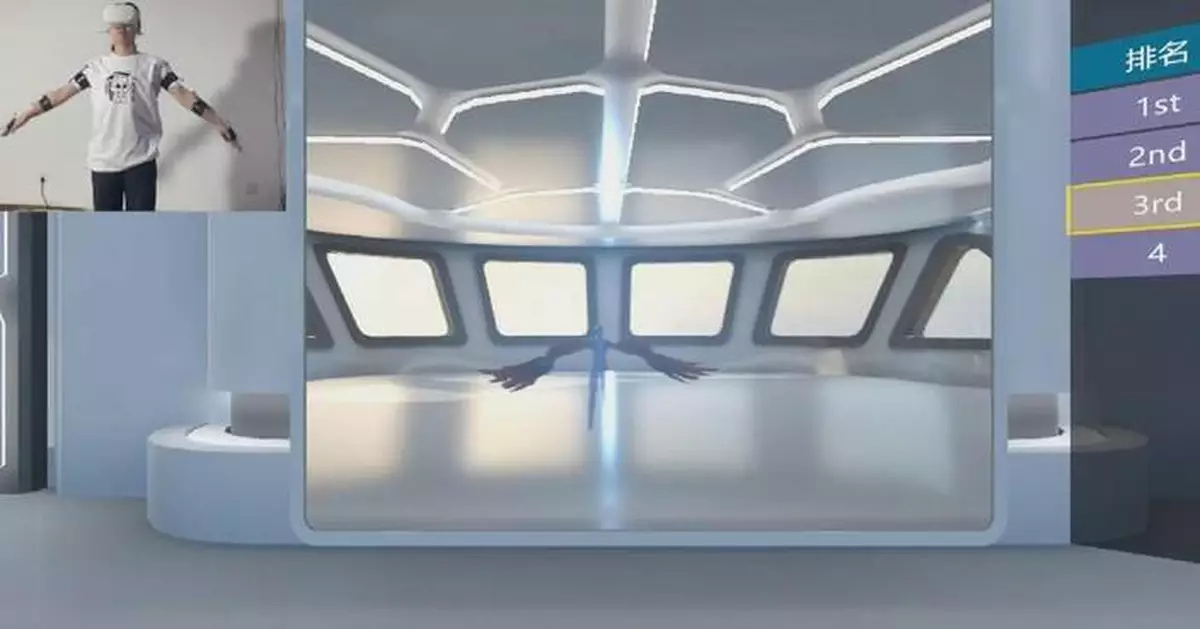
In a recent virtual reality (VR)-based study, a research team from Peking University in Beijing has demonstrated that the human brain can incorporate virtual wings into its body schema, offering new insights for the development of embodied intelligence technologies including brain-computer interfaces and smart exoskeletons.
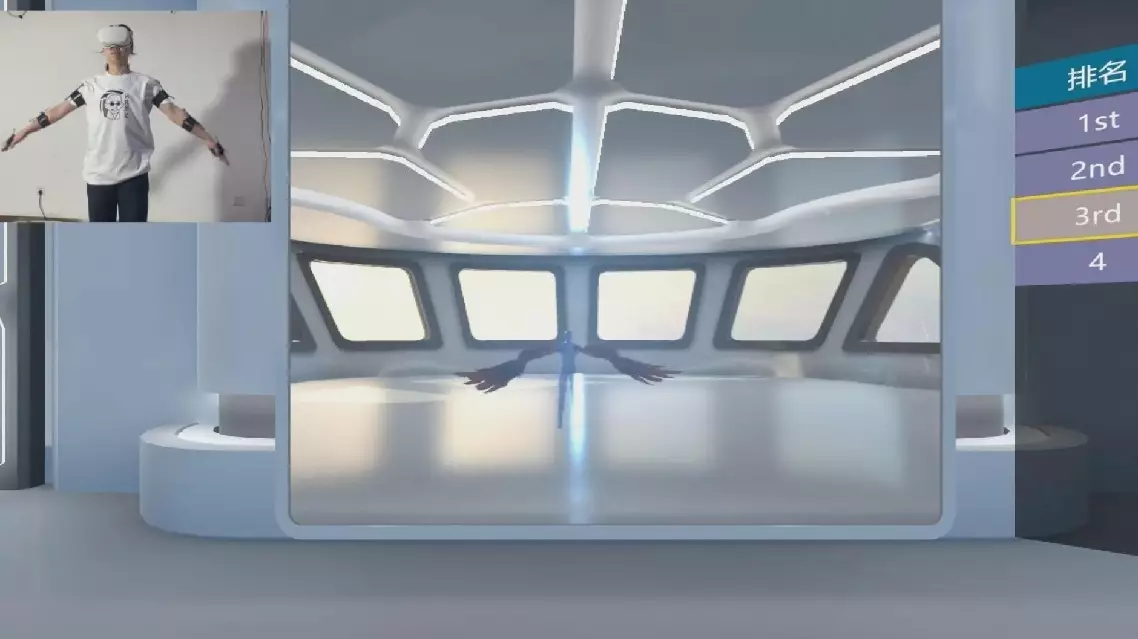
With a VR headset on, users can flap their arms and twist wrists to control a pair of virtual wings and feel a lifelike flight experience.
This immersive experience is made possible by a high-precision optical motion-capture system built by the Chinese researchers. With over a dozen cameras tracking every movement in fine detail, the virtual wings mirror the user's arms in real time -- flapping, ascending, diving, and turning -- all with the kind of seamless, instinctive control that makes the user forget the wings aren't really there.
The researchers also designed a progressive flight-training program, from basic pose-mimicking exercises, to hovering in three-dimensional space, all the way to navigating ring-shaped obstacles. They were essentially learning to operate the wings from the ground up -- as if they were birds learning to master their own wings for the very first time.
After just one week of virtual flight training, functional Magnetic Resonance Imaging (MRI) scans revealed a striking change: when volunteers viewed images of the wings again, the neural representation of the wings in their brains had become more similar to that of their own upper limbs and the connectivity between sensory and motor-related brain regions had also strengthened.
This suggests that even short-term VR training can reshape how the brain perceives an external object -- transforming unfamiliar wings into something imbued with bodily and motoric meaning. In short, the brain had begun to treat the virtual wings as though they actually belonged to the body.
The scientists attributed this remarkable adaptability to neuroplasticity -- the brain's innate ability to rewire itself. Rather than being fixed hardware, according to the researchers, the human brain is a dynamic system that continuously learns and updates.
"The brain essentially interpreted the wings as part of my own body -- that's the change we observed. This gives us new insights into how the brain works, and it has implications for other brain-related research, such as brain-computer interfaces. For instance, when we integrate external devices with the human brain, the question of where and how to integrate them becomes critical to performance. These are exactly some of the directions this work may inform," said Bi Yanchao, a professor at the School of Psychological and Cognitive Sciences, Peking University.
And it's not just about flight. Research teams around the world are now leveraging VR to unlock the brain's perceptual and cognitive potential -- from helping amputees gain better control over prosthetic limbs, to enhancing spatial awareness, directional judgment, and episodic memory.
As VR technology continues to converge with neuroscience, the field of embodied intelligence -- including brain-computer interfaces and smart exoskeletons -- could be in for a major leap forward on the road to truly seamless human-machine integration.
In many ways, this work is also fulfilling a vision articulated back in the 1990s by the renowned Chinese scientist Qian Xuesen, who famously translated the term "virtual reality" into Chinese as "ling jing" -- or "reverie" -- a prescient nod to the idea that technology can push humanity beyond its innate biological limits, continually expanding the boundaries of perception and action.
Chinese scientists' VR wings offer glimpse into future of embodied intelligence