SAN LEANDRO, Calif.--(BUSINESS WIRE)--Jul 28, 2026--
C-Crete Technologies has published two Environmental Product Declarations (EPDs) verifying that its cements cut embodied carbon by up to 95% versus conventional portland cement. C-Crete’s technology converts a broad range of natural rocks and industrial by-products into cementitious binders with no clinker and no kiln, so production is inherently decentralized — and it is already being poured in commercial concrete today.
This press release features multimedia. View the full release here: https://www.businesswire.com/news/home/20260728132467/en/
Verified performance, not projections
C-Crete’s clinker-free Ultra Low Carbon Cement ( NRMCA EPD 20353 ) reports a global warming potential of just 43.1 kg CO 2 -eq per metric ton — roughly 95% below the 919 kg CO 2 -eq reported in the Portland Cement Association’s industry-average EPD for U.S. portland cement. A second declaration ( NRMCA EPD 20355 ) covers a family of products: clinker-free versions range from 129 to 187 kg CO 2 -eq per metric ton (80–86% lower), while blended versions that retain some clinker range from 227 to 312 kg (66–75% lower). Both are third-party-verified Type III EPDs, developed under ISO 14025 and ISO 21930 and published through the National Ready Mixed Concrete Association (NRMCA).
The reductions come without sacrificing performance. C-Crete’s cements meet the ASTM C1157 hydraulic cement standard, reaching more than 5,200 psi at 28 days. The savings come from eliminating clinkerization — firing limestone in a kiln at roughly 1,450°C, the source of most of cement’s CO 2 — and instead activating natural minerals or industrial by-products through a proprietary chemistry.
One platform, many raw materials
C-Crete’s platform activates a wide spectrum of feedstocks into cementitious binder: natural minerals such as limestone, dolomite, granite, basalt, zeolite, pumice, and tuff, and industrial by-products and waste streams such as slag, fly ash, recycled concrete, and mine tailings. That lets producers build low-carbon cement from whatever materials are plentiful in their region — turning industrial and mining waste into a resource.
Built for local production and partnership
Conventional cement is capital-intensive and geographically fixed: a single clinker kiln can cost hundreds of millions of dollars. C-Crete inverts that model. With no kiln and no high-temperature calcination, and feedstocks abundant in nearly every region, production carries a far smaller capital and energy footprint and can be sited close to demand. For established producers, that is a capital-light path to a verified low-carbon product line that works within existing operations and distribution, draws on regional feedstocks, and helps meet tightening low-carbon procurement mandates. Rather than displacing incumbents, C-Crete’s model is designed to be adopted by them, market by market.
Already in commercial use — and ready for standards worldwide
This is not a laboratory concept: C-Crete’s binders are already being batched and poured in commercial concrete, a material producers can specify and place today. Nor is it limited to one market. Beyond the U.S. ASTM C1157 standard, the platform is well positioned for international standards that permit high portland-cement replacement — for example, Europe’s EN 197 allows roughly 55% replacement under CEM IV/B-P and up to about 50% and 65% under the composite cements CEM II/C-M and CEM VI. As regions move to lower the clinker content of their cements, C-Crete’s binders are natural candidates to fill that role.
“Decarbonizing cement can’t happen from one plant or one country — it has to happen everywhere cement is made,” said Dr. Rouzbeh Savary, Founder and President of C-Crete. “Because our chemistry runs on raw materials that exist almost everywhere, it’s well suited to local, decentralized production rather than a handful of massive kilns — a natural fit for producers who want verified ultra-low-carbon cement in their own markets, and we’re glad to work alongside them.”
About C-Crete Technologies
C-Crete is a materials science company whose platform technology converts a wide range of natural rocks and industrial by-products into ultra-low-carbon cementitious binders, replacing clinker-based portland cement without compromising performance or cost. Built for decentralized, locally sourced manufacturing, C-Crete’s binders are made for global scale.
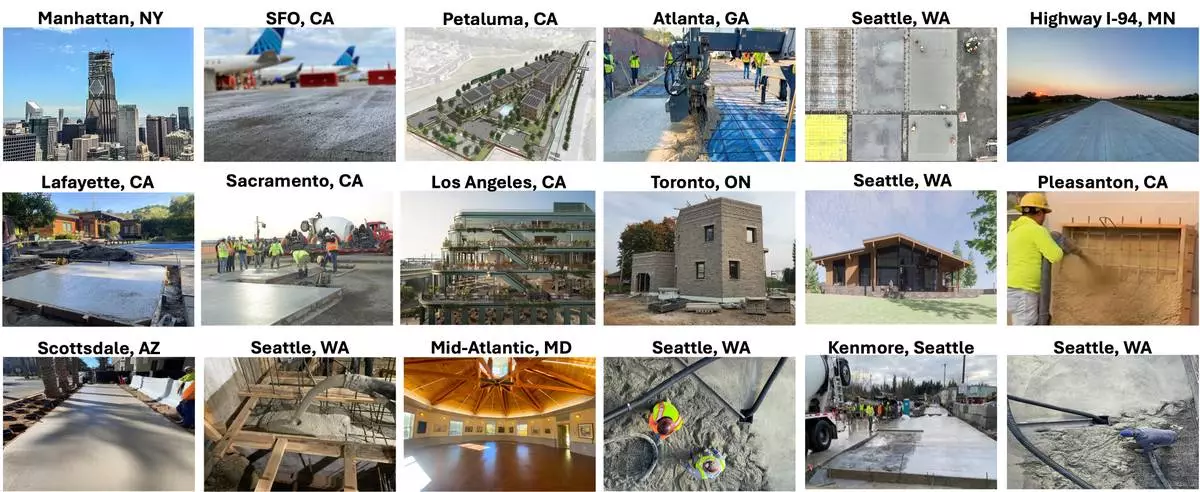
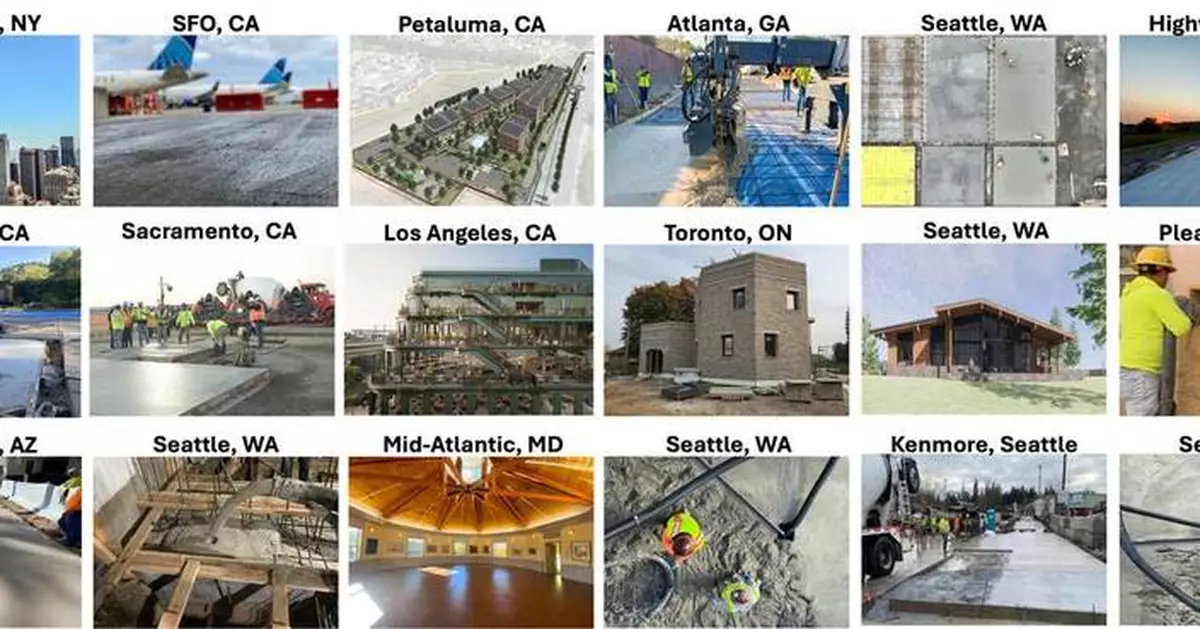
Representative C-Crete's project portfolio. More than 4000 tons of C-Crete's ultra-low carbon concrete have been poured in different cities since 2023. C-Crete's oldest pour is more than 3 years old, with no sign of degradation or cracking.