China has released its national climate change response plan for the 15th Five-Year Period (2026-2030), outlining key steps to meet the country's carbon reduction goals and bolster readiness for climate adaptation.
The plan, jointly released by the Ministry of Ecology and Environment and 17 other government departments on Wednesday, marks the first time a five-year plan has systematically established a full-scope target system for addressing climate change.
It stipulates that during the 15th Five-Year period, new and major progress will be achieved in climate change response and carbon peaking and neutrality efforts, with the full completion of the 2030 Nationally Determined Contribution.
By 2030, carbon dioxide emissions per unit of gross domestic product are set to decline by 17 percent from the 2025 level, while carbon dioxide emissions per product unit in industries covered by the national carbon market are to fall by approximately 3 percent from the 2025 level.
"This time, based on the 2035 nationally determined contribution target the state announced last year, we have further incorporated non-carbon-dioxide-related targets. For the first time, we have proposed that non-carbon-dioxide emission reduction capacity during the 15th Five-Year period should reach 30 million tons of carbon dioxide equivalent. This indicates that China's response to climate change and carbon emission reduction are advancing toward full greenhouse gas emission reduction," said Chai Qimin, director of the strategic planning department at the National Center for Climate Change Strategy and International Cooperation.
This plan tackles the climate crisis through eight major moves.
Slashing carbon dioxide emissions in high-impact sectors and reining in other potent greenhouse gases anchor the effort. To drive accountability, the strategy supercharges the national carbon market and builds a reliable carbon footprint tracking system.
These domestic measures pair with stronger defenses against climate risks and ramped-up real-world adaptation. The entire framework sharpens climate governance while stepping up China's global role in the fight against a warming planet.
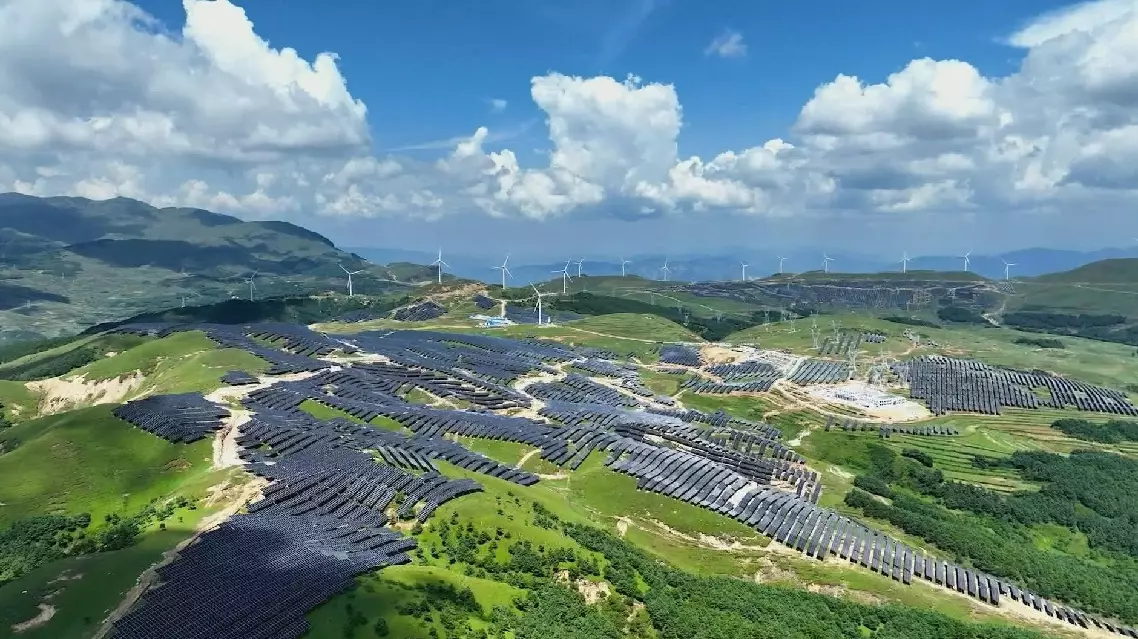
China releases national climate change response plan for 2026-2030
A number of university students in the U.S. capital have shared their views on China's initiative to invite 100,000 young Americans to visit the country for exchanges and study over the next five years.
The program was announced by Chinese President Xi Jinping when addressing a welcome ceremony at the White House during his visit to the United States from Wednesday to Friday.
Many of the students interviewed expressed their hope to visit some well-known places in China like Beijing, Shanghai and Guangdong.
"My dad's been to China for work, and he really loves it, so I'd love to go sometime. Maybe Shanghai. That's where my dad went, and he really liked it there," said a student.
"I've heard of Guangdong. I've heard of the basketball team," another student said.
Many of the students agreed that allowing more young Americans to experience Chinese culture in person would be beneficial for both countries.
"I think that's really cool to have the opportunity to connect with those cultures. And I really do like that idea. I think it's a great idea to invite us to China. It's great," said a student.
"I feel like the culture. I feel like getting the opportunity to immerse yourself in different cultures is really important," said another student.
"There's definitely value in traveling to other places and learning other cultures. So I think that it can be beneficial," said another one.
Even beyond cultural exchange, the students expressed their beliefs that American youth could learn a lot from Chinese society.
"I think, for me personally, it's the scale, with how many people live in China. I would definitely be interested in seeing how that functions, especially in those larger cities," said a student.
"I think I would like to know what their people are like. What are their thoughts on the world? On what the world should be like?" one student said.
"I think China's amazing. They're so far ahead. We're supposed to be the Western world, but I feel like they're so much more advanced than us in so many ways. I know AI and medicine are big things right now, and I think China has made huge advancements in that. So probably that," said a student.
The students also hope that the program will help strengthen China-U.S. relationship, promote educational exchanges, and broaden the horizons of those who take part.
"It's better for both countries to be connected and to build a better relationship over the coming years. And I think that's important to global peace and prosperity," said a student.
"I think it's really a great thing. I think different cultures, combining different cultures, and education is such a global thing, and having different students come all over the place and take classes here and there," said another student.
"There's a lot more to this world than what's right in front of us. And there's a lot to learn from different ways of seeing things around the world. So I think it could be valuable from that standpoint," a student said.

US students share views on China's plan to invite 100,000 young people for study, exchange