The latest statistics on Siberian tigers and Amur leopards, jointly compiled by Chinese and Russian teams, were released on Wednesday, the 16th International Tiger Day, showing that 21 tigers and 27 leopards engage in frequent cross-border activities.
Siberian tigers are China's only tiger subspecies with a stable wild breeding population, mainly living in Hunchun City and Wangqing County in northeast China's Jilin Province, on the border between China and Russia. They also live in cities like Dongning and Muling in northeast China's Heilongjiang Province.
As Siberian tigers migrate across the boundary line and river between the two countries, sharing intricate kinship, it is difficult to count their numbers precisely.
"This family actually roams across the border between the two countries, but before making comparisons, the Russian side only captured the image of the female tiger leading the tiger behind her, and they always believed that she had given birth to one in this litter. However, after our joint comparison this time, the Russian side also finally confirmed that she actually gave birth to two cubs this year," said Kong Weiyao, an official from the Assets Protection Division at the Northeast China Tiger and Leopard National Park Administration.
In November 2025, led by the Northeast China Tiger and Leopard National Park and Russia's Land of the Leopard National Park, institutions from both countries began conducting surveys on Siberian tigers and Amur leopards. After nearly eight months of work, experts from both sides recently confirmed the statistical results of individual tigers and leopards.
"After long-term joint efforts and repeated comparisons and verifications by experts from the two countries, it was finally determined that at least 147 wild Siberian tigers have been recorded in the cross-border protected areas between China and Russia. Among them, 72 are in the Northeast China Tiger and Leopard National Park, 96 are in Russia's Land of the Leopard National Park, and 21 are shared by both sides across the border. There are at least 223 wild Amur leopards, among which 115 are in the Northeast China Tiger and Leopard National Park, while 135 are in the Land of the Leopard National Park, with 27 individuals shared across the border between the two sides," said Duan Zhaogang, director of the Northeast China Tiger and Leopard National Park Administration.
The China-Russia joint survey on wild tiger and leopard populations has laid a solid foundation for further exploration of cross-border animal conservation and scientific research between the two countries.
The two countries will further establish a regular mechanism for monitoring and information sharing, with both sides to share data at least once every year for joint analysis, so as to update their data on tiger and leopard populations and the migration and spread of the animals in a timely manner.
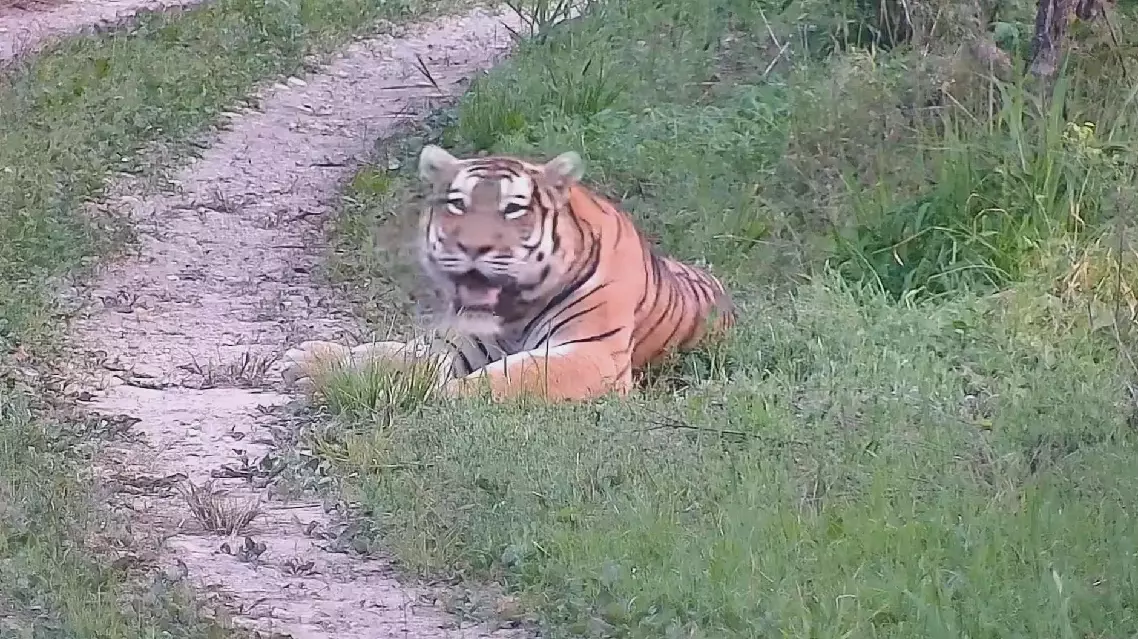
China, Russia unveil new data on Siberian tigers, Amur leopards