China's three high-growth industries, powered by innovation and high-tech breakthroughs, are gaining global traction, a China Media Group commentary said on Tuesday.
An edited English version of the commentary is as follows:
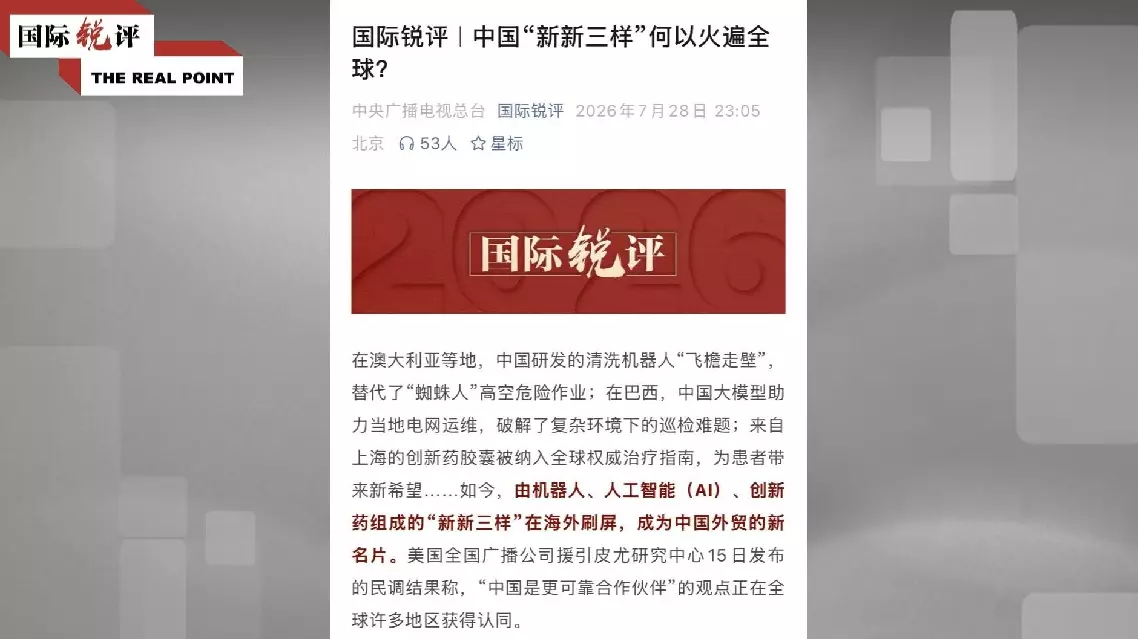
In Australia, the Chinese-developed facade-cleaning robots are taking over high-risk work at heights that once relied on "Spiderman" workers. In Brazil, Chinese large language models support local power grid operation and maintenance, solving inspection challenges in complex environments. An innovative drug capsule researched in Shanghai has been included in a globally influential treatment guideline, bringing new hope to patients.
China's next "new trio" - AI, robotics and innovative medicines, are going viral globally and have become the new name card for China's foreign trade. A recent Pew Research Center poll shows that people in many countries see China as a more reliable partner.
The shifts in China's foreign trade "best-seller list" trace a clear path of industrial upgrading. In the early stage of reform and opening-up, the "old trio" -- clothing, furniture and home appliances --secured access to global markets leveraging China's labor resource and cost advantages.
In recent years, China has seized opportunities in green transition, with green production capacity represented by new energy vehicles, lithium-ion batteries and photovoltaic products emerging as a standout force to form the "new trio" of China's foreign trade.
Today, China actively embraces the surging trends of AI and life sciences. Through forward-looking layout in new tracks and in-depth research and development of core technologies, it is driving the accelerated rise of the next "new trio" and the transformation from "Made in China" to "Smart Manufacturing in China".
Data shows that China's industrial robot exports rose 18.6 percent year on year in the first six months, which were sold to 141 countries and regions. Surgical robot exports saw an even more dramatic surge, jumping 3.3 times compared with the same period last year.
Chinese large language models registered 36.11 trillion tokens in weekly calls in the third week of July, ranking the first globally for 12 straight weeks, according to OpenRouter, a leading global AI platform.
In the first half of the year, all 11 new targets and new mechanisms drugs that approved by China's National Medical Products Administration were developed by Chinese firms. The value of China's innovative drug out-licensing deals reached about 110 billion U.S. dollars, which is 80 percent of last year's total. Chinese firms secured eight of the top 10 global pharmaceutical licensing deals by value.
The thriving next "new trio" industries show China is moving from a "world factory" to a global "innovation hub". The remarkable leap is driven by two key factors: China's profound understanding of and proactive approach to the new round of technological revolution and industrial transformation, and its consistent adherence to high-level self-reliance in science and technology.
Over the past five years, China's total research and development expenditure has registered an average annual growth rate of 10 percent, with its investment scale consistently ranking the second largest worldwide.
China's next "new trio" products have drastically lowered the threshold for accessing cutting-edge technologies, delivering more accessible advanced technologies and more inclusive outcomes sharing.
In Southeast Asia, Chinese AI solutions empower small and medium-sized enterprises to advance smart transformation and bridge the digital divide. In Thailand, Chinese medical robots deliver drugs and samples nonstop, easing local shortages of medical resources. In South America, Chinese firms have developed ride-hailing order dispatching systems based on telemetry technology, spurring new service models including motorcycle travel and ride-hailing delivery. These tailored solutions deliver tangible support for economic development and livelihood improvement across Global South countries.
Unlike certain Western countries that build barriers and blockades, China pursues innovation with an open-door policy, bringing new opportunities for global opening up and cooperation. The cumulative global download volume of China's open-source large models has exceeded 10 billion. Financial Times reported that international platforms including Pinterest and Airbnb have long adopted Chinese open-source models to optimize their products and iterate services.
The World Artificial Intelligence Cooperation Organization (WAICO) was recently established in Shanghai, a key milestone in the history of AI development that will rally the international community to actively advance AI development and governance.
Openness drives progress, while isolation inevitably leads to backwardness -- this is the rule of the development of the world's industries. The next "new trio", leading the way towards an intelligent future, serve not only as new engines for China's economic growth, but also as key driving forces for common prosperity across all countries. This once again strongly proves that China's development brings the world opportunities rather than shocks, and empowerment rather than threats.
China's AI, robotics, pharmaceuticals gain global traction as innovation drives high-tech rise: commentary