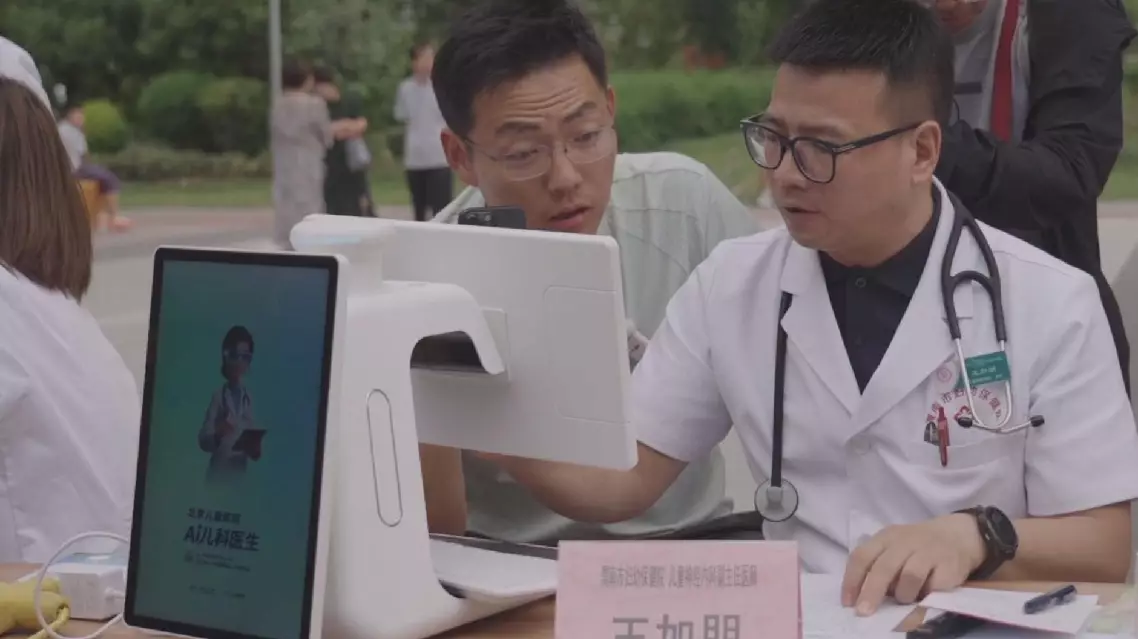
In a small maternal and child health center in rural Weinan City in northwest China's Shaanxi Province, an unusual consultation is underway.
As Dr. Wang Jiapeng examines a young patient, an artificial intelligence (AI) system quietly listens in, transcribing symptoms and analyzing data in real time.
The 'AI pediatrician' developed by Beijing Children's Hospital is now being deployed to counties, townships, and villages across China.
Rather than replacing human doctors, the technology serves as an intelligent aid, assisting clinicians at the grassroots level to deliver quality care closer to home.
The more the doctor examines the patient, the more precise the AI's diagnostic suggestions become. It processes the dialogue between doctor and patient, generates case analyses, and offers treatment recommendations—all in sync with the consultation.
"This is an 'AI pediatrician' from Beijing Children's Hospital. While we are seeing the patient, it listens in on the presenting complaints. His diagnosis runs in parallel with mine," said Dr. Wang, director of the Pediatric Neurology Department at the Weinan Maternal and Child Health Hospital.
"Look, the AI also confirmed [the allergic rhinitis] as the final diagnosis. Local folks often think a child's dark circles are caused by food retention. But when rhinitis develops, the nasal cavity becomes edematous, and the capillary drainage is obstructed, causing blood to pool there. That's what forms these dark patches," Wang said.
In complex cases, such as the young narcolepsy patient Dr. Wang consulted recently, the AI provides a vital second opinion.
"The child I saw just now is a narcolepsy patient. This child is a bit special as he is suffering a neurological disorder. Some medicines are not working well on him, so I want to check if the 'AI pediatrician' can give him better guidance," Wang said.
For many families, access to top-tier pediatric expertise has long meant traveling to provincial capitals or even Beijing. One parent, clutching a thick stack of medical records from visits to Xi'an, Guangzhou, and Shenzhen, worried that a costly trip to Beijing would be the only option if current treatments failed.
"We've taken him to Xi'an, Guangzhou and Shenzhen. If those don't work either, Beijing is our only option left," said the parent.
The 'AI pediatrician' aims to change this dynamic.
According to Ni Xin, president of Beijing Children's Hospital, the system is the product of nearly a decade of development. Since 2015, the hospital has been digitizing the collective knowledge of its specialists.
"We developed an auxiliary diagnostic software back in 2015. We interviewed every expert at our hospital over a period of about six months. Through these interviews, we transformed each expert's understanding, thoughts and considerations about all diseases into hard-core knowledge to train our software," said Ni.
The software was subsequently trained on hundreds of thousands of consultations and fed a vast dataset of 30 million high-quality medical records, alongside the latest scientific research and clinical guidelines.
Since its launch over a year ago, the pilot program has expanded to 12 provinces and regions across China.
"So what empowers our grassroots pediatric doctors to treat patients and to dare to treat them? This 'AI pediatrician' is a medical team that never leaves the community. Just keep it powered and keep the computing power flowing, and it's there to stay," said Ni.
The initiative represents a significant step in bridging the urban-rural healthcare divide, ensuring that advanced medical knowledge is no longer confined to big cities, but is accessible to every family, regardless of their location.
'AI pediatrician' brings top hospital expertise to rural clinics in Shaanxi