Northwest China's Xinjiang Uygur Autonomous Region, a major livestock production base in China with more than 50 million head of cattle and sheep, has entered its annual season of hay-making for livestock wintering, as farmers across the Tianshan Mountains start cutting forage for winter storage.
The Nalati grassland, located in the Ili River Valley, is one of Ili's core forage-producing areas. It will brace the hay harvest season in early August.
In the Tajik Autonomous County of Taxkorgan, 1,800 mu (120 hectares) of alfalfa are blooming in full splendor on the Pamir Plateau.
These purple flowers are hailed as the "king of forage" and serve as a vital winter feed source for local cattle and sheep.
In addition to natural pastures, the growth of cultivated forage is equally encouraging.
In the Beishawu area of Altay City, green grass "circles" are embedded in the yellow sand, creating a unique landscape in the desert.
The locals employ water-saving sprinkler irrigation technology to establish large-scale forage planting bases in sandy regions, which not only prevent wind erosion, stabilize sand dunes, and improve the ecosystem but also produce a diverse range of forage to support the livestock industry, achieving a win-win outcome for both ecological and economic benefits.
Hay harvesting in most parts of Xinjiang will be largely completed by the end of August this year, while harvesting in high-altitude mountain pastures will continue through early September.
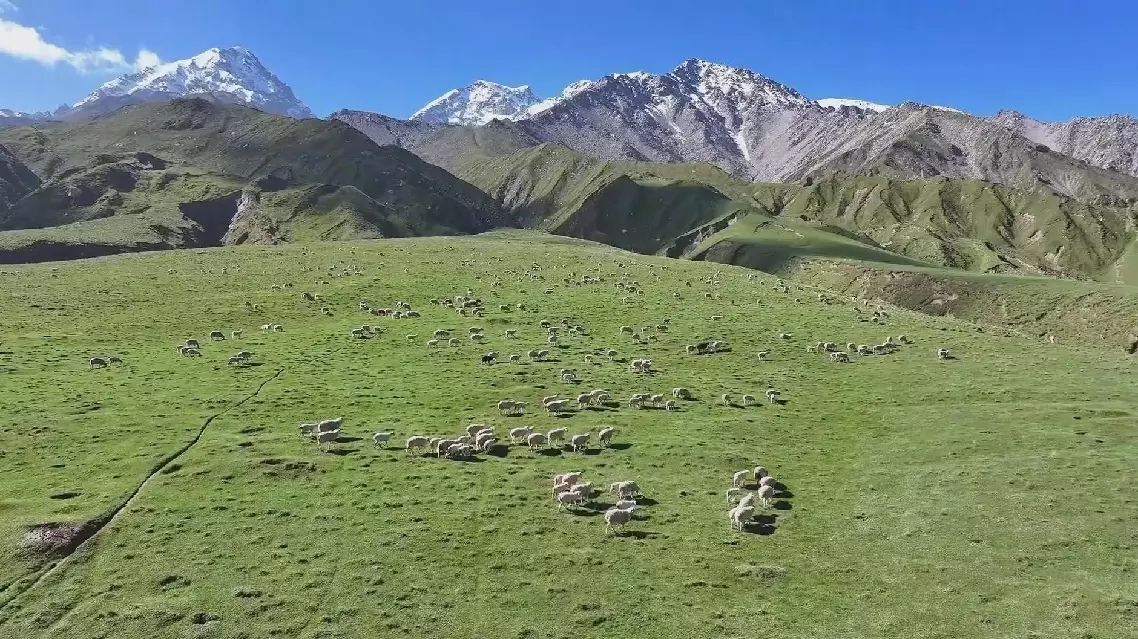
Northwest China's Xinjiang enters busy season of hay harvest for livestock wintering