The claim by some Western countries that China has overcapacity is unfounded. On the contrary, China's development is continuously providing opportunities and benefits to the world, a China Media Group commentary said on Wednesday.
An edited English version of the commentary is as follows:
In recent years, some Western economies have politicized trade and economic issues to protect their industrial competitiveness and market position, hyping up the erroneous claim of so-called "overcapacity" in China and using it as a pretext to implement various protectionist measures. China's Ministry of Commerce released a document on Tuesday, using detailed data and case studies to clarify its position, providing a window for the international community to comprehensively and objectively view global production capacity and the so-called "overcapacity." There is currently no broad global consensus on what constitutes "overcapacity". Capacity utilization rate is commonly used as a metric, but it needs to be considered in light of each country's specific circumstances. Data from relevant institutions indicates that the median capacity utilization rate in developed and rapidly growing economies is mostly between 75 and 80 percent, while in less developed countries it is generally between 50 and 64 percent.
As the world's largest developing country, China continues to advance its supply-side structural reforms. By 2025, the capacity utilization rate of industrial enterprises above designated size has reached 74.4 percent, which is within reasonable range.
Cui Fan, a professor at the University of International Business and Economics, said that a major highlight of China's newly-released paper is that it dedicates a chapter to sorting out four core relationships between "overcapacity" and industrial subsidies, trade surplus, economic imbalance, and market competition, which effectively clarifies some erroneous interpretations and perceptions of the international community regarding China's production capacity issue.
In response to the erroneous claim that China's industrial subsidies have led to overcapacity,the paper clearly states that subsidies themselves are not the problem, but they should be used reasonably within the framework of WTO principles of openness, fairness, and compliance. Multiple reports from UNCTAD show that global industrial support policies have been increasing over the past five years, with providing research and development subsidies, tax incentives, and low-interest loans being common international practices for supporting the development of emerging industries. Experts said that China's industrial subsidy policies reflect an organic combination of an effective market and a proactive government. At the same time, China's subsidies are applied equally to all types of market operators. For example, in the trade-in program for consumer goods, the policy is consistent for both domestic and foreign companies, with foreign-invested enterprises actively participating and benefiting equally.
China's technological breakthroughs and leading positions in many fields are the result of long-term, high-investment research and development, overcoming difficulties and challenges, rather than relying on government subsidies.
In an recent media interview, Joe Ngai, McKinsey's Greater China chair, described China as "the world's toughest gym," training hyper-competitive companies.
In response to some Western countries equating China's large trade surplus with "overcapacity," the paper also uses numerous examples to demonstrate that this argument is untenable. As a responsible major country, China never deliberately pursues a trade surplus. Its export growth stems from economies of scale and improved innovation capabilities, as well as the needs of countries for green transformation and industrialization.
In terms of the distribution of trade benefits, foreign-invested enterprises accounted for 27 percent of China's exports and 16 percent of its trade surplus in 2025, with both their surplus and profit growth rates exceeding those of Chinese enterprises. Moreover, China has deficits in service trade and investment income, but overall, its current account surplus accounts for approximately 3.7 percent of GDP, which is within the internationally recognized reasonable range.
Some Western countries attribute their own economic slowdown and lagging industrial transformation to China's development, which is inconsistent with the laws of economic development.
Ultimately, the development difficulties faced by some Western economies are the result of a combination of factors, including the profound restructuring of global industrial chains, geopolitical instability, and lagging reforms, and are by no means due to the so-called "Chinese industrial shock."
In fact, China is leveraging its market advantages, industrial development, and technological progress to provide the world with increasing dividends in market, in development, and in innovation, continuously unleashing "China Opportunity 2.0."
Today, the "new trio"—new energy vehicles, lithium batteries, and photovoltaic products—continue to gain popularity globally, while the next "new new trio" - AI, robotics and innovative medicines—are developing rapidly, powerfully driving global green, low-carbon, and technological progress. An article on the US website "Foreign Policy in Focus" points out that the West's one-sided narrative about China's "overcapacity" deliberately ignores the important role China plays in global economic stability.
Take China-Europe economic and trade cooperation as an example. Both sides are each other's second-largest trading partners, with strong industrial complementarity and enormous potential for cooperation. For a long time, European companies in high-end manufacturing and biomedicine have cultivated the Chinese market and reaped tangible development benefits. Today, China is rapidly breaking through in innovative sectors such as new energy, AI, and the digital economy, creating new growth opportunities for deepening China-EU industrial cooperation and leveraging each other's strengths.
Overcapacity is a dynamic phenomenon in a market economy. Related economies should view it objectively and dialectically, based on the laws of economic development. Blaming China will not solve their own problems. Recent polls by the Pew Research Center and several international organizations show that positive perceptions of China are steadily rising globally. This demonstrates that various fallacies about China cannot deceive the world; and that "China Opportunity 2.0" is widely-recognized consensus.
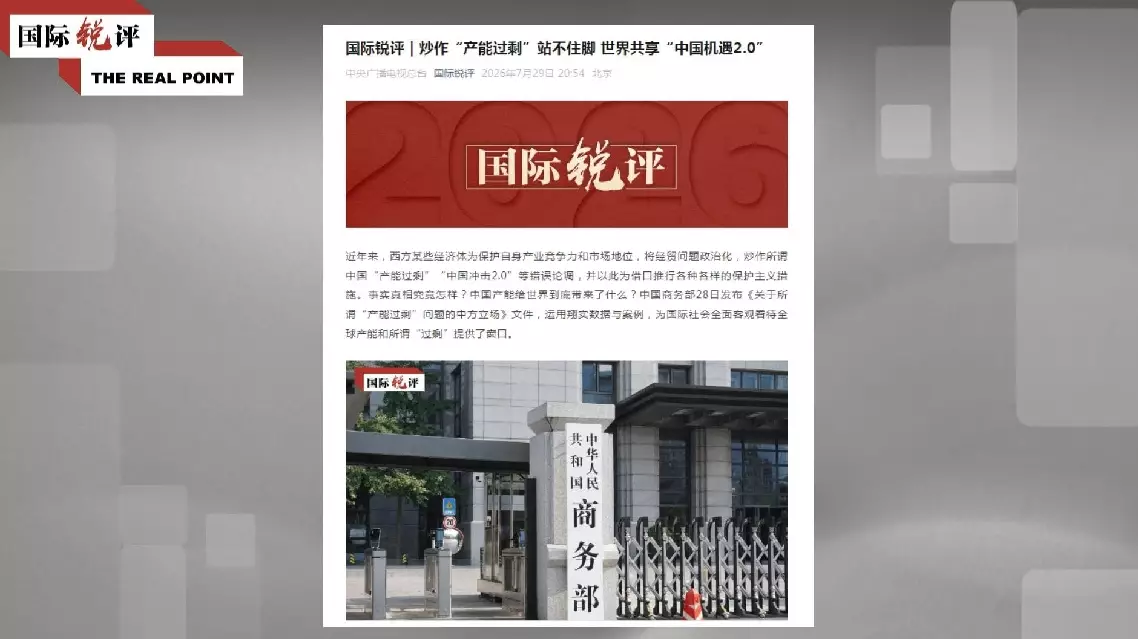
China clarifies so-called overcapacity issue, provides opportunities to globe: commentary