BRENTWOOD, Tenn.--(BUSINESS WIRE)--Jul 30, 2026--
Comdata today announced the launch of Pay Codes across locations nationwide, the latest innovation in Comdata's continued commitment to protecting fleets, simplifying fuel payments, and keeping drivers moving.
This press release features multimedia. View the full release here: https://www.businesswire.com/news/home/20260730422821/en/
For more than 50 years in the industry, Comdata has continuously evolved its fuel payment solutions to address the changing needs of fleets. Comdata introduced the industry's first No Fraud Guarantee, OneClick for streamlined fueling transactions, and eReceipts for lumper payments. Comdata has consistently invested in technologies that help fleets operate more efficiently while strengthening payment security. The launch of Pay Codes represents the next step in that evolution. Available now nationwide at TA, at select Pilot and 7-Eleven locations, and expanding to more locations soon.
"Our customers expect us to continuously innovate on their behalf," said Feras Chami, President & GM, Corpay North America Trucking. "Pay Codes demonstrate our ongoing commitment to listening to the marketplace and delivering solutions that make fueling faster, easier, and more secure."
Pay Codes provide drivers and fleets with a fast, secure, single-use digital fueling option that can be generated directly within the Comdata app and the Driven for Comdata (DFC) app. Pay Codes can be administered by both fleets and drivers and deliver the same transaction integrity, controls, and protections that customers expect from every Comdata fuel transaction.
In addition to enhancing fraud prevention by helping eliminate common tactics such as card skimming, credential theft, and unauthorized card reuse, Pay Codes dramatically accelerate onboarding. New customers can be approved and fueling in minutes rather than waiting days for physical cards to arrive, helping fleets get drivers on the road faster and reduce operational delays.
At launch, Pay Codes provide fleets with:
"At Comdata, innovation has never been about a single product — it's about continually finding new ways to help fleets operate more efficiently and securely," said Randy Morgan, President of Comdata. "Pay Codes builds on the foundation we've established through innovations like the No Fraud Guarantee and OneClick, giving fleets another powerful tool to combat fraud, simplify operations, and keep drivers moving."
Available now through the Comdata app and Driven for Comdata (DFC) app. Pay Codes add another layer of protection to Comdata's comprehensive fuel payment ecosystem. This launch reflects Comdata's ongoing investment in delivering practical innovations that help fleets move faster, stay protected, and adapt to the evolving demands of the trucking industry.
To learn more, visit Comdata.com.
About Comdata
Comdata Inc., a Corpay company, is a leader and innovator in commercial payment solutions, driving actionable insights from spending data, building enhanced controls to protect clients’ interests, and positively impacting day-to-day operations for fleet owners and managers and drivers in the trucking industry. Founded in 1969 in Brentwood, Tennessee, Comdata has proudly supported the life-impacting trucking industry for over 50 years. To learn more, visit www.Comdata.com.
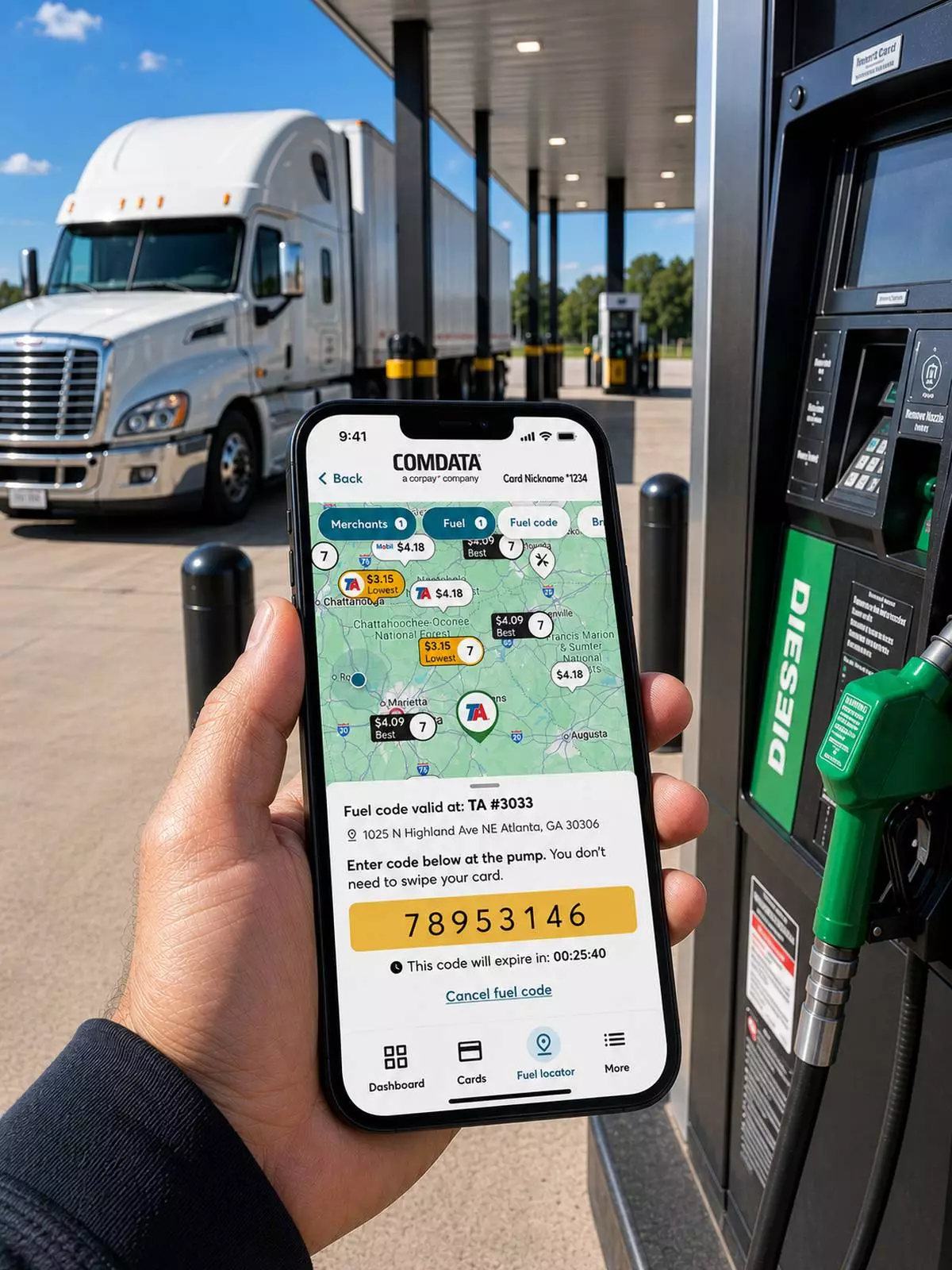
Comdata Pay Codes shown on mobile device next to fuel pump
NEW YORK (AP) — U.S. stocks are rebounding Thursday after Microsoft leaped on hopes that its big spending on AI is translating into profits, while computer-chip companies clawed back some of their sharp recent losses.
The S&P 500 rallied 1.3% and recovered two-thirds of its drop from the prior day, which was its worst in seven weeks. The Dow Jones Industrial Average was up 450 points, or 0.9% as of 12:50 p.m. Eastern time. The Nasdaq composite, which is full of artificial-intelligence stocks, jumped 2.3% a day after it fell 9.8% below its record set last month.
Microsoft led the way and leaped 16.3% after reporting a stronger profit for the latest quarter than analysts expected. Growth was strong for its Azure cloud business, and CEO Satya Nadella said it reflects how customers are using Microsoft to move into AI.
Perhaps just as importantly for Wall Street, Microsoft did not announce a big increase in how much it plans to spend on AI investments, something that several other Big Tech rivals have done. Worries are high that such spending is eating into companies’ cash flows and may not ultimately be worth it if AI does not produce as much productivity and profits as promised.
Meta Platforms helped demonstrate such fears after falling 9.5%. The parent company of Facebook and Instagram reported a weaker profit for the latest quarter than analysts expected, even though it made slightly more in revenue than expected. It also raised the lower end of its forecasted range for spending on investments this year.
Companies involved in the making of the computer memory and processors that such “hyperscalers” are buying rose Thursday, recovering some of the big losses they’ve taken on worries that their stock prices shot too high in the euphoria around AI.
Micron Technology jumped 16%, for example, to trim its loss for the week to 6.9%. It was one of the strongest forces lifting the S&P 500 after Microsoft.
Lam Research, a supplier to the semiconductor industry, soared 17.6% after reporting stronger profit and revenue for the latest quarter than analysts expected. Chip giant Advanced Micro Devices rallied 12.9%.
In the bond market, longer-term Treasury yields held a bit steadier following their sharp accelerations Wednesday. They had jumped after the chairman of the Federal Reserve, Kevin Warsh, gave few clues about what the central bank will do with interest rates to combat the painfully high inflation that continues to hurt the country.
Higher rates could keep a lid on inflation, but they can also slow the economy and undercut prices for stocks and other investments.
The yield on the 10-year Treasury eased to 4.66% from 4.67% late Wednesday. The 30-year Treasury yield held steady at 5.20%, a day after it shot up from 5.09%. They move with investors’ expectations for inflation and economic growth in upcoming years.
Warsh reaffirmed on Wednesday the Fed wants to get inflation back down to 2%, even though the central bank decided not to raise interest rates despite its remaining higher than that. He also implied the bond market may already be doing some of the Fed’s work to restrain inflation, and he pointed to how yields have climbed since the central bank’s last meeting six weeks earlier.
That leaves investors questioning whether the Fed is prepared to act if inflation worsens, or whether it is relying on financial markets to achieve the same outcome, according to Seema Shah, chief global strategist at Principal Asset Management.
“If investors conclude that the latter is true, the credibility of the Fed’s inflation-fighting commitment could come under increasing scrutiny. Arguably, it already is.”
President Donald Trump, who nominated Warsh to lead the Fed, has argued for lower interest rates even though they could cause inflation to accelerate.
Reports released Thursday suggested the U.S. economy’s growth slowed by more during the spring than economists expected. A measure of Inflation, meanwhile, remained worse last month than the Federal Reserve’s target, but it slowed from May.
In the oil market, prices eased back.
Brent crude, the international standard, fell 1.2% to $87.01 per barrel. It had swung as low as $72 early this month and as high as $102 last week on uncertainty about whether the United States and Iran could reach a deal to allow oil tankers to move freely again from the Middle East to customers worldwide.
In stock markets worldwide, indexes rose in Europe following a mixed finish in Asia. South Korea's Kospi fell 1.2%, and France's CAC 40 rose 0.9% for two of the world's bigger moves.
Seoul's market has been at the center of the huge recent moves for AI stocks because it's dominated by two tech titans, Samsung Electronics and SK Hynix. After more than doubling through this year's first six months, the Kospi has plunged 34% so far in July.
Its drop on Thursday came as Samsung Electronics dipped 0.7%. The tech giant reported a record profit for the spring and said demand for its chips continues to outpace supply, but its earnings nevertheless fell shy of analysts' high expectations.
AP Business Writers Chan Ho-him and Matt Ott contributed to this report.

FILE - People pass the New York Stock Exchange on May 28, 2024, in New York. (AP Photo/Peter Morgan, File)

FILE - The New York Stock Exchange is seen in New York, Thursday, March 19, 2026. (AP Photo/Seth Wenig, File)

A screen shows the Korea Composite Stock Price Index (KOSPI), SK Hynix and Samsung Electronics Co. stock price at the foreign exchange dealing room of the Hana Bank headquarters in Seoul, South Korea, Thursday, July 30, 2026. (AP Photo/Ahn Young-joon)

Currency traders work at the foreign exchange dealing room of the Hana Bank headquarters in Seoul, South Korea, Thursday, July 30, 2026. (AP Photo/Ahn Young-joon)
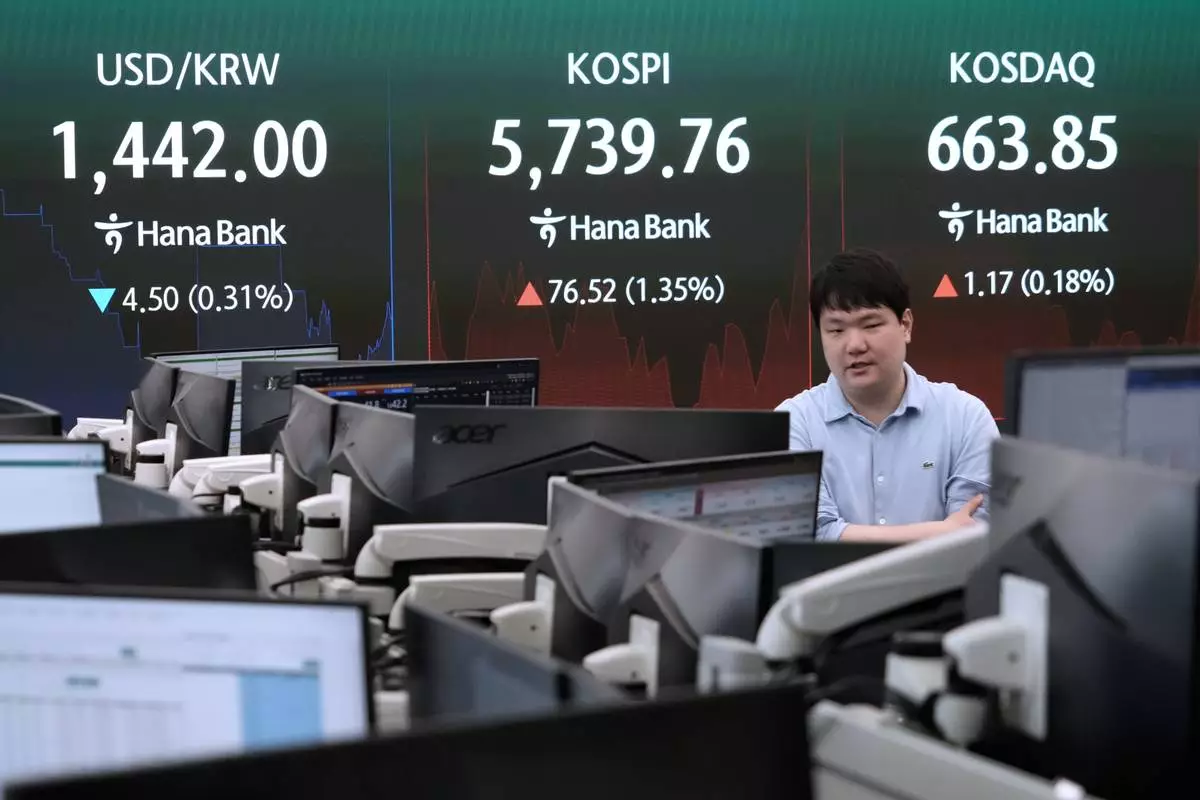
A currency trader passes by a screen showing the Korea Composite Stock Price Index (KOSPI) and the foreign exchange rate between U.S. dollar and South Korean won at the foreign exchange dealing room of the Hana Bank headquarters in Seoul, South Korea, Thursday, July 30, 2026. (AP Photo/Ahn Young-joon)

Currency traders watch monitors near a screen showing the Korea Composite Stock Price Index (KOSPI) at the foreign exchange dealing room of the Hana Bank headquarters in Seoul, South Korea, Thursday, July 30, 2026. (AP Photo/Ahn Young-joon)
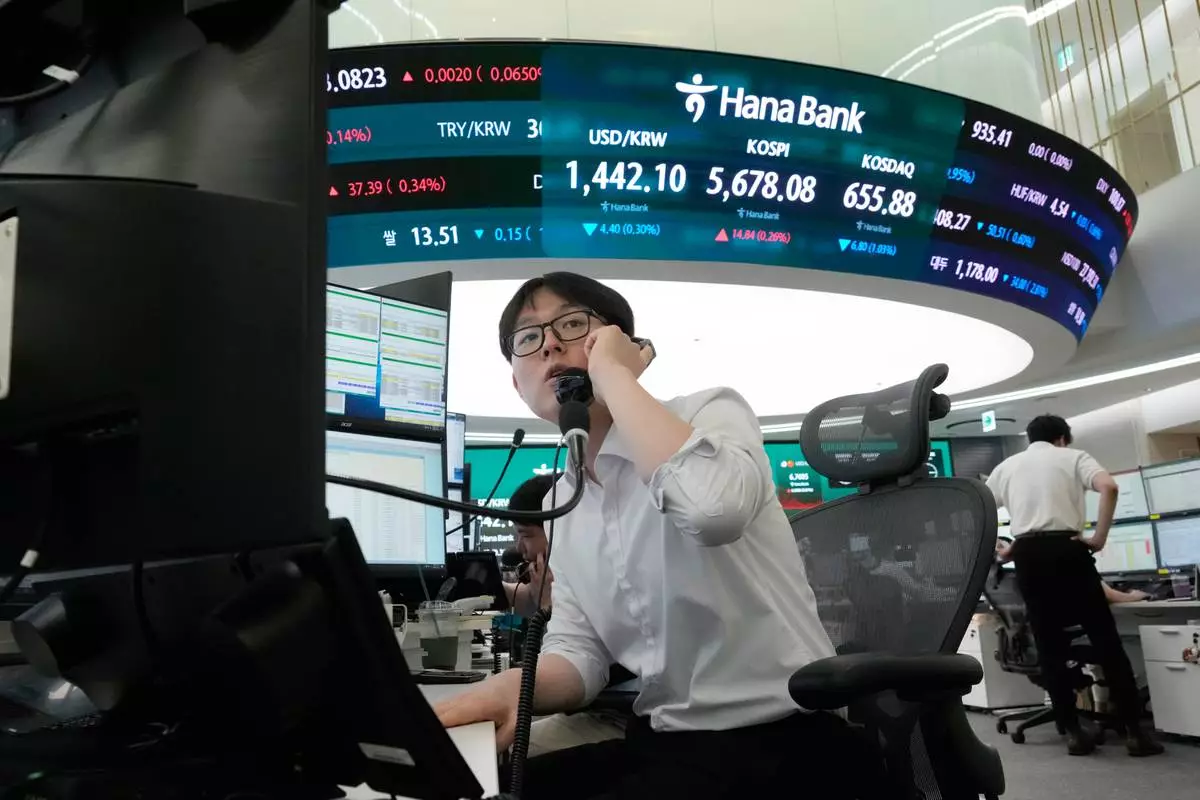
A currency trader talks on the phone at the foreign exchange dealing room of the Hana Bank headquarters in Seoul, South Korea, Thursday, July 30, 2026. (AP Photo/Ahn Young-joon)