MIAMI GARDENS, Fla. (AP) — Don't call it a rebuild. Miami Dolphins players and coaches aren't viewing this season as one.
The team has a first-year head coach, a new general manager and a reshaped roster with a lot of young, unproven players but no one wants this to be just a bridge year.
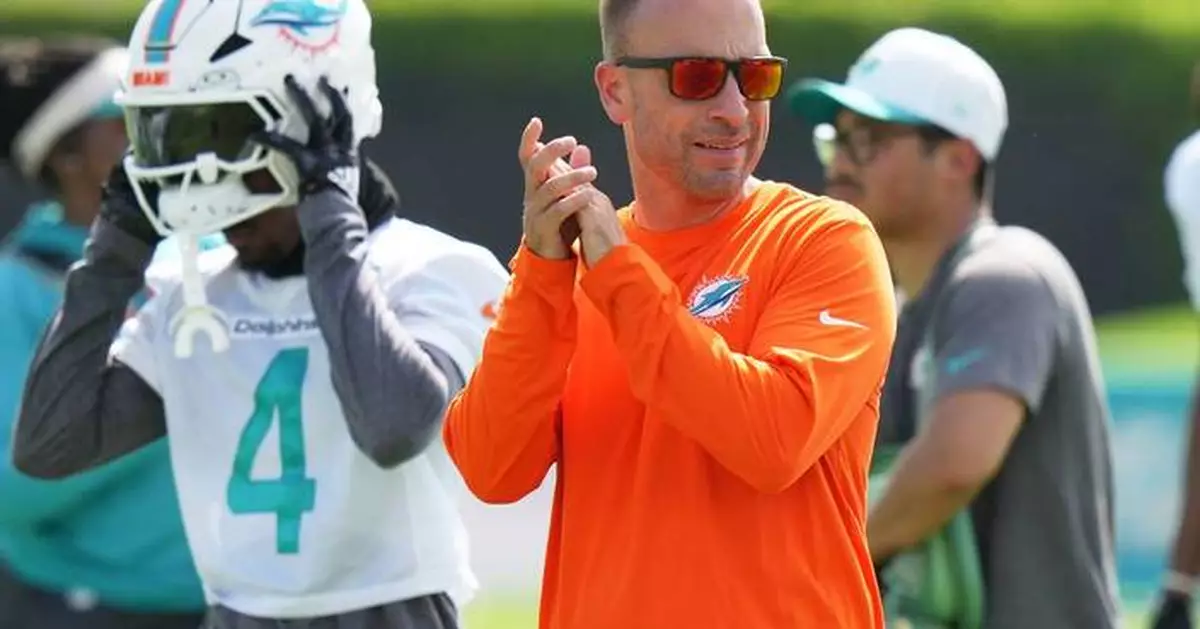
“I don't know how you can have a conversation with a competitive player or a competitive coach and have it sit right with them where we're just going to say, 'We're just going to rebuild this year,'” Dolphins coach Jeff Hafley said Thursday ahead of Miami's second full day of training camp practice. “I mean, that's just not the mentality of any competitor who's made it to this level or any coach that's made it to this level. Whether it's practice or whether it's a drill. I think we all want to win. And our mindset is we need to get better.”
When GM Jon-Eric Sullivan arrived in January, one of his immediate goals was to help the Dolphins out of their woeful financial situation.
More than half of the Dolphins’ salary cap space for the upcoming season will go to players who are no longer on their roster. That includes $54 million they will pay to former starter Tua Tagovailoa after cutting him in March and starting over at quarterback with Malik Willis. The move resulted in a $99 million dead cap hit, the largest in NFL history, to be split over two years.
Over the past few months, Sullivan began a process that has included trading and releasing established cornerpieces with lucrative contracts and bringing in younger players, mostly on one-year deals. The former Green Bay executive is also employing the same philosophy that he has said allowed the Packers to build sustained success over the years: by drafting a developing their own players.
Both Sullivan and Hafley have said it will take time to develop into the perennial winner they're aiming to be, but that doesn't mean they don't believe they can see immediate returns from the current players on their roster.
“Everything we do is going to be about competing to get better throughout the process, and we want to win,” Hafley said. "So I just don’t think any player or any coach is going to sit here and say ‘I’m just going to throw in the towel and just rebuild.’ That’s probably why no one’s hearing that. I think if you had a group of players saying that, then I think we’ve got the wrong players.”
That mindset has trickled down to players.
“I don’t look at it as a rebuild because I’m in it and I play the game,” said veteran linebacker Jordyn Brooks, who recently signed a three-year contract extension. “I realize being in the league, everybody is super talented, and it’s not always what it looks like on paper. ... I don’t really care if people think that it’s a rebuild or they think we’re going 0-17 or whatever people have been saying. I look at it as we've got a bunch of football players who’s hungry, super talented. Nobody in this locker room would be here if they didn’t have what it takes."
Practices so far under Hafley have been lively and physical: characteristics the coach wants his team to embody all year.
Thursday's session was highlighted by a forced fumble and recovery by edge rusher Chop Robinson on running back De'Von Achane early in 11-on-11 drills. Rookie cornerback Chris Johnson also forced and recovered a fumble on running back Ollie Gordon II.
Hafley has opted to forgo typical 7-on-7 drills during the first two days of training camp, instead having team drills take place in a more game-like 11-on-11 format. The former Packers defensive coordinator said he prefers it that way to build better situational down-and-distance habits.
“All those little things with the officials being there in 11-on-11 and they’re throwing the flags will send the message of ‘this is important,'” Hafley said. “If they weren’t there, and we were just doing 7-on-7 — I mean, we had a great play on defense yesterday. It was third-and-10, and our defensive end lined up offsides. That doesn’t happen in 7-on-7. Like all those things, we have to get the rust off, and that’s what training camp is all about.”
Players like it that way as well.
“It's real life football,” said veteran center Aaron Brewer, also coming off an offseason contract extension. “We're not here playing flag football. When you go to gameday, it's 11-on-11 — not 7-on-7. It's more work to translate from practice to game day. That's what we're trying to do.”
AP NFL: https://apnews.com/hub/nfl
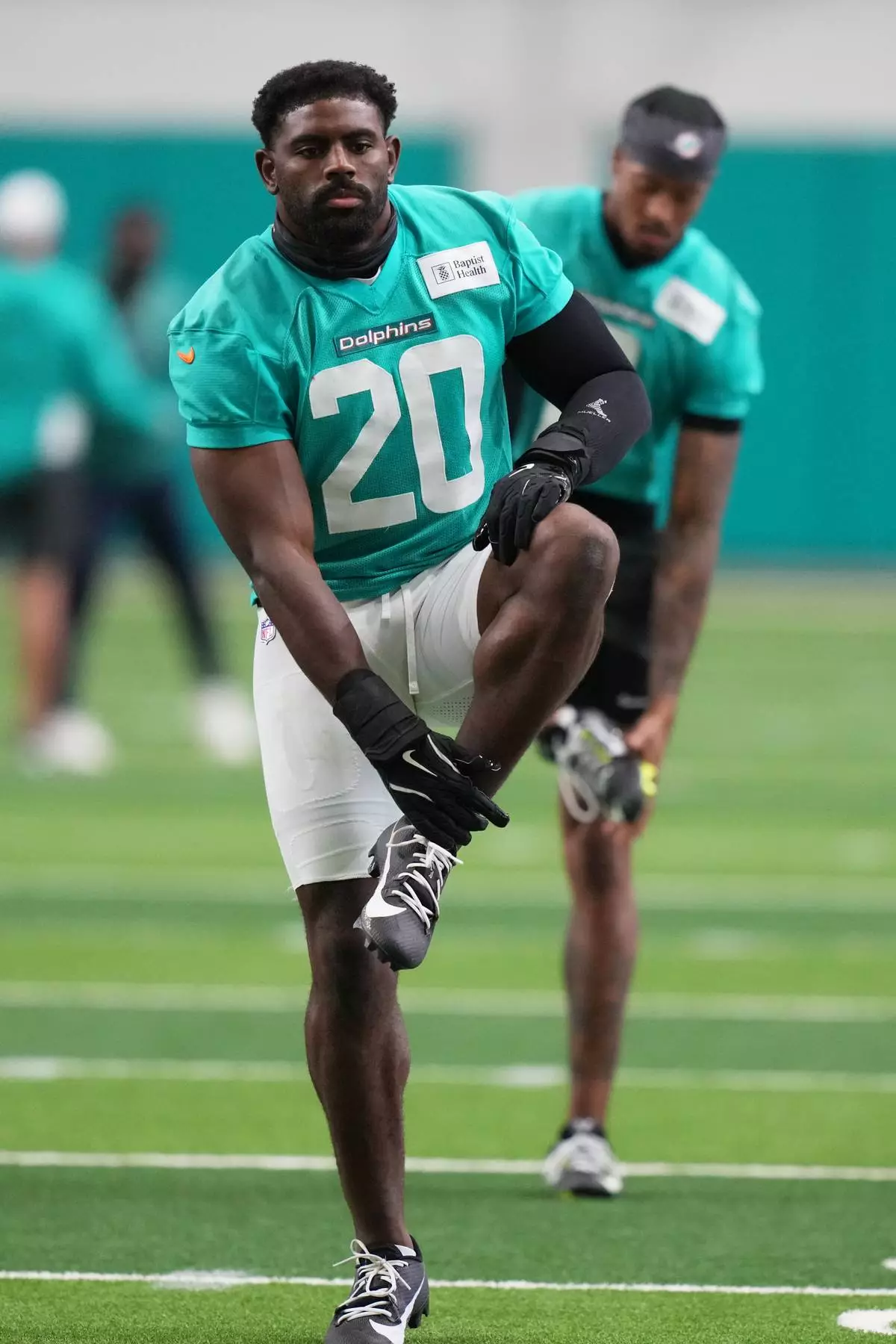
Miami Dolphins linebacker Jordyn Brooks (20) stretches during practice at the team's NFL football training camp, Wednesday, July 29, 2026, in Miami Gardens, Fla. (AP Photo/Lynne Sladky)
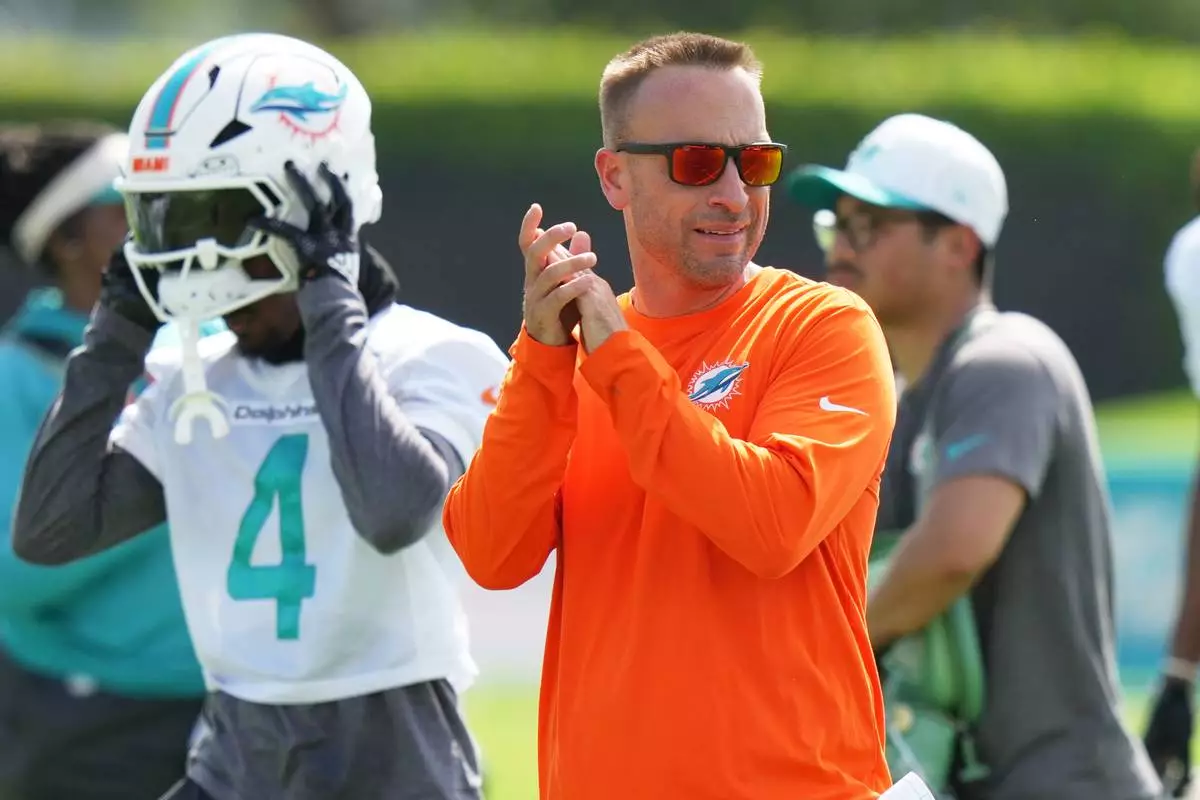
Miami Dolphins head coach Jeff Hafley watches practice at the team's NFL football training camp, Wednesday, July 29, 2026, in Miami Gardens, Fla. (AP Photo/Lynne Sladky)
NEW YORK (AP) — U.S. stocks are rebounding Thursday after Microsoft leaped on hopes that its big spending on AI is translating into profits, while computer-chip companies clawed back some of their sharp recent losses.
The S&P 500 rallied 1.3% and recovered two-thirds of its drop from the prior day, which was its worst in seven weeks. The Dow Jones Industrial Average was up 450 points, or 0.9% as of 12:50 p.m. Eastern time. The Nasdaq composite, which is full of artificial-intelligence stocks, jumped 2.3% a day after it fell 9.8% below its record set last month.
Microsoft led the way and leaped 16.3% after reporting a stronger profit for the latest quarter than analysts expected. Growth was strong for its Azure cloud business, and CEO Satya Nadella said it reflects how customers are using Microsoft to move into AI.
Perhaps just as importantly for Wall Street, Microsoft did not announce a big increase in how much it plans to spend on AI investments, something that several other Big Tech rivals have done. Worries are high that such spending is eating into companies’ cash flows and may not ultimately be worth it if AI does not produce as much productivity and profits as promised.
Meta Platforms helped demonstrate such fears after falling 9.5%. The parent company of Facebook and Instagram reported a weaker profit for the latest quarter than analysts expected, even though it made slightly more in revenue than expected. It also raised the lower end of its forecasted range for spending on investments this year.
Companies involved in the making of the computer memory and processors that such “hyperscalers” are buying rose Thursday, recovering some of the big losses they’ve taken on worries that their stock prices shot too high in the euphoria around AI.
Micron Technology jumped 16%, for example, to trim its loss for the week to 6.9%. It was one of the strongest forces lifting the S&P 500 after Microsoft.
Lam Research, a supplier to the semiconductor industry, soared 17.6% after reporting stronger profit and revenue for the latest quarter than analysts expected. Chip giant Advanced Micro Devices rallied 12.9%.
In the bond market, longer-term Treasury yields held a bit steadier following their sharp accelerations Wednesday. They had jumped after the chairman of the Federal Reserve, Kevin Warsh, gave few clues about what the central bank will do with interest rates to combat the painfully high inflation that continues to hurt the country.
Higher rates could keep a lid on inflation, but they can also slow the economy and undercut prices for stocks and other investments.
The yield on the 10-year Treasury eased to 4.66% from 4.67% late Wednesday. The 30-year Treasury yield held steady at 5.20%, a day after it shot up from 5.09%. They move with investors’ expectations for inflation and economic growth in upcoming years.
Warsh reaffirmed on Wednesday the Fed wants to get inflation back down to 2%, even though the central bank decided not to raise interest rates despite its remaining higher than that. He also implied the bond market may already be doing some of the Fed’s work to restrain inflation, and he pointed to how yields have climbed since the central bank’s last meeting six weeks earlier.
That leaves investors questioning whether the Fed is prepared to act if inflation worsens, or whether it is relying on financial markets to achieve the same outcome, according to Seema Shah, chief global strategist at Principal Asset Management.
“If investors conclude that the latter is true, the credibility of the Fed’s inflation-fighting commitment could come under increasing scrutiny. Arguably, it already is.”
President Donald Trump, who nominated Warsh to lead the Fed, has argued for lower interest rates even though they could cause inflation to accelerate.
Reports released Thursday suggested the U.S. economy’s growth slowed by more during the spring than economists expected. A measure of Inflation, meanwhile, remained worse last month than the Federal Reserve’s target, but it slowed from May.
In the oil market, prices eased back.
Brent crude, the international standard, fell 1.2% to $87.01 per barrel. It had swung as low as $72 early this month and as high as $102 last week on uncertainty about whether the United States and Iran could reach a deal to allow oil tankers to move freely again from the Middle East to customers worldwide.
In stock markets worldwide, indexes rose in Europe following a mixed finish in Asia. South Korea's Kospi fell 1.2%, and France's CAC 40 rose 0.9% for two of the world's bigger moves.
Seoul's market has been at the center of the huge recent moves for AI stocks because it's dominated by two tech titans, Samsung Electronics and SK Hynix. After more than doubling through this year's first six months, the Kospi has plunged 34% so far in July.
Its drop on Thursday came as Samsung Electronics dipped 0.7%. The tech giant reported a record profit for the spring and said demand for its chips continues to outpace supply, but its earnings nevertheless fell shy of analysts' high expectations.
AP Business Writers Chan Ho-him and Matt Ott contributed to this report.

FILE - People pass the New York Stock Exchange on May 28, 2024, in New York. (AP Photo/Peter Morgan, File)

FILE - The New York Stock Exchange is seen in New York, Thursday, March 19, 2026. (AP Photo/Seth Wenig, File)

A screen shows the Korea Composite Stock Price Index (KOSPI), SK Hynix and Samsung Electronics Co. stock price at the foreign exchange dealing room of the Hana Bank headquarters in Seoul, South Korea, Thursday, July 30, 2026. (AP Photo/Ahn Young-joon)

Currency traders work at the foreign exchange dealing room of the Hana Bank headquarters in Seoul, South Korea, Thursday, July 30, 2026. (AP Photo/Ahn Young-joon)
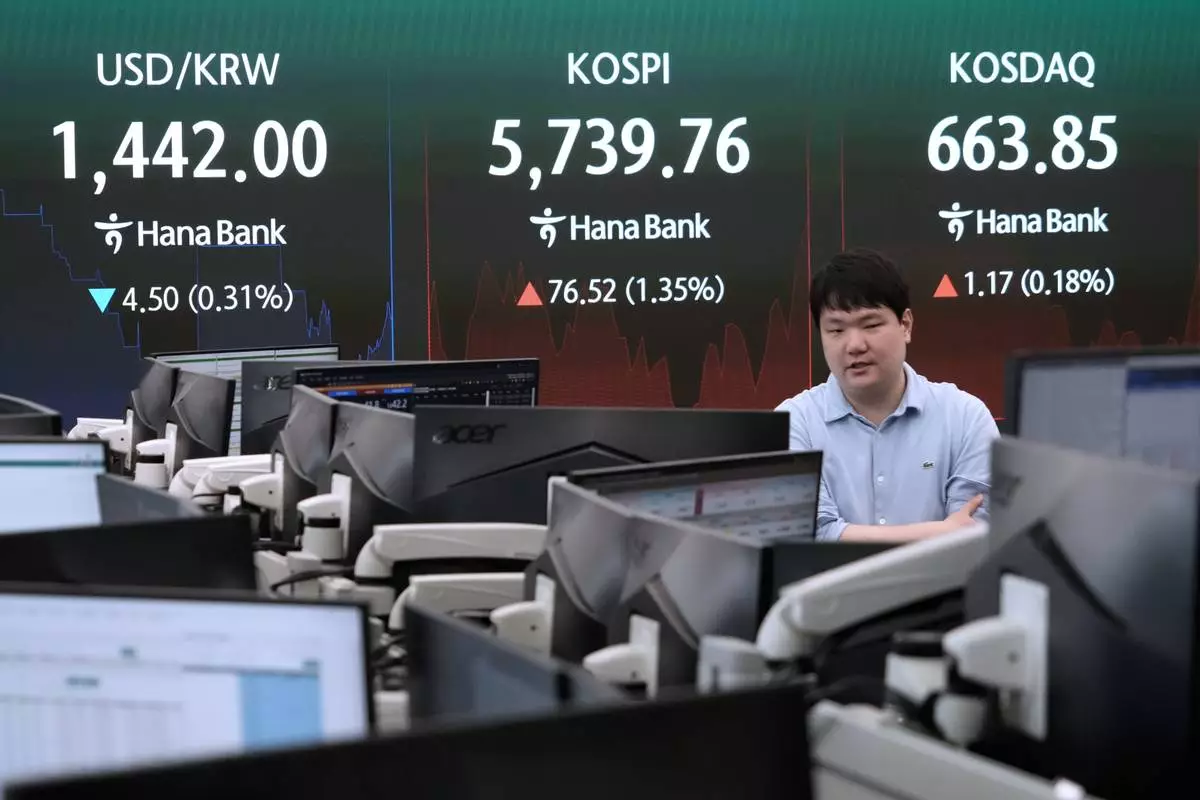
A currency trader passes by a screen showing the Korea Composite Stock Price Index (KOSPI) and the foreign exchange rate between U.S. dollar and South Korean won at the foreign exchange dealing room of the Hana Bank headquarters in Seoul, South Korea, Thursday, July 30, 2026. (AP Photo/Ahn Young-joon)

Currency traders watch monitors near a screen showing the Korea Composite Stock Price Index (KOSPI) at the foreign exchange dealing room of the Hana Bank headquarters in Seoul, South Korea, Thursday, July 30, 2026. (AP Photo/Ahn Young-joon)
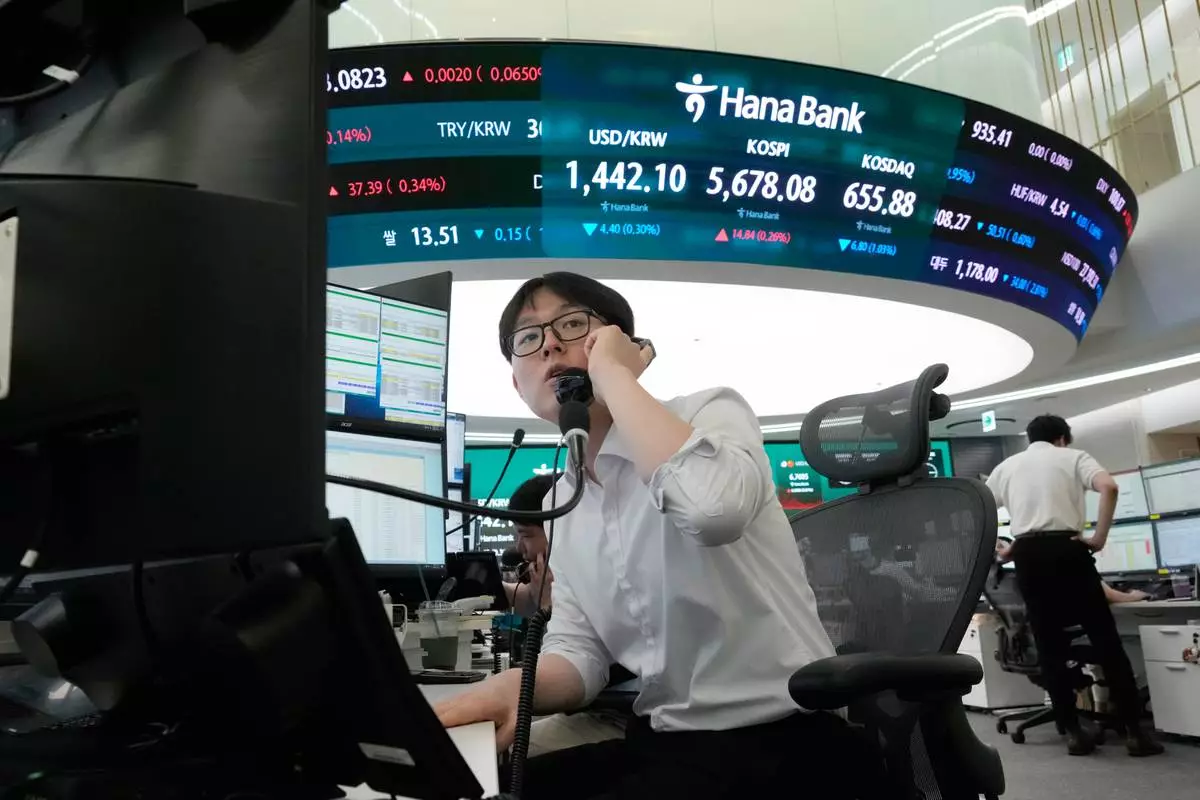
A currency trader talks on the phone at the foreign exchange dealing room of the Hana Bank headquarters in Seoul, South Korea, Thursday, July 30, 2026. (AP Photo/Ahn Young-joon)