JERUSALEM (AP) — Israelis across political and religious lines are worried about the weakening connection with younger Jewish Americans — who, according to a recent AP poll, tend to consider support for Israel less crucial to their Jewish identity than older adults.
“It’s extremely important to us,” said Itai Nixon, who leads the diaspora department for Israel’s Ministry of Diaspora Affairs. “We’re the state of the Jewish people, not just Israelis.”
Lesley Sachs, who has protested the current Israeli government and chairs the Israel Movement for Progressive and Reform Judaism, also considers a close relationship with diaspora Jews a “strategic asset” for both Israel and Jews worldwide.
So she’s greatly concerned about diaspora Jews losing the sense that Israel can be a homeland for them, especially as rising antisemitism targets them regardless of political and religious affiliations.
“That was always really, really important that everybody around the world, especially after the Holocaust, knows that there is a country that will always take them,” Sachs said in her synagogue in Tel Aviv. “This is already a few generations after, and this is less prominent in their DNA. And I think that this is really a failure on the part of both Israel and world Jewry, that we have not managed to keep that prominent.”
Since 2000, Taglit-Birthright Israel has brought a million Jewish young adults from the United States and elsewhere for a free 10-day “discovery” tour of Israel. The organization’s CEO says it’s more necessary than ever to show what their connection to Israel could be like beyond controversial politics.
“That really increases the importance of my job to expose people to what they give up on,” said Gidi Mark. “What we give them is a mirror.”
Israel and the United States have long been staunch allies. U.S. President Donald Trump and Israel’s Prime Minister Benjamin Netanyahu met in Washington earlier this week to discuss the war against Iran they launched together five months ago.
“The United States is perceived as the best friend of Israel in the entire world, and that’s still the case,” said Tamar Hermann, who directs the Israel Democracy Institute’s Viterbi Center for Public Opinion and Policy Research in Jerusalem.
Divisions over the ceasefire in the Iran war, however, have weakened Jewish Israelis’ belief that Trump prioritizes Israel’s security — from 64% in March to 26% in June — according to the center.
Amid diplomatic tensions, the role of Jewish Americans who historically lobbied for political, military and financial support for Israel gains new prominence, Israelis said. And that deepens the concern that many young progressive Americans, including Jews, now see supporting Israel in any way as irreconcilable with their worldview.
The decline in support for Israel has become particularly stark since the Oct. 7, 2023, attack when Hamas-led militants killed 1,200 people, mostly civilians in southern Israel, and abducted 251 others. Israel’s ensuing war against Hamas in Gaza has killed more than 73,000 people, according to the Gaza Health Ministry. The ministry, which was part of the recently dissolved Hamas-run government, maintains detailed records viewed as generally reliable by U.N. agencies and international organizations. It does not distinguish between civilians and militants but says women and children make up around half of all fatalities.
That in turn ignited protests across the United States, especially on college campuses.
“Holocaust, refugees, the importance of Israel in times of need abroad, and the fact that Israel is a small country fighting for its existence … that’s history they read in a book,” Sachs said of younger Jewish Americans. “They weren’t emotionally part of it in any way or any form. And so they look at their values and the things that they believe in. And they don’t see it in Israel.”
Only about 4 in 10 religious Jewish adults under 45 in the United States say that supporting Israel is “extremely” or “very” important for their Jewish identity, while about half of older religious Jewish adults do, according to the AP-NORC poll.
The survey of 1,022 Jewish adults — including people who identify as Jewish by religion and religiously unaffiliated people who identify as Jewish through culture, ethnicity or family background — also found that only about half of religious adults say Israel’s ongoing military operations in Gaza are justified. The number drops to 2 in 10 among Jewish adults without a religious affiliation.
At the same time, about 6 in 10 Jewish adults say prejudice against Jewish people is an “extremely” or “very” serious problem in the United States today.
To many Israelis, safety threats against Jews make it all the more tragic — and dangerous — that young Jewish Americans do not see the state of Israel as a refuge or even an ally.
“Antisemitism sadly helps us to explain why a Jewish homeland is not a bad idea,” said Asaf Zamir, a deputy mayor of Tel Aviv who served as consul general in New York. “Opposing the government is fine, but you cannot understand your history as a Jew without understanding the part of Israel in it.”
In order to promote deeper attachment between Israel and diaspora Jews, both the government and religious organizations are reinforcing exchange programs. For decades, young Israelis have traveled to Jewish summer camps across North America, and non-Israeli Jews get free trips to Israel.
“To see Israel and meet Israelis is the gold standard,” Itai Nixon said of programs bringing teens to the country.
Taglit-Birthright’s Gidi Mark said that since 2023, with multiple wars, tour participants are fewer — and their reactions to touring Israel have also changed. He recalled one participant shouting “Israel! Israel!” outside his hotel just because he felt safe to express himself.
“These people don’t feel free to experience who they are in the places that they are coming from,” Mark said.
These and other initiatives are focusing on secular Jews and adherents to Reform Judaism. The largest branch of the religion in North America, it emphasizes progressive values such as social justice.
Orthodox Jews abroad tend to have stronger ties to Israel — and Orthodox Jews in Israel tend to see themselves as closer to diaspora Jews than do secular Israelis, Hermann said.
Within the Israeli Reform movement, which is a small part of Judaism in the country, there’s a push to send more young Israelis to the United States, including as camp counselors.
“That kind of action is important, that one-on-one connection saying, ‘You know what, we believe in the same things you do. Really, we have the same ideology in general, and we feel we need to change Israel together,'" Sachs said. “We need to be partners in making Israel the country that we all need.”
Alma Edry, 18, is spending two months as a counselor at a progressive Jewish summer camp in Ontario with teens and young adults from Canada and the United States. She said her biggest surprise has been “that Israel is such a big deal for people outside the country.”
“Most of their friends are anti-Israel,” she said of the campers. “This is their chance to celebrate their connection.”
Associated Press religion coverage receives support through the AP’s collaboration with The Conversation US, with funding from Lilly Endowment Inc. The AP is solely responsible for this content.
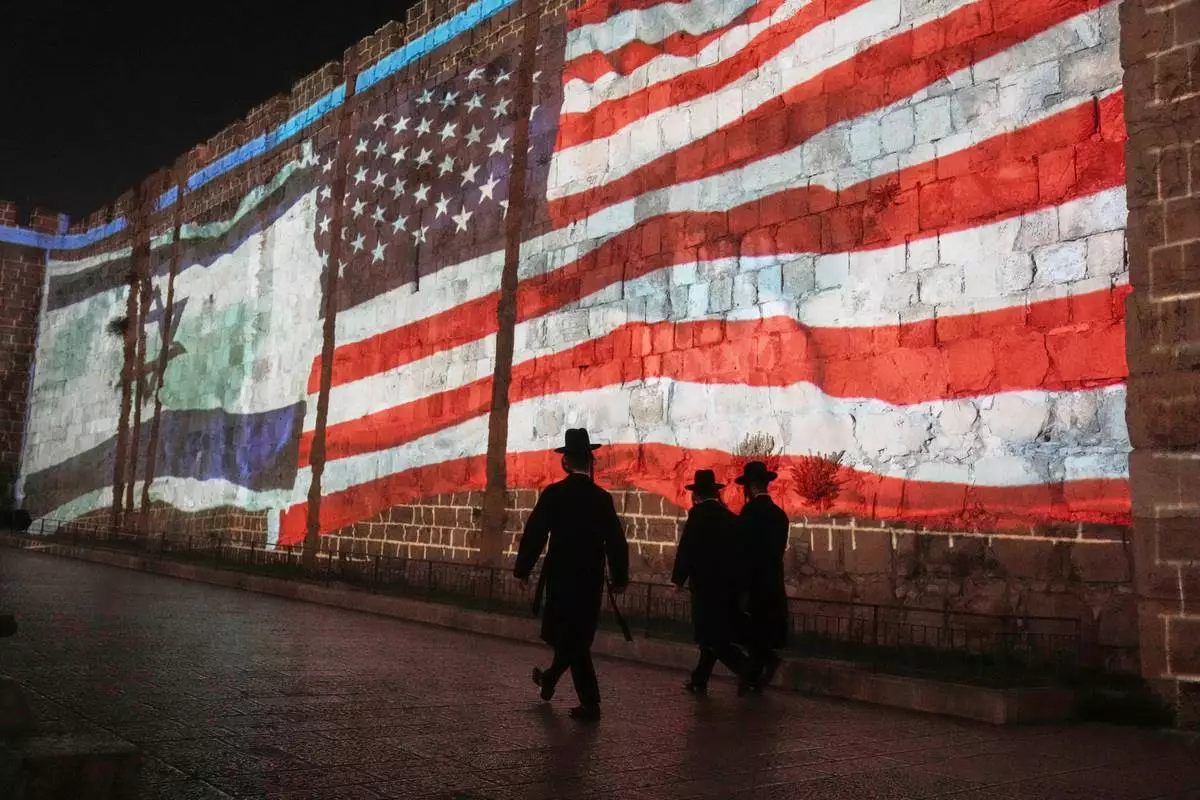
FILE - An Image of the U.S. and Israeli flags is projected on the walls of Jerusalem's Old City, Sunday, July 22, 2025. Following the U.S. involvement in the war between Israel and Iran. (AP Photo/Mahmoud Illean, File)
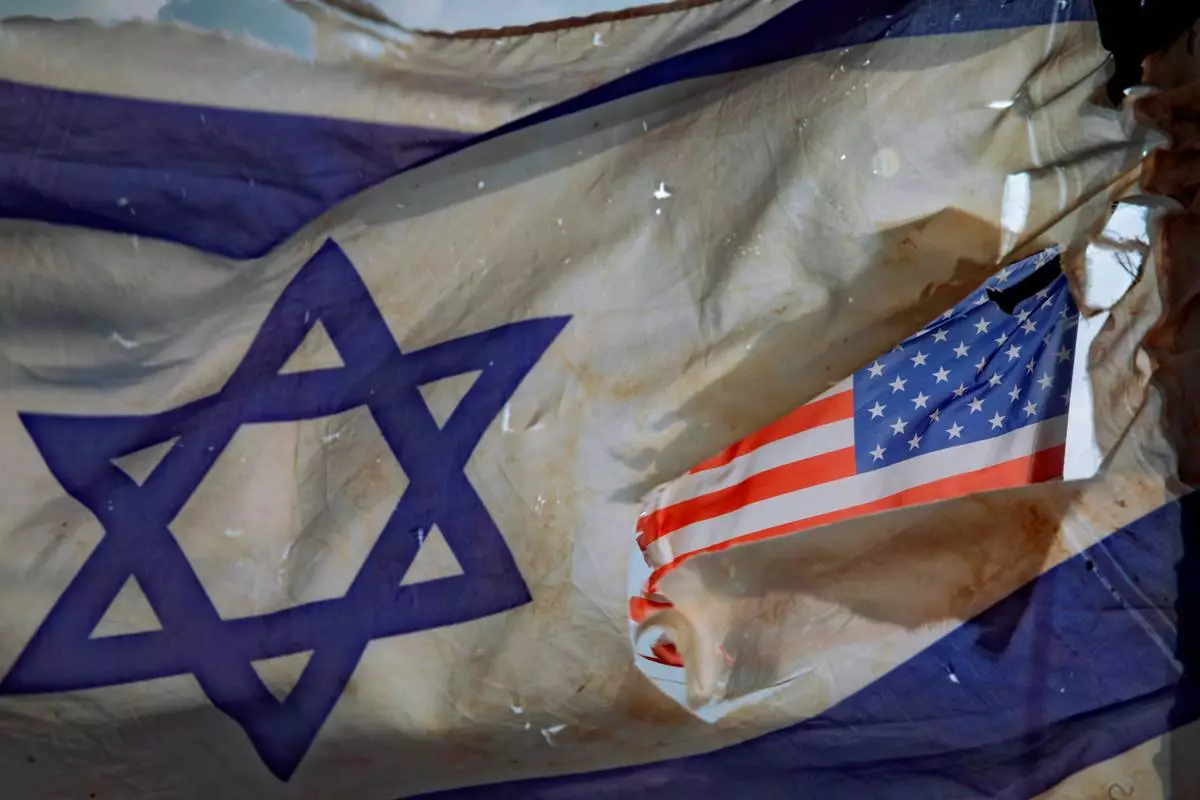
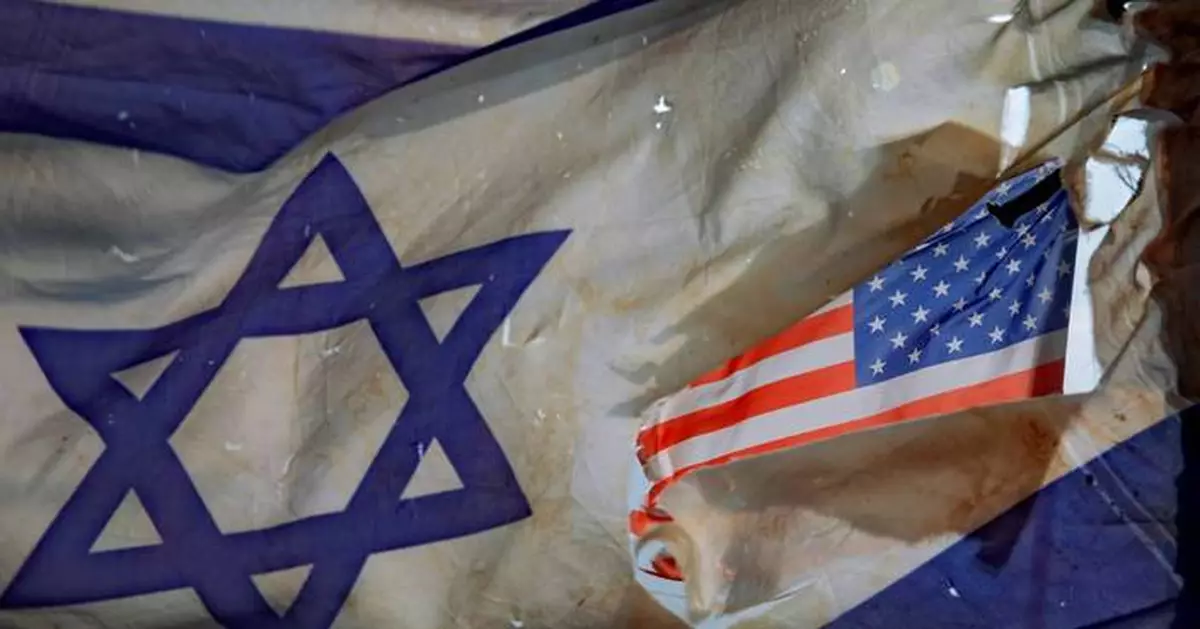
FILE- A U.S. flag is seen through a hole torn in an Israel national flag, as they wave in the wind at a horse ranch, near the southern Israeli town of Sderot, Friday, Nov. 20, 2020. (AP Photo/Oded Balilty, File)