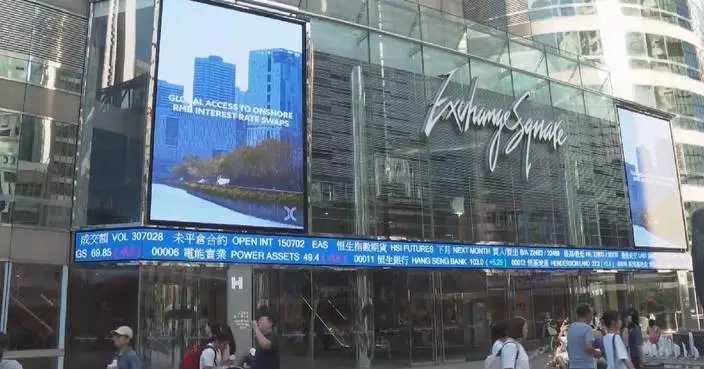
The U.S.-China Economic and Trade Cooperation Forum and the promotion meeting for the 5th China International Supply Chain Expo (CISCE) was held in Chicago on Thursday, with the participation of over 180 representatives from political and business circles of the two countries.
As the world's first national-level exhibition focusing on supply chains, the CISCE has been an internationally shared public good since the first edition was held in 2023. The fifth edition is expected to be held in 2027.
Attendees at the event noted that the industrial and supply chains of China and the U.S. are deeply intertwined, providing a solid foundation and broad scope for cooperation.
They called on the business community to strengthen exchanges to promote healthy and stable development of China-U.S. economic and trade relations.
"The Chinese market is huge. Arguably, China is one of the best manufacturers in the whole world. The supply chain connectivity and the growth of the Chinese market is substantial. So the U.S. and China have to find a way to be able to cooperate because of both our economic size, our competitiveness and ability to use comparative advantages to accelerate both of our economies," said Daniel Bellefleur, vice president of foreign direct investment, Illinois Economic Development Corporation.
"I think the more we learn about each other, the more we are going to see our commonality, and I truly believe that we have a lot to gain by collaboration," said Lori Lightfoot, former mayor of Chicago.
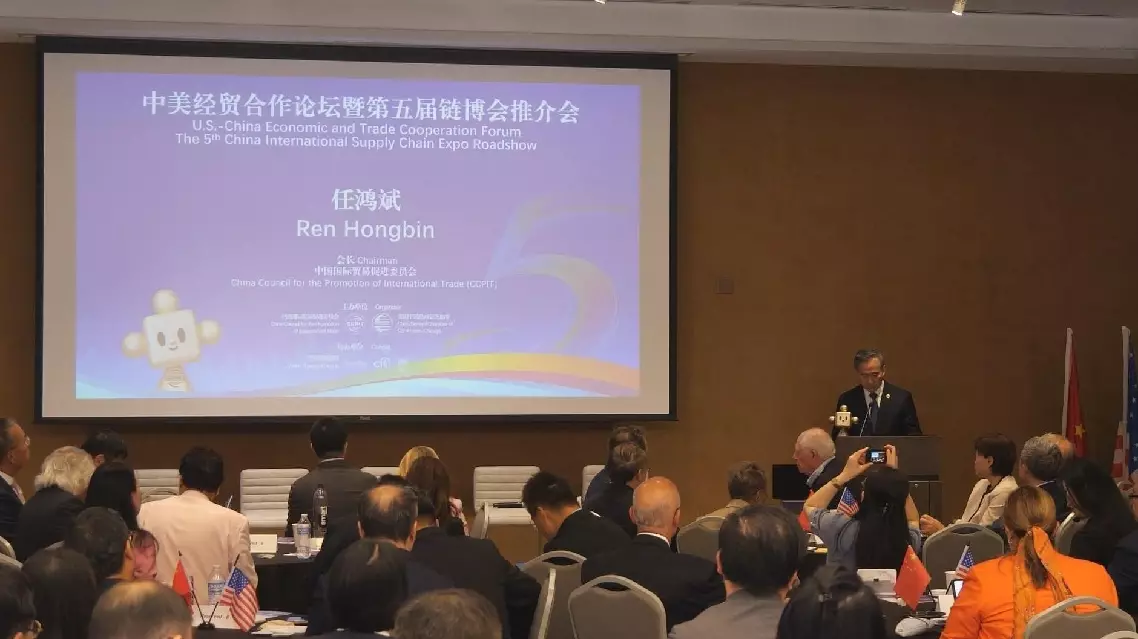
Event held in Chicago to promote 5th China's supply chain expo
China's first two-tonne-class tethered balloon entered trial operation in a major power transmission project on Monday, providing a brand-new solution for transportation in power grid construction projects in high-altitude and ecologically sensitive areas, according to the State Grid.
The project is a massive ultra-high voltage (UHV) power transmission line that will carry clean energy from Xizang Autonomous Region in southwest China across thousands of kilometers to the Guangdong-Hong Kong-Macao Greater Bay Area in south China.
At the construction site, a large balloon with a diameter of 25 meters and a volume of 8,000 cubic meters slowly rose into the air.
As multiple mooring lines were simultaneously extended and retracted, the heavy construction materials suspended beneath the balloon were lifted off the ground and moved smoothly along a predetermined route toward the mountainous work site.
"This is our newly developed load-bearing tethered balloon. We have just completed a maximum load test of two tonnes at an altitude of 4,000 meters. Next, we will conduct a hoisting operation for power supply materials over a straight-line distance of 500 meters and a vertical drop of 120 meters," said Qin Jian, researcher at the Transmission and Transformation Engineering Technology Research Institute of the State Grid Electric Power Engineering Research Institute.
A heavy-lift tethered balloon involves launching a helium-filled balloon into the air and connecting it to the ground with one or several cables.
By adjusting the cable, the balloon's altitude and horizontal position are controlled to facilitate the transport of materials at high altitudes.
The balloon can travel up to 800 meters and carry a maximum load of two tonnes, with a positional accuracy of within 0.5 meters.
As the construction of new power grids is extending more rapidly into high-altitude, remote mountainous and ecologically sensitive areas, the transportation of materials for transmission projects has become a major challenge constraining construction progress.
Traditional road construction for transportation have long cycles and significant ecological disruption, while drones, though agile and flexible, face limitations in scenarios requiring heavy loads or prolonged continuous transport.
Tethered balloon transport technology effectively overcomes these difficulties.
"The construction section where this technology is applied is located in an uninhabited mountainous area at an altitude of over 4,000 meters. Many tower sites are situated on steep ridges inaccessible by road, making this the section with the highest altitude, most treacherous terrain and most challenging operations in the entire project. The two-tonne tethered balloon is better suited to high-altitude conditions characterized by thin air and strong winds, and its load capacity and stability can better meet transportation requirements," said Feng Tao, project manager of the State Grid Henan Power Transmission and Transformation Company.
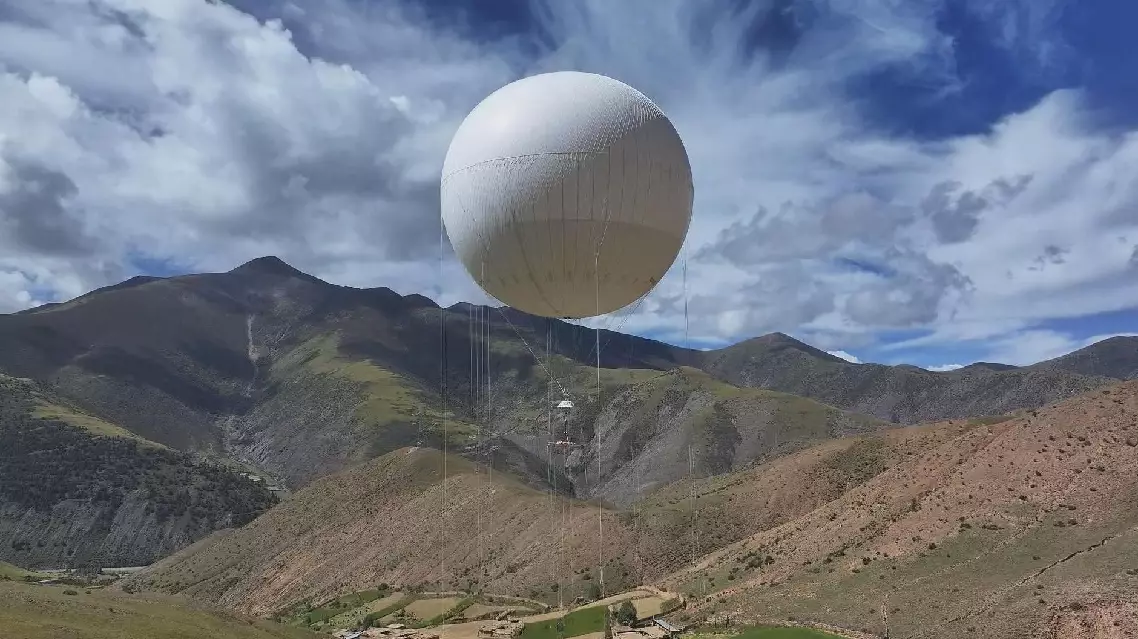
China puts first 2-tonne tethered balloon into operation