BARCELONA, Spain (AP) — A crisis at the border in Ceuta, a tiny Spanish territory in North Africa, has resulted in unsubstantiated claims about Spain’s migration policies and the causes of the border surge at the territory’s frontier with Morocco.
Some 60,000 migrants entered Ceuta from Morocco on Thursday and Friday, local Spanish officials have said, equivalent to 70% of the city’s regular population. At least 57 migrants died attempting the crossing either by drowning while trying to swim to Spanish territory or in a stampede.
Click to Gallery

Belongings left behind by migrants float in the sea after they crossed from Morocco into the Spanish enclave of Ceuta, Friday, July 31, 2026. (AP Photo/Antonio Sempere)
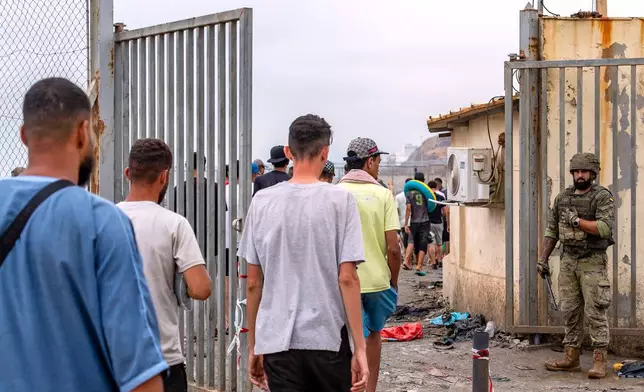
Migrants return to Morocco from the Spanish enclave of Ceuta, Friday, July 31, 2026. (AP Photo/Antonio Sempere)

A migrant runs from Spanish police officers as they cordon off access to the beach for people crossing from Morocco into the Spanish enclave of Ceuta, Friday, July 31, 2026. (AP Photo/Antonio Sempere)
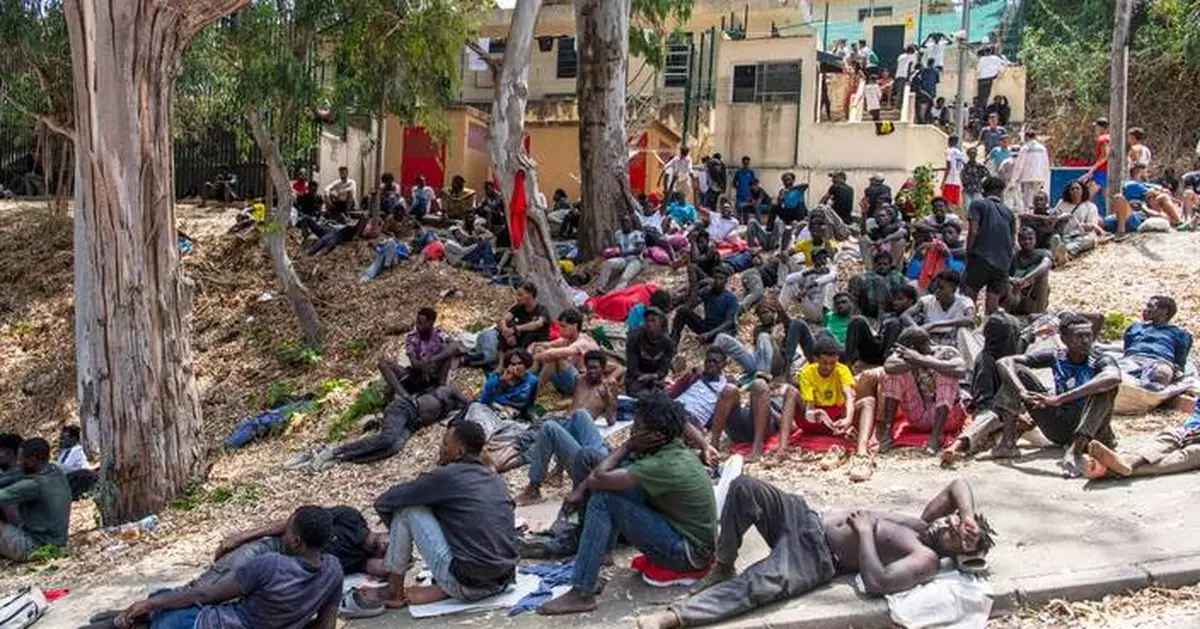
Migrants rest outside the Temporary Center for Immigrants (CETI) after crossing from Morocco into the Spanish enclave of Ceuta, Friday, July 31, 2026. CETI is the Spanish acronym for the migrant reception center. (AP Photo/Antonio Sempere)
Here’s a look at the facts.
CLAIM: Spain’s move to legalize the status of immigrants caused the rush.
THE FACTS: Spain’s government is carrying out an amnesty for immigrants without residency permits who could prove they had been living in the country for at least five months and arrived before Jan. 1, 2026. Over 1 million people applied before the window closed at the end of last month.
Critics, including U.S. President Donald Trump and his administration, say that the amnesty sparked the rush to the Ceuta border by sending the message that Spain is lenient on migrants.
Spain's “weak law, bad management” was to blame, Trump said Friday. The U.S. State Department doubled down in a post on X, saying that “this unacceptable incident is the direct result of the Spanish Government’s deliberate efforts to enable and facilitate mass illegal migration into Europe.”
Spain's government strongly rejects that premise, saying that criminal gangs were behind the border crisis. Madrid has tried to maintain a hard line on illegal attempts to cross its borders while encouraging orderly arrivals of workers, who the government says are needed to keep up the country's strong economy.
Poverty and youth unemployment are high in neighboring Morocco, particularly away from coastal cities that have experienced some development in recent years. Gen Z-led protests last year called for social justice and better public services. The inequality has prompted many young Moroccans to attempt to leave for Europe in search of better economic opportunities.
Still, it isn’t fully clear what caused the sudden surge in crossings at Ceuta.
CLAIM: A misconstrued Spanish court ruling is to blame.
THE FACTS: Spanish Prime Minister Pedro Sánchez has pushed the argument that a recent ruling by Spain's Supreme Court had been intentionally misconstrued by migrant smugglers to convince thousands of people to cross the border by swimming around the border fence.
That court ruling said migrants arriving by sea could not be summarily deported without due process, unlike those who cross by land or climb the border fence because they had not crossed a physical barrier.
Migration and human rights activists said social media posts and misinformation helped fuel the departures.
“The departures were promoted in a certain way. At first, people were hearing that the border was open, and then everyone started referring to the Spanish court decision. That contributed to the crossings,” said Achraf Maimouni, a human-rights activist.
CLAIM: Morocco intentionally opened the border
THE FACTS: In 2021, more than 8,000 people crossed the Ceuta border when Moroccan border officials dropped their guard, sparking a diplomatic crisis between the neighbors.
The move was broadly interpreted as retaliation from Morocco for Spain’s decision to allow a pro-independence leader from the disputed Western Sahara region to receive medical treatment at a Spanish hospital. Sánchez defused the crisis when he shifted his country’s long-standing position on Western Sahara, and met with Moroccan King Mohammed VI the following year.
In this most recent crisis, which dwarfs the one five years prior, the first response by Spanish officials was to say that Moroccan counterparts were working alongside them to stop the rush. Whatever those efforts were, they proved ineffective as migrants kept steadily coming from all over Morocco to the border, with thousands breaching the frontier on Thursday and Friday.
An Associated Press freelance photographer witnessed Moroccan gendarmes standing aside with their arms crossed on Thursday as thousands of migrants passed near them into Ceuta. Eventually, Moroccan security forces stepped up, employing tear gas, batons and water cannons to disperse large groups of migrants reaching the border on Friday.
Morocco’s ambassador to Spain expressed hope that those who crossed from Morocco into the Spanish territory would return, saying the situation had unfolded against Rabat’s wishes.
Yet Morocco has never officially recognized Ceuta and its sister Spanish enclave, Melilla, as European territories even though they have been under Spanish control for centuries.
CLAIM: The surge in migrants is payback for Sánchez’ position on Iran and Gaza.
The mass crossing has given birth to conspiracy theories online, including one take that sees Trump and Israel encouraging a friendly Morocco to let this happen as payback for Spain's position on immigration and its harsh criticism of their joint attack on Iran and the Israeli military campaign in Gaza.
THE FACTS: Trump has for months raged against Spain and recently threatened to end trade with the European country, and the Israeli leader has accused Spain of waging a diplomatic war against his country. But there is no evidence to support claims of a U.S. or Israeli hand in the Ceuta crisis.
CLAIM: Those who crossed will end up in mainland Europe.
THE FACTS: The Ceuta crossings have led to political leaders in Italy, France and other EU nations to take measures that appear aimed at stopping people from entering their countries. Premier Giorgia Meloni threatened to suspend Italy’s open-border Schengen agreement with Spain even though Italy doesn’t share a border with Spain and receives many more migrants crossing the Mediterranean than Spain. French Interior Minister Laurent Nunez said France would also strengthen border checks with Spain.
While the influx is clearly unmanageable for the city of Ceuta, the impact of the crossing will mostly be limited to the Spanish territory and have limited impact on mainland Spain.
By Friday evening, the majority of migrants had already returned to Morocco voluntarily, Spanish authorities said. Those who remain in Ceuta will either be sent back eventually or face a long period of legal limbo and possibly spells in government-run centers.
EU migration commissioner Magnus Brunner posted on X that “not a single person has crossed to mainland EU” and that the Schengen Borders Code already includes special border checks for people traveling from Ceuta and Melilla.
Find AP Fact Checks here: https://apnews.com/APFactCheck.

Belongings left behind by migrants float in the sea after they crossed from Morocco into the Spanish enclave of Ceuta, Friday, July 31, 2026. (AP Photo/Antonio Sempere)
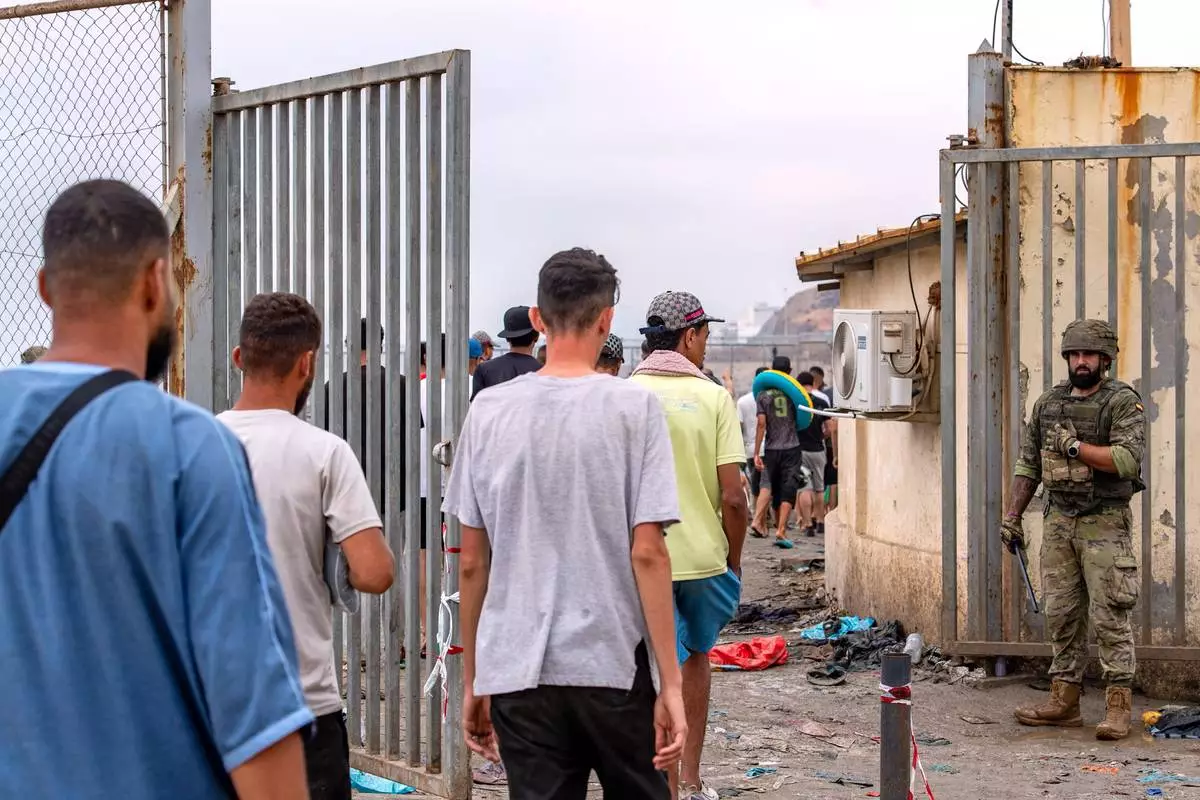
Migrants return to Morocco from the Spanish enclave of Ceuta, Friday, July 31, 2026. (AP Photo/Antonio Sempere)
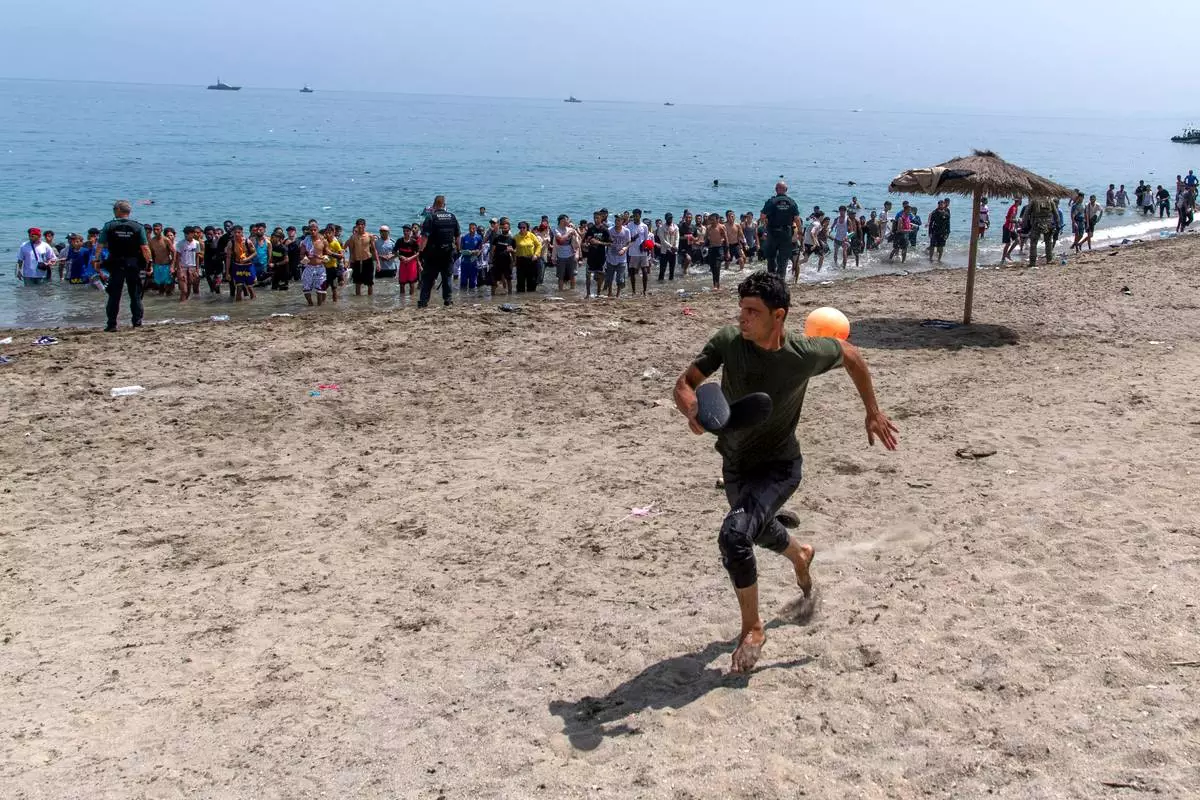
A migrant runs from Spanish police officers as they cordon off access to the beach for people crossing from Morocco into the Spanish enclave of Ceuta, Friday, July 31, 2026. (AP Photo/Antonio Sempere)
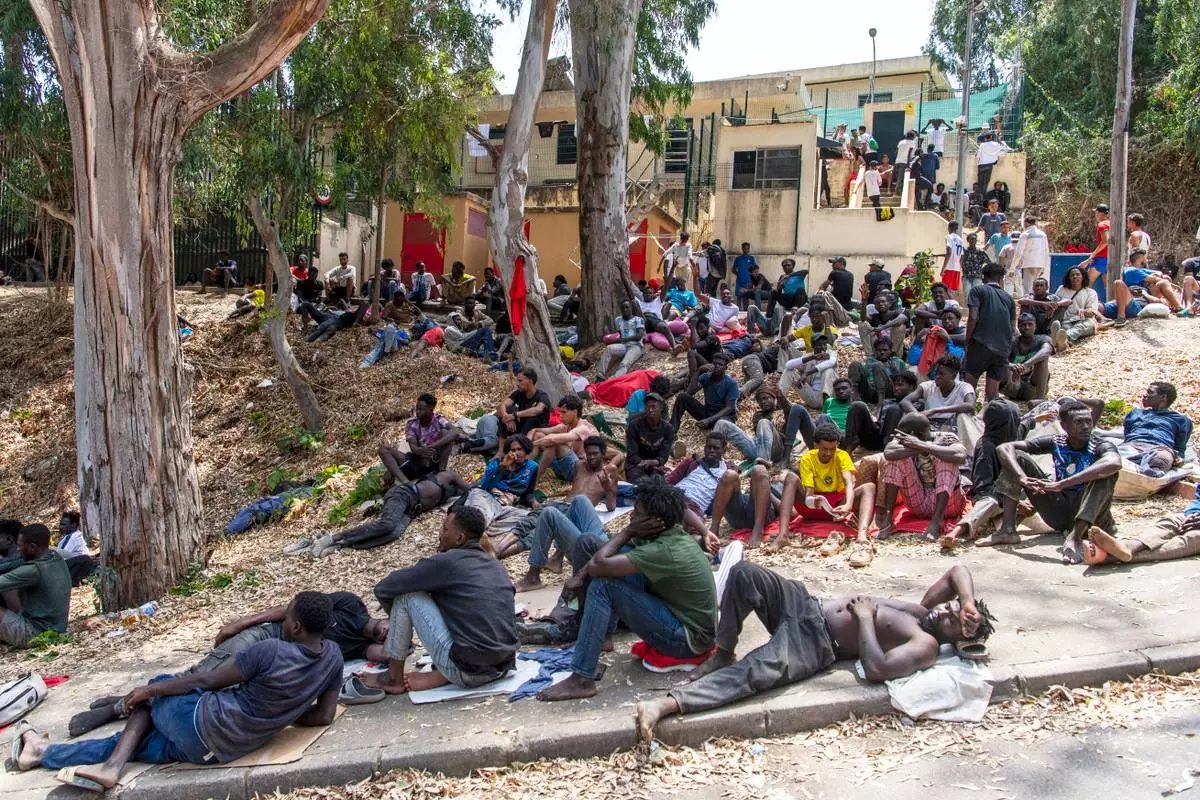
Migrants rest outside the Temporary Center for Immigrants (CETI) after crossing from Morocco into the Spanish enclave of Ceuta, Friday, July 31, 2026. CETI is the Spanish acronym for the migrant reception center. (AP Photo/Antonio Sempere)