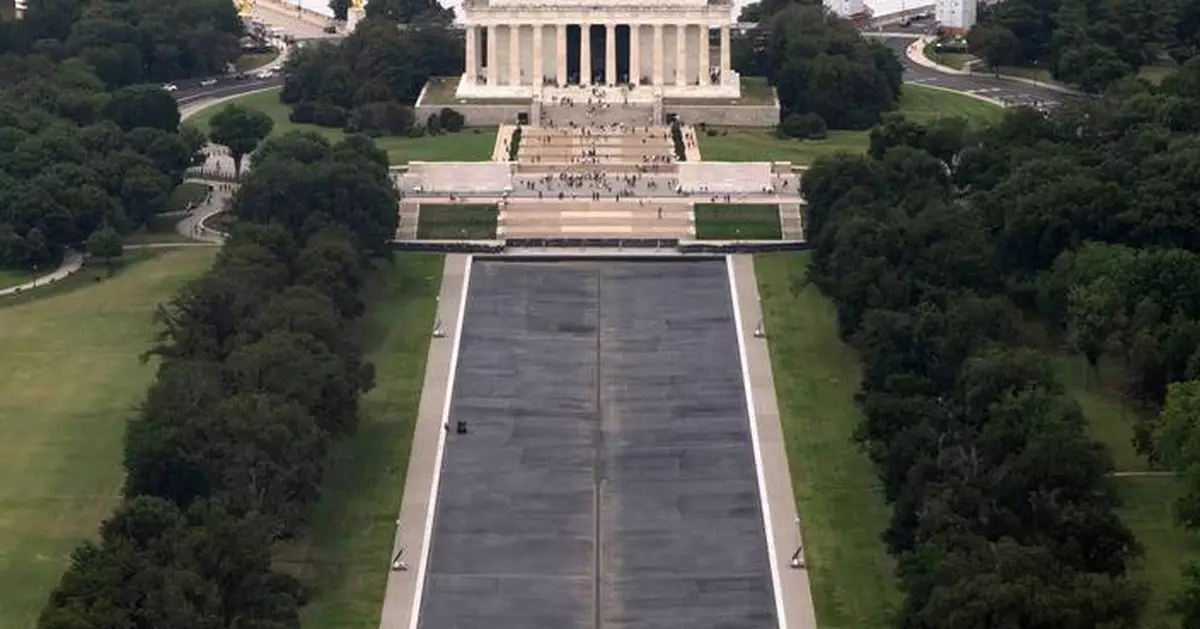
WASHINGTON (AP) — The Justice Department moved Friday to dismiss a criminal case charging a former Olympian with deliberately damaging the Lincoln Memorial Reflecting Pool, saying evidence prosecutors had recently received refuted the idea that vandals were to blame.
Government lawyers said in a 20-page court filing that additional documents provided by the Interior Department since the indictment of David Hearn show that the damage was the result of a botched installation by a contractor as well as “the rush to complete the project prior to events associated with the America 250 celebration in the weeks surrounding Independence Day 2026.” In addition, a recent visual inspection revealed damage throughout the pool, including in the middle — where prosecutors say a vandal would not likely have attempted to peel the lining.
“Given all of this newly discovered information, it is difficult to attribute the widespread damage to the Reflecting Pool to vandalism, let alone to establish that fact beyond a reasonable doubt,” said the filing from U.S. Attorney Jeanine Pirro, which asked a judge to formally dismiss the case.
Hearn's lawyers said in a statement that the case against him should never have been brought.
“Its dismissal today does not erase the abuse of government power in arresting and charging a patriotic American who did nothing wrong. The government’s approach was ready, fire, aim. The administration owes Mr. Hearn an apology,” the lawyers said.
The dismissal marks an embarrassing setback for a Justice Department that had billed the prosecution as accountability for damage at a Washington landmark where President Donald Trump had launched a massive renovation project before the country's 250th anniversary celebrations. Trump, without providing evidence, has alleged the damage was caused by vandals.
But the case has long been saddled with evidentiary problems and challenges. Hearn has for weeks maintained his innocence and his supporters have characterized the prosecution as a politically motivated attempt by the Trump administration to deflect blame and scapegoat others.
Earlier this week, Hearn's lawyers sought access to grand jury transcripts because of what they said were “irregularities” in the process. They said a National Park Service official testified that the pool already was damaged before Hearn allegedly touched it, couldn’t quantify any damage attributable to Hearn and said the same repairs would have been required regardless of his conduct.
“The witness’s testimony established that the pool had substantial preexisting damage requiring repair before any alleged conduct by Mr. Hearn,” his lawyers wrote. “According to the witness, the pool was leaking more than one million gallons of water per week; its expansion joints had exceeded their service life; and the liner already contained a rip.”
Hearn pleaded not guilty earlier this month to one felony count of property destruction and had a trial scheduled to start Sept. 28 in D.C. Superior Court. The charge, which carries a maximum prison sentence of 10 years upon conviction, accused Hearn of causing at least $1,000 in damage to the pool.
In court papers Friday, prosecutors said they had only recently received new information that undermined the basis for the prosecution.
“It was not until after these documents were produced that (prosecutors) first became aware of information showing that the damage was the result of a botched installation and not vandalism as initially represented” by the Interior Department. Prosecutors could “only rely,” they wrote, on the initial information suggesting that the damage was caused by vandals.
Hearn has told The Associated Press he was detained by National Guard troops and U.S. Park Police for five hours after stopping by the pool during a bike ride on June 19. He said he reached in to examine the pool’s newly peeled coating and briefly touched a chunk attached to the side of the pool, but said he obeyed a park worker who told him to let go of it.
Hearn, 67, of Bethesda, Maryland, competed in three Summer Olympics, earning his best finish, ninth, at the 1996 Atlanta Olympic Games, the U.S. Olympic and Paralympic Committee says on its website.
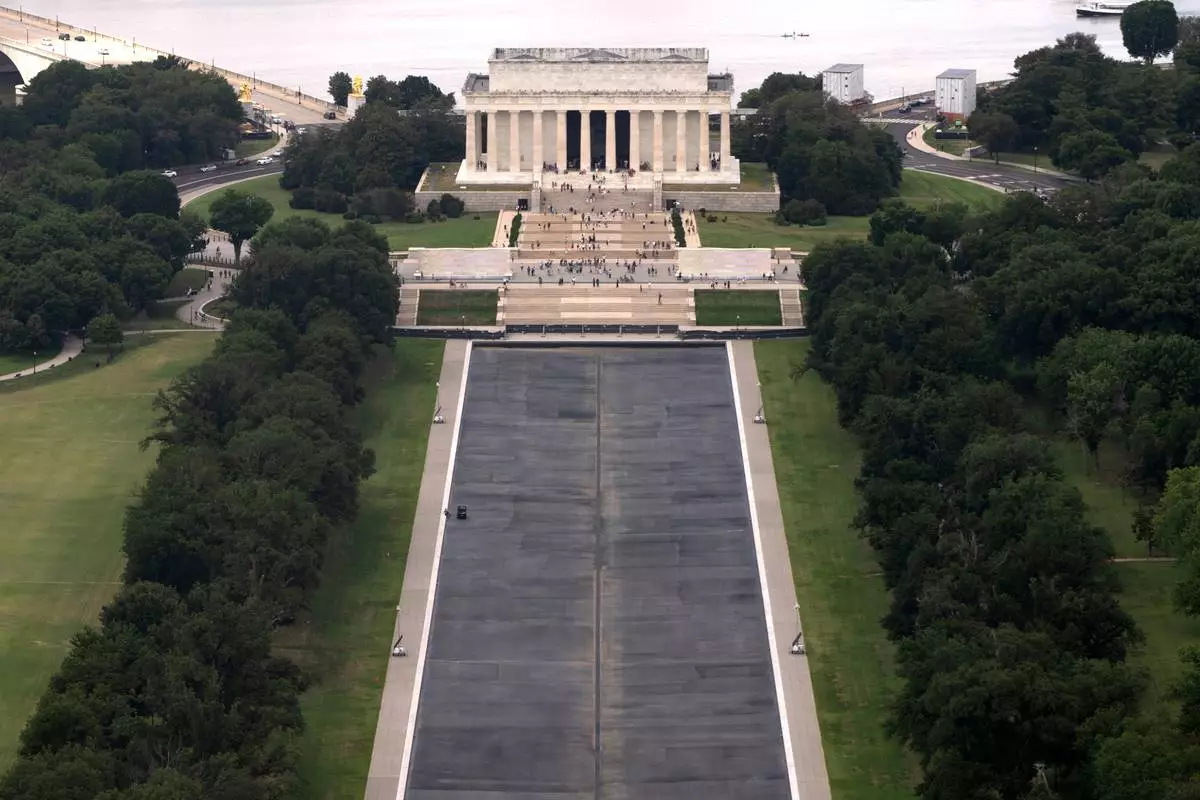
The Lincoln Memorial Reflecting Pool is seen from the Washington Monument, Friday, July 31, 2026, in Washington. (AP Photo/Mark Schiefelbein)
The Big Ten and Southeastern Conferences agreed Friday night to support a Senate bill that seeks to regulate college sports, ending a breakneck week of negotiations and pulling the bipartisan measure out of what looked like a certain death spiral.
School presidents from both conferences voted to back the bill after receiving last-minute concessions over language regarding third-party name-image-likeness deals and the so-called “associated entities” that often make those arrangements.
More details need to be worked out, but the headline is that the bill still has a chance to earn the 60 votes it needs to halt debate and head to an up-or-down vote before the Senate heads for summer break next Friday.
The summer recess was increasingly looking like a hard deadline for the Protect College Sports Act, a bipartisan effort headed by Sens. Ted Cruz, R-Texas, and Maria Cantwell, D-Wash.
After the conferences, which had balked at large sections of the bill, put out a short release announcing they supported the act “as currently drafted,” Cantwell went on social media and said: “Good. Now progress can be made in protecting women and Olympic athletes and moving the legislation closer to the President’s desk.”
President Donald Trump, who has also been seeking fixes for an industry that now pays its players millions, got involved late Thursday, which helped push the parties back to the negotiating table.
Cody Campbell, the Texas Tech regent who has played a big role in shaping this policy, called the SEC and Big Ten support “ a major breakthrough that moves us closer to a Senate vote — and a better future” for college sports.
The most groundbreaking part of the reworked deal is the $27.5 million that schools would be allotted to retain players, in addition to the $21.3 million cap that already exists.
It could represent a major reworking of the House settlement — the lawsuit settlement that governs paying players. The idea is that the extra money will take the place of payments from “associated entities” that were allowed above and beyond the $21.3 million cap. It was those payments that, many schools complained, obliterated any idea of a cap or controlled cost.
The SEC and Big Ten sought stronger language in the bill to guarantee that any third-party deals are truly outside deals and not coming from the schools’ multimedia-rights partners, which currently broker the majority of those deals.
Among the questions still unanswered are whether the new cap will comport with the House settlement, which had very specific instructions about the hard cap (22% of a certain part of revenues, which equals $21.3 million this season).
Also, what would happen to the College Sports Commission, the main NIL enforcement arm that spends the bulk of its time analyzing third-party NIL deals that would be greatly reduced under this arrangement?
Even with Friday night’s victory, the bill has a long road ahead. Sen. Tommy Tuberville, R-Ala., has been a staunch opponent of the bill since the beginning. Before the latest compromise, Sen. Bill Cassidy, R-La., said that “as written today,” the act “creates chaos and eliminates opportunity for student-athletes.”
Whether the SEC’s approval is enough to get those senators and others from SEC states on board is one issue. If the bill clears the Senate, it would still then need to pass the narrowly divided House, which flailed on another college bill called the SCORE Act, for more than a year.
There’s also the matter of whether smaller conferences, long in favor of the bill, will remain so now that their bigger competition is being allowed to directly pay players up to $48.8 million.
Almost everyone in college sports agrees that the status quo isn’t working.
The news about the bill broke only hours after the NCAA lost a pair of key court cases involving its new rule that would give most Division I athletes five years to complete five seasons of eligibility.
Using those losses as another chance to urge for passage of the bill, NCAA President Charlie Baker said “It is long past time leaders across college sports call for the immediate passage of the bipartisan Protect College Sports Act.”
Two-time national champion hoops coach Dan Hurley of UConn used social media to outline the stakes in more colorful terms: “Somebody please come and fix College Sports. It’s a complete (expletive) show,” he said, using an emoji where the expletive would go.
AP college sports: https://apnews.com/hub/college-sports
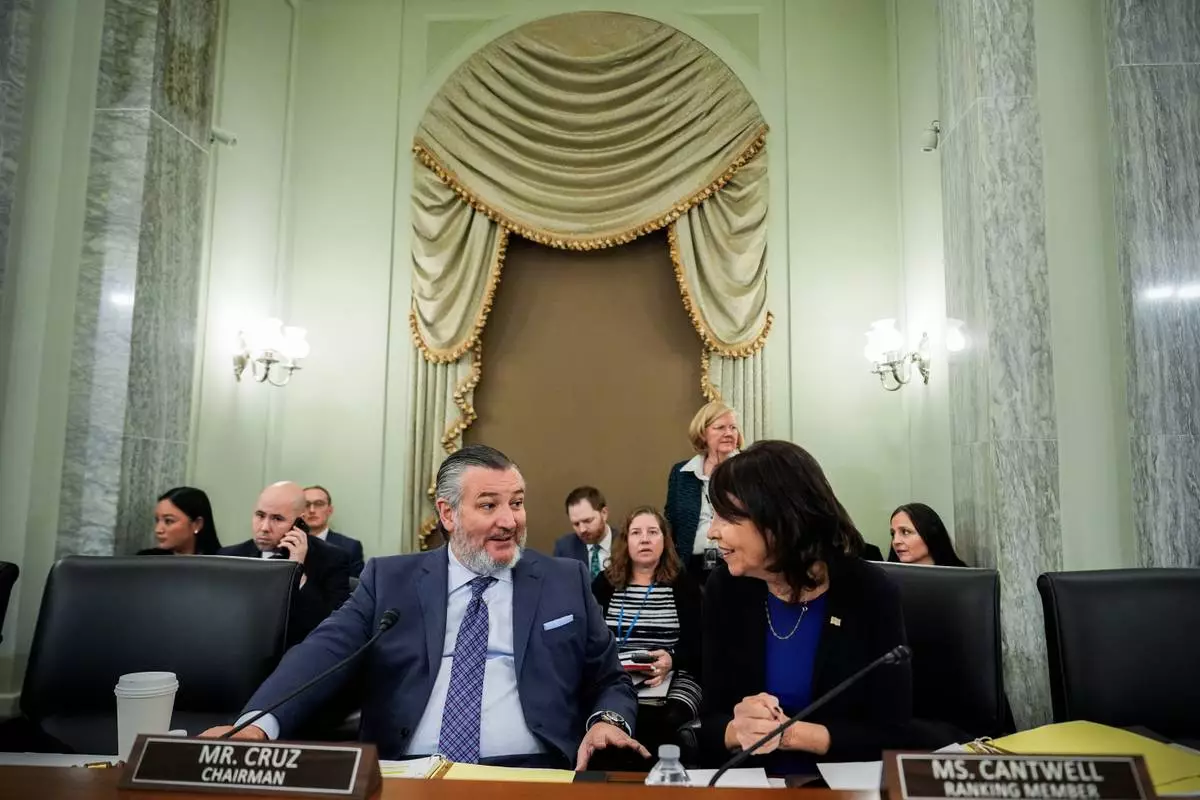
FILE - Sen. Ted Cruz, R-Texas, left, chairman of the Senate Commerce, Science and Transportation Committee, speaks with Sen. Maria Cantwell, D-Wash., right, before a hearing Wednesday, Nov. 19, 2025, on Capitol Hill in Washington. (AP Photo/Julia Demaree Nikhinson,File)