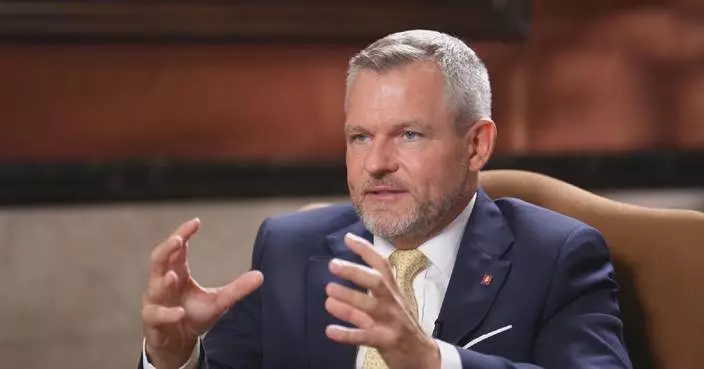
Artificial intelligence (AI) must not become the preserve of wealthy nations or powerful corporations, Slovak President Peter Pellegrini said Wednesday, urging a global framework to ensure the technology serves all humanity.
Pellegrini, speaking to China Media Group in Beijing on Wednesday during his state visit, voiced full support for President Xi Jinping's vision on global AI governance. He said the approach aims to build a just, equitable, and inclusive framework, one that rejects technological containment and treats AI as a global public good.
On access to this transformative technology, the Slovak president spoke highly of Xi's commitment to promoting the global governance of AI that truly serves all of humanity, rather than benefit just a few powerful nations or corporations.
He also emphasized the security dimension, warning of the new challenges for privacy posed by the AI boom.
"First, he's very strong commitment to finding a world regulatory framework or world governance of AI in such a way that it really serves all people of the world, that it is not a privilege of rich countries, not a privilege of big high-tech companies. [That's] the first thing. The second, of course, it's [the] security of it. Because through this we create completely new type of data. But now people start to communicate with AI about their own feelings, [asking it] everything for advice. So, you can imagine which kind of data the providers have about concrete person," Pellegrini said.
He stressed the need to build trustworthy AI and to prevent the technology from being monopolized by a few actors. His remarks echoed Xi's message at the opening of the 2026 World Artificial Intelligence Conference and High‑Level Meeting on Global AI Governance in Shanghai on July 17.
"To keep it a trustful technology is very important, but then also, we have to bring the AI from the beginning, from the young generation to the old generation in a way that it's improving their lives, not complicating their lives. And the most important thing is, once again, that there should not be one person or one government in the world which will decide that you can use it and I cannot use it. Your Mr. President, he had a speech at the AI summit, which was organized here in China, to avoid this [in which] that the world will be, thanks to new technologies, again unequal," he said.
Additionally, the Slovak president highlighted China's growing influence in global AI development and its role as a stabilizing force in international affairs.
"I fully agree with President Xi Jinping that we must find a way how to regulate AI, that it is really serves the whole world and also, the third countries and less developed countries. And of course, we see such an instability in the world. So, we are looking to China, [to see] how China is reacting on this. And I have to say that we see China is not commenting immediately [on] something what is going on in the world. They react, or they comment, or they act only when it makes sense. So, it's, I would say, a calm power [with] not hysteric actions, not big announcements, but very stable and calm and patient. And I think China can really play a key role by trying to reduce the tension in the whole world," Pellegrini said.
Pellegrini, who took office as Slovakia's president in June 2024, paid a state visit to China from Monday to Wednesday at the invitation of President Xi.
During their talks on Tuesday, Xi and Pellegrini both called for a closer partnership between China and Slovakia in AI, robotics, and the digital economy -- interconnected sectors that are fundamentally shaping national productivity and development.
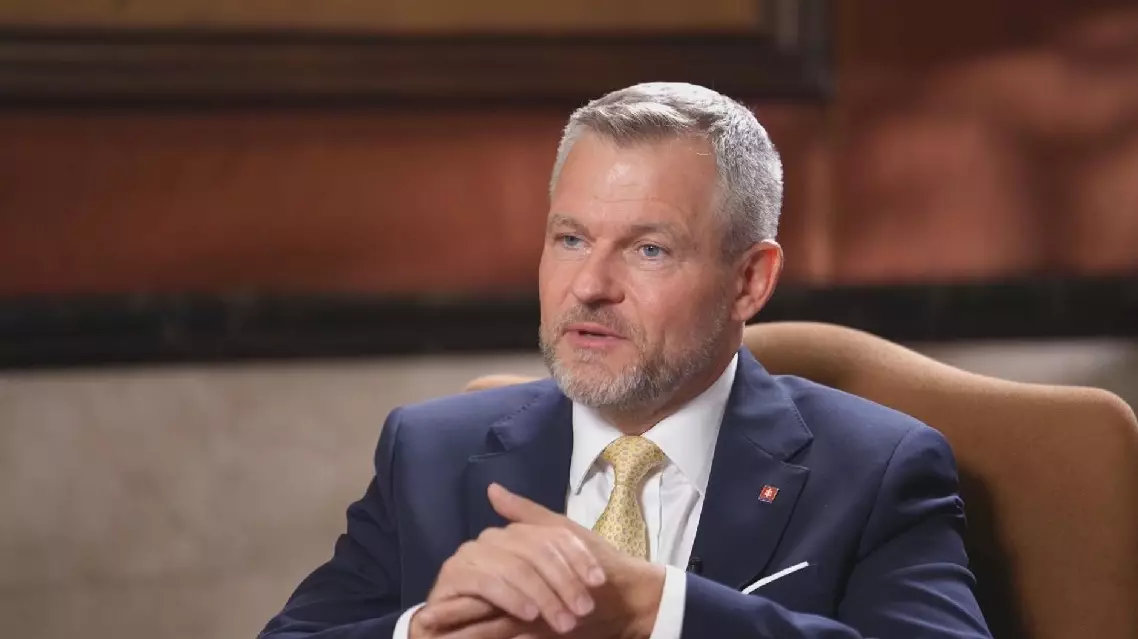
Slovak president calls for global AI rules, warns against monopoly