The 28th China Robot and Artificial Intelligence Competition (CRAIC) National Finals of the Humanoid Robot Special Competition kicked off Saturday in Beijing.
A total of 213 teams from more than 100 universities brought about 350 robots to the competition. The machines showcased autonomous skills in multi‑terrain driving, intelligent obstacle avoidance, and part‑sorting, all achieved through environmental perception.
As a competition covering full-size, medium-size and small-size humanoid robots, the event has transitioned from a purely academic contest into a practical gateway for identifying and cultivating industrial talent.
Notably, this year marked the first time full‑sized humanoid robots competed entirely without remote control. The competition recreated real‑world industrial scenarios such as high‑risk inspection missions, production‑line loading and unloading, and automotive parts sorting.
Inside the arena, robots relied solely on onboard sensors to identify their surroundings. They were tasked with autonomously completing demanding maneuvers, from climbing slopes to walking across rugged terrain, all within a strict 50‑minute time limit.
"We were deeply impressed by this competition, because the industrial setting is quite different from our lab environment. When we continue our research at the lab, we'll definitely need to improve the robot's versatility and enhance its ability to handle various unexpected factors," said Li Zixiang, a participant from Xi'an University of Technology.
For medium‑size humanoid robots, the competition focused on public service applications. Tasks such as scheduled reminders, intelligent navigation, and precise medication delivery were used to assess autonomous decision‑making in complex environments.
The small‑size humanoid robot contest concentrated on AI system applications and embodied intelligence research, with particular emphasis on interactive development with large language models. By integrating technologies such as embodied intelligence and OpenHarmony, the event tested teams’ skills in image recognition, path planning, and related research and development. It also provided a practical battleground for groups pursuing different technological approaches.
"Embodied intelligence is by nature a multidisciplinary field, with a strong focus on integrating AI with robotics—and the future scenarios it will encounter are far more complex. As the technology evolves, next year's event is likely to feature even more authentic real-world settings. It is expected that within about five years, embodied intelligence will achieve broad application in multiple domains," said Sun Lining, a professor at the Harbin Institute of Technology.
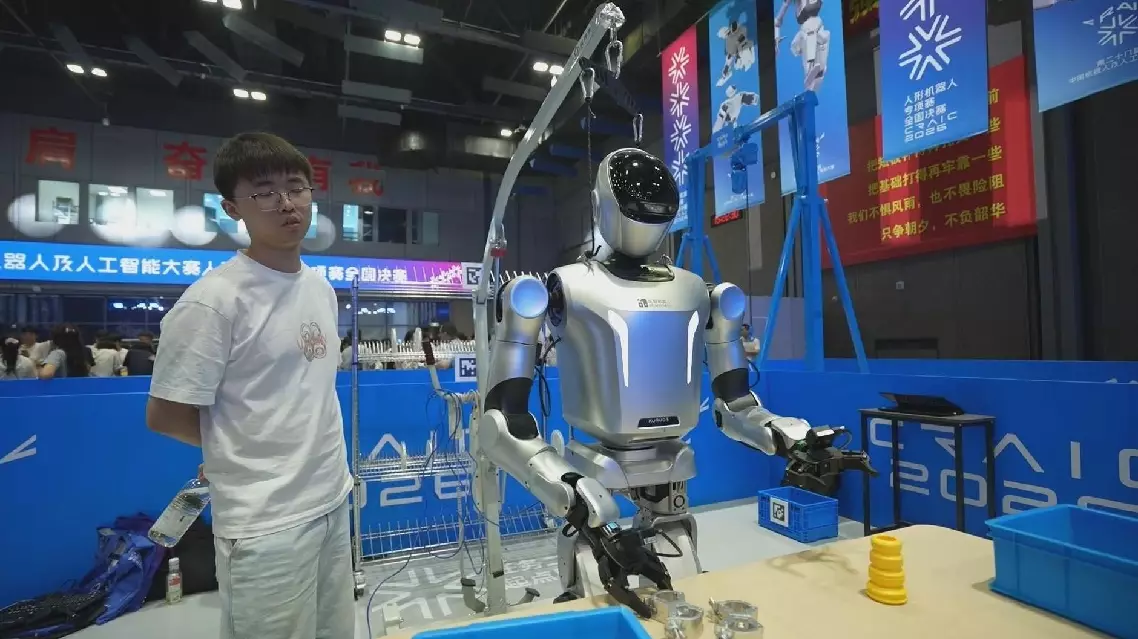
CRAIC 2026 humanoid robot finals held in Beijing