TORONTO (AP) — José Fermin hit a tiebreaking single in the ninth inning and the St. Louis Cardinals defeated the Toronto Blue Jays 5-1 on Sunday, avoiding a three-game sweep.
Matthew Liberatore pitched six shutout innings and George Soriano (4-3) worked one inning for the win as the Cardinals used a four-run ninth to snap an eight-game losing streak against Toronto.
Click to Gallery
Toronto Blue Jays' Luis Urias breaks his bat on a swing during the first inning of a baseball game against the St. Louis Cardinals in Toronto, Sunday, Aug. 2, 2026. (Sammy Kogan/The Canadian Press via AP)
Toronto Blue Jays' Vladimir Guerrero Jr., right, unsuccessfully challenges a strike call during the fourth inning of a baseball game against the St. Louis Cardinals in Toronto, Sunday, Aug. 2, 2026. (Sammy Kogan/The Canadian Press via AP)
St. Louis Cardinals' Matthew Liberatore works against the Toronto Blue Jays during the fourth inning of a baseball game in Toronto, Sunday, Aug. 2, 2026. (Sammy Kogan/The Canadian Press via AP)
Toronto Blue Jays' Max Scherzer works against the St. Louis Cardinals during the first inning of a baseball game in Toronto, Sunday, Aug. 2, 2026. (Sammy Kogan/The Canadian Press via AP)
St. Louis Cardinals' Nathan Church sprints in to score on a double by Lars Nootbaar during the third inning of a baseball game against the Toronto Blue Jays in Toronto, Sunday, Aug. 2, 2026. (Sammy Kogan/The Canadian Press via AP)
St. Louis won for the fifth time in 17 games since the All-Star break, and scored more than three runs for the first time since a 7-0 win over Cincinnati on July 25.
Blue Jays closer Louis Varland (3-4) walked Masyn Winn to begin the ninth. Winn advanced to third on a base hit by Bryan Torres before scoring on Fermin’s line drive single to center.
Varland hadn’t allowed a run since July 10 at San Diego.
Two outs later, Torres scored on a throwing error by second baseman Luis Urias. Jordan Walker followed with a two-run single, chasing Varland.
The four runs off Varland matched the number he allowed in 13 appearances in June.
St. Louis opened the scoring in the third inning when Nathan Church scored from first on a two-out double by Lars Nootbar.
Alejandro Kirk’s infield single in the second was the only hit off Liberatore. The left-hander walked one and struck out seven.
The Blue Jays tied it against Soriano in the eighth. Andrés Giménez reached on a two-out single and stole second before scoring on Urías’ double.
Blue Jays right-hander Max Scherzer allowed one run and four hits in six innings. Scherzer walked one and struck out five, boosting his career total to 3,512.
Cardinals RHP Michael McGreevy (4-9, 3.57 ERA) is expected to start at New York on Monday against Yankees RHP Cam Schlittler (10-6, 2.04).
Blue Jays RHP Shane Bieber (2-2, 5.74 ERA) is scheduled to start at Houston on Monday against Astros RHP Cristian Javier (1-1, 7.17).
__
AP MLB: https://apnews.com/hub/mlb

Toronto Blue Jays' Luis Urias breaks his bat on a swing during the first inning of a baseball game against the St. Louis Cardinals in Toronto, Sunday, Aug. 2, 2026. (Sammy Kogan/The Canadian Press via AP)

Toronto Blue Jays' Vladimir Guerrero Jr., right, unsuccessfully challenges a strike call during the fourth inning of a baseball game against the St. Louis Cardinals in Toronto, Sunday, Aug. 2, 2026. (Sammy Kogan/The Canadian Press via AP)

St. Louis Cardinals' Matthew Liberatore works against the Toronto Blue Jays during the fourth inning of a baseball game in Toronto, Sunday, Aug. 2, 2026. (Sammy Kogan/The Canadian Press via AP)

Toronto Blue Jays' Max Scherzer works against the St. Louis Cardinals during the first inning of a baseball game in Toronto, Sunday, Aug. 2, 2026. (Sammy Kogan/The Canadian Press via AP)

St. Louis Cardinals' Nathan Church sprints in to score on a double by Lars Nootbaar during the third inning of a baseball game against the Toronto Blue Jays in Toronto, Sunday, Aug. 2, 2026. (Sammy Kogan/The Canadian Press via AP)
MIKITAMÄE, Estonia (AP) — As an accordion plays, 80-year-old Maime Kapten spins across the grass field, her embroidered skirt swirling and silver chains and coins around her neck jangling.
Kapten is a member of the Seto ethnic community, which once a year turns a village in southeastern Estonia into a symbolic kingdom for a day — complete with entry visas instead of tickets, made-up currency and even a mock military parade. She's one of only a few thousand fluent speakers of Seto, which is closely related to the Estonian language.
The idea was born in 1994 as the Setos, whose homeland was divided by the Estonian-Russian border after the collapse of the Soviet Union, created a special event to highlight their unique culture and preserve their language, and bring the community together.
“This is an important cultural day for us,” Kapten said. “We get to meet people we know, we get to talk, exchange a few words, give each other a hug.”
The Seto people have lived for centuries in the border region and never had a real kingdom. After the Soviet Union's collapse, many on the Russian side of the border eventually abandoned or sold their houses and moved to Estonia. Fewer than 200 stayed behind.
Those who remained on the different sides of the border couldn’t see each other as easily as before and needed visas to visit family graves and relatives.
According to Estonia's 2021 census, about 25,000 people reported being able to speak Seto, but linguists estimate only a few thousand use it in everyday life. Seto speakers are spread across Estonia, and the Setomaa parish in their traditional home region is home to fewer than 3,000 people.
The parish includes the usually quiet village of Mikitamäe, host to this year's kingdom day, whose streets were bursting on Saturday with men and women in colorful folk costumes.
A local saying goes that you hear a Seto woman before you see her because of the noise her silver chains and dangling coins make. Those traditional dresses, worn every day a century ago, now are only worn for special occasions.
“Seto clothes say a lot about the person who wears them," said cultural activist Piret Torm-Kriis, 62. “If you look at a Seto woman, you can understand whether she is married or single, whether she is going to the church or to the market, to a party or to work.”
For centuries, Seto culture has combined Eastern Orthodox traditions and pre-Christian mythology.
Setos attended church services but also sought help from Peko, the god of fertility and king of the Setos in local folklore. The tradition lives on with the annual election of a new Ülemsootska, the representative of the community, who speaks on Peko’s behalf and serves as his messenger.
Each year, a man and a woman declare their program while standing on tree stumps to the Seto people, who quickly form lines in front of their favored candidate, holding onto threads stretching hundreds of meters (yards).
On Saturday, the longest line formed in front of folk costume maker Ingrit Kala, who was declared the Ülemsootska.
Topping Kala's agenda: promoting the Seto culture and preserving the Seto language. The language is officially viewed as a dialect of Estonian but considered a separate language by the Seto themselves, with its distinct pronunciation, grammar and vocabulary.
“We have so many different things, so many skilled craftspeople, to show what a rich culture we have and to really introduce it,” Kala said.
Saturday's events prominently featured the traditional Seto way of singing, known as leelo, believed to be over 1,000 years old and recognized on UNESCO's list of intangible cultural heritage.
It features a woman singing the first verse line, with a choir joining in for the final syllables before the singing blends together. Its lyrics and themes are often mythological and have been passed down orally from one generation to another.
Singing traditionally accompanied all daily activities, with songs for everything, including work, rituals and celebrations.
Leelo singing contains a lot of information about the world and people at the time of its origins, "how were they thinking, what was important, what did they believe in,” leelo singing researcher and teacher Mari Palolill said after singing with her choir.
Seto traditions have survived largely by being passed on by word of mouth, and the annual kingdom day is one of the most important events for preserving the Seto language.
In Setomaa, there is a Seto-speaking kindergarten group and a newspaper in Seto. Some books, including Antoine de Saint-Exupéry's “The Little Prince,” have been translated into Seto.
Still, it remains a language largely learned in the family.
“If Seto isn’t spoken at home, then what children learn at school doesn’t help much,” Kala said
Maria Grünberg, 23, learned Seto by listening to leelo songs as a child and trying to sing along. Now she’s leading the youth leelo choir and her dream is to help every generation embrace Seto.
“We all together try to preserve the songs, the language, and show also other young people that Seto songs and Seto language is not only for old people," said Grünberg, who sang wearing a traditional Seto dress she customized herself and her grandparents' jewelry. “We want to show that this is for everyone.”
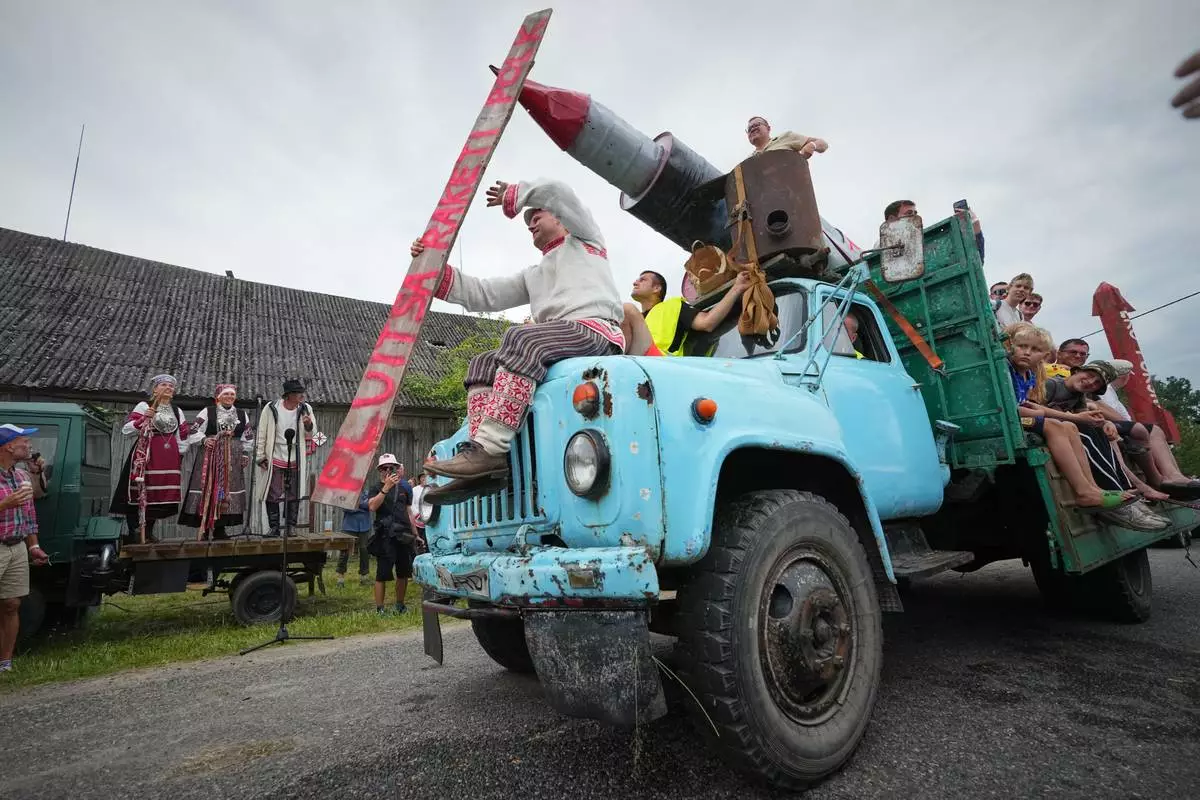
Estonia Seto Kingdom Day People attend mock military parade during the annual Seto Kingdom Day in Mikitamäe, south Estonia, Saturday, Aug. 1, 2026. (AP Photo/Sergei Grits)

Estonia Seto Kingdom Day Men wearing traditional Seto costumes dance during the annual Seto Kingdom Day in Mikitamäe, south Estonia, Saturday, Aug. 1, 2026. (AP Photo/Sergei Grits)
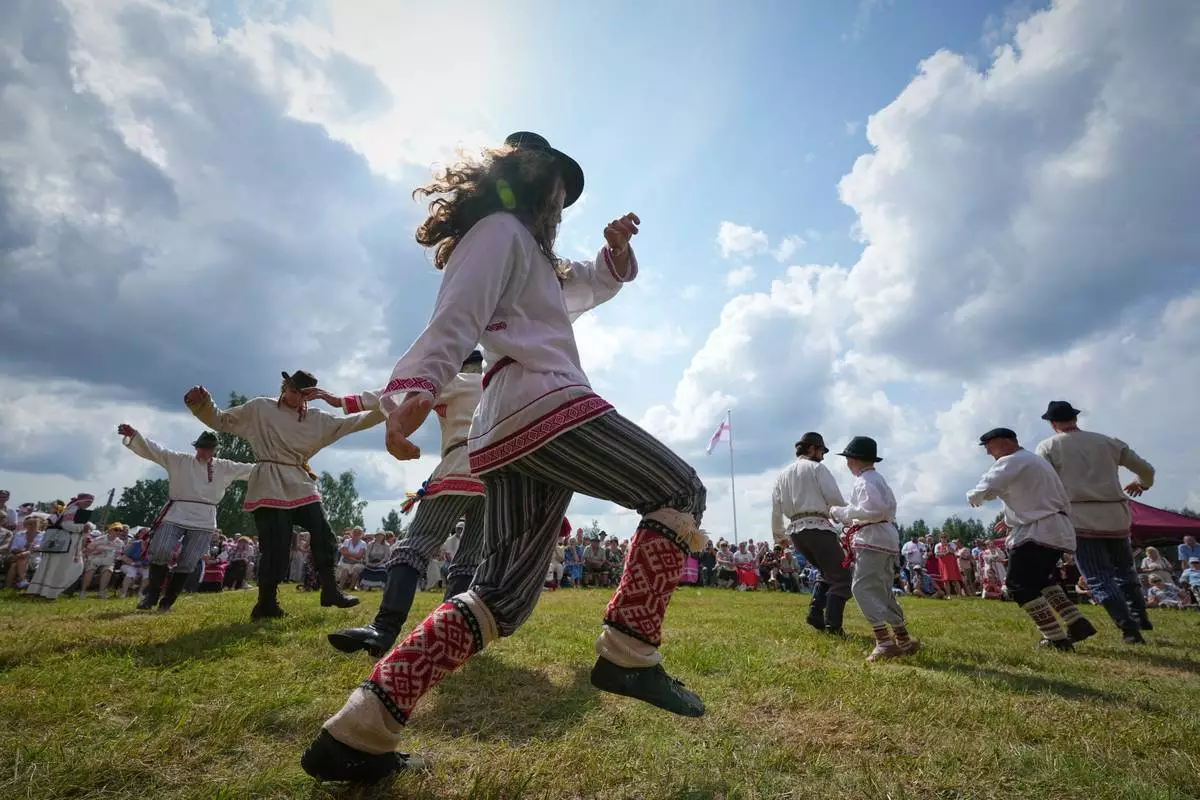
Estonia Seto Kingdom Day Men wearing traditional Seto costumes dance during the annual Seto Kingdom Day in Mikitamäe, south Estonia, Saturday, Aug. 1, 2026. (AP Photo/Sergei Grits)

Estonia Seto Kingdom Day A woman wearing traditional Seto costumes dances during the annual Seto Kingdom Day in Mikitamäe, south Estonia, Saturday, Aug. 1, 2026. (AP Photo/Sergei Grits)
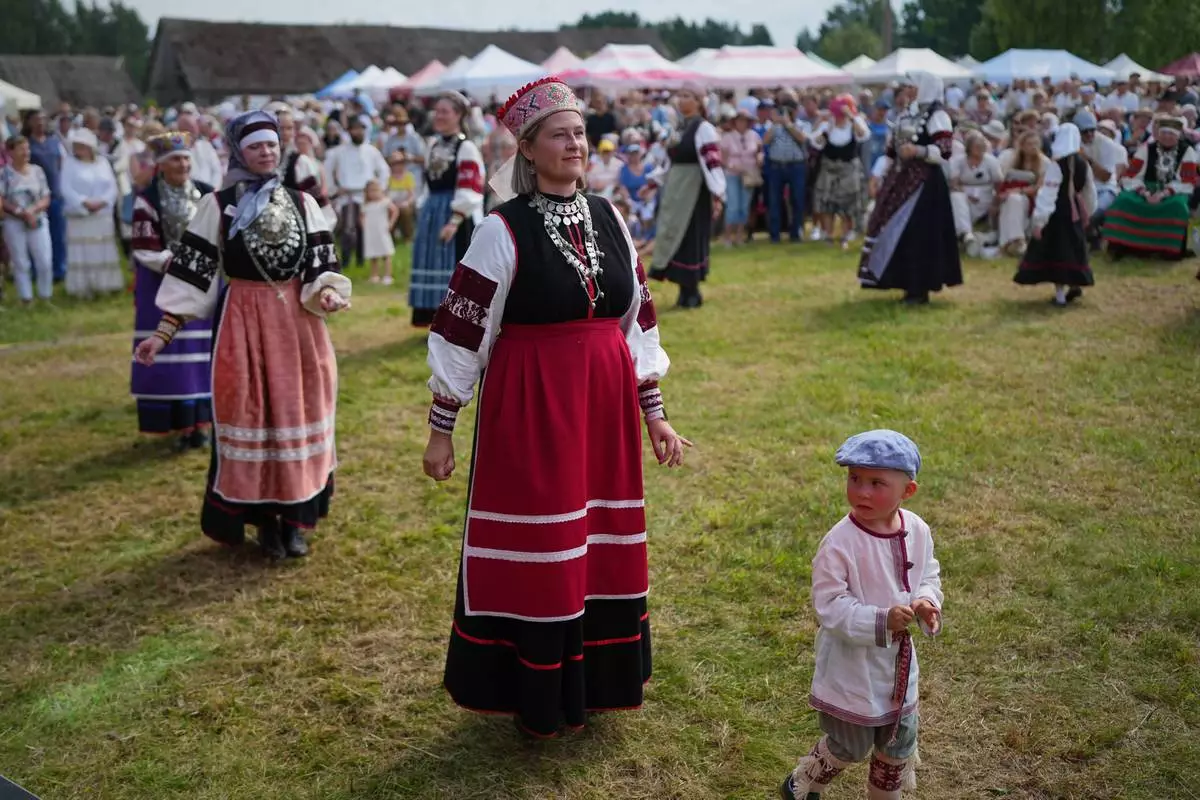
Estonia Seto Kingdom Day Women wearing traditional Seto costumes dance during the annual Seto Kingdom Day in Mikitamäe, south Estonia, Saturday, Aug. 1, 2026. (AP Photo/Sergei Grits)