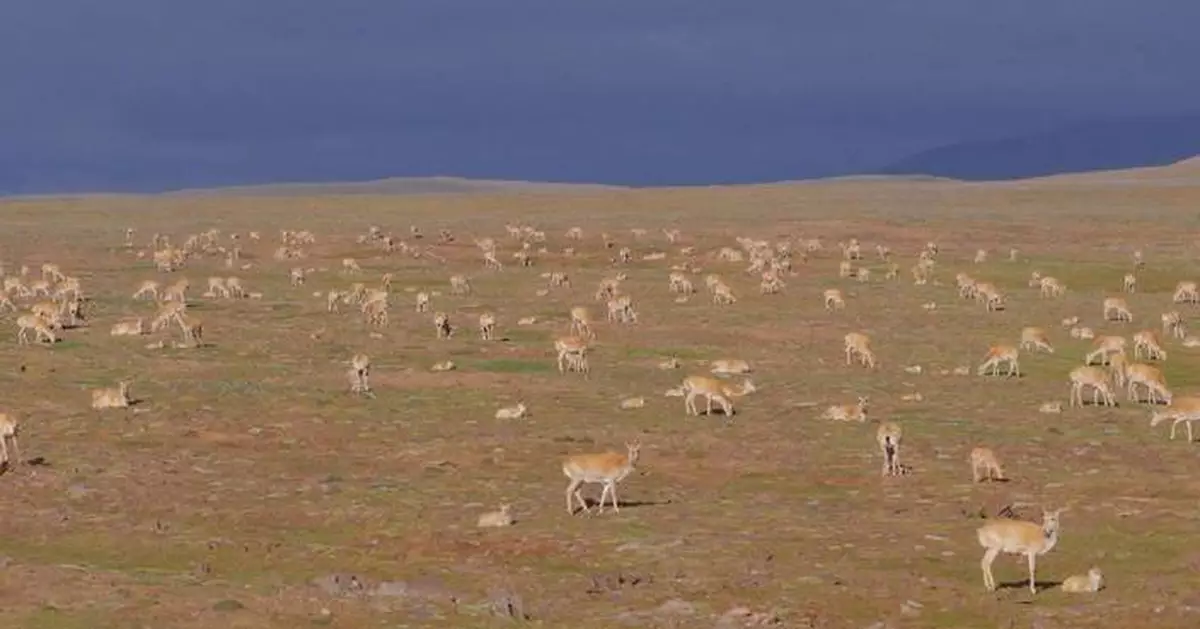
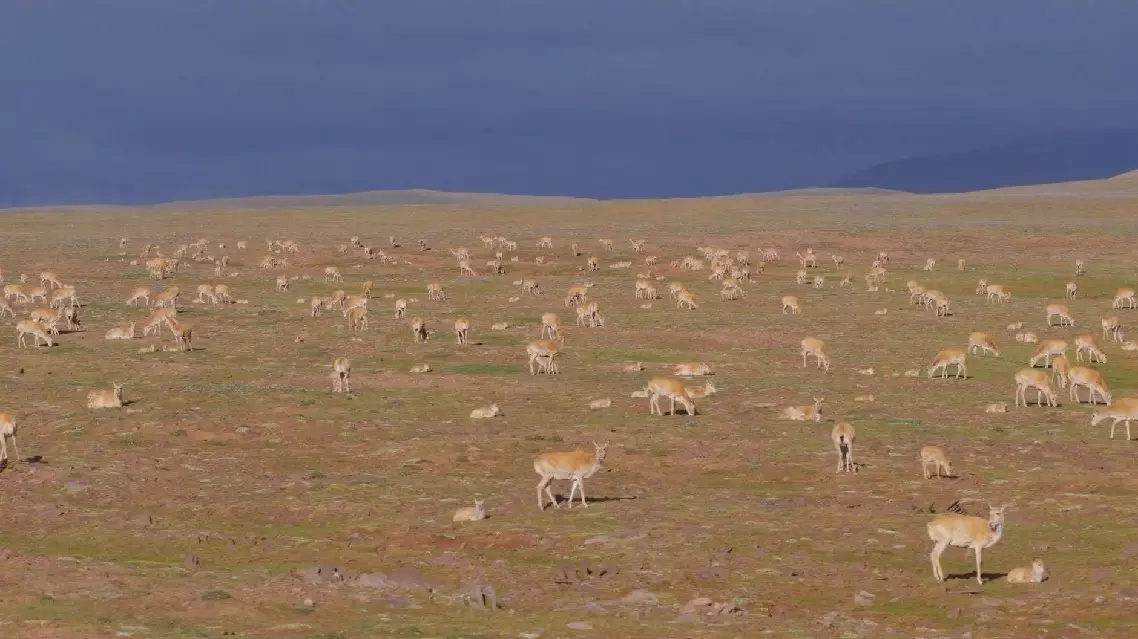
A scientific expedition of Qinghai University ventured deep into the rugged wilderness of Hoh Xil in the northwestern province in July for a field survey during the calving season of Tibetan antelopes, as they have done every year.
At the UNESCO World Natural Heritage site which is often called a "forbidden zone for human life," the group of researchers from the university based in Xining, the provincial capital of Qinghai, collected samples from fresh feces, placentas and other tissues of Tibetan antelopes for genetic analysis.
The time window is narrow, and the team had to race against the clock to collect samples.
"Tibetan antelopes drink water in the morning and then defecate, so that's when the samples are the freshest. But at this altitude on the plateau, the wind is strong and the sunlight would degrade the DNA very quickly once the sun comes out. That is rather detrimental to our follow-up work, as there's no way to collect feces by 10 or 12 o'clock," said Chen Jiarui, an associate professor of the School of Ecological and Environmental Engineering of the Qinghai University.
While collecting samples, team members discovered a pair of antelope horns. Identification confirmed they belonged to a male Tibetan antelope that died of natural causes, a finding that offers important clues about the species' population dynamics.
"We can see that the antelope died several years ago. For us, it's a fascinating discovery. People tend to assume only females gather in the calving grounds, but that's not true. Here we have the direct evidence that males are distributed here as well," Chen said.
The team also encountered a newborn calf lying still on the ground. Its light-brown fleece blends almost perfectly with the soil, making it nearly invisible at a glance.
Experts explained that newborn calves have limited mobility and following their mothers would expose them to predators. They therefore stay put, relying on camouflage, and wait for their mothers to return from foraging and nurse them.
"Its coat color is closely identical with that of the soil, which is an excellent camouflage. That is its survival wisdom," Chen said.
Over the course of the 21-day expedition, the team collected a total of 619 samples from feces, placentas and muscle tissues.
They also used drones and artificial intelligence (AI) recognition technology to record the movement patterns of Tibetan antelopes in real time.
Scientific expedition surveys Tibetan antelopes' calving in Qinghai