DENVER (AP) — The judge who granted the right to play another year of college sports to some athletes whose eligibility ran out last school year issued a new order Sunday that makes clear that does not include football players who signed pro contracts this summer then had a change of heart.
U.S. District Judge Charlotte Sweeney responded to an NCAA request for clarity about her Friday ruling that granted a fifth year to athletes who graduated high school in 2022 and were not included in the new NCAA rule that allows five seasons of eligibility for Division I players.
That decision, she said, still stands, but has no impact on other NCAA rules, including its prohibition on players signing pro contracts, then coming back to college.
The ruling, as first written, had the potential to upend the upcoming college football season, where teams are starting camp planning on the so-called “five for five” rule to take effect beginning next fall.
Extending it to players this fall granted hundreds a chance to return to school. In the direct aftermath of the decision, some media reports were listing players on NFL and CFL rosters who were signaling they’d be open to returning to school.
But that appears to be off the table after Sweeney's clarification that said there are no changes to the NCAA's rules regarding pros; no exceptions over when athletes can enter the transfer portal; and no impact on elements of the landmark House lawsuit settlement, which dictates how many players teams can put on rosters and how much schools can pay them.
The rulings out of U.S. District Court in Denver figures to impact sports differently. Football teams, for instance, have already started practice for this season, while baseball doesn't start for a while.
In making decisions, teams figure to factor the NCAA's coming appeal of Sweeney's order and whether to risk bringing back players who could then be declared ineligible if her decision is overturned.
NCAA President Charlie Baker issued a statement after Sweeney's initial ruling came out Friday, saying the ruling was potentially chaos-inducing and a reason Congress needs to pass the Protect College Sports Act. That bill, being considered in the Senate, includes lawsuit protection for the NCAA over eligibility rules, the likes of which they defending in several courts around the country.
AP college sports: https://apnews.com/hub/college-sports

FILE - Footballs rest on the field in the second half of an NCAA college football game Nov. 28, 2020, in Boulder, Colo. (AP Photo/David Zalubowski, File)
LONDON & SYDNEY--(BUSINESS WIRE)--Aug 3, 2026--
Reimagine Robotics, an AI robotics company founded by former leaders of Google DeepMind’s Applied Robotics team, today emerged from stealth with new technology that allows robots to learn on the job.
This press release features multimedia. View the full release here: https://www.businesswire.com/news/home/20260803688779/en/
The company is developing intelligent robots that anyone can train and use. Instead of requiring specialist programmers whenever a task or production process changes, workers can show the robot what to do, watch it attempt the task and correct it on the spot.
“A useful robot should be able to learn from the person doing the work,” says Jonathan Scholz, co-founder and CEO of Reimagine Robotics. “They should be able to show it a task, put it right when it makes a mistake and move on to the next problem. That is what it means for a robot to learn on the job. It’s a process we call ‘monkey-see, monkey-do’.”
“A robot should arrive with the attitude of a new colleague: ‘How can I help? What do you want me to do?’ The people who understand the process should be able to answer those questions by showing the robot directly.”
Scholz founded Google DeepMind’s Applied Robotics team in London and led it for seven years. He later co-founded Reimagine Robotics in April 2025 alongside former colleagues Oleg Sushkov, Akhil Raju and Misha Denil, with headquarters in London and Sydney. That first phase was funded by pre-seed financing from venture capital firms Fly Ventures and firstminute capital and a number of angel investors.
The next phase
“We’re excited to come out of stealth,” Scholz says. “This last year was about building a core product and a team, and working with customers to test the platform. After working with several partners, we’re absolutely convinced it’s not only viable, but that there is a need for this technology, and that it has massive potential across an array of industrial and manufacturing settings.”
“This next stage is about a new round of fundraising, expanding our team for more deployment muscle, putting robots into more workplaces, and showing that each deployment can make the next one faster, more reliable, and more efficient.”
Robots already on the factory floor
The company is already deploying its robots in advanced manufacturing and electronics disassembly facilities.
At a made-to-order plastics business, Reimagine Robotics trained its robots to tend 3D printers overnight by removing print beds, operating latches and pressing controls. The customer’s own team used the platform to automate additional stages, including washing, curing and drying.
In a separate deployment involving the recovery of valuable critical materials from used hard drives, Reimagine Robotics worked with process engineers to develop a three-robot disassembly cell. The resulting workflow combines robots and people working together to evolve and optimise the workflow in real-time.
During the project, Reimagine Robotics reduced the time required to prototype and test a new robot behaviour from approximately one day to around ten minutes. That allowed the robots to become part of the process-design conversation: teams could propose a new use for a robot and test the idea almost immediately.
Humans at the heart of robotics
Throughout all Reimagine Robotics deployments, people remain central to the model.
“For us, this is not about taking people out of the process,” Scholz says. “A robot that learns on the job depends on people. The worker identifies the bottleneck, shows the robot how to help and corrects it until it is useful.”
“The robot turns that person’s knowledge into leverage. Instead of someone having to repeat a tedious physical task thousands of times, they can teach the robot, and apply that ability wherever it is needed.”
“I think of it more as a tool to amplify human labour.”
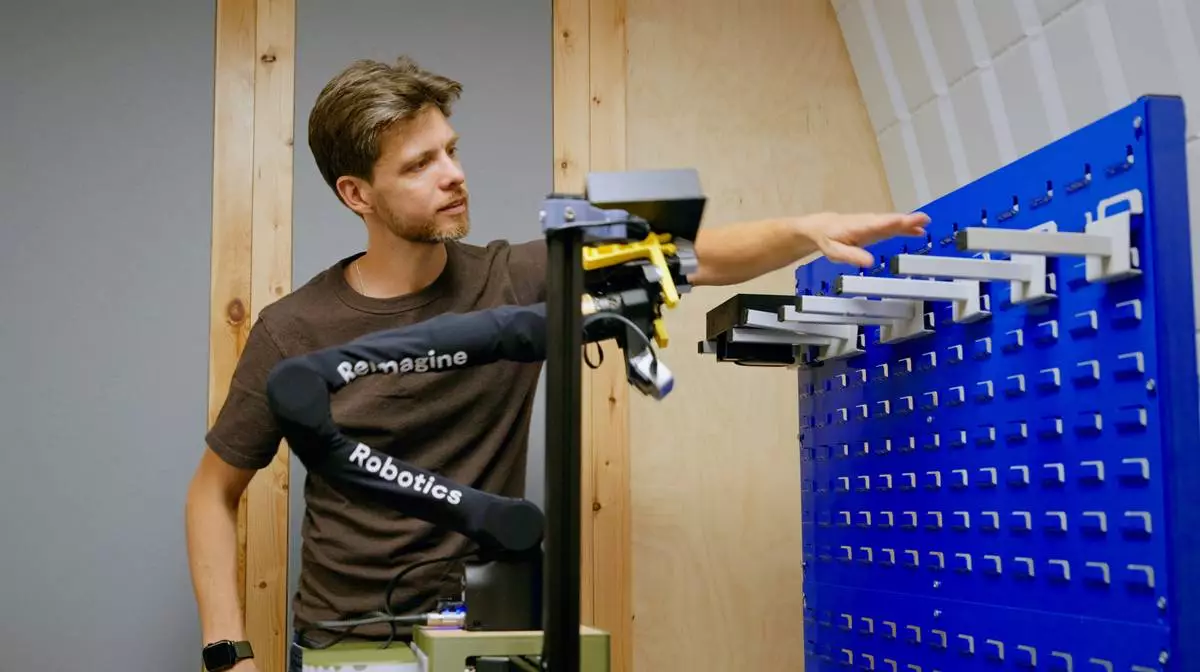
Reimagine Robotics CEO Jonathan Scholz with the company's AI-powered robot learning on the job. Credit: Reimagine Robotics