SYDNEY (AP) — The trial of a retired Sydney radio broadcaster and former Australian national rugby coach accused of sexual offenses against six men and boys over two decades began on Monday.
The 85-year-old has pleaded not guilty to 20 counts of indecent assault and two of sexual touching without consent. The offenses were allegedly committed between 2003 and when he retired from radio in 2020 at various locations in Sydney and at his farm on the Southern Highlands in New South Wales state.
Jones and his lawyers did not answer reporters’ questions as they arrived at the Downing Center Local Court in Sydney on Monday morning. The trial is expected to hear more than 70 witnesses and continue for months.
Jones opted to be tried by Judge Glenn Walsh without a jury. None of the six complainants can be identified for legal reasons.
Prosecutor Georgina Wright said in her opening address that one of the complainants was about 16 years old and a budding sports champion when he first met Jones.
Jones is accused of committing nine offenses against the man, including kissing him multiple times without consent and touching the man’s genitals while the man was driving.
The complainant “felt trapped and didn’t know what to do,” Wright told the court.
Another complainant, who was 21 years old and worked on Jones’ radio program, would testify that Jones called him “darling” and groped the man while he was driving, Wright told the court.
Jones has repeatedly denied the allegations since he was arrested in 2024.
“These allegations are either baseless or they distort the truth,” Jones said a month after his arrest.
Jones hosted a popular Sydney breakfast radio show for close to two decades. He was regarded as one of the most powerful people in Australian media.
He was also a successful coach of the Australian national rugby team, the Wallabies, for four years from early 1984. The team won 86 of their 102 matches under his leadership.
Jones was also influential in conservative politics and was a speechwriter for Prime Minister Malcolm Fraser. Fraser was in power from 1975 until 1983. He died in 2015.
Police set up a strike force to investigate Jones after The Sydney Morning Herald newspaper reported in 2023 that Jones used his position of power, first as a schoolteacher and later as a popular broadcaster, to prey on a number of young men.

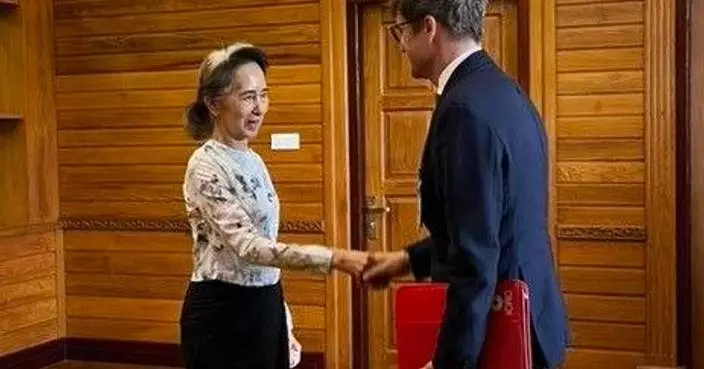
Former Australian rugby coach and broadcaster Alan Jones, center, arrives at Downing Centre Local Court in Sydney, Australia Monday, Aug. 3, 2026. (Bianca De Marchi/AAP Image via AP)
LONDON & SYDNEY--(BUSINESS WIRE)--Aug 3, 2026--
Reimagine Robotics, an AI robotics company founded by former leaders of Google DeepMind’s Applied Robotics team, today emerged from stealth with new technology that allows robots to learn on the job.
This press release features multimedia. View the full release here: https://www.businesswire.com/news/home/20260803688779/en/
The company is developing intelligent robots that anyone can train and use. Instead of requiring specialist programmers whenever a task or production process changes, workers can show the robot what to do, watch it attempt the task and correct it on the spot.
“A useful robot should be able to learn from the person doing the work,” says Jonathan Scholz, co-founder and CEO of Reimagine Robotics. “They should be able to show it a task, put it right when it makes a mistake and move on to the next problem. That is what it means for a robot to learn on the job. It’s a process we call ‘monkey-see, monkey-do’.”
“A robot should arrive with the attitude of a new colleague: ‘How can I help? What do you want me to do?’ The people who understand the process should be able to answer those questions by showing the robot directly.”
Scholz founded Google DeepMind’s Applied Robotics team in London and led it for seven years. He later co-founded Reimagine Robotics in April 2025 alongside former colleagues Oleg Sushkov, Akhil Raju and Misha Denil, with headquarters in London and Sydney. That first phase was funded by pre-seed financing from venture capital firms Fly Ventures and firstminute capital and a number of angel investors.
The next phase
“We’re excited to come out of stealth,” Scholz says. “This last year was about building a core product and a team, and working with customers to test the platform. After working with several partners, we’re absolutely convinced it’s not only viable, but that there is a need for this technology, and that it has massive potential across an array of industrial and manufacturing settings.”
“This next stage is about a new round of fundraising, expanding our team for more deployment muscle, putting robots into more workplaces, and showing that each deployment can make the next one faster, more reliable, and more efficient.”
Robots already on the factory floor
The company is already deploying its robots in advanced manufacturing and electronics disassembly facilities.
At a made-to-order plastics business, Reimagine Robotics trained its robots to tend 3D printers overnight by removing print beds, operating latches and pressing controls. The customer’s own team used the platform to automate additional stages, including washing, curing and drying.
In a separate deployment involving the recovery of valuable critical materials from used hard drives, Reimagine Robotics worked with process engineers to develop a three-robot disassembly cell. The resulting workflow combines robots and people working together to evolve and optimise the workflow in real-time.
During the project, Reimagine Robotics reduced the time required to prototype and test a new robot behaviour from approximately one day to around ten minutes. That allowed the robots to become part of the process-design conversation: teams could propose a new use for a robot and test the idea almost immediately.
Humans at the heart of robotics
Throughout all Reimagine Robotics deployments, people remain central to the model.
“For us, this is not about taking people out of the process,” Scholz says. “A robot that learns on the job depends on people. The worker identifies the bottleneck, shows the robot how to help and corrects it until it is useful.”
“The robot turns that person’s knowledge into leverage. Instead of someone having to repeat a tedious physical task thousands of times, they can teach the robot, and apply that ability wherever it is needed.”
“I think of it more as a tool to amplify human labour.”
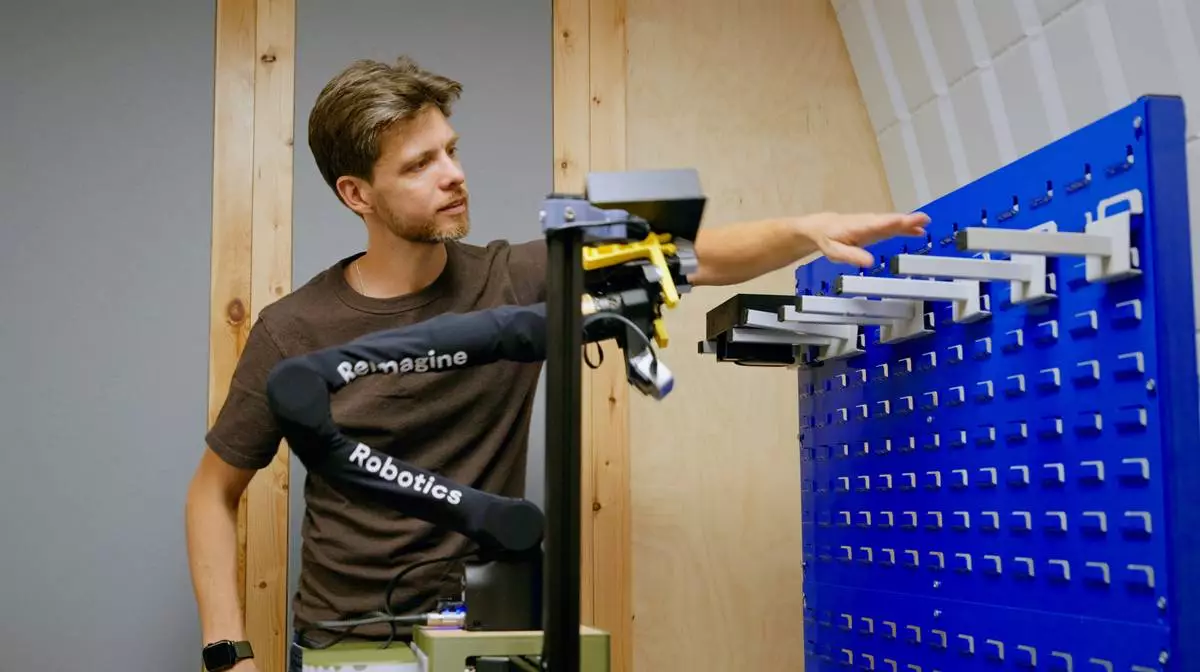
Reimagine Robotics CEO Jonathan Scholz with the company's AI-powered robot learning on the job. Credit: Reimagine Robotics