NEW YORK--(BUSINESS WIRE)--Aug 3, 2026--
Faruqi & Faruqi, LLP, a leading national securities law firm, is investigating potential claims against Badger Meter, Inc. (“Badger Meter” or the “Company”) (NYSE: BMI) and reminds investors of the August 3, 2026 deadline to seek the role of lead plaintiff in a federal securities class action that has been filed against the Company.
This press release features multimedia. View the full release here: https://www.businesswire.com/news/home/20260803994509/en/
Faruqi & Faruqi is a leading national securities law firm with offices in New York, Pennsylvania, California and Georgia. The firm has recovered hundreds of millions of dollars for investors since its founding in 1995. See www.faruqilaw.com.
As detailed below, the complaint alleges that the Company and its executives violated federal securities laws by making false and/or misleading statements and/or failing to disclose that Badger Meter’s strong financial results reflected “ongoing favorable industry trends,” “secular growth drivers,” and “solid operating execution.” They likewise touted “strong” demand and said they were seeing “robust order pacing and a strong bid pipeline that positions us well for continued sales and earnings growth,” and that Badger Meter possessed a “long runway” for growth.
The court-appointed lead plaintiff is the investor with the largest financial interest in the relief sought by the class who is adequate and typical of class members who directs and oversees the litigation on behalf of the putative class. Any member of the putative class may move the Court to serve as lead plaintiff through counsel of their choice, or may choose to do nothing and remain an absent class member. Your ability to share in any recovery is not affected by the decision to serve as a lead plaintiff or not.
Faruqi & Faruqi, LLP also encourages anyone with information regarding Badger Meter’s conduct to contact the firm, including whistleblowers, former employees, shareholders and others.
To learn more about the Badger Meter class action, go to www.faruqilaw.com/BMI or call Faruqi & Faruqi partner Josh Wilson directly at 877-247-4292 or 212-983-9330 (Ext. 1310).
Follow us for updates on LinkedIn, on X, or on Facebook.
Frequently Asked Questions (FAQ) for Investors Regarding the Badger Meter Securities Class Action Lawsuit:
What is the Badger Meter securities fraud lawsuit about?
The Badger Meter securities fraud lawsuit is a federal securities class action alleging that Badger Meter, Inc. (NYSE: BMI) and its executives made false and misleading statements to investors by touting "strong" demand, a "robust" order pipeline, and a "long runway" for growth while concealing that the Company's financial results were not sustainable. As the truth emerged through a series of disclosures — including disappointing Q2 2025 results and a sequential sales decline forecast on July 22, 2025, missed revenue expectations and a 6% sequential decline in utility water sales on January 28, 2026, and Q1 2026 earnings that missed consensus estimates by $0.26 per share with revenue missing by $28.58 million on April 17, 2026 — BMI's stock price dropped sharply, causing significant losses for investors.
Who may be eligible to participate in the Badger Meter class action lawsuit?
Investors who purchased or acquired Badger Meter (BMI) stock between April 18, 2024 and April 16, 2026 — the Class Period — and suffered financial losses may be eligible to participate in the Badger Meter securities class action. Participation as a class member does not require taking any affirmative legal action; eligible investors may recover losses simply by remaining members of the class. Whistleblowers, former Badger Meter employees, and others with relevant information about the Company's conduct are also encouraged to come forward.
What is a lead plaintiff, and how can I seek appointment in the Badger Meter lawsuit?
A lead plaintiff in the Badger Meter class action is a court-appointed investor — typically the one with the largest financial interest in the case — who directs and oversees the litigation on behalf of all class members. Any Badger Meter investor who purchased BMI stock during the Class Period may move the Court to serve as lead plaintiff through counsel of their choice. The deadline to seek lead plaintiff appointment is August 3, 2026. Importantly, choosing not to seek the lead plaintiff role does not affect an investor's ability to share in any recovery obtained for the class.
What should investors do if they purchased Badger Meter stock during the Class Period?
Investors who purchased Badger Meter (BMI) stock between April 18, 2024 and April 16, 2026 and suffered losses should contact Faruqi & Faruqi, LLP immediately to discuss their legal rights. The deadline to seek appointment as lead plaintiff in the Badger Meter securities class action is August 3, 2026. To speak directly with securities litigation partner Josh Wilson, call 877-247-4292 or 212-983-9330 (Ext. 1310), or visit www.faruqilaw.com/BMI for more information.
Attorney Advertising. The law firm responsible for this advertisement is Faruqi & Faruqi, LLP ( www.faruqilaw.com ). Prior results do not guarantee or predict a similar outcome with respect to any future matter. We welcome the opportunity to discuss your particular case. All communications will be treated in a confidential manner.

CLASS ACTION DEADLINE TONIGHT: Faruqi & Faruqi, LLP Reminds Badger Meter (BMI) Investors of Securities Class Action Lawsuit Deadline on August 3, 2026
NEW YORK (AP) — More drops for stocks in the artificial intelligence industry dragged the U.S. market lower on Monday, led by Nvidia.
The weakness for tech stocks helped knock the S&P 500 index 1.9% lower and pushed the Nasdaq composite index to a 2.5% loss. The Dow also fell sharply as losses broadened into other sectors. AI-focused companies were by far the biggest weights on the market and have been behind much of the recent turbulence on Wall Street.
Nvidia sank 4.1% and was again the heaviest weight on Wall Street following its crisis of leadership. The company has lost $735 billion in market value since the scandal erupted about CEO Jensen Huang’s infidelities and his ties to an alleged Chinese spy.
Nvidia is one of the most influential companies in the world not only because its chips are powering much of the world’s move into AI technology but also because its cash has helped companies across the industry to grow.
Now, following Huang’s resignation as Nvidia’s CEO last week, both the chip company and the broad industry are facing a more uncertain future without the leather-jacketed man who became one of AI’s biggest celebrities.
It’s the latest challenge for the AI industry, which had already been shaken by criticism that stock prices in the industry shot too high and were in a bubble. The sweeping victories for Democrats in this month’s U.S. midterm elections also raised worries about possible restrictions on further construction of AI data centers.
“The market was already worried about this risk before what happened at Nvidia,” Zhiwei Zhang, president and chief economist at Pinpoint Asset Management, said in a commentary. “Now the risk has become even more serious.”
The sector is also now facing more scrutiny from the U.S. government. The Trump administration on Monday issued new rules to restrict remote access to advanced U.S. computing chips and servers.
Outside of Nvidia, other chip companies also fell. They had climbed in the earlier days of Nvidia’s fall on hopes that they could gain a competitive advantage. But Broadcom dropped 3.9% and notched its second straight loss on concerns about the broader industry. Advanced Micro Devices fell 5.6%.
CoreWeave, which buys Nvidia chips and then rents out access to them to customers over the cloud, sank 6.1%. GE Vernova, which is helping to power AI data centers, fell 4.9%.
The next big milestone for the AI industry may arrive Tuesday after trading in the U.S. stock market ends for the day. That’s when Nvidia will report its latest quarterly results, and interim CEO Colette Kress is set to speak to Wall Street. Investors have become accustomed to Nvidia not only reporting stronger results than analysts expected for each quarter but also giving a forecast for upcoming revenue that’s well above expectations.
Elsewhere on Wall Street, L3Harris Technologies fell 3.9% after officials in President Donald Trump’s administration suggested the contractor for the Federal Aviation Administration may be at fault for a nationwide ground stop Friday. L3Harris said Saturday that it’s supporting the FAA in its investigation.
Summit Therapeutics sank 16.5% after the biopharmaceutical company said the U.S. Food and Drug Administration indicated it cannot approve its application for a therapy to treat certain patients with lung cancer.
Tyson Foods rose 8.7% after reporting a stronger profit for the latest quarter than analysts expected. The company behind the Jimmy Dean and Hillshire Farm brands, though, also reported weaker revenue than expected after selling less beef than it did a year earlier.
Overall, the S&P 500 shed 145.08 points to close at 7,416.59, marking the third straight loss for the benchmark index. The Dow Jones Industrial Average fell 739.38 points, or 1.4%, to 51,608.17. The Nasdaq composite fell 626.52 points to 24,509.76.
The recent swings for AI stocks have overshadowed what's been another strong earnings reporting season for U.S. companies. The big businesses in the S&P 500 index are on track to deliver earnings per share for the summer nearly 32% higher than a year earlier, according to FactSet.
It's the third straight quarter of growth above 25% for the index, which is important because corporate profits are one of the two big levers that set stock prices over the long term, along with interest rates.
In the bond market, Treasury yields eased back following last week's jump due to a worse-than-expected report on U.S. inflation.
The yield on the 10-year Treasury fell to 5.13% from 5.15% late Friday, though it remains well above a low of 4.80% reached earlier this month. Higher yields make borrowing money more expensive for everyone, and they’ve already hurt the housing industry through expensive mortgage rates.
Yields fell as oil prices sank, which took away some of the upward pressure on inflation. The price for a barrel of Brent crude oil fell 3.5% to $92.44. It’s been yo-yoing amid uncertainty about what will happen in the war with Iran.
In stock markets abroad, indexes were mixed in Europe.
AP Business Writers Chan Ho-him and Michelle Chapman contributed to this report.
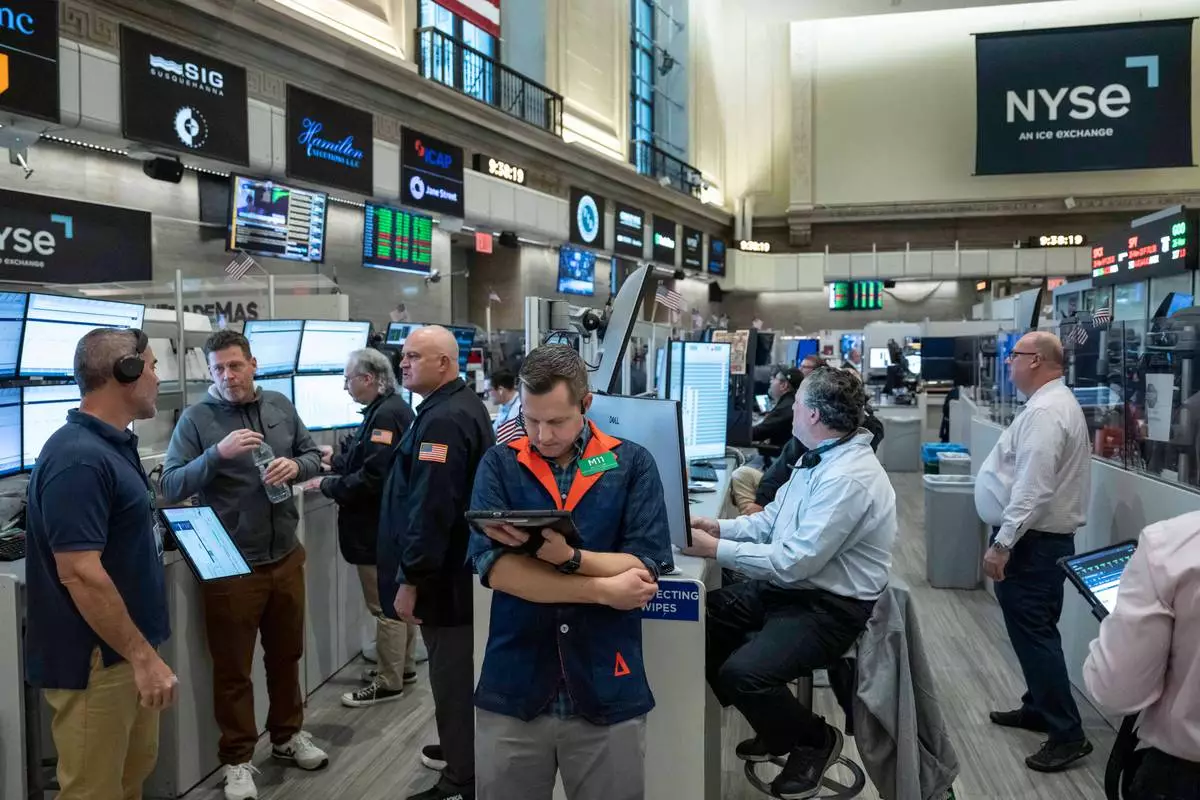
Options traders, including Bill Taylor, center, work on the floor of the New York Stock Exchange in New York, Monday, Nov. 9, 2026. (AP Photo/Yuki Iwamura)
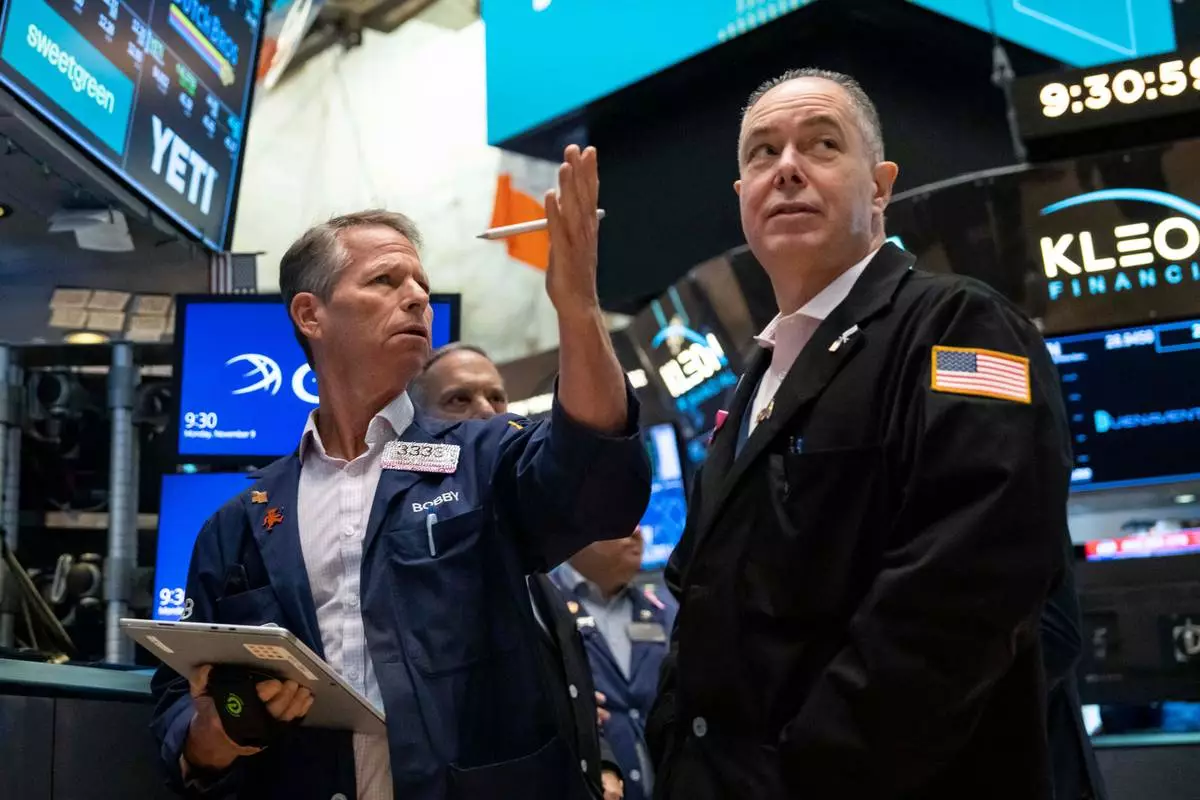
Trader Robert Charmak, left, works on the floor of the New York Stock Exchange in New York, Monday, Nov. 9, 2026. (AP Photo/Yuki Iwamura)
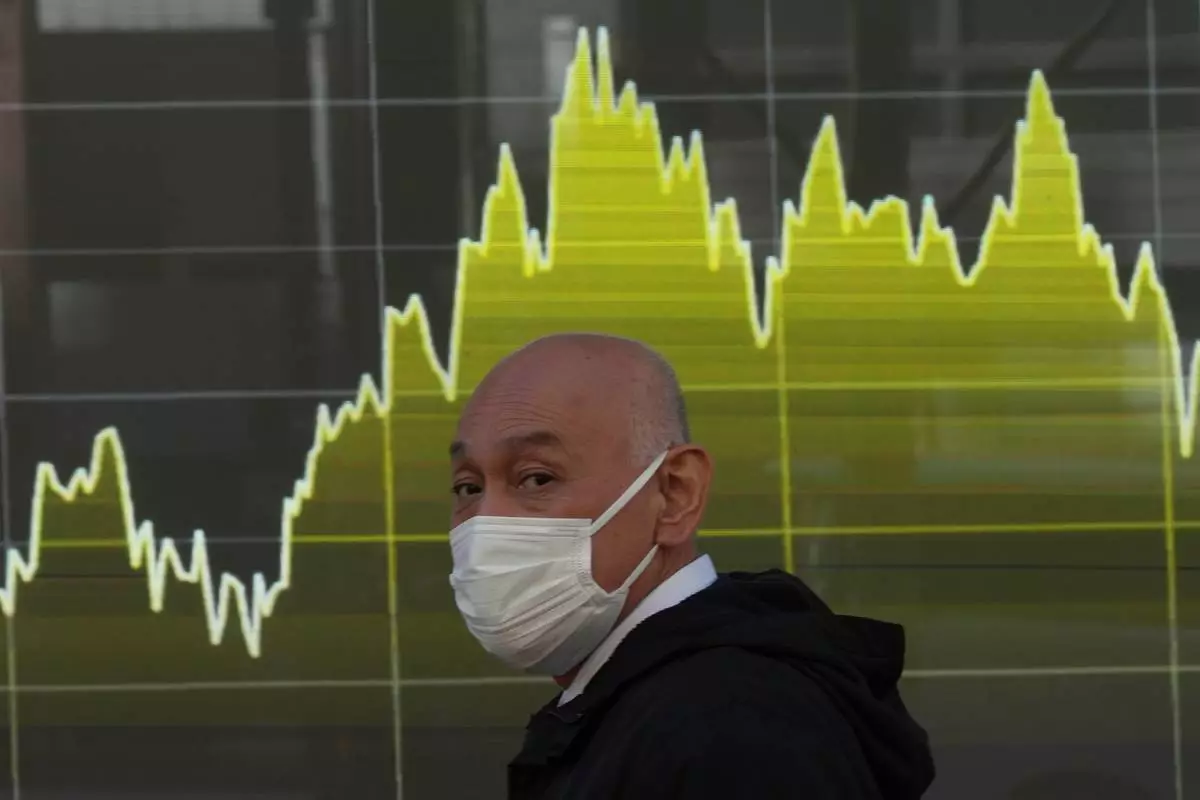
A person walks in front of an electronic stock board showing Japan's Nikkei index at a securities firm Monday, Nov. 16, 2026, in Tokyo.(AP Photo/Eugene Hoshiko)
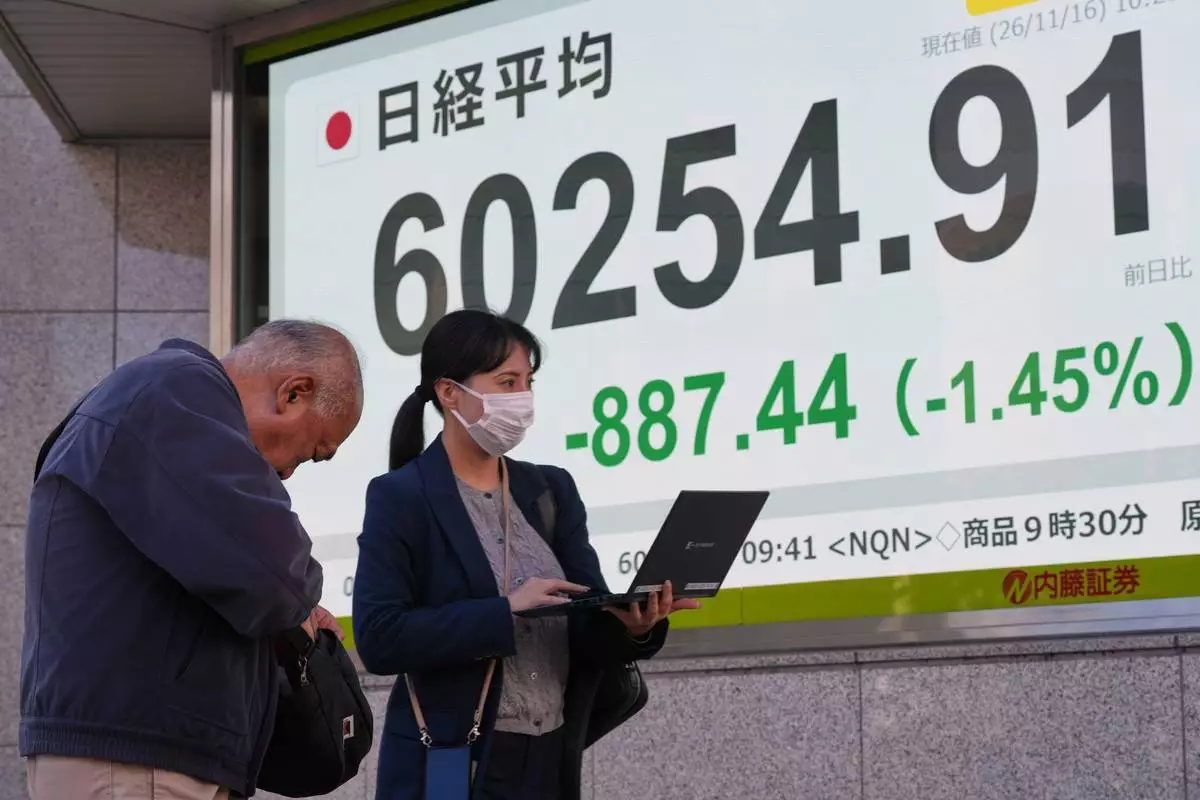
People walk in front of an electronic stock board showing Japan's Nikkei index at a securities firm Monday, Nov. 16, 2026, in Tokyo. (AP Photo/Eugene Hoshiko)
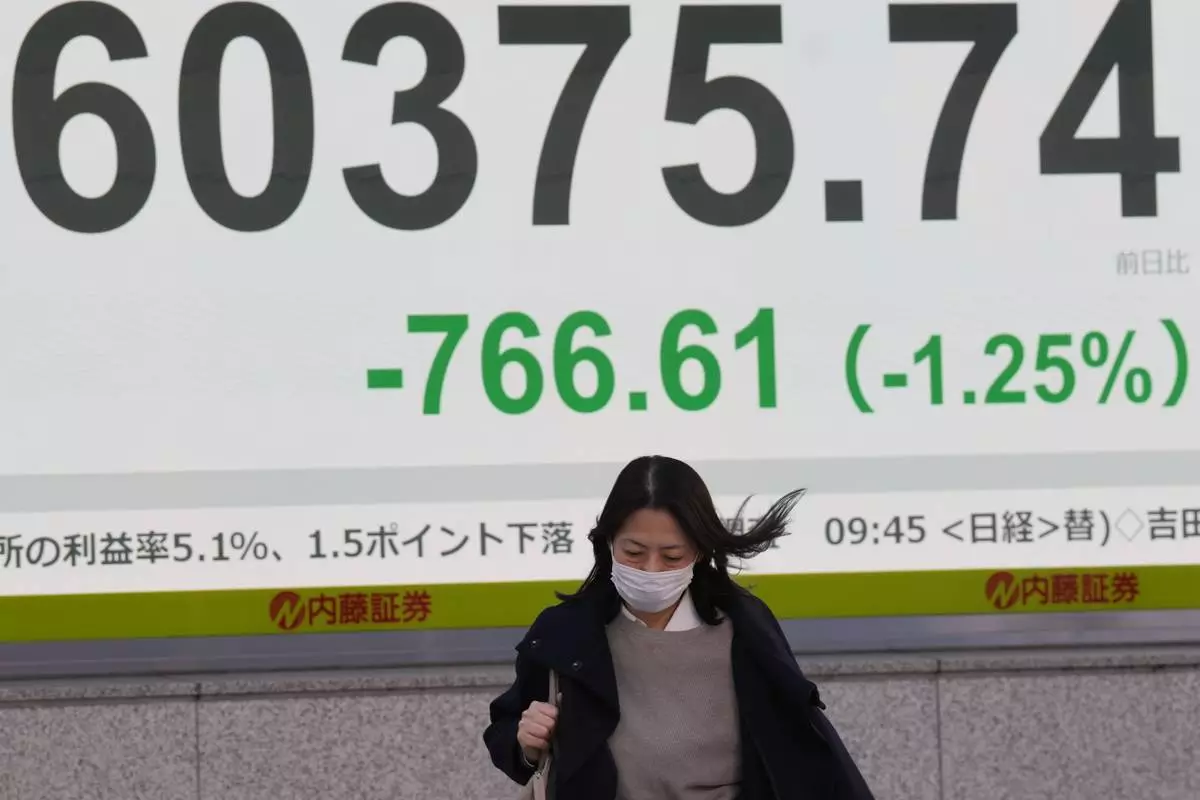
A person walks in front of an electronic stock board showing Japan's Nikkei index at a securities firm Monday, Nov. 16, 2026, in Tokyo.(AP Photo/Eugene Hoshiko)
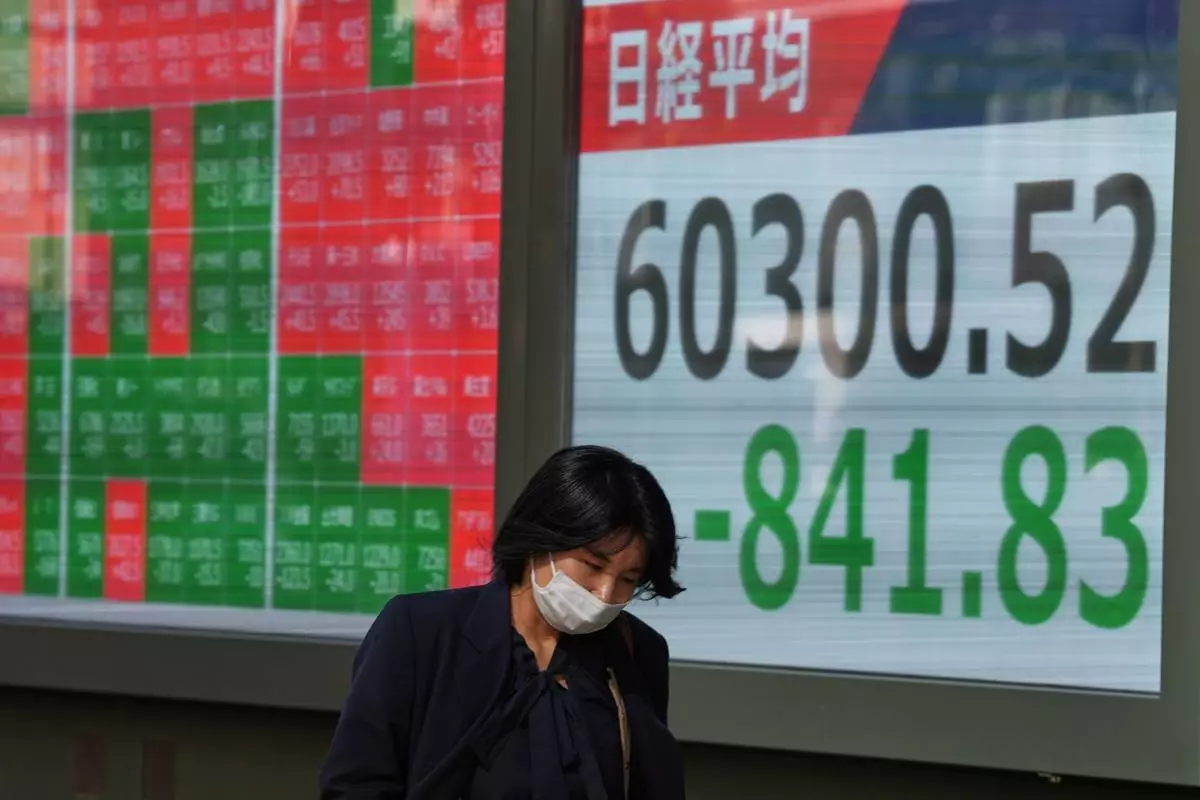
A person walks in front of an electronic stock board showing Japan's Nikkei index at a securities firm Monday, Nov. 16, 2026, in Tokyo. (AP Photo/Eugene Hoshiko)
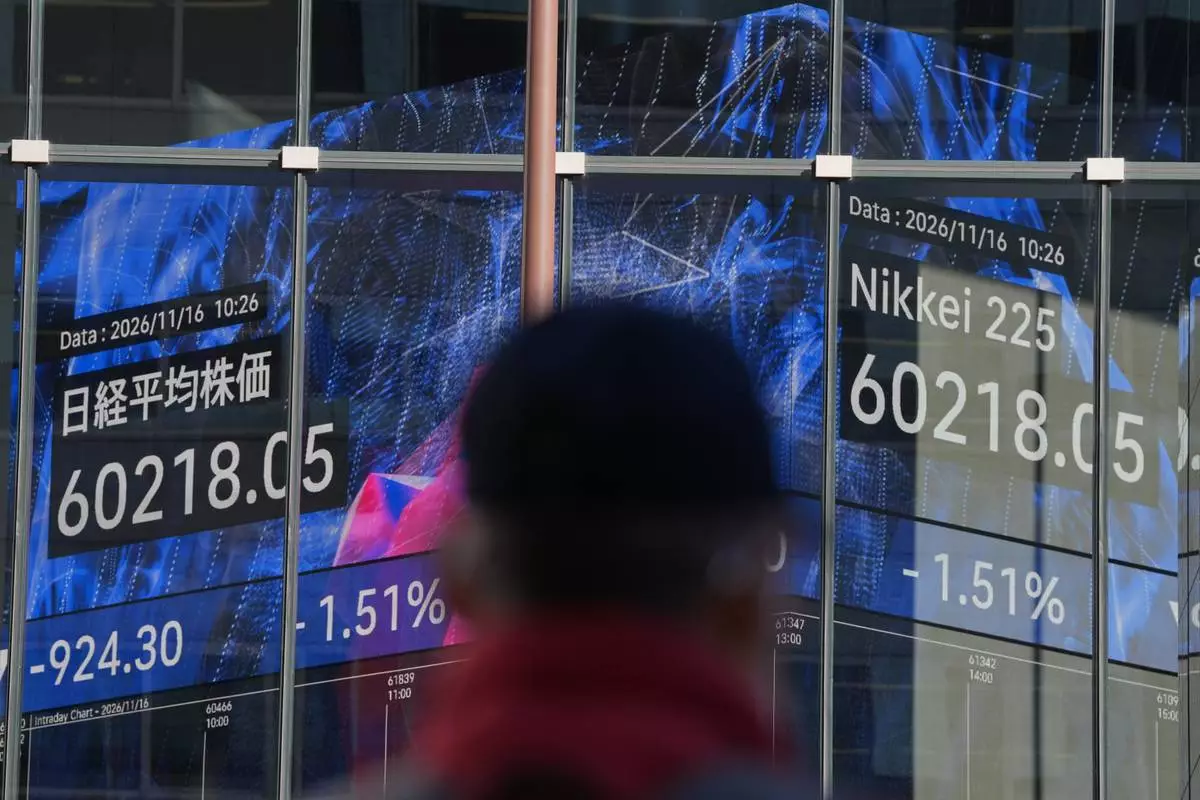
A person watches an electronic stock board showing Japan's Nikkei index at a securities firm Monday, Nov. 16, 2026, in Tokyo. (AP Photo/Eugene Hoshiko)