A new direct flight between northwest China's Xinjiang Uygur Autonomous Region and Kyrgyzstan took off early Tuesday, further promoting people-to-people exchanges between the two countries.
"The flight was amazing. It took us only one-and-a-half to two hours directly from Bishkek to Urumqi. It's all nice that flights are increasing, especially direct flights from Bishkek to Urumqi, because before we used to come from Alma-Ata to China, and right now since it's increasing and the flight was full. I think it's going to be very good international agreements between the two countries," said Gulzana Nazarkulova, a Kyrgyz tourist who took the inaugural flight from Bishkek, the capital city of Kyrgyzstan, to Xinjiang's Urumqi.
The two-hour service, the first regular direct flight to China operated by Kyrgyz airline Aero Nomad, complements the existing 14 weekly round-trip flights.
The number of passengers flying the Urumqi-Bishkek route is up 34 percent from a year ago to over 43,000.
Urumqi Tianshan International Airport is China's gateway to Central Asia, serving 12 destinations, and is a perfect launchpad for Silk Road explorers.
Summer travel since July has been boosted by China's visa-free policies and streamlined airport services. July passenger numbers at Urumqi airport topped 150,000, up nearly 16 percent.
The authorities said they have taken multiple measures to facilitate passenger exit and entry.
"To manage the summer rush, we've rolled out online arrival card filing, seamless transfers and fast crew clearance with airlines. As cross-border tourism surges, we're partnering with foreigner service centers to offer one-stop support on inquiries, payments and communications," said Wu Yong, deputy chief of Urumqi Exit-Entry Border Inspection Station.

Direct flight between China's Urumqi, Kyrgyzstan's Bishkek takes off
A 100-bed Ebola treatment center is expected to open this week in Bunia, eastern Democratic Republic of the Congo, as a rapidly expanding outbreak strains health services in a region already affected by conflict and displacement.
At the Kigonze displacement site in Bunia, International Medical Corps has set up an eight-bed transit center to identify suspected cases, isolate patients and refer confirmed cases for treatment.
"As you can see here behind me, there is a barrier; this is the red zone. When a case is triaged here and suspected of being Ebola, the patient is referred to one of the isolation rooms located behind me. We have a capacity of eight beds here. From that point, we take over their care -- collecting the initial samples for testing. If the test result is negative after 48 hours, we run a second test. If both tests are negative, the person is discharged and returns home, receiving treatment for any other conditions associated with the initial suspicion," said Dr. Francis Bigirimwami Chibanvunya, a doctor at the Kigonze transit center.
The outbreak has compounded a severe humanitarian crisis in Ituri Province, where conflict and violence have displaced nearly 1 million people, according to the UN Office for the Coordination of Humanitarian Affairs, or OCHA.
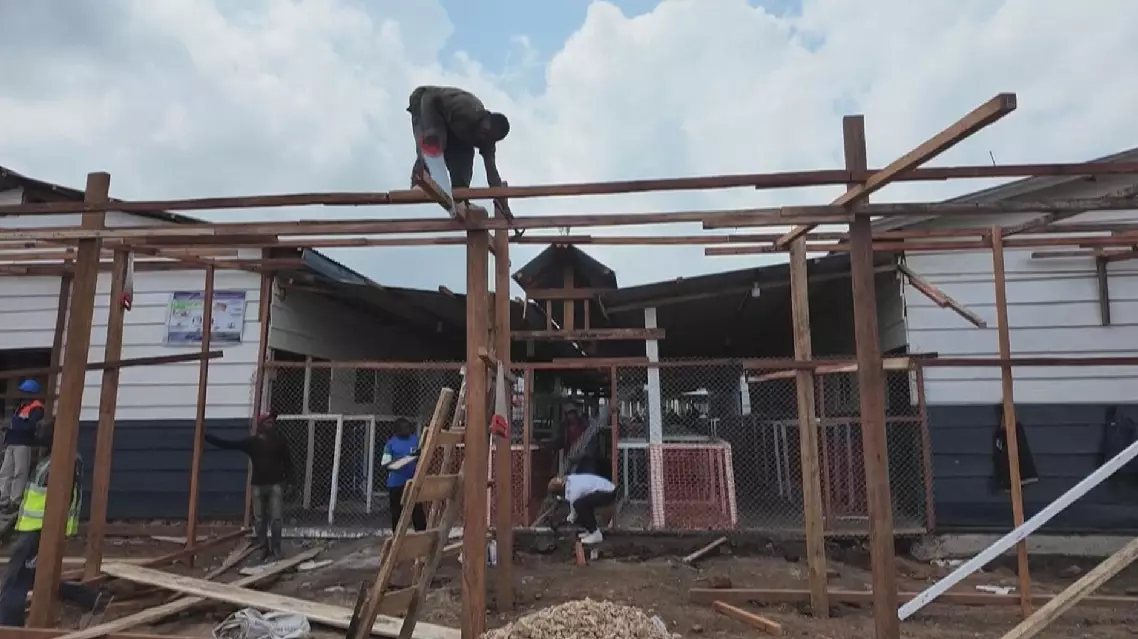
Construction workers are putting the finishing touches on the new treatment center, which is intended to ease pressure on existing facilities operating at full capacity.
"IMC (International Medical Corps) will inaugurate this week the biggest treatment center of the country with a capacity 100 beds. At OCHA, we coordinate partners on the ground on the humanitarian response, but also through the humanitarian fund. We make sure they receive funding quickly to scale up the response," said Ramatoulaye Moussa Mazou, communications officer for OCHA in the Democratic Republic of the Congo.
The facility will separate suspected and confirmed cases and is expected to employ more than 300 people, expanding the capacity to detect, isolate and treat patients as the outbreak spreads.
"So, the work is nearing completion. It is a 100-bed facility - with a capacity of 100 beds - comprising 60 beds for confirmed cases and 40 beds for suspected cases. More than 300 staff members will be working at the center, and we are counting on the community to help accelerate the process of identifying cases," said Dr. Sambo Sidikou of International Medical Corps.
As of July 30, the DRC had reported 3,605 confirmed cases of Ebola disease caused by the Bundibugyo virus, including 1,587 deaths, representing a case fatality rate of 44 percent, the WHO said in its latest disease outbreak report.
New Ebola treatment center set to open as outbreak strains DR Congo