China has ramped up construction of major science infrastructure this year, as the country's existing megaprojects continue to contribute to exciting discoveries about the universe.
So far this year, China's astronomical observatories have been a key driver of major scientific discoveries.
Using the Large High Altitude Air Shower Observatory (LHAASO) in southwest China's Sichuan Province, researchers recently detected a binary system in the constellation Cygnus that serves as the most powerful particle accelerator discovered found in the Milky Way to date, offering new insights into extreme cosmic environments such as black holes.
Meanwhile, the Five-hundred-meter Aperture Spherical Radio Telescope (FAST) in Guizhou has resumed observations after completing a steel cable replacement. Since its launch in 2016, FAST has discovered nearly 1,300 pulsars, far exceeding the combined total of other telescopes in the world during the same period.
China currently has more than 70 infrastructure-level national science facilities either operational or under construction, ranking second globally. Some facilities have reached world-leading levels, with distinctive clusters formed in Beijing's Huairou District, Shanghai's Zhangjiang area, Hefei in Anhui Province, and the Guangdong-Hong Kong-Macao Greater Bay Area.
A new batch of major science infrastructure is planned for launch through 2030, including a high-precision ground-based timing system and a deep rock engineering disturbance simulation facility.
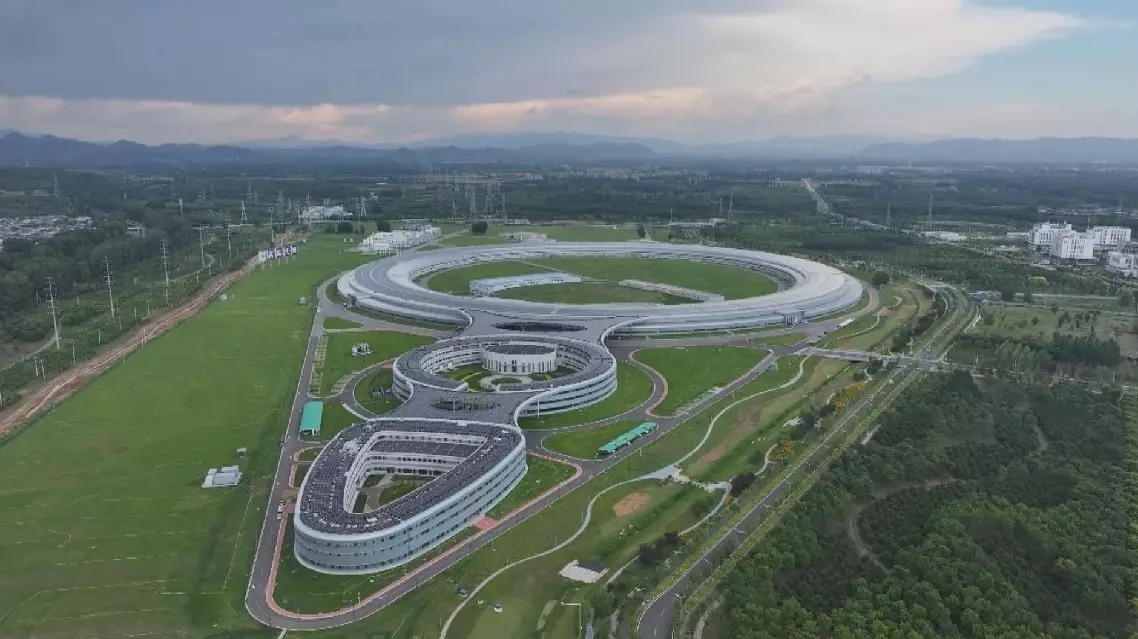
China accelerates construction of major science installations as breakthroughs mount
The Republic of Korea (ROK)'s consumer price inflation eased in July, breaking a multi-month accelerating trend amid stabilizing energy prices and lower farm goods prices, statistical ministry data showed Tuesday.
The consumer price index (CPI) rose 2.8 percent in July from a year earlier, falling below 3.0 percent in three months, according to the Ministry of Data and Statistics.
It marked a noticeable deceleration from 3.2 percent in June, after accelerating from 2.0 percent in February to 2.2 percent in March, 2.6 percent in April and 3.1 percent in May.
Headline inflation, however, stayed above the central bank's mid-term inflation target of 2 percent for 11 straight months since September 2025.
The Bank of Korea raised its benchmark interest rate by 25 basis points to 2.75 percent in July, turning toward monetary tightening in about three and a half years since January 2023.
Oil products price gained 15.5 percent last month, after spiking 24.7 percent in the previous month. The price lifted overall inflation by 0.60 percentage points.
Price for gasoline and diesel jumped 12.6 percent and 21.5 percent each, while computer price shot up 25.1 percent amid soaring semiconductor price. Price for industrial products, including oil products and processed food, advanced 3.7 percent in July compared to the same month last year, slower than an expansion of 4.4 percent in the previous month.
Processed food price added 1.0 percent in July from a year earlier, faster than a growth of 0.9 percent in the previous month.
Price for agricultural, livestock and fishery products climbed 0.9 percent in July from a year earlier, after picking up 3.2 percent in June.
Agricultural products price slipped 2.2 percent last month, turning downward from an increase of 1.1 percent in the prior month. Those for livestock and fishery products swelled 4.4 percent and 3.9 percent each.
Rice price mounted 7.9 percent, but those for napa cabbage, watermelon, spinach, cucumber and zucchini retreated in double figures. Those for beef, imported beef, pork, egg and mackerel increased in single digits.
Price for electricity, natural gas and tap water was up 0.4 percent in July on a yearly basis.
City gas charge and waterworks fee added in single digits, but heating cost dipped 0.2 percent.
Services price surged 2.6 percent last month, hiking up the headline inflation by 1.46 percentage points.
Public service price rose 1.4 percent, while private service price, including eating-out costs, expanded 3.5 percent.
The eating-out expense gained 2.6 percent, and the private service price excluding the dining-out cost jumped 4.1 percent.
Affected by a spike in fuel surcharges from rising oil prices, international airfares soared 21.7 percent last month.
Housing rent, including Jeonse and monthly rent, was up 1.1 percent in July from a year earlier.
Jeonse is the country's unique contract between two households where a landlord grants two-year residential rights to a tenant, who in turn lends a certain amount of money, or a deposit, to the landlord.
The livelihood items index, which gauges prices for daily necessities, climbed 2.5 percent, while the fresh food index, which measures prices for fish, shellfish, fruit and vegetables, declined 2.3 percent.
Demand-side inflationary pressure lingered. Core consumer price index, which excludes volatile agricultural and oil products, appreciated 2.5 percent last month.
The OECD-method core price, excluding volatile food and energy costs, went up 2.6 percent in the cited month.
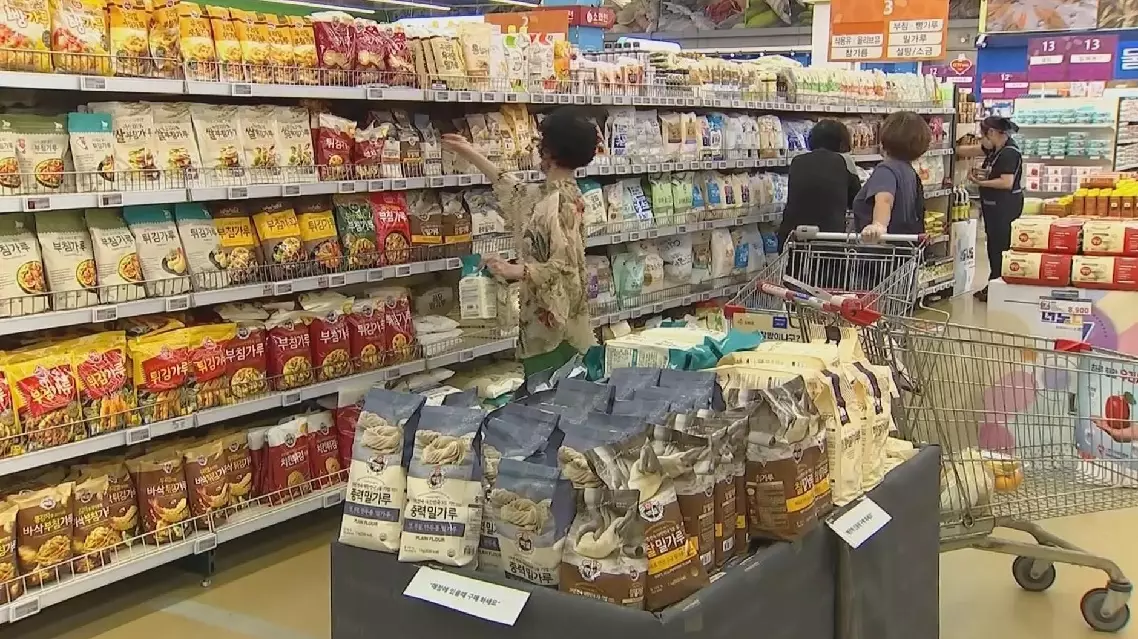
ROK's consumer price inflation eases to 2.8 pct in July