Skip to Content Facebook Feature Image

Lingnan University Joint Study: AI Autonomously Taking over Tasks May Not Reduce Employees' Mental Workload

HK

Lingnan University Joint Study: AI Autonomously Taking over Tasks May Not Reduce Employees' Mental Workload
HK

HK

Lingnan University Joint Study: AI Autonomously Taking over Tasks May Not Reduce Employees' Mental Workload

2026-08-06 13:35 Last Updated At:13:36

As artificial intelligence (AI) is gradually being integrated into various industries, human-AI collaboration has become a subject of significant concern. A joint study conducted by the Department of Psychology at Lingnan University found that while AI helps maintain employee performance during surges in workload, allowing it to autonomously decide when to take over and relinquish control may make it difficult for users to regain situational awareness, thereby increasing mental fatigue and even leading to human-machine conflict. Academics point out that enhancing the transparency of intelligent systems to help users understand AI decision-making logic, while ensuring humans retain control over task allocation, is essential for maintaining long-term performance and sound judgement. These findings have been published in the renowned interdisciplinary academic journal, International Journal of Human-Computer Interaction.
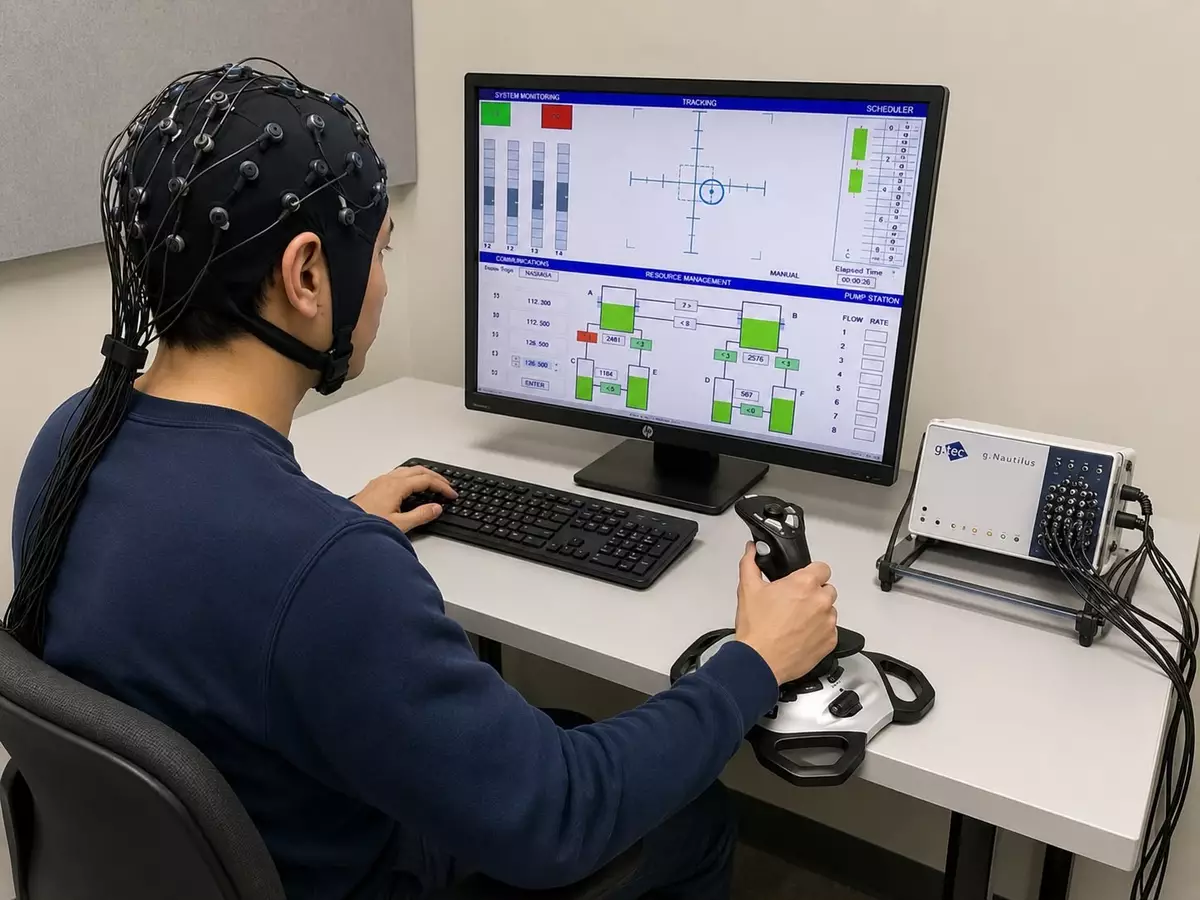
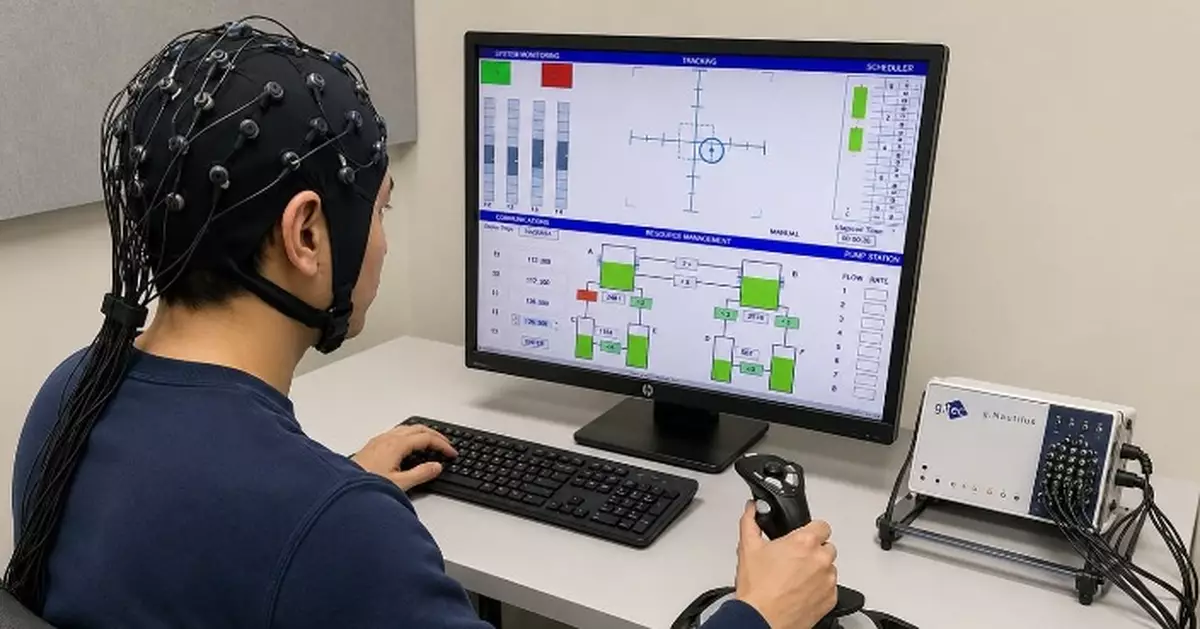
Lingnan research team uses the aviation industry as their research background, employing flight simulators to test different modes of human-machine collaboration. The team utilises the multi-attribute task battery (MATB), developed by NASA, to mimic work scenarios where operators have to multitask, and analyses how the distribution of decision-making and control authority between humans and intelligent systems affects safety, work efficiency, and user experience. Photo source: Lingnan University

Lingnan research team uses the aviation industry as their research background, employing flight simulators to test different modes of human-machine collaboration. The team utilises the multi-attribute task battery (MATB), developed by NASA, to mimic work scenarios where operators have to multitask, and analyses how the distribution of decision-making and control authority between humans and intelligent systems affects safety, work efficiency, and user experience. Photo source: Lingnan University

Led by Prof Jie (Jay) Xu, Director of the Lingnan University Cognitive Science Research Centre and Associate Professor of the Department of Psychology, the research team used the aviation industry for their research background, employing flight simulators to test different modes of human-machine collaboration. The team used the multi-attribute task battery (MATB), developed by NASA, to mimic work scenarios where operators have to multitask, and analysed how the distribution of decision-making and control authority between humans and intelligent systems affects safety, work efficiency, and user experience.

The research team recruited 92 university students to participate in two rounds of practical testing, during which they were required to perform three tasks simultaneously within the simulation platform: tracking involving joystick manipulation, system monitoring, and resource management.

The first round of the experiment was designed to determine participants' baseline performance. When the workload surged, their performance in the tracking task, which requires continuous control and focus, dropped significantly, with accuracy falling from 76 per cent to 55 per cent. Meanwhile, other tasks, including system monitoring and resource management, remained largely unaffected. The team noted that these results suggest that, under high-pressure work conditions, employees allocate greater priority to discrete response-based tasks than to continuous monitoring tasks, leading to a noticeable decline in tracking performance.

In the second round, the team compared the impact of two different authority allocation strategies on work efficiency. The first was the human-led authority allocation (HLAA), where the operator decides when to delegate tasks to the intelligent system and when to retake control. The second was the shared authority allocation (ShAA), where the intelligent system automatically detects workload changes and proactively takes over or returns certain tasks.

The results showed that when the workload suddenly peaked or emergencies occurred, the ShAA helped alleviate human pressure, particularly by assisting with the tracking task, thereby preventing operators from being overwhelmed by the surge in workload and maintaining stable performance.

However, when the workload decreased, the HLAA resulted in superior performance. The team pointed out that when an intelligent system takes over autonomously, the operator may become detached from the actual operation, and when the system subsequently returns control, they may not be able to regain situational awareness immediately, leading to a temporary decline in performance. Allowing humans to decide for themselves when to hand over or reclaim control helps maintain control over the work situation and reduces unnecessary human-machine authority conflict.

The study also found that in long-duration work scenarios, participants using the ShAA experienced higher levels of fatigue in the latter stages of the experiment. Their fatigue scores were considerably higher than those in the human-dominant group, indicating that a higher degree of automation does not necessarily equate to a lower mental workload.

Prof Jay Xu Jie, Director of the Lingnan University Cognitive Science Research Centre and Associate Professor of the Department of Psychology, Photo source: Lingnan University

Prof Jay Xu Jie, Director of the Lingnan University Cognitive Science Research Centre and Associate Professor of the Department of Psychology, Photo source: Lingnan University

Prof Jie (Jay) Xu pointed out that while the intention of introducing intelligent systems is to assist humans in efficiently processing vast amounts of data and handling complex tasks, this study reveals that it is a misconception to assume that higher levels of automation will always make work easier, more efficient, or lead to better performance. This is especially true when AI determines when to take over, as operators must continuously monitor system operations, understand its decision-making logic, and anticipate its next moves. These additional cognitive demands may increase mental effort. Furthermore, the root cause of human-machine conflict may not be related to AI capability.

Prof Xu stated, "If an intelligent system fails to explain the rationale behind authority transfer to the user clearly, it is easy to create a cognitive gap between the human and the machine, which impairs collaboration. Future intelligent system design should place greater emphasis on transparency and human-machine communication mechanisms. This would allow users to understand system status and decision-making reasons, and adjust the authority allocation mechanism flexibly, based on the work context. This balance between automation efficiency and human authority is key to reducing human-machine conflict."

He also noted that these findings provide vital reference value for various industries, including in future flight deck design, remote operations, intelligent transportation, and human-machine collaboration scenarios involving high-risk decision-making.

Co-authors of the paper are Dr Ge Xianliang and Prof Song Xiaolei from Shaanxi Normal University; Dr Xu Hanlin, Dr Zhang Ke, and Dr Hao Ni from Zhejiang University.
 
For the full research paper, please visit: https://www.tandfonline.com/doi/full/10.1080/10447318.2026.2647133#abstract

BANGKOK (AP) — Shares were mixed Thursday in Europe and Asia and South Korea’s Kospi dropped more than 4% following declines for some Big Tech giants including memory chipmaker SK Hynix.

Oil prices held steady, with Brent crude trading near $79 a barrel. Uncertainty about the direction of the U.S. war with Iran is still overhanging markets despite hopes for a reopening of the Strait of Hormuz.

The future for the S&P 500 was up 0.1% while that for the Dow Jones Industrial Average gained 0.2%.

Markets will get an update Friday on U.S. jobs with the monthly employment report for July, and analysts say investors appear to be bracing for its potential impact.

“Asia's chip selloff looks like a combination of profit-taking and risk reduction ahead of Friday's nonfarm payroll report,” Stephen Innes of SPI Asset Management said in a commentary.

Strong corporate profits and expectations for more growth ahead generally have been steering U.S. stocks higher. But Asian benchmarks have been hit by bouts of selling of computer chipmakers and other companies related to the boom in artificial intelligence.

SK Hynix plunged 10.4% after dropping 30% ahead of the open in Seoul, while its larger rival Samsung Electronics lost 6.3% in the latest rout for shares linked to the AI boom.

The Kospi lost 4.6% to 6,296.38.

In early European trading, Germany's DAX was unchanged at 26,126.08, while the CAC 40 in Paris surged 0.7% to 8,730.85. Britain's FTSE 100 edged 0.2% higher, to 10,913.07.

Japan's Nikkei 225 lost 0.9% to 65,683.26.

In Hong Kong, the Hang Seng declined 1.7% to 25,470.93, while the Shanghai Composite index climbed 0.6% to 3,900.35.

Australia's S&P/ASX 200 gained 0.5% to 9,271.60.

U.S. President Donald Trump said a deal to reopen the Strait of Hormuz was coming soon. But there have been many stops and starts during the five-month-old conflict that has stifled the global supply of oil and rattled energy markets.

The price of Brent crude, the international standard, rose 0.3% to $79.70 a barrel. Oil prices have been swinging for months and were as high as $102 per barrel at one point during the conflict, jolting already stubbornly high inflation. Higher oil prices pushed gasoline prices higher and increased shipping costs for a wide range of products.

U.S. benchmark crude oil was unchanged at $75.21 a barrel.

On Wednesday, the S&P 500 slipped 0.2% from an all-time high to close at 7,723.55. The Dow industrials rose 0.5% to 54,349.12. The Nasdaq composite lost 0.8% to 26,363.44.

Among big technology companies losing ground, Google’s parent company, Alphabet, fell 4% and Microsoft lost 1.1%.

Overall, the market has been rising as companies head into the closing stretch of their latest round of earnings reports with sharp overall gains. Three-quarters of the companies within the S&P 500 have reported results so far, and Wall Street expects profit growth of 50% when they are all finished.

The Walt Disney Co. rose 3.6% after easily beating Wall Street’s profit forecasts, helped by a $1 billion box office haul from “Toy Story 5” and theme park revenue.

Booking Holdings jumped 6.6% after reporting that strong travel demand drove profit and revenue growth during its most recent quarter.

Elon Musk's SpaceX fell 13.6% following the release late Tuesday of its first quarterly report as a public company, which showed that it sharply boosted spending on artificial intelligence. The company did help give semiconductor giant Nvidia a 3.4% boost after announcing it would exclusively use that company’s chips for its artificial intelligence technology.

Musk had said earlier he would use chips from both Nvidia and Advanced Micro Devices for SpaceX and his electric vehicle company, Tesla.

Inflation concerns have been hanging over markets and the Federal Reserve. The central bank has been holding its key benchmark rate steady as it monitors the costs and the impact on the economy.

In other dealings early Thursday, the dollar rose to 157.85 Japanese yen from 157.77 yen. The euro fell to $1.1549 from $1.1555.

Associated Press writer Hyung-jin Kim in Seoul, South Korea, contributed to this report.

Specialist Michael Pistillo works on the floor of the New York Stock Exchange, Wednesday, Aug.. 5, 2026, in New York. (AP Photo/Yuki Iwamura)

Specialist Michael Pistillo works on the floor of the New York Stock Exchange, Wednesday, Aug.. 5, 2026, in New York. (AP Photo/Yuki Iwamura)

A person stands near an electronic board showing Japan's Nikkei index at a securities firm Thursday, Aug. 6, 2026, in Tokyo. (AP Photo/Eugene Hoshiko)

A person stands near an electronic board showing Japan's Nikkei index at a securities firm Thursday, Aug. 6, 2026, in Tokyo. (AP Photo/Eugene Hoshiko)

A person walks past an electronic board showing Japan's Nikkei index chart at a securities firm Thursday, Aug. 6, 2026, in Tokyo. (AP Photo/Eugene Hoshiko)

A person walks past an electronic board showing Japan's Nikkei index chart at a securities firm Thursday, Aug. 6, 2026, in Tokyo. (AP Photo/Eugene Hoshiko)

A person walks past an electronic board showing Japan's Nikkei index at a securities firm Thursday, Aug. 6, 2026, in Tokyo. (AP Photo/Eugene Hoshiko)

A person walks past an electronic board showing Japan's Nikkei index at a securities firm Thursday, Aug. 6, 2026, in Tokyo. (AP Photo/Eugene Hoshiko)

People walk past an electronic board showing Japan's Nikkei index at a securities firm Thursday, Aug. 6, 2026, in Tokyo. (AP Photo/Eugene Hoshiko)

People walk past an electronic board showing Japan's Nikkei index at a securities firm Thursday, Aug. 6, 2026, in Tokyo. (AP Photo/Eugene Hoshiko)

Recommended Articles