Culture: Deal signed for joint protection
BEIJING, Aug. 6, 2026 /PRNewswire/ -- A news report from China Daily:
Cultural heritage is a living dialogue connecting the past, the present and a shared future, participants at a cultural event said on Wednesday, highlighting the importance of further deepening cooperation to enhance the reach and appeal of Chinese civilization and promote mutual learning among civilizations.
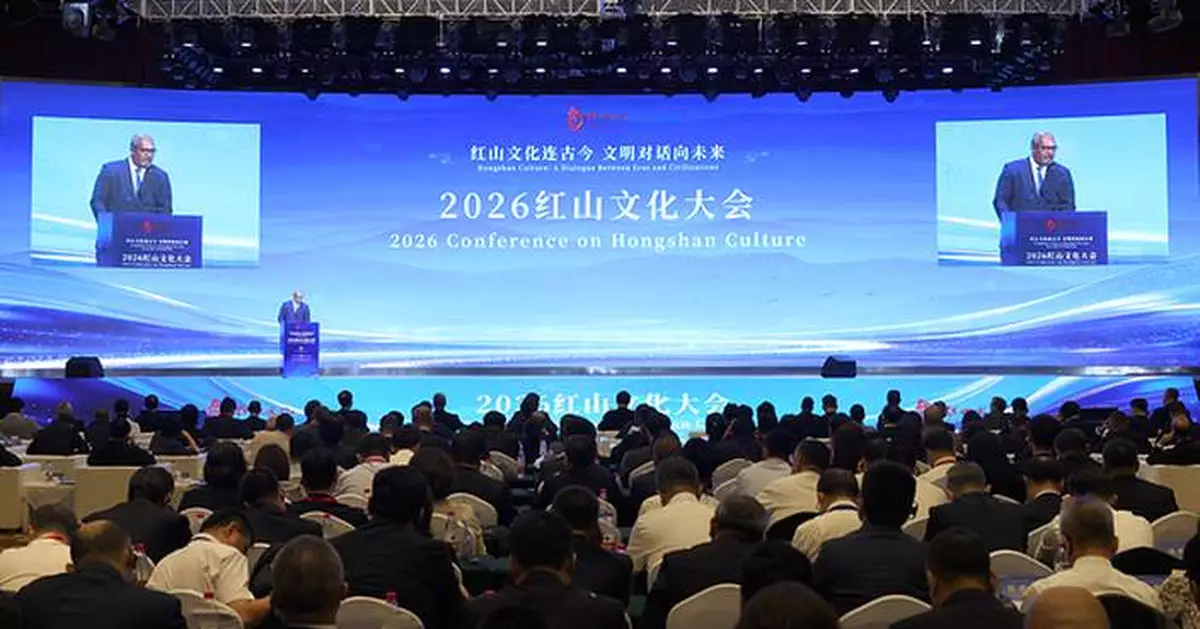
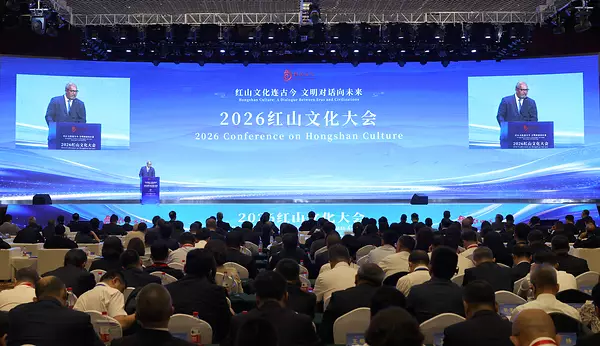
The remarks came as archaeologists, heritage experts, civilization researchers, diplomatic envoys to China and governmental officials gathered for the 2026 Conference on Hongshan Culture in Chaoyang in Northeast China's Liaoning province, from Wednesday to Thursday.
Hongshan culture, a major Neolithic culture dating back 5,000 to 6,500 years, once spanned what is now Liaoning and Hebei provinces and the Inner Mongolia autonomous region.
Xu Kunlin, secretary of the Communist Party of China Liaoning Provincial Committee, said the province actively participates in the national project to trace the origins of Chinese civilization, prioritizes the protection and inheritance of Hongshan culture in its drive to build a culturally strong province, and strives to continuously enhance the influence of Hongshan culture.
"We have strengthened legislative protection for Hongshan culture's Niuheliang site in Chaoyang and stepped up academic research by setting up the Hongshan Culture Research Institute, and promoted Hongshan culture beyond Liaoning to the world through a youthful tone and digital forms," said Xu.
Furthermore, Liaoning is cooperating with other regions to promote a joint bid for World Heritage status, Xu said.
Under the theme of "Hongshan Culture: A Dialogue Between Eras and Civilizations", participants delivered remarks on the culture's historical and civilizational significance.
Rao Quan, head of the National Cultural Heritage Administration, called for continued efforts to advance the transformation and utilization of archaeological achievements, upgrade the construction and operation of archaeological site parks and thematic museums, launch more high-quality exhibitions and public education activities, and offer diverse public cultural products.
Rao also advocated deeper integration of culture and tourism, calling for using cultural relic resources to develop study tours, travel routes and cultural experience programs, in order to boost public cultural confidence.
"It's important to build a robust global communication network for Hongshan culture, leveraging platforms including international archaeological cooperation, overseas thematic exhibitions and high-level academic dialogues," he said.
Qu Yingpu, publisher and editor-in-chief of China Daily, said, "The rose patterns of Yangshao culture, the octagonal star patterns of Lingjiatan culture and the dragon-scale patterns of Hongshan culture symbolize the distinct cultural characteristics of the civilizations in the basins of the Yellow, Yangtze and Liaohe rivers."
He said that, like many stars shining together, the early Chinese cultures of different regions interacted across vast distances and eventually formed a diverse yet unified Chinese civilization.
"We should jointly tell the stories of Hongshan culture and Chinese culture to the world, helping global audiences better understand Chinese civilization and gain a deeper insight into China in the new era," Qu said.
Khaled Nazmy, ambassador of Egypt to China, said, "Our gathering today is proof that our ancient heritage and civilization are not only a chapter in history, but also a living legacy that continues to inspire us, bring us together and remind us of our shared responsibility to preserve our cultural heritage and deepen our friendship."
Shahbaz Khan, director and representative of the UNESCO Regional Office for East Asia, said in a video speech: "Hongshan culture represents a foundational chapter in human development. Its ritual architecture and extraordinary jade craftsmanship reveal humanity's early spiritual and social evolution. For UNESCO, protecting these roots is about safeguarding the unique human genius that grounds our collective identity."
Wang Wei, a member of the Chinese Academy of Social Sciences' Academic Divisions, noted that Hongshan culture demonstrates that Chinese civilization did not originate from a single center, but rather emerged from the independent development and mutual influence among multiple regional cultures.
Wang noted that in the past, Chinese as well as Western archaeologists defined civilization by the presence of writings, cities and metallurgy. Hongshan culture lacked all three, yet it formed a complex society organized around belief systems, ritual structures and shared spiritual identity, showing that there is more than one path to civilization, he said.
Media representatives from Liaoning, Hebei and Inner Mongolia shared stories behind iconic Hongshan relics: the Hongshan goddess statue, the jade dragon in ring-like shape known as jue and the C-shaped jade dragon.
At the conference, a special tribute was paid to those who have made outstanding contributions to the preservation and research of Hongshan heritage. Su Shenzhi, daughter of the late archaeologist Su Bingqi, accepted the honor on her father's behalf, together with archaeologist Guo Dashun and Sinologist Elizabeth Childs-Johnson from the United States. The three were presented with commemorative certificates.
At the event, heads of the cultural heritage administrations of Liaoning, Hebei and Inner Mongolia signed the Liaoning-Hebei-Inner Mongolia Cooperation Agreement on Archaeological Research into Hongshan Culture, a move seen as a key step toward coordinated protection and cross-regional collaboration.
** This press release is distributed by PR Newswire through automated distribution system, for which the client assumes full responsibility. **
Dialogue highlights Hongshan culture protection
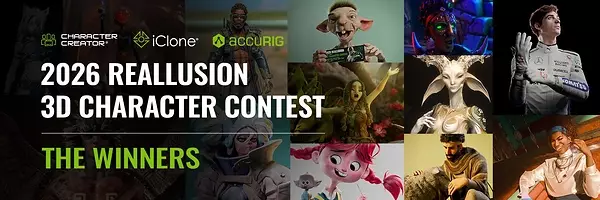
SAN JOSE, Calif., Oct. 15, 2026 /PRNewswire/ -- Reallusion's 2026 3D Character Contest was held from June 1st to October 1st, 2026. Within 3 months, 200 submissions were submitted from 49 countries. The contest showcases the best 3D character design and animation created using Reallusion's powerful character production ecosystems: Character Creator for 3D character creation, iClone for facial and body animation, and AccuRIG for rigging.
"We at Reallusion are thrilled to watch so many world-class character artists integrate Character Creator and iClone into their professional workflows. This contest clearly demonstrated that Character Creator gives artists complete creative freedom to build original 3D characters in any style or genre. Huge congratulations to every participant. We are excited to keep pushing the boundaries of 3D innovation for the community!"
– Enoc Burgos, Reallusion Director of Partnership Marketing
Prizes Sponsored by Renowned Industry Leaders
The Contest was hosted by Reallusion and sponsored by industry leaders such as NVIDIA, Maxon, Epic Games, Unity, SideFX, Marvelous Designer, MSI, WD, and CenterGrid. Through this contest, Character Creator's extensive pipeline lets artists seamlessly integrate a new workflow for rapid creativity with zero sacrifice in character quality.
Meet Our Winners And Their Testimonials
The contest challenged artists to create stunning, original 3D characters that not only showcased their artistic abilities, but also demonstrated mastery of animation tools like Character Creator and iClone. After weeks of careful evaluation by our esteemed panel of judges, the following winners stood out for their exceptional work.
Watch winner video: https://youtu.be/zhGfrHHtT7Y
Realistic Character Design
Under this category, entrants create a realistic human character in Character Creator by combining the character base with tools like ZBrush, Substance Painter, Marvelous Designer, Blender, Wrap, Texturing.xyz, and Maya. Watch their winning entry and testimonials below.
1st Place: Jax: Soul of the Street – by Jimmy Watelle, Manager | Costa Rica
"Character Creator and the Blender Data Link helped me a lot in building the base of the Jax character, but I also faced numerous challenges related to my skill level and navigating between software, sometimes losing data or synchronization along the way. This project brought me as much enjoyment, and it helped me grow tremendously." – Jimmy Watelle
View Jimmy's entry and WIP
2nd Place: Shannaz – by Leudemar "Leo" Lima, Concept Artist | Brazil
"Character Creator helped me bring my design to 3D with a lot of fidelity and realism; easy to use and intuitive, CC5 is a really powerful tool for concept artists." – Leudemar "Leo" Lima
View Leo's entry and WIP
3rd Place: An Unearthly Find – by Jeet Shah, Technical Artist | India
"The speed of CC5 in making changes to primary forms for any character is impeccable and probably the best among any 3D software I've ever used. Need a skinny short girl- tweak a few sliders you get a skinny short girl. Need a fat stubby creature- tweak some more sliders and take it to ZBrush and you have a humanoid creature in under an hour all the while maintaining the subdivided geometry details in CC5 thanks to GoZ Plus. And all of them with a full-body skeleton that's ready to add some controls for posing. The new HD morphs in CC5 are certainly an upgrade to the previous version, where the lack of base mesh resolution made the morphs a bit less detailed; the new ones still come out quite detailed. One other feature I've heavily used is the new addition to Auto Setup for Maya. That allowed for a seamless experience in making the facial expressions on the characters directly in Maya, where I rendered them."– Jeet Shah
View Jeet's entry and WIP
Stylized Character Design
Under this category, entrants create a stylized character in Character Creator by combining the character base with tools like ZBrush, Substance Painter, Marvelous Designer, Blender, Wrap, Texturing.xyz, and Maya. Watch their winning entry and testimonials below.
1st Place: Kohaku - Warden of Memories – by Oscar Fernandez Gonzalez, 3D Character Artist | Spain
"As a sculptor, Character Creator lets me start from a clean, optimized base mesh that I can freely customize in ZBrush. Moving back and forth between ZBrush and CC5 allows me to use each application for what it does best, making the entire workflow faster and more efficient. My favorite feature is being able to test poses on the character with incredible precision. It's fast, intuitive, and a genuinely enjoyable part of the creative process." – Oscar Fernandez Gonzalez
View Oscar's entry and WIP
2nd Place: Erlen From Lemuria's Savage Lands – by Felix Enrique Yaguare Lopez, Student and Freelancer | Venezuela
"Character Creator allowed me to bring my character to life effortlessly. Being able to quickly test and iterate different poses gave me the freedom to explore Erlen in multiple situations, something that would have been impossible in my timeframe, as I joined the contest a month and a half late while finishing my class projects for Libel Academy." – Felix Enrique Yaguare Lopez
View Felix's entry and WIP
3rd Place: Alyssa – by Thivolan Moodley, 3D Sculptor & Freelancer | South Africa
"I was able to use the base mesh to really push the design from start to finish without needing to retopologize or change much else! This helped me focus on sculpting and likeness more!" – Thivolan Moodley
View Thivolan's entry and WIP
Realistic Character Animation
Use iClone to create a realistic animation for a character made with the CC3+ Base. The character model can be customized with Reallusion tools and content or third-party software like ZBrush, Blender, Unreal Engine. Watch their winning entry and testimonials below.
1st Place: Franco Colapino – by Off World, FCGI Cinematics Freelancer | Argentina
"Without Reallusion's tools, achieving this level of quality and ease of iteration in pursuing our goal would not have been possible; the power and creative freedom it provides are immense." – Off World
View Off World's entry and WIP
2nd Place: The Hunt – by Joseph Hoback, 3D | United States
"There's no way I could have gotten as far as I did without the use of an iClone. The mocap informed not only the timing and energy but also the character as a whole." – Joseph Hoback
View Joseph's entry and WIP
3rd Place: Special ops: Lioness – by Hector Mercado, CGI artist & Filmmaker | Dominican Republic
"The new Headshot 3 features, together with the AI-assisted reference image generation and cleanup, really help in getting the character likeness when trying to create a digital double!" – Hector Mercado
View Hector's entry and WIP
Stylized Character Animation
Under this category, contestants use iClone to create a stylized animation for a character made with the CC3+ Base. The character model can be customized with Reallusion tools and content or third-party software like ZBrush, Blender, Unreal Engine. Watch their winning entry and testimonials below.
1st Place: STONE GODZ – by Dazhi Benjamin Sokomba, Animator | Nigeria
"I used iClone for the final real-time render, Character Creator 5 for the main character and AccuRIG for the stone characters." – Dazhi Benjamin Sokomba
View Benjamin's entry and WIP
2nd Place: Moss Fairy – by Affan Shiekh, CGI artist | Pakistan
"Character Creator 5 is amazing. It gets better every year, and I would like more implementations for the Blender addon!" – Affan Shiekh
View Affan's entry and WIP
3rd Place: Max Mad Animation – by Soorena Sardarzadeh, CGI artist & Filmmaker | United States
"With iClone, making animation isn't harder than it needs to be." – Soorena Sardarzadeh
View Soorena's entry and WIP
Best AccuRIG Characters
Powered by AccuRIG, artists can transform static models into fully animatable characters, regardless of topology. The winning characters showcase high sculpting details with attractive poses and professional renders. Reallusion selected four winners from this category, and here are the winners, entries, and respective WIPs.
- Oscar Fernandez Gonzalez (Spain)
- Laura Antonacci (Italy)
- Carolyna Figueiredo (Portugal)
- Stasia Bubnova (Russian Federation)
Special Awards
Special Awards recognize outstanding achievement across specific technical and artistic categories. Beyond their distinctive visual aesthetics, these winning entries demonstrate a deep mastery of 3D pipelines and creative problem-solving techniques. Their entries present compelling character designs, solid anatomy, and exceptional composition. View all winning entries and WIPs.
Best Render
- Vanesa Arambašić (Croatia)
- Jacopo Filo della Torre (Italy)
- Bahar Tavakoli (Iran)
Best Pipeline Use
- David Sujono (Australia)
- Olivier Beguin (Switzerland)
- Ignacio Coronel (Argentina)
- Joachim Jensen (Denmark)
- Jorge Leonardo Ayala Arias (Colombia)
Best Mocap Use
- Sangkoo Lee (Republic of Korea)
Best Digital Double
- Mobin Hivehchi (Iran)
- Frederick Talavera Martinez (Spain)
Best Student Artwork
- Carlos Humberto Rivas Garcia (Venezuela)
Best Costume
- Eva Sophie Cringle (Belgium)
- Myron Mortakis (United States)
- Massimo De Antonis (Italy)
- Saillish (Australia)
- Weedi Masindraoka (Madagascar)
- Sadegh Khavand (Iran)
- Rafael S. Benedicto (Philippines)
- Angel Ricalde (Peru)
Honorable Mentions
Honorable Mentions celebrate standout entries that captivated the judging panel through exceptional dedication, skill, and creative vision. While not taking home a top placement, these artists delivered remarkable craft and passion throughout the competition. View all Honorable Mention entries and WIPs.
- Ariya Hasani (Iran)
- Markus Haertel (Brazil)
- Kurt Boutilier (Canada)
- Onur Erdurak (Turkey)
The judging process for the "2026 Reallusion 3D Character Contest" proved to be quite difficult and took many hours of deliberation. In addition to the top 3 placements in Best Character Animation & Best Character Design, Reallusion also selected 28 winners for AccuRIG characters, Special Awards, and Honorable Mentions. See the Winner Page for winner details and showcases, and we look forward to your entry submission next year!
** This press release is distributed by PR Newswire through automated distribution system, for which the client assumes full responsibility. **
Reallusion's 2026 3D Character Contest - Meet the Winners!