Chinese leading robot maker Unitree Robotics began a preliminary inquiry for its initial public offering (IPO) and listing on the STAR Market of the Shanghai Stock Exchange (SSE) on Wednesday.
Based on the STAR Market's standard 500-share lot size and the estimated post-IPO valuation, the issue price is preliminarily estimated at around 104 yuan (around 15.4 U.S. dollars) per share. One subscription lot would therefore require about 52,000 yuan (around 7,703 U.S. dollars) in payment, though the final price will depend on market demand during the inquiry process.
Upon completion of the inquiry phase, the official subscription window is scheduled to open on August 10.
Founded in 2016, Unitree Robotics has emerged as one of China's leading robotics firms, specializing in the development of quadruped and humanoid robots. In 2025, its humanoid robot shipments surpassed 5,500 units, ranking first globally.
According to an announcement released last week, the firm based in Hangzhou in east China plans to issue 40.45 million shares, representing 10 percent of its enlarged share capital. The offering will combine strategic placement, offline institutional subscription and online public subscription.

China's Unitree kicks off STAR market IPO pricing
The Mecca Joint Defense Agreement, a newly formed defense pact among Pakistan, Saudi Arabia and Türkiye, represents a deterrence strategy rather than an actual threat to Iran, according to Hossein Kanani Moghaddam, a former commander of Iran's Islamic Revolutionary Guard Corps (IRGC).
The three nations on Friday signed the joint defense agreement in Mecca, Saudi Arabia, to deepen cooperation among the three regional powers amid rising regional security concerns, according to Pakistan's Foreign Ministry.
The agreement aims to strengthen collective deterrence against any act of aggression, under which an armed attack against any one of the three states shall be regarded as an attack against all, the ministry said in a statement.
However, its signing amid the backdrop of the Middle East conflict has prompted questions as to whether the parties would actually uphold their obligations in the event of a real attack.
"Treaties like these are more about deterrence than operational use. That is, if we were to attack the U.S. base in Saudi Arabia tomorrow, Pakistan wouldn't react. Even Türkiye, because they know that if they respond they'd be drawn into a war against Iran, is mostly engaging in propaganda. And in my view, it has no effect in terms of threatening Iran," said Kanani Moghaddam, who now works as a military analyst.
"We want to attack the U.S. base; we're not attacking Saudi Arabia. This base is in Saudi Arabia, and in any case Saudi Arabia understands that we're not seeking war with them. It seems that this pact that has been forged will have no effect on the war between Iran, the United States, and the Zionist regime; it is viewed more as a deterrent measure," he said.
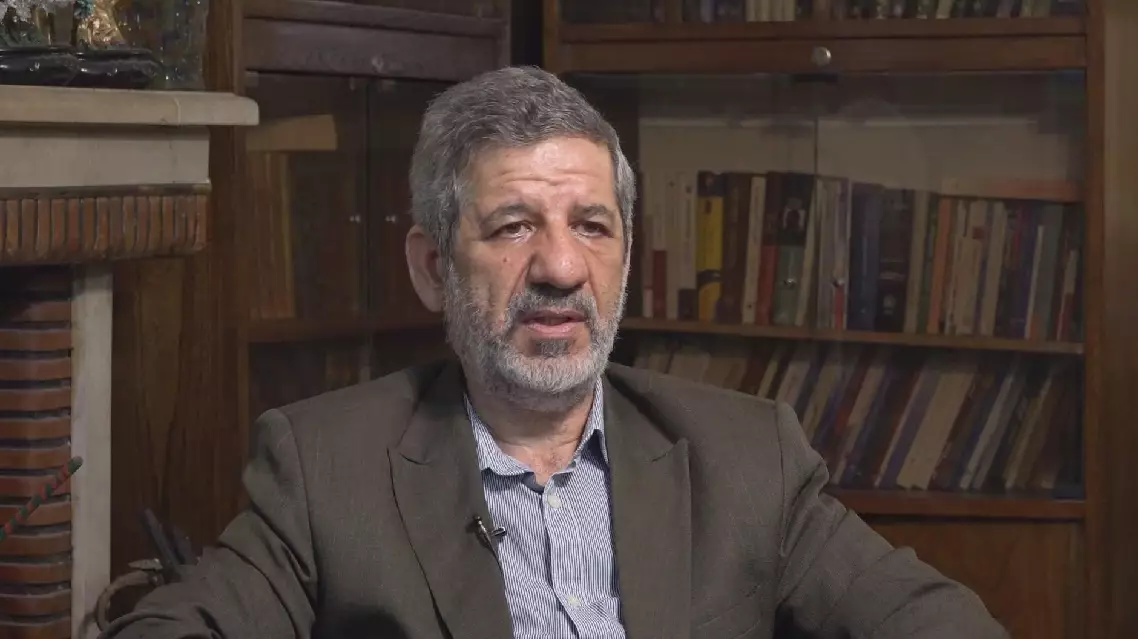
Former IRGC commander plays down threat from Pakistan-Saudi-Türkiye defense pact