MADRID (AP) — Real Madrid has reached a deal with Leipzig for the transfer of young Ivory Coast international Yan Diomande.
The Spanish powerhouse said Thursday that the 19-year-old forward will be linked to the club for the next seven seasons.
Diomande had an outstanding World Cup, and some Premier League teams were reportedly interested in signing him. Leipzig had been saying he was not for sale.
Ivory Coast was eliminated by Norway in the World Cup round of 32.
Leipzig sporting director Marcel Schäfer said Diomande “impressed us with his carefree attitude, willingness to learn, and courage from day one.”
“He quickly established himself at the highest level with us, showcasing his speed, dribbling skills, and goal-scoring threat.”
He said the club was proud that Diomande’s performances “garnered significant international attention.”
Paris Saint-Germain also was reportedly interested in signing the young forward.
It was not yet clear if Diomande would initially be registered with Madrid's B squad.
Madrid's main team has been revamped since a disappointing end to last season. The new signings who will be coached by José Mourinho include playmaker Bernardo Silva, center back Ibrahima Konaté, right back Denzel Dumfries and left back Marc Cucurella.
AP soccer: https://apnews.com/hub/soccer

FILE - Ivory Coast's Yan Diomande (11) moves the ball during the World Cup round of 32 soccer match between Ivory Coast and Norway in Arlington, Texas, June 30, 2026. (AP Photo/Sam Hodde, File)
WASHINGTON (AP) — President Donald Trump's administration said Thursday it plans to overhaul Head Start, tossing out many of the regulations that are the hallmark of the early education program for the nation's poorest children.
Officials from the Department of Health and Human Services, which oversees the federally funded preschool program, said the proposed changes would encourage more local decision-making. Early childhood policy experts argue the deregulation could undermine Head Start's position as the gold standard in early education.
The Associated Press previously reported on the overhaul proposal, which became public Thursday when it was posted online. The public will have 60 days to weigh in on it before it goes into effect, though it could face legal challenges that would delay implementation.
Head Start centers serve around 700,000 of the nation’s most vulnerable children, including those who are homeless, in foster care or disabled. That wouldn't change under the overhaul.
But Alex J. Adams, an assistant secretary at Health and Human Services, said the department is hoping to give Head Start centers the flexibility to change the way they operate. That means eliminating most of Head Start's regulations, such as standards for low staff-to-student ratios or requirements to provide services to preschoolers' families.
"Federal mandates can certainly hinder local decision-making, drive up costs and limit the program’s reach,” Adams said on a call with reporters. He highlighted a decade-long decline in Head Start enrollment. “If we get this proposed rule right, we will grow the number of Head Start slots.”
On a call previewing the proposed changes, Health Secretary Robert F. Kennedy spoke reverently about Head Start, which was started by his uncle Sargent Shriver during the Lyndon B. Johnson administration.
“It’s a program that works for the most vulnerable of the poorest kids in our society, and it’s really important we protect it,” Kennedy said.
But the changes would undermine many of the things that make Head Start distinct from other early education programs, policy experts say.
“This version of Head Start is a shell of the program,” said Khari Garvin, who oversaw Head Start under Democratic President Joe Biden. “This is a deeply diluted version of the program which in my view will cause child and community outcomes to wane.”
Head Start, which began in the 1960s as part of Johnson's War on Poverty, is currently governed by more than 100 pages of regulations. Those regulations require centers to have low staff-to-student ratios and a research-backed curriculum, among other things, and they ensure centers are providing wraparound services that are critical to children in poverty, including medical and dental screenings and parent coaching.
The proposal would toss out nearly all of that rule book. Instead, Head Start’s 1,600 operators — which include nonprofits and school districts — would look to state and local childcare licensing requirements for guidance on many aspects of the program.
While the proposed rules largely loosen requirements, Adams emphasized that centers have the option to continue to operate as they had in the past. He estimated the new rules could generate more than $2 billion in savings and potentially allow Head Start to serve more children.
The proposal adds some new requirements. Staffers would have to deliver all instruction in English, except in tribal communities that run immersion programs in native languages. There would be a 5% cap on administrative expenses, down from 15%. The proposal also includes new nutrition standards, championed by Kennedy, and a requirement for 30 minutes of physical activity — outside if the weather permits — for every three and a half hours of the program.
Overall, experts emphasize, state childcare licensing requirements are far more lax than Head Start's current regulations. State rules are largely focused on ensuring children are healthy and safe. Generally speaking, they do not require centers to provide things like medical or dental screenings, they don't specify ways to engage with parents, and they don't speak to what — if anything — should be taught in childcare settings.
Shantel Meek, who heads the Children’s Equity Project at Arizona State University, co-authored an analysis that compared state licensing requirements with Head Start standards and found massive gaps.
“Whereas licensing is, like, the bare minimum to keep kids safe, Head Start includes keeping kids safe but also ensuring that kids are developing, growing, learning well,” Meek said. “It’s a totally different purpose.”
Critically, states allow adults to care for far more children than is allowed under Head Start standards. In Mississippi, for example, one Head Start teacher is only allowed to teach up to four 2-year-olds. State childcare regulations would permit up to a dozen 2-year-olds to be supervised by one adult.
Head Start, which operates in all 50 states, has long had support from both Democrats and Republicans. But it has faced repeated threats under the Trump administration, whose budget chief, Russell Vought, had previously called for it to be eliminated. Not long after Trump, a Republican, took office again in early 2025, some Head Start programs had to briefly shutter because they had problems accessing their federal money. Later, a budget draft eliminated Head Start's funding, but it was restored after widespread backlash.
In a call with reporters, Kennedy said he believes Head Start is effective. He cited research showing its graduates have fewer law enforcement encounters, do better in school and have better jobs than their peers. He added that he tried to shield Head Start from many of the cuts that hit the rest of his agency.
Still, the Trump administration succeeded last year in laying off much of Head Start's support staff and closing half of its regional offices.
The Associated Press’ education coverage receives financial support from multiple private foundations. The AP is solely responsible for all content. Find the AP's standards for working with philanthropies, a list of supporters and funded coverage areas at AP.org.
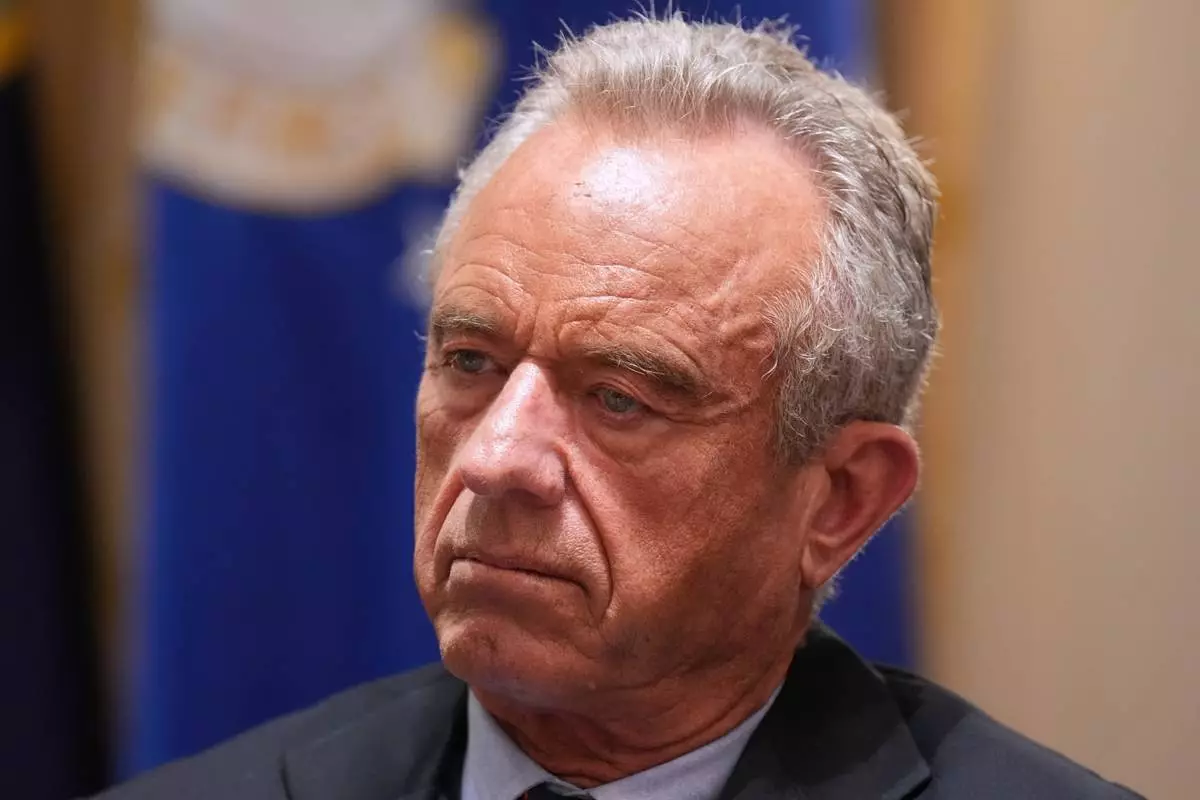
FILE - Secretary of Health and Human Services Robert F. Kennedy Jr., listens during a Cabinet meeting at the White House, May 27, 2026, in Washington. (AP Photo/Jacquelyn Martin, File)