Skip to Content Facebook Feature Image

Coulson Aviation Canada Acquires 10 Former RCAF Hercules, Doubling C-130H Fleet

Business

Coulson Aviation Canada Acquires 10 Former RCAF Hercules, Doubling C-130H Fleet
Business

Business

Coulson Aviation Canada Acquires 10 Former RCAF Hercules, Doubling C-130H Fleet

2026-08-08 01:17 Last Updated At:01:30

ABBOTSFORD, British Columbia--(BUSINESS WIRE)--Aug 7, 2026--

Coulson Aviation Canada, the Canadian division of Coulson Aviation, has acquired 10 former Royal Canadian Air Force CC-130H Hercules aircraft from the Government of Canada.

This press release features multimedia. View the full release here: https://www.businesswire.com/news/home/20260807019094/en/

The acquisition doubles Coulson’s global C-130H fleet from 10 aircraft to 20 and gives its Canadian division the scale to build the world’s largest and most capable C-130 airtanker fleet.

The program will be led by Coulson Aviation Canada and its engineering, manufacturing, maintenance and operational teams in British Columbia.

“These aircraft served Canada for decades and we would like to recognize the men and women of the RCAF that operated these aircraft with exceptional professionalism throughout their service,” said Wayne Coulson, CEO of Coulson Aviation Canada.

For many years, the CC-130H served Canada in tactical airlift, search and rescue, Arctic operations, disaster response, humanitarian missions and international deployments.

Canada is experiencing longer and more complex wildfire seasons, with larger and more intense fires placing greater demands on firefighters and response agencies. That changing environment requires aircraft that can reach fires quickly, deliver large and controlled retardant lines, and sustain operations throughout increasingly demanding fire seasons.

The acquisition builds on Coulson’s existing C-130H program and its experience modifying, certifying, operating and supporting the aircraft as an airtanker.

Coulson’s operational C-130H airtankers are equipped with the company’s proprietary RADS-XXL retardant delivery system. Each aircraft can carry up to 4,000 U.S. gallons, or more than 15,000 litres, of water or fire retardant.

The RADS-XXL system gives flight crews precise control over the amount and coverage level of each drop. Its high flow rate, combined with the C-130’s payload, speed, range and ability to operate from shorter runways, makes the aircraft well suited to both rapid initial attack and sustained wildfire response.

“Firefighters on the ground need aircraft overhead that can get there quickly, carry a meaningful load and keep working,” said Coulson. “These aircraft will multiply the current initial attack capacity operating in Canada today.”

Coulson Aviation Canada supports the complete C-130 airtanker program, including engineering, certification, manufacturing, aircraft modification, maintenance, training and flight operations.

The acquisition is expected to expand skilled work in Canada across aircraft engineering, manufacturing, maintenance, flight operations and technical training.

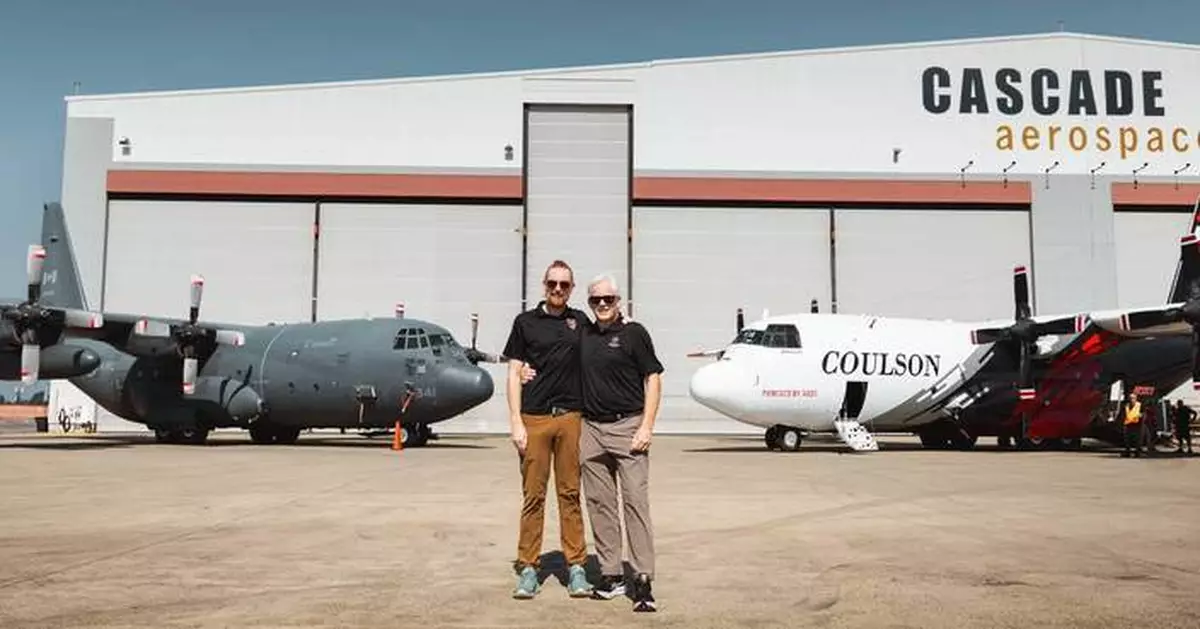
The announcement was made at Cascade Aerospace in Abbotsford, where several of the former RCAF aircraft are currently located.

Coulson also brought Tanker 131, one of its operational C-130H airtankers, to Abbotsford to demonstrate what the Hercules can do in its next role. Tanker 131 will perform a demonstration drop during the Abbotsford International Airshow, showing the capabilities of Coulson’s 4,000-gallon RADS-XXL airtanker system.

About Coulson Aviation Canada

Coulson Aviation Canada is the Canadian division of Coulson Aviation, a family-owned global aviation company headquartered in Port Alberni, British Columbia.

Coulson is the world’s largest private aerial firefighting company, with more than 60 years of aviation experience and more than four decades of aerial firefighting experience.

The company operates a mixed fleet of more than 60 fixed-wing and rotary-wing aircraft supporting government agencies across North America, South America and Australia.

Coulson designs, manufactures, certifies, operates and supports its own aerial firefighting systems, including the RADS family of retardant delivery systems. This integrated approach allows the company to continually improve the safety, accuracy and effectiveness of its aircraft and firefighting technology.
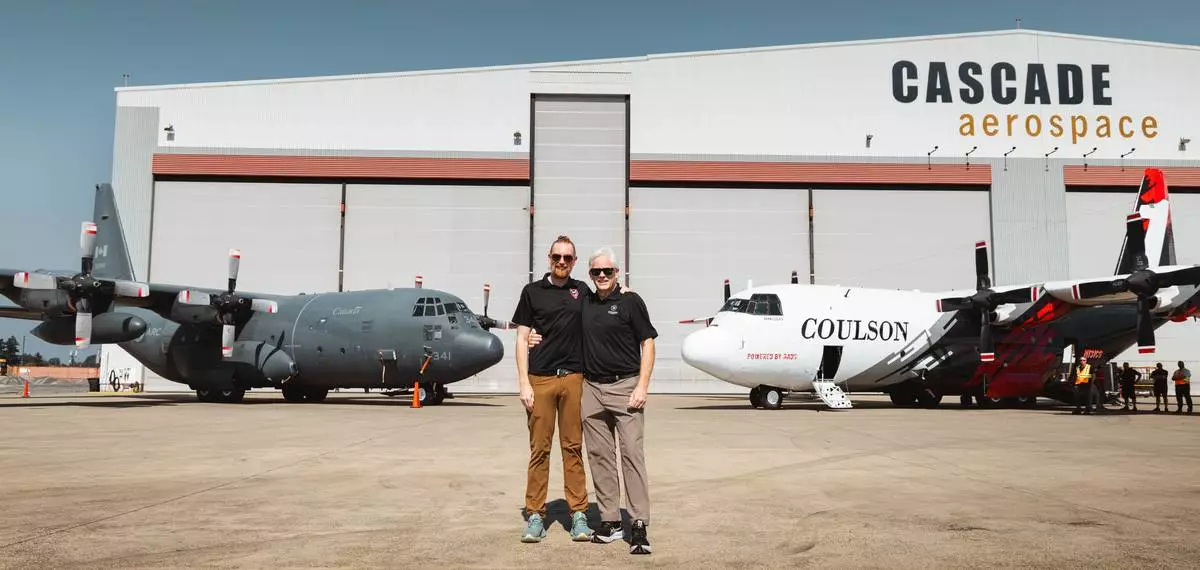
Britton Coulson, left, and Wayne Coulson stand in front of one of 10 former Royal Canadian Air Force CC-130H Hercules aircraft recently acquired by Coulson Aviation from the Government of Canada. At right is a Coulson C-130H outfitted for aerial firefighting with the company’s proprietary RADS-XXL retardant delivery system, capable of carrying up to 4,000 U.S. gallons, or more than 15,000 litres, of water or fire retardant. The acquisition doubles Coulson’s global C-130H fleet to 20 aircraft, expanding its capacity to build the world’s largest C-130 airtanker fleet.


Britton Coulson, left, and Wayne Coulson stand in front of one of 10 former Royal Canadian Air Force CC-130H Hercules aircraft recently acquired by Coulson Aviation from the Government of Canada. At right is a Coulson C-130H outfitted for aerial firefighting with the company’s proprietary RADS-XXL retardant delivery system, capable of carrying up to 4,000 U.S. gallons, or more than 15,000 litres, of water or fire retardant. The acquisition doubles Coulson’s global C-130H fleet to 20 aircraft, expanding its capacity to build the world’s largest C-130 airtanker fleet.
CAMP GRAYLING, Mich. (AP) — The U.S. Army said Friday that it is opening up test ranges to private companies developing missiles, drones and other weapons in hopes of buying them more quickly for use on the battlefield.

Army Secretary Dan Driscoll told reporters at a military testing range in Michigan that the effort will cut months and sometimes years of the red tape that typically stifles military contractors. He pledged to grant companies access to ranges in the U.S. or those belonging to allies abroad within 30 days of them making a request through an online marketplace that went live Friday.

“It can take 12 to 18 months for a company that wants to go test the thing that can make a soldier’s life better, that can increase their lethality and that can keep them safer," Driscoll said. "That is not sufficient.”

The announcement comes as warfare rapidly changes around the globe, from the swarms of Shahed drones that Iran launched against American forces in the Middle East to Ukraine's innovations in drone technology while defending against Russia's invasion. But the Army is also opening its ranges as the Pentagon grapples with the costs of the Iran war, which has diminished the nation's stockpiles of advanced weapons that sometimes cost millions of dollars for a single missile or interceptor.

Driscoll told The Associated Press that policy changes such as making test ranges more accessible were driven in part by his observations of the war in Ukraine and how quickly that country has moved to produce new weapon systems. The Army secretary had been a key interlocutor during talks between Russia and Ukraine last year before those negotiations stalled.

Pentagon leaders have been trying to increase the tempo of production by incentivizing smaller companies to enter the market to build cheap and effective weapons. Driscoll told reporters that the Army aims to “break down every single barrier that we have put up over the last 20 or 30 years.”

“We are inviting industry to get in the mud with our soldiers, to innovate, to invest behind them,” Driscoll said in a roundtable call. “And then our commitment as an Army is we will purchase the things that will make our soldiers more lethal, more safe, and keep our country safer.”

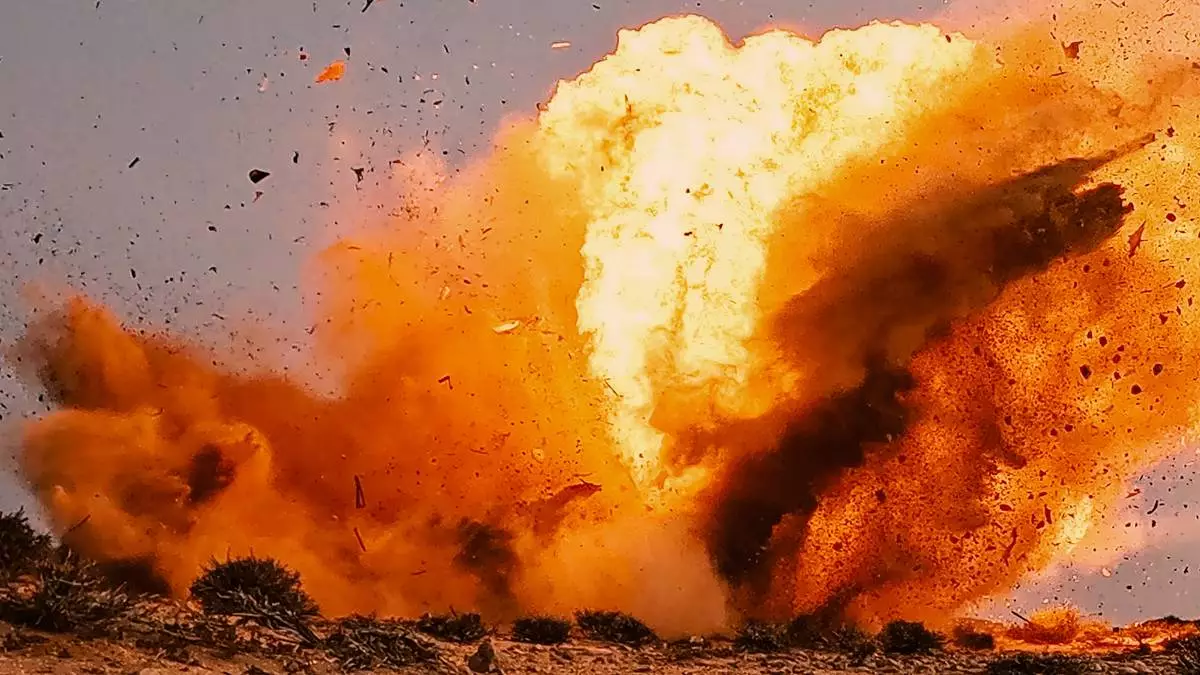
The first company to take advantage of the new program has tested a new cruise missile at the Army’s missile test range in Morocco.

Abby Denburg, an executive with Covenant Industries, said the company “demonstrated not only the performance of the Anthem missile but also a repeatable pathway now available to every company.”

The program allows drone and missile companies to use five Army ranges to test new rockets, drones and anti-drone weapons even if that company does not have a military contract.

The effort to get weapons faster to the battlefield comes as a recent think tank analysis found that the conflict with Iran has used up more of the U.S. military’s already diminished stockpiles of advanced interceptors such as Patriot and THAAD missiles that are used to defend against air threats such as missiles and drones.

The analysis, conducted by the Center for Strategic and International Studies, also noted that this shortfall could force the U.S. and its Middle Eastern allies to take more risks to conserve those air defenses.

President Donald Trump has pushed back on media coverage about the issue, telling reporters Thursday that “we need more all the time.” He claimed that certain kinds of munitions are in “virtually unlimited supply” and others are “a little bit tighter.” He didn’t offer more specifics.

Driscoll deflected questions about the nation's munitions stockpiles. He said that “we have a larger arsenal than any nation in the history of the world, and we will have an even larger arsenal with new and different and layered defenses.”

Associated Press writer Ben Finley in Washington contributed to this report.

FILE - Army Secretary Dan Driscoll speaks at the United States Army War College in Carlisle, Pa., during the Pennsylvania Defense and Innovation Summit, July 15, 2026. (AP Photo/Matt Rourke, File)

FILE - Army Secretary Dan Driscoll speaks at the United States Army War College in Carlisle, Pa., during the Pennsylvania Defense and Innovation Summit, July 15, 2026. (AP Photo/Matt Rourke, File)

In this image provided by the U.S. Army, Covenant Industries' Anthem missile is tested Thursday, Aug. 6, 2026, at the Multidomain Training Area range complex, a component of the Africa Multidomain Training and Experimentation Center, in Morocco. (U.S. Army via AP)

In this image provided by the U.S. Army, Covenant Industries' Anthem missile is tested Thursday, Aug. 6, 2026, at the Multidomain Training Area range complex, a component of the Africa Multidomain Training and Experimentation Center, in Morocco. (U.S. Army via AP)

Recommended Articles