PALO ALTO, Calif.--(BUSINESS WIRE)--Aug 11, 2026--
Pathway, an AI lab building a Post-Transformer architecture and models, today published benchmark results for BDH-CQ, a 150-million-parameter reasoning model. BDH-CQ scored 29.5% pass@2 on the public ARC-AGI-1 evaluation set at a computed inference cost of $0.0007 per task. Thanks to a new approach to reasoning, BDH-CQ runs approximately 11 times as cheaply per task as GPT 5.6 Luna (Low), even after accounting for OpenAI’s 80% price cut of 5.6 Luna on July 30th. Luna scores 34.2% against BDH-CQ's 29.5%, a modest accuracy gain at 11 times the cost.
This press release features multimedia. View the full release here: https://www.businesswire.com/news/home/20260811268264/en/
ARC-AGI-1 is a public reasoning benchmark that tests whether a system can infer an underlying rule from a small number of examples and apply it to a new input, a capability often associated with human-like intelligence.
The cost gap comes from a structural difference. Many transformer-based reasoning systems externalize their work as a chain-of-thought, generating extra tokens sequentially and feeding them back into later steps. As the trace grows, so do inference cost and latency, significantly. BDH-CQ instead performs this work in a recurrent latent state, learning from examples and refining a solution without generating an intermediate text trace. It thinks natively rather than using an intermediate-language scratchpad.
“Today’s AI pays a steep token cost for reasoning, but that cost is imposed by architecture, not by any law of intelligence. Currently, every reasoning step consumes context, adds latency, and burns compute. We show that a different architecture changes the game and opens up a whole new space in terms of how much intelligence per dollar. A 150M-parameter model, built on Pathway’s BDH architecture, reasons recurrently in latent space, and sets a new state of the art in cost efficiency on ARC-AGI-1. The bottleneck was never intelligence. It was design,” said Zuzanna Stamirowska, CEO and co-founder of Pathway.
“Customers are increasingly exploring how to move advanced reasoning from experimentation into production, where performance, efficiency, and scalability all matter,” said Nicolas Tarducci, Head of Solution Architecture for Startups EMEA at Amazon Web Services. “Pathway’s work training BDH-CQ on Amazon SageMaker HyperPod points to a promising path toward deploying high-performing systems more cost-effectively at scale.”
Scores and comparison costs are drawn from the ARC Prize Foundation's public leaderboard, which plots each submitted system's benchmark score against its cost per task, as of July 2026. Pathway's cost is computed from measured hardware time. Comparison costs are those reported to the leaderboard and may reflect API pricing for generalist models.
BDH's ARC-AGI-1 results were evaluated by Łukasz Kaiser, a co-author of the 2017 paper that introduced the Transformer architecture, who said, "I've followed Pathway closely and replicated their ARC-AGI-1 results myself. Pathway shows that model architecture, not just scale, can drive the next leap in AI reasoning."
The results were also reproduced by Richard Zhong, an NYU researcher focused on model evaluation and benchmark robustness and a co-author from Bielik.
Pathway plans to scale the architecture next and extend the approach to more challenging reasoning benchmarks such as mathematical reasoning, ARC-AGI-2, and ARC-AGI-3, and to build a latent reasoning Large Language Model. When its efficiency and state-tracking capabilities extend to those domains, BDH will support a wide range of applications that must reason reliably as information and constraints change, from cybersecurity incident response to real-time industrial operations. Early experiments confirm Transformer-like scaling laws apply during pretraining at scales from 1B to 600B parameters, while preserving the latent reasoning capabilities specific to BDH-CQ.
The full paper and methodology are available at http://pathway.com/research/introducing-bdh-cq/arc-agi-1.
About Pathway
Pathway is an AI lab building Post-Transformer model architecture. Its BDH architecture keeps memory and reasoning inside the model rather than in a growing context window, an approach aimed at systems that can adapt as information changes instead of starting from the same state on every use.
Pathway is led by co-founder and CEO Zuzanna Stamirowska, a complexity scientist, alongside CTO Jan Chorowski, previously a researcher at Google Brain, and CSO Adrian Kosowski, a computer scientist who completed his PhD at 20. The company is backed by investors and advisors including Łukasz Kaiser, a co-author of the paper that introduced the transformer architecture. Pathway is headquartered in Palo Alto, California.
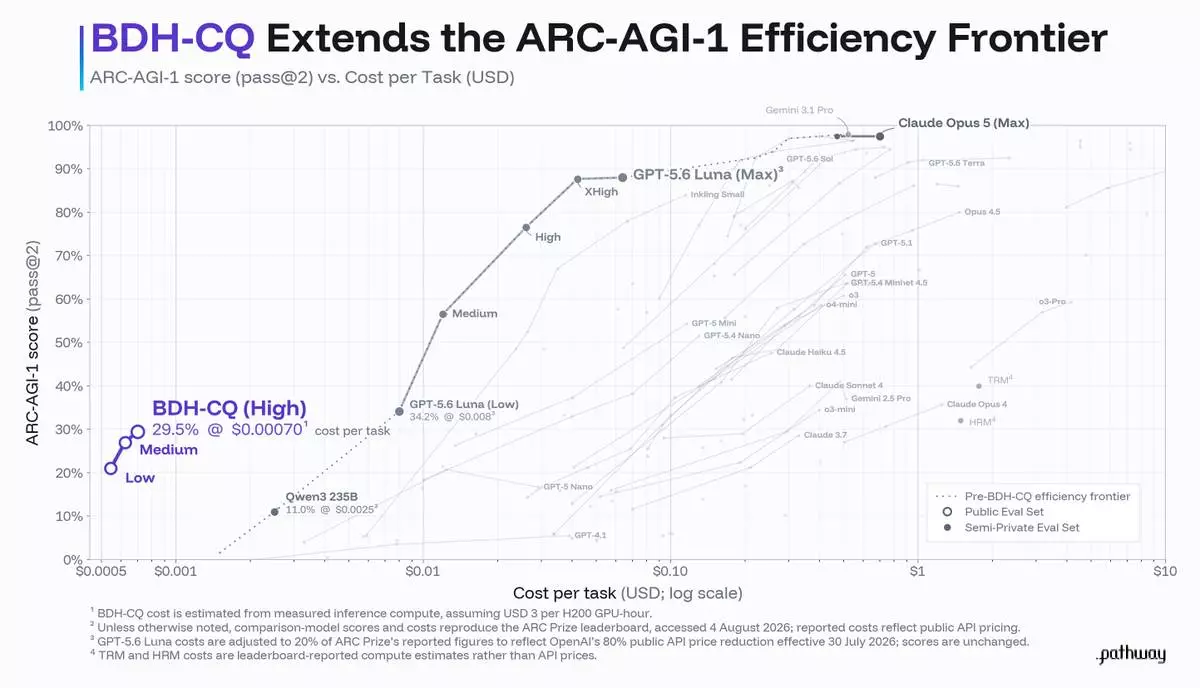
ARC-AGI-1 score versus estimated cost per task alongside official ARC Prize leaderboard results as of July 31, 2026. The reported score surpasses the previously reported cost-accuracy Pareto frontier, setting a new benchmark for ARC-AGI-1 cost efficiency.
Primary elections are taking place in six U.S. states on Tuesday — Alabama, Connecticut, Minnesota, South Carolina, Vermont and Wisconsin.
Minnesota voters will settle a moderate-versus-progressive Democratic U.S. Senate primary between centrist U.S. Rep. Angie Craig and progressive Lt. Gov. Peggy Flanagan. In the race for governor, Mike Lindell, known as the MyPillow Guy, leads a crowded Republican primary with President Donald Trump’s endorsement, while Sen. Amy Klobuchar faces minimal opposition for the Democratic nomination.
The Democratic primary for Wisconsin governor is another high-profile clash between the party’s establishment and progressive wings, as democratic socialist Francesca Hong tries to rise above establishment candidate David Crowley. In a Republican primary for U.S. House, Trump-backed candidate Michael Alfonso, the 26-year-old son-in-law of U.S. Transportation Secretary Sean Duffy, is seeking to win Duffy’s former district.
And Republicans in South Carolina are casting ballots in a special primary election to replace the late U.S. Sen. Lindsey Graham on the state’s general election ballot. The crowded race has attracted top party members, including two congressmen and a former governor — but Trump has endorsed Graham’s sister, Sen. Darline Graham, a political unknown appointed to serve out the final months of her late brother's current term.
Here's the latest:
Michael Alfonso has leaned into his endorsement from Trump in the five-way Republican primary for Wisconsin’s 7th Congressional District.
The 26-year-old Alfonso has faced blowback from some Republican leaders in the district who question whether he is too young and inexperienced for the job.
Alfonso is counting on Trump’s endorsement carrying the day in the deeply red district.
Duffy held the congressional seat from 2011 until 2019, when he resigned mid-term. He returned to politics last year when Trump tapped him to serve as transportation secretary. Alfonso is married to Duffy’s daughter, Evita Duffy.
After losing a top Senate advocate when the South Carolina Republican suddenly died, Trump has angled to play a role in picking his replacement, too.
Trump heralded the selection of Darline Graham as “a fabulous tribute” to serve as her brother’s interim replacement. And he urged her to run in the special primary, endorsing Graham before she’d made her candidacy official.
In forging a relationship with Darline Graham, Trump could be angling to develop another ally to help steer his agenda through the Senate.
So far, Darline Graham has been doing just that. Repeatedly stressing to voters her intent to support Trump’s policy positions, she often references in particular her co-sponsorship of a voting bill that’s become a key priority for the president.
Trump relied on Lindsey Graham in the Senate and has endorsed Darline Graham to replace him.
She had already been known as Lindsey Graham’s sister and lifelong supporter, but since her brother’s death a month ago, Darline Graham has been thrust into the political spotlight.
A day after the late senator’s sudden death was announced, South Carolina Gov. Henry McMaster named Darline Graham to serve the remaining months on his current term, which expires in January. She was sworn in the next day and took his spot on powerful committees, including Judiciary.
Days later, Darline Graham was among the candidates jumping into a special GOP primary to replace her late brother on November ballots. She’s appeared at various stump events and one debate, although Senate business kept her off the campaign trail as other hopefuls traversed the state.
U.S. Rep. Angie Craig has support from the party’s establishment, while Lt. Gov. Peggy Flanagan is backed by prominent figures on the left including Sen. Bernie Sanders.
The primary will again take the temperature of Democratic voters a week after progressive Abdul El-Sayed won a bitter and divisive primary in Michigan that fired up the left and fueled anxiety among party leaders that Democrats will alienate moderate swing voters.
Craig says her record of winning repeatedly in a battleground House district will ensure the seat stays in Democratic hands. Flanagan says Craig hasn’t stood firm enough against President Donald Trump and wealthy donors.
Wisconsin voter Jesse Heer said Hong understands “what it’s like to live here and have to afford to live here.”
Heer, a 32-year-old business owner from Madison, said Hong’s focus on affordability issues was the top reason he voted for her. And he’s not buying the argument from other Democrats, including Hong’s more moderate challenger, Milwaukee County Executive David Crowley, that she will have a harder time winning in the general election.
“I think she’s a good candidate,” Heer said. “I think a lot of people agree.”
Hong voter Kelly McClurg, 40, of Sun Prairie, says Hong has shown “she’ll be able to push back more” on issues that Democrats care about, like affordability.
McClurg said if fellow Democrats believe in her, and don’t assume she can’t beat Republican Tom Tiffany, “she can win.”
Wisconsin voters who cast their ballots Tuesday for the gubernatorial candidate favored by more mainstream Democrats say they are confident the party will unite even if the progressive challenger wins.
David Zimmerman, a 79-year-old retired industrial engineering professor, voted for Milwaukee County Executive David Crowley. Crowley is endorsed by Gov. Tony Evers and is seen as the pick of more moderate Democrats.
Zimmerman says he worries “a lot” about progressive candidate Francesca Hong’s ability to defeat Republican Tom Tiffany in November.
“I think she’s going to have trouble winning,” Zimmerman said.
But both Zimmerman and fellow Crowley voter Julie Martinson, 69, predict Democrats will come together even if Hong wins. They said they would vote for her in November.
“There’s no reason we can’t galvanize around her and get her in there,” Martinson said.
No Connecticut governor has served three consecutive terms in modern times. Former Republican Gov. John G. Rowland was elected to a third consecutive term in November 2002 but he resigned in 2004 amid a corruption scandal.
In Tuesday’s Democratic primary, Lamont, 72, takes on state Rep. Josh Elliott, 41, who is running left of the current governor.
One of two Democratic governors who attended President Donald Trump’s inauguration, Lamont has carefully chosen which issues to criticize the Republican president on. That tactic has prompted complaints from more liberal Democrats in Connecticut.
This post has been updated to correct the ages of Lamont and Elliott. Lamont is 72, not 71. Elliott is 41, not 42.
The state is holding special primaries in four congressional districts after it won permission from the U.S. Supreme Court to change its congressional maps. The state tossed out the results of May primaries and scheduled the Tuesday special primaries using the new map.
Turnout for party primaries is typically low. It was 23% in the May primary and 10.7% for the June runoff. It is expected to be particularly low in a special late-summer primary, when people are unaccustomed to voting.
Six Republicans are seeking the GOP nomination in the redrawn 2nd Congressional District. The winner will challenge Democratic Rep. Shomari Figures in November.
Republican candidates and party officials have been trying to promote the special primary and get voters to the polls. The primaries will be decided without a runoff.
Polling places opened across the state at 7 a.m. EDT, and voters have until 7 p.m. to cast their ballots.
It’s only been two months since South Carolina voters made their picks in the primary elections in June. But Graham’s sudden death last month set into motion a special primary to pick a Republican replacement for the general election ballot in November.
Candidates have only had a matter of weeks to campaign.
There were three days of early voting last week, and Tuesday’s special election also coincides with the first day of school in some areas, so polling places have changed for many who typically are assigned to vote at schools for summertime primaries.
The topsy turvy race pits democratic socialist Francesca Hong against the governor’s endorsed candidate David Crowley.
Hong has ridden a wave of support from liberals to bolster her insurgent campaign. Crowley had quit the race but got back in — with Democratic Gov. Tony Evers’ endorsement.
Crowley rejoined the race after Lt. Gov. Sara Rodriguez dropped out last month amid a campaign finance scandal.
Former Lt. Gov. Mandela Barnes had the highest name recognition after a 2022 U.S. Senate run, but he also dropped out less than two weeks before the primary amid questions about inappropriate behavior.
In the Republican primary for governor, U.S. Rep. Tom Tiffany has Trump’s endorsement and faces nominal opposition.
Progressive candidates for governor in Wisconsin and U.S. Senate in Minnesota are increasing the pressure on a Democratic establishment that has spent the year on its heels.
Today’s primaries come a week after Abdul El-Sayed narrowly defeated Rep. Haley Stevens in Michigan’s divisive and costly U.S. Senate primary. El-Sayed’s victory has energized the left while stoking fears among Democratic Party leaders that the shift to the left, particularly in battleground states like Michigan and Wisconsin, will make it more difficult to win in November.
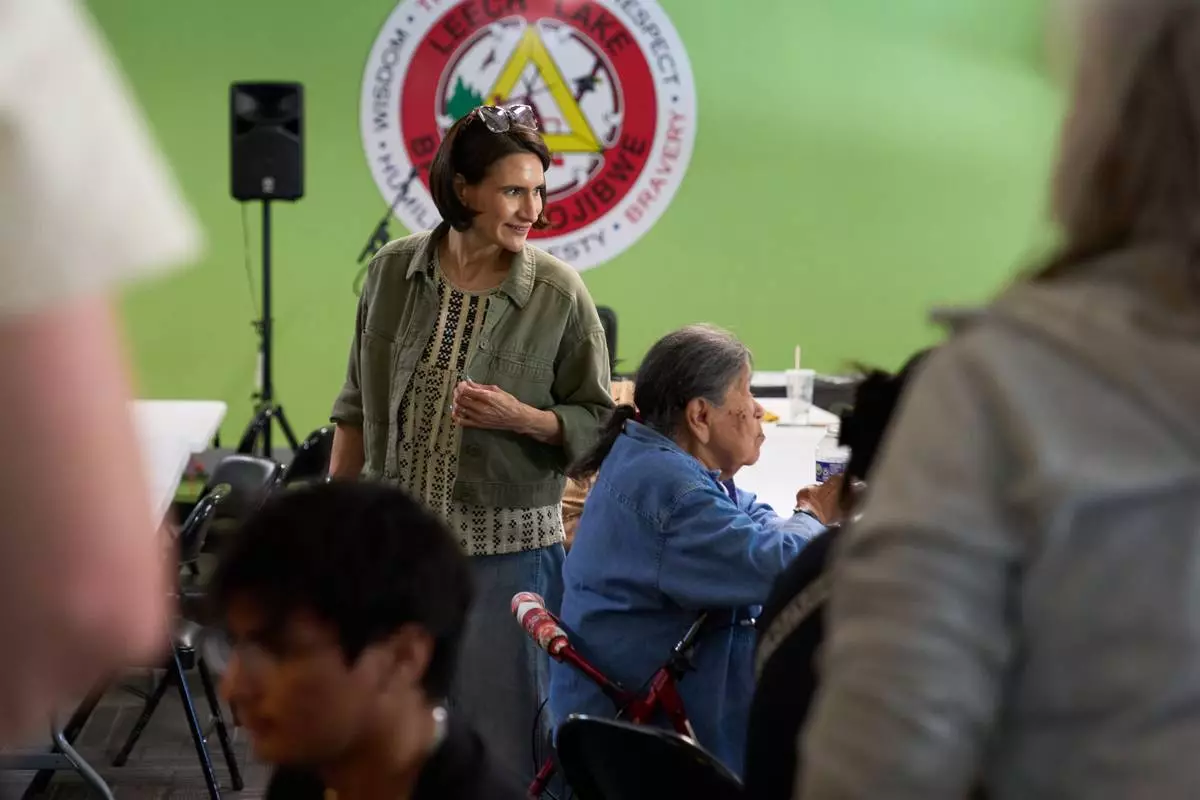
Minnesota Lt. Gov. Peggy Flanagan, a Democratic candidate for U.S. Senate, greets supporters during a campaign event at the Leech Lake Band of Ojibwe Twin Cities Office in Minneapolis, Saturday, Aug. 8, 2026. (AP Photo/Ellen Schmidt)
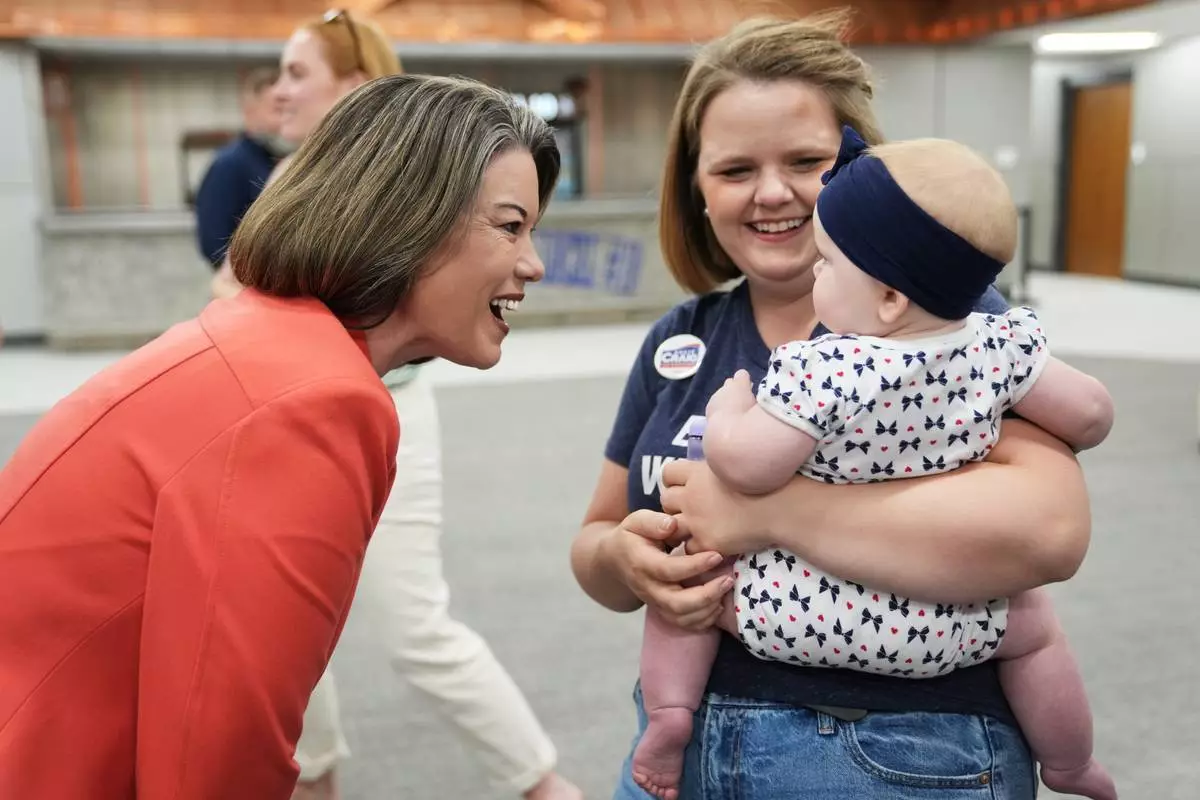
U.S. Rep. Angie Craig, D-Minn., candidate for U.S Senate, greets Merci Wolff and her daughter during a canvassing event at SMART Sheet Metal Workers Local #10 headquarters, Monday, Aug. 10, 2026, in St. Paul, Minn. (AP Photo/Ellen Schmidt)

Campaign signs for Michael Alfonso, a candidate for U.S. House in Wisconsin's 7th congressional district, line the entrance to an event, Tuesday, Aug. 4, 2026, in New Richmond, Wis. (AP Photo/Ellen Schmidt)

David Crowley, right, Democratic candidate for Wisconsin governor talks with CJ Arthur, left, owner of WordHaven BookHouse during a campaign stop with Wisconsin Gov. Tony Ever, center, Friday, Aug. 7, 2026, in Sheboygan, Wis. (AP Photo/Kayla Wolf)